🚨 the Standard Agent Specification is now open source!
⋅ MIT license — do what you want
⋅ Own your agents — fully defined in code
⋅ Own your runtime — the spec provides everything
⋅ Focus on agent outcomes, not machinery
⋅ Use our runtime to experiment with $2 of credit
Announcing a major milestone achieved by my team @GoogleDeepMind: we have proven key security properties of the machine code underlying the Signal messaging protocol. This is the first time the actual production code of a widely deployed protocol has been formally verified – by any method, with or without AI – and at this depth.
More than a research breakthrough, it’s a prime example of how frontier AI can be a force multiplier to counter the speed and scale of modern cyber threats.
Formal verification offers a higher standard of security; however, it’s extremely complex and time consuming, which is why in many cases it’s considered to be impractical. Similar efforts could take teams decades of combined effort. We did it in a month’s time.
Using AlphaProof Code, Google DeepMind's new agentic framework for formal verification that runs on LLMs including Gemini Carbon, we verified the Signal protocol down to the actual code running on devices. This milestone lays the groundwork for a future in which vital systems, from medical device firmware to power grid software, ship with mathematical proof that their protections work.
Reaching that future will take continued research from our community. In that spirit, we're open-sourcing our formal specifications and verification artifacts so others can build on this work.
On a personal note, this moment is of deep significance to me. I started my own research journey more than two decades ago as an intern working on checking the consistency of complex software systems. Seeing this grand challenge made practical with modern AI is extraordinary.
I'm extremely proud of my team members: Swarat Chaudhuri, Andrew Ferraiuolo, Anton Kovsharov, Tej Chajed, Sam Schlesinger, Karn Seth, Jonathan Katz, and Charles Sutton for taking on this grand challenge and delivering, and grateful to the Signal team for their partnership.
https://t.co/kN1eRYQ8fF
Why is AI slop so frustrating to read?
AI writing often obscures main ideas and invents awkward phrases, making sentences more complex than necessary.
Many of these slop patterns violate writing principles established in English writing books.
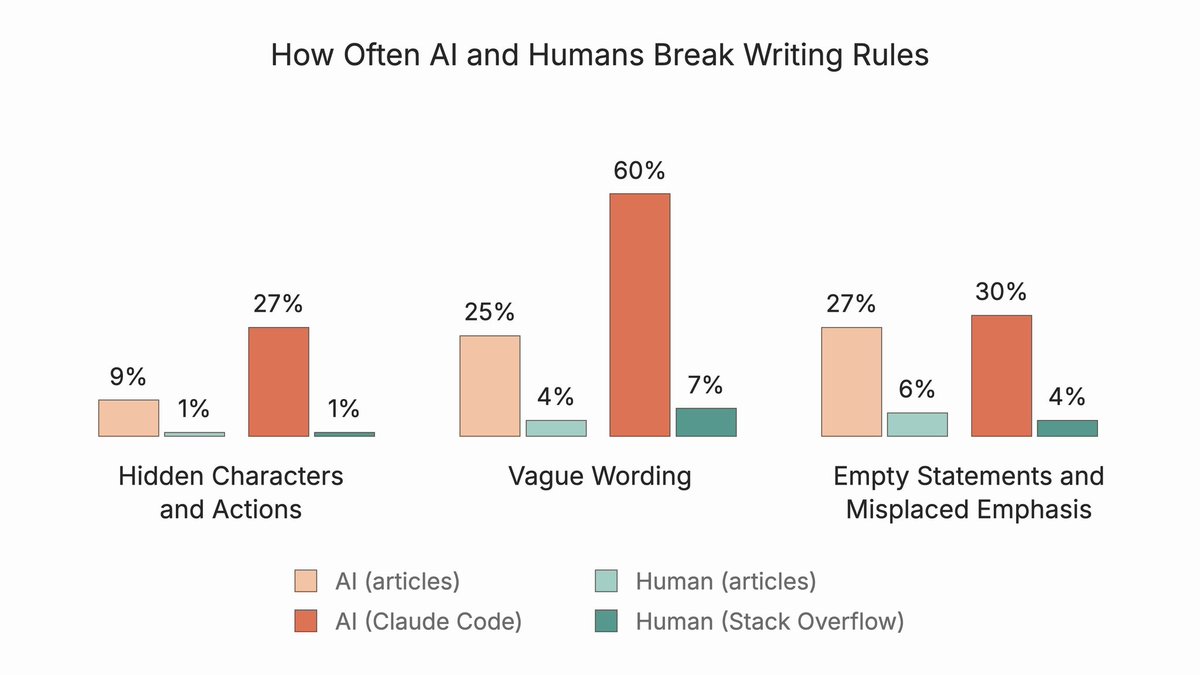
In our benchmark, AI writing breaks these principles far more often than human writing, with Claude Code replies by far the worst offenders.
We show examples of the most common slop patterns in this thread
Introducing Claude Fable 5.2 and Claude Mythos 5.2, designed to tackle the most daunting technical challenges.
They’re capable collaborators on ambitious projects in many fields, and show improvements in areas like coding, reasoning, and vision.
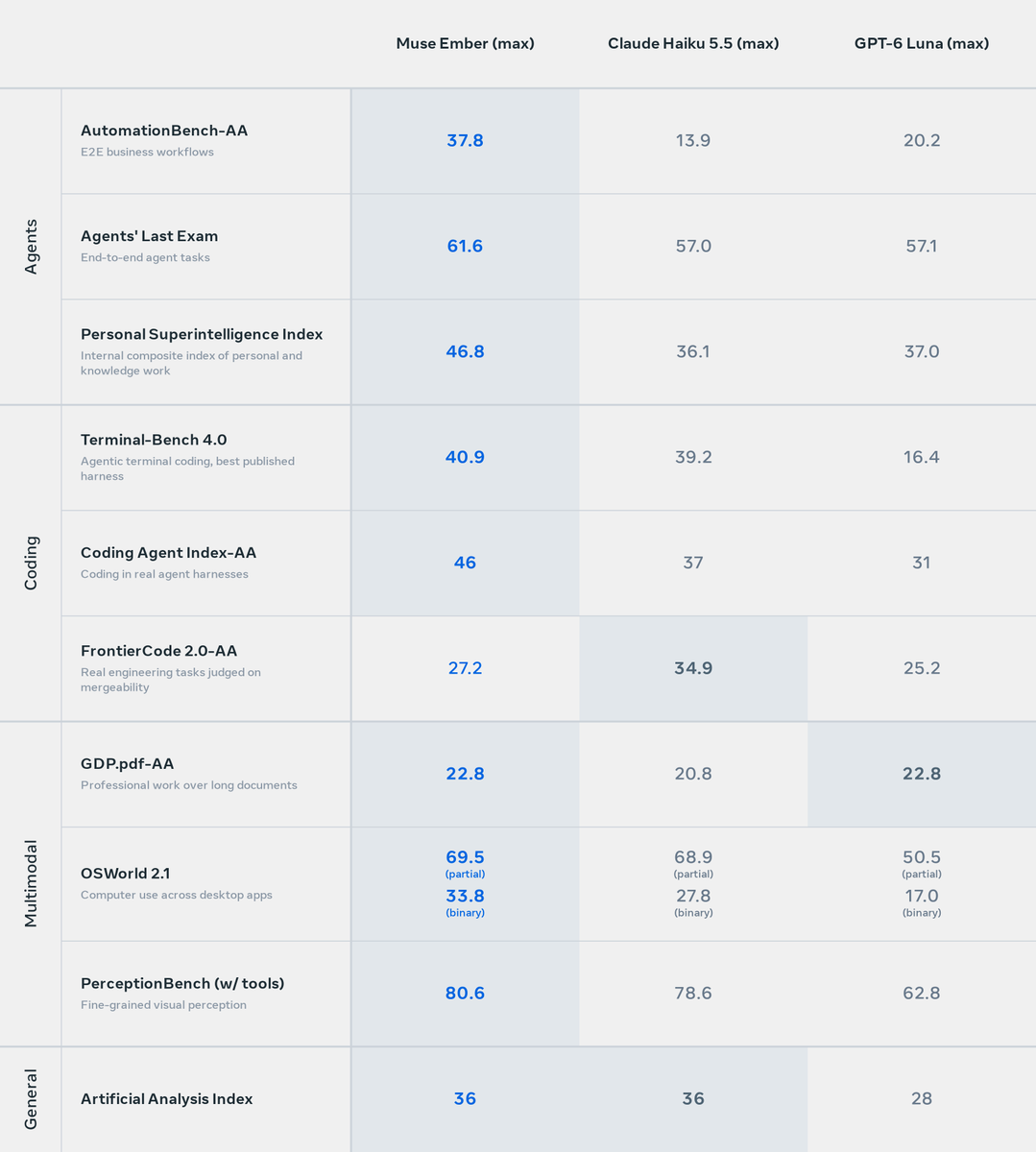
Today we're introducing Muse Ember, our smallest and most efficient model, built for complex reasoning execution and everyday agent work.
Muse Ember can carry workflows across apps, call tools in sequence, run tests and make targeted code fixes. With a 1M-token context window and native understanding of text, images, audio and video, it can also work across large document sets and varied inputs.
1/
What if an LLM could not just edit a model's weights, but re-architect it as it trains?
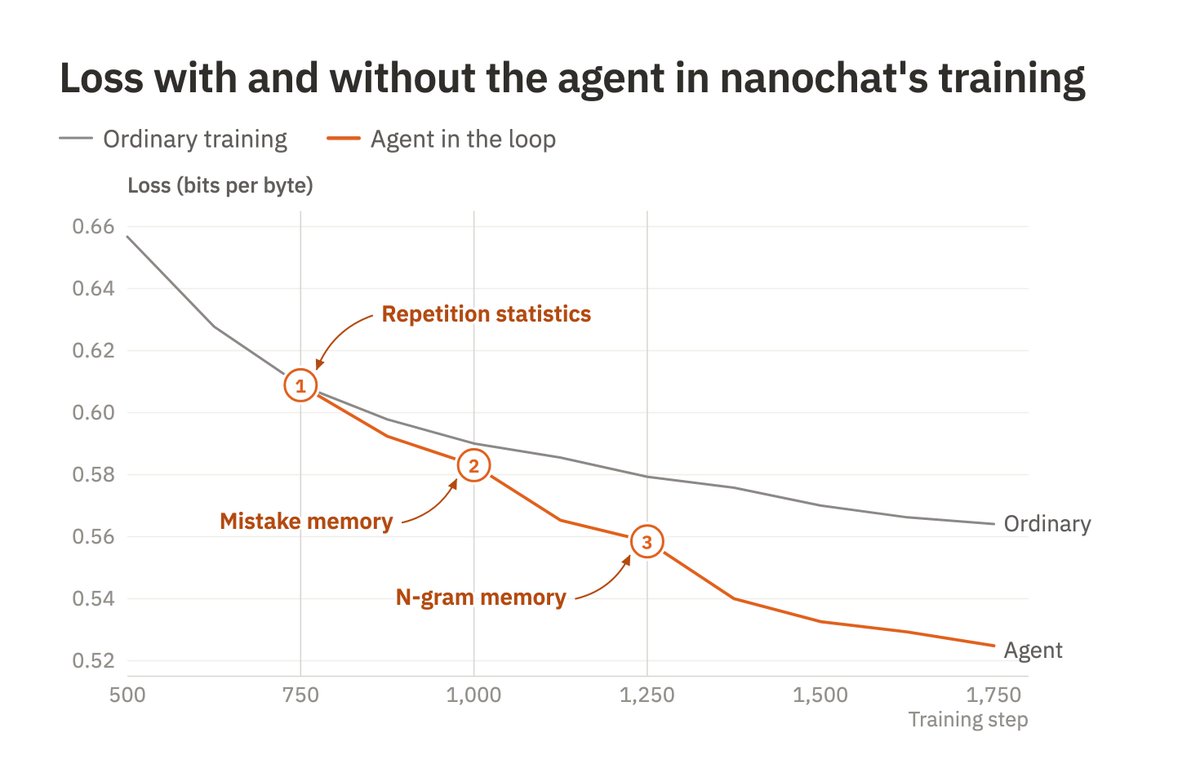
We tried just that. The resulting architectures exit the known territory of transformers: the coding agents spliced code directly into the network.
On nanochat, the loss fell below ordinary training after each new code layer was introduced. On algorithmic reasoning, accuracy rose from 55% to 84%. We even let DeepSeek-V4.1-Flash act as the agent modifying itself, raising its AIME and HMMT 2026 score from 64% to 71%.
To do all this, the agents built a set of tools we’ve never seen before, which we call mechanistic intervention!
Blog: https://t.co/JOenIuttAR
Announcing Parcel v3, a ground up rewrite in Rust! 🚀
• Up to 100x faster than v2, 6x less memory
• Standalone Rust binary – no Node
• Native plugins in Rust, Go, Swift, or C
• Multi-threaded JS plugin runtime
• Smarter code splitting
• New library mode
Now in alpha. 👇
Since August, a team within METR has worked with internal Anthropic information to assess whether AI itself is accelerating AI development.
We are now publishing a report summarizing the results of this risk assessment.
So we are finally opening our new app that we use internally for a few weeks.
It is a Linear / Notion / Slack / Discord / Mailing all in one app that you can self-host on a few MB of RAM and own all the data.
https://t.co/GXDncLmUDA
There is also a cloud/hosted version with 7 days of free trial so you can test things out.
After that it is just $10/month/workspace. No per seat or similar bs. $10 for your whole team.
I will go broke for sure, but you won't :D
(I have to at least get back the domain price somehow to get on 0)
Same philosophy as any coolLabs apps, no restrictions, no pay-to-feature.
Lets Orbit together with your team haha!
Today we’re introducing Zyphra Hierarchical Attention (ZHA), a path to true subquadratic attention.
ZHA searches a learned tree of compressed summaries, with projected speedups of 35× over dense attention and 5× over MSA at 10M tokens, increasing to ~400× and ~55× at 1B. 🧵
We believe voice is the most natural way to interact with intelligence, so we created Dessa, the most authentic full-duplex speech model ever built. Talking with it feels like talking with a person…full of emotion, nuance, pauses, and a natural cadence.
https://t.co/r0qFLdvd6c
Kimi K3.1 Pro launches at 4th on the Artificial Analysis Intelligence Index scoring 55, making large gains in agentic performance; it will be the leading open-weights model once its weights are published
@Kimi_Moonshot's new reasoning model gains 11 points over Kimi K3 (max, 44). It trails only Claude Opus 5.5 (max with fallback, 58), Claude Sonnet 5.5 (max with fallback, 56), and Muse Wonder Full (max, 56) on the Intelligence Index.
Once the weights for K3.1 Pro are released it will be the highest-scoring open weights model and the gap between the leading open weights and proprietary models on the Intelligence Index will narrow from 12 points to 3.
Key results:
➤ Large gains in agentic performance: Kimi K3.1 Pro scores 3rd on GDPval-AA with 1,846 Elo, up 312 Elo from Kimi K3, behind only Claude Opus 5.5 (1,866 Elo) and Muse Wonder Full (1,857 Elo). Kimi K3.1 Pro also achieves the highest score of any model on Terminal-Bench 4.0. K3.1 Pro scores 67%, up from 13% for Kimi K3 and ahead of Claude Sonnet 5.5 (64%). AutomationBench-AA, which tests agentic SaaS workflows, rises from 58% to 73%.
➤ Gains in other evals are more moderate: Humanity's Last Exam rises from 47% to 52%, CritPt from 23% to 25%, and SciCode from 59% to 61%. AA-Omniscience Index rises from 20 to 30, as the hallucination rate falls from 53% to 44% and accuracy rises from 48% to 51%.
➤ Cost per Task roughly equal to Kimi K3 at $1.98 per Task: K3.1 Pro uses 55K output tokens per Intelligence Index task, 14% more than Kimi K3 at 48K, while its first-party token prices are 33% lower.
Additional model details:
➤ Context window: 1M tokens.
➤ Size: 2.8T total, 104B active parameters
➤ Input modalities: Text and image
➤ Weights and license: Weights currently not published, Moonshot is expected to release the weights soon after launch
➤ Pricing: $2/$10/$0.20 per 1M input/output/cache hit tokens, 33% lower than Kimi K3 on all three rates.
Congratulations to the team at @Kimi_Moonshot on the release!
If all the govs shutting down servers for a PHP update, all the hosters & enterprises terrified by the vuln, gave $100k, or just $50k a year to the PHP Foundation, things could look very differently. Go, make your employer sponsor *today* https://t.co/z1mUcXMqy9 #php #phpc @Th@ThePHPF
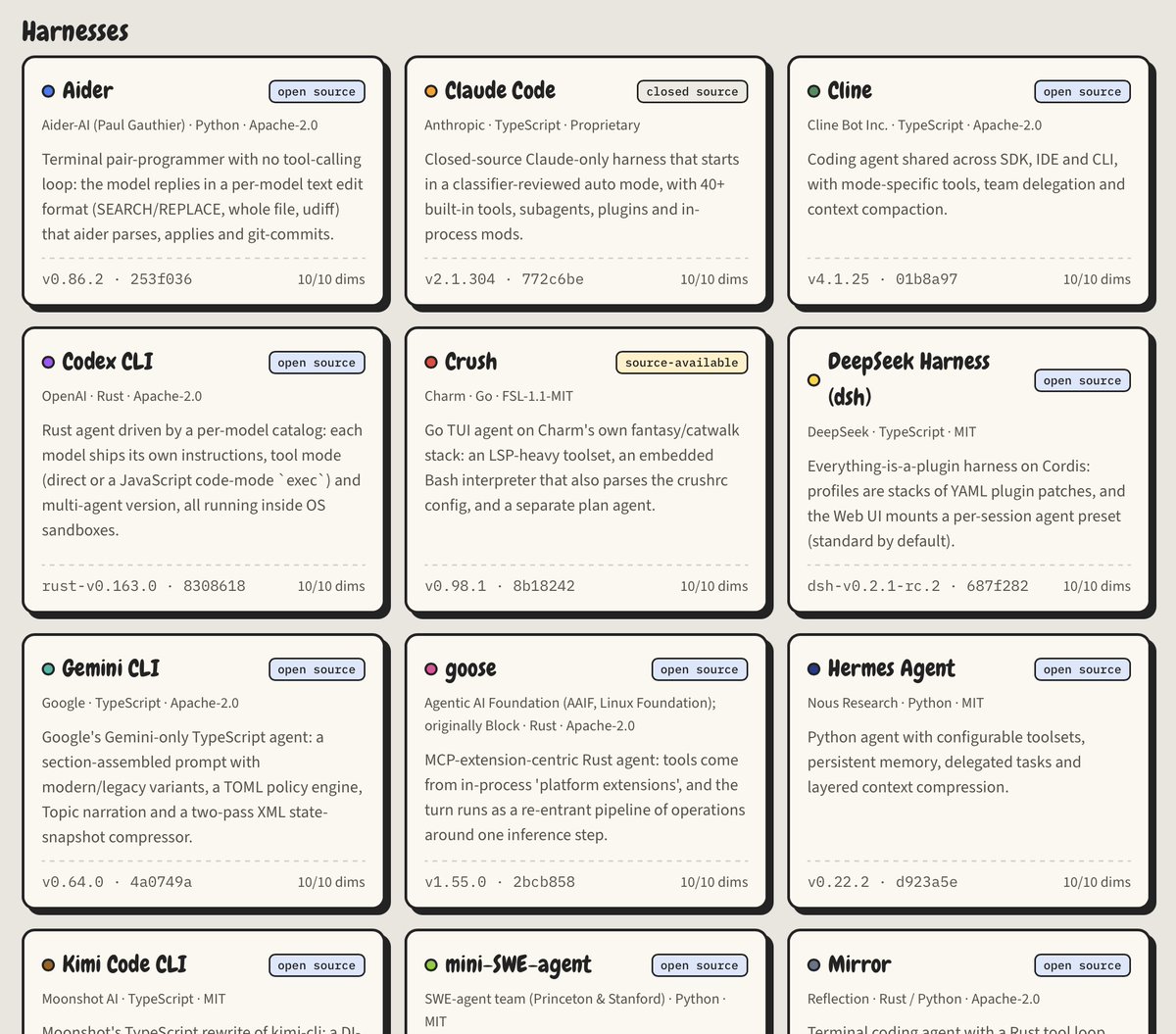
We read the source code of 17 coding agents so you don’t have to.
From mini-SWE-agent. A ~100-line loop, a single bash tool, a fresh subprocess per command, and a history that’s never compacted.
To Kimi Code shipping a 128-way AgentSwarm.
Here are some fun fact and tips about the tools we use everyday 🧵