Perceptron's Isaac 0.5 is now live on @DreamscaleLabs for YAM and SO-101 checkpoints!
It's a sparse 36B (!) robot model trained on more than 35 embodiments, 100K hours of teleop, 1M hours of general video, and 3T multimodal tokens.
Try now at: https://t.co/KpqDlpcAQ7
And yes, with AI, we’ll have people who had no ability to create software do just that.
AI will make (is making!) the “traditional” software engineering (hand writing code) obsolete and unnecessary. But it makes engineering - desiging and building sw factories, loops, formal validation approaches, o11y innovations etc - far more in-demand
I'm deleting Blender and Unreal tonight. I just dropped a free Claude skill that builds a whole f**cking logistics network out of a few screenshots.
i fed my own skill 14 screenshots of a warehouse app and one word, "logistics", to see where it breaks.
it never broke:
> Claude kept the screenshots as a target only and wrote every dock door, pallet and pin itself in three.js
> forklift FL-01 fills TRK-2051 at bay 1 from 2/4 to 4/4 pallets, 4.8 t on board
> the truck runs to the cross-dock at 55 km/h and reverses into door In 3 on its own path
> FL-10 strips it onto the staging rows while the charger card logs 40.1 kWh for the day
> a reefer, TRK-2148, backs into the cold store's dock 2 holding -18 °C
> 3 sites, 8 trucks at the docks, 3,012 pallets and one click pulls the camera out over all of it
it modeled exactly 2 new things for this, a forklift charger and a rooftop AC unit. every truck, forklift and warehouse is recycled from the airport i packed inside the skill.
the install line and every prompt are in my article 👇
Also a reminder that not doing due diligence will look bad on the company that makes the purchase.
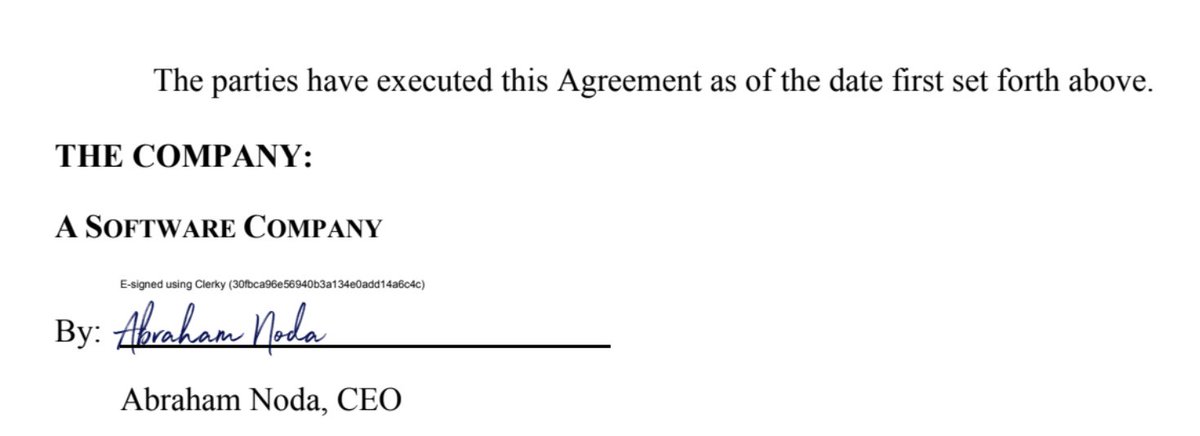
I still have my signed contract with Abi Noda, about the advisory shares in DX, as do other advisors.
Atlassian's last CTO saw these, shrugged, and nothing happened.
So excuse me if I have an issue with both DX, and Atlassian.
Recently, one compromised vendor injected malicious JS code into 178 websites, including BBC, Zoom and HSBC Insurance.
AI will accelerate the failure of digital infrastructure that runs on a single central point of failure.
There's no better time to build parallel infrastructure that is private by default: architectures that minimise trust and exposure, and leave AI-assisted attackers fewer data points to exploit.
We call this PriFi, a technical design philosophy at the core of our work at @Logos_network.
Thank you for having me @FINTECHTVglobal and @RaghdaIbraheem
if you’re a startup founder or building any business - i wear to god, have claude review all the software uve been using in the past year.
find all the black friday, year end, christmas deals companies are running right now and stock up on credits for all the software u love.
if the software you use doesn’t have a deal, ask your ai agent to email those companies asking them that if they can create a one time 50% deal like others are, you will stock up for the entire year.
this will save you thousands of dollars
The US can't afford higher rates... Warsh knows that.
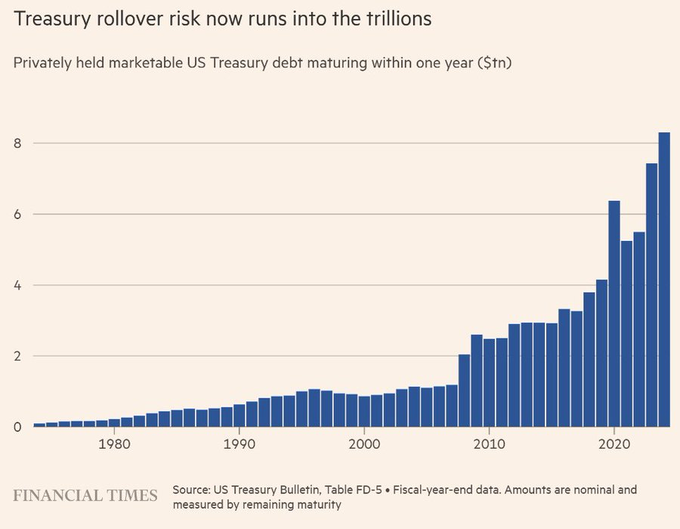
- Over the next 12 months, ~$8T in USTs will need to be rolled over.
- The average coupon is ~3.3%.
- The US 10Y yield is ~5%.
Refinancing that $8T at today's 10Y yield would add ~$136B in annual interest costs...
And that's before factoring in the interest burden from an ongoing $2T annual deficit.
Meanwhile, with long-term USTs becoming increasingly "bidless," Bessent is shifting more issuance toward short-term debt...
Shortening the refinancing cycle and making the US even more vulnerable to rising rates.
Volcker could crush inflation with double-digit interest rates because inflation had already helped reduce debt to GDP from ~120% to ~30%.
Today, we're back at ~120%...
First, you inflate away the debt, then, you raise rates to crush inflation.
We're still in the inflation phase of the cycle...
You know what that means.
d1.2 is the new top-trending Decision Model on @huggingface, congrats Liquid AI!
Note that we've shipped a dedicated tag for this, find all of them here https://t.co/k0FcyFjszp
Tyler Cowen's worry for anyone hiring right now: the old signals can't tell you who will be good at AI.
@tylercowen is the George Mason economist who co-runs the Marginal Revolution blog. He also co-wrote Talent, a 2022 book on spotting talented people, with investor Daniel Gross. So this is a talent scout saying the usual signals have gone quiet.
On @a16z's podcast this week, hosted by @eriktorenberg:
"it's just hard to tell right now if you're hiring someone, will the person be good at AI? The skills they used to need, we had imperfect indicators."
A degree from @Cornell, straight A's, a good interview. In his words: "Oh, they went to Cornell, or they got all A's, or they had a good interview."
What matters now: "will they be mentally flexible enough to pick up AI? You know, we don't know often. So that could increase the natural rate of unemployment."
The mechanism is matching: "Good matches will be harder, search will take longer."
And he expects it to pass: "I don't think that problem will be with us forever. Eventually the AIs themselves will figure it out."
My take: the fix is already in his answer. If the old proxies stopped working, stop hiring on proxies: give candidates a real task, let them use the AI tools they'd use on the job, and watch how they check its work. An hour of that tells you more than a transcript does.
From @a16z's podcast with @tylercowen.
If you think oil prices are high... well, they're going to be even higher in the future.
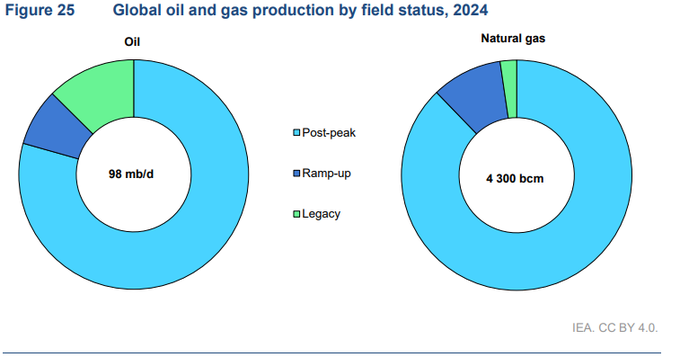
80% of global oil production now comes from post-peak fields.
Just 10% comes from fields that have yet to reach their peak...
No one is looking for new oil fields.
Meanwhile, the Permian, the only growth story of the last decade+, is peaking...
And the Iran war is exacerbating this problem.
Normally, elevated oil prices lead to an increase in CapEx spending.
This time, Big Oil sees this clusterfuck going on and decides to return more cash to shareholders rather than investing to grow production.
Over the medium to long term, this will lead to lower production levels and higher oil prices.
Every kid at some point discovers that things cost more than they used to, and it usually feels unfair. In the third episode of @ZerodhaVarsity Junior, two boys walk into their local barbershop for a regular haircut, find out the price has gone up, and spend the rest of the story trying to figure out why.
That's inflation, which most of us adults can't explain properly either. 😀 @karthikrangappa and the team have managed to do it in 12 minutes without making it feel like a lesson.
A parent left a comment saying that after watching this, his 10-year-old went and asked his grandfather what things used to cost when he was a kid. I can't think of a nicer way for a child to start learning about money than that conversation.
These stories, along with the minor accounts we have on @zerodha, are our attempts to get kids to start thinking about money early.
Happy Children's Day. If you have kids at home, this is worth watching with them this weekend, and maybe get the grandparents to join in.
NEW RESEARCH: Touch data can finally be normalized!
This project involves @liwenjiao2, @TengyuLiuAI, @siyuanhuang95, and others.
UVTA, for Unified Visual-Tactile-Action Modeling from Human Demonstrations for Dexterous Manipulation, is a system from the Beijing Institute for General Artificial Intelligence, Sharpa and Shanghai Jiao Tong University.
It is designed for collecting human touch data and using it to train robot hands.
The capture rig is a 22-DoF passive exoskeleton of rigid carbon-fibre links with joint encoders, four force-sensing resistors per fingertip, a VIVE Tracker for 6-DoF wrist pose, and a monocular fisheye RGB camera at the wrist, all synchronised.
The dataset is 1,000 human demonstrations plus 150 robot demonstrations for each of five contact-rich tasks: flipping a single page of a book, screwing a light bulb into a socket until it lights, toggling a circuit breaker, sorting visually identical balls by material, and drawing liquid with a dropper and dispensing it.
The model encodes a wrist image with a ViT-S/8 trained from scratch, concatenates a 20-D tactile token to make a 404-D representation, and runs two heads off it: a FiLM-conditioned 1-D U-Net diffusion head emitting 16-step chunks of 31-D actions (9-D relative wrist plus 22-D absolute finger joints), and an MLP regressing the next 16x20 tactile trajectory.
Robot hardware is a fixed-base Sharpa North with two 22-DoF Sharpa Wave hands.
I find interesting that human data is a regulariser here, not a substitute for robot data.
The robot's rich visuotactile sensor is thrown away to match the glove's.
Sharpa Wave hands produce deformation maps, and UVTA converts them into piezoresistive signals.