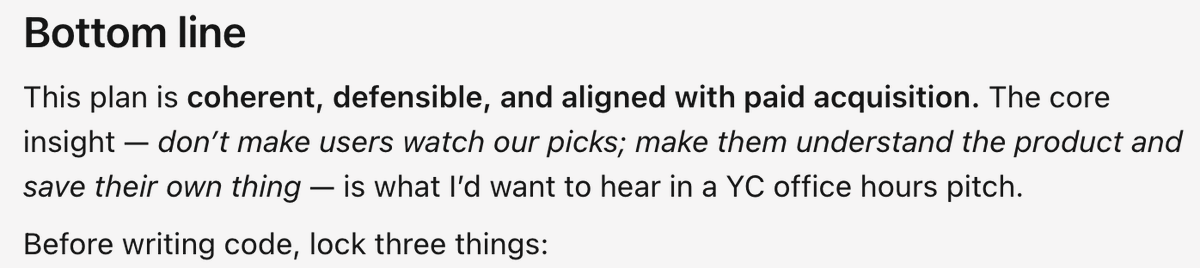
Tip: before coding, mention your plan in @cursor_ai and say: "You are an elite YC veteran. Review this plan."
That one prompt caught our wrong activation metric. Awesomeee.
@corbin_braun Cursor was my first ai IDE, around March 2025, then switched to Windsurf, and now back to Cursor - really like it. Haven't played with Devin, which Windsurf transformed into.
Update 5 building @pricemist_com - where expensive taste gets organized:
🚀 Prepared and published the Chrome extension in the Chrome Web Store, making it easier to add items (instead of manually copying and pasting the URL into the app).
What did I learn?
💡 Google is highly cautious when reviewing extensions that require broad permissions across websites. If the extension requests user permission on-demand (rather than requiring it upfront during installation), the review process is significantly faster.
What am I planning for next week?
📊 Await Google's final approval for the extension and monitor the first installations post-release.
Update 4 building @pricemist_com - a better way to buy expensive things. What did I ship this time?
🧩 Browser Extension Polish
My hypothesis is that users simply don't want to copy-paste URLs manually. Because of this, I focused heavily on polishing the browser extension. Visually and technically it is now rock solid, but I didn't manage to lock down the final build in time, so I'm holding off the release for just a bit longer.
📉 Affiliate Aggregators
I tried onboarding with major networks (Skimlinks, Sovrn), but got rejected. My assumption that organic user-driven traffic would be enough turned out to be wrong - these networks expect a site to have actual content with product links. The issue is that my blog is currently "too clean" and has zero outbound product links, which likely triggered automatic rejections. This is just my suspicion, as you never get the exact reason from them. Time for a strategy shift and a retry later on.
📱 Critical Mobile UX Fix (PostHog)
Fixed a bug where the PostHog survey on mobile was impossible to close (the "X" button was blocked by a z-index issue). This was bad enough to make some users just give up and drop off.
What did I learn?
🥚 The chicken-and-egg problem of affiliate networks: Networks won't accept you without product links on your site, but you don't have those links active until you get accepted. The solution: I need to start linking to products "dry" (e.g., in a Discover section or within blog posts) to prove I can drive real high-intent shopping traffic.
⚠️ Small bug, massive potential churn: Not knowing that mobile users literally couldn't tap the "close" button on a survey is a silent killer. User session recordings and behavior monitoring are critical to catching these "dumb" but devastating friction points.
What's on the radar for next week?
🛒 Chrome Web Store: Officially submitting the extension to the store and navigating the review process.
💸 Cracking the affiliate networks: Keeping at it to find a way into auto-generating affiliate links. For now, Amazon Associates remains my only active source.
Update 3 building @pricemist_com - a better way to buy expensive things.��� Marketing & Feedback
😌The Problem: A large number of users add an item or two and never return. They might just be "wanderers," or maybe something else is off. After Grzesiek's "Wyzwanie 2026" webinar, I reached out to a dozen of my most active users. Following The Mom Test framework, the key is to ask questions about past facts, not opinions on your idea. So far, radio silence in my inbox 😀 - I'll be reaching out to the next batch soon.
Reddit Marketing: My promotion efforts on Reddit resulted in a few subreddit bans - I was definitely too direct. On top of that, I received a DM claiming they found "critical vulnerabilities" and offering to share them in exchange for money. I assumed it was a extortion attempt, but took it as a cue for proactive action.
🛡️ Security & Infrastructure
System Hardening: In response to those Reddit "probes," I audited the system and pre-emptively tightened security.
Fair Priority Queue: I implemented user rotation and weighted scoring. This ensures a single user tracking thousands of products won't clog the queue for new sign-ups - the system now fairly rotates tasks among everyone.
🎨 UX & Charts
Sticky Navigation: The system now remembers which collection you were in. Refreshing the page no longer dumps you back into "All items" - you land exactly where you left off.
Stepped Line Charts: Switched chart rendering to a "stepped" line format.
Profile Convenience: Added a searchable combobox for country selection. Scrolling through a list of 200 countries just to find yours was a massive pain. I need this data to serve relevant affiliate recommendations down the road.
💸 Affiliate
Amazon Associates: Implemented automatic injection of my affiliate tags into Amazon links within emails and buttons. Next step: re-applying to Skimlinks and/or Impact soon.
What did I learn?
Reddit doesn't forgive spam. The line between "sharing your project" and "obnoxious marketing" is razor-thin.
"Security by noise." Instead of panicking over vague DMs about vulnerabilities, I used it as a healthy reminder to run a routine security check.
Patience in user research. Even if you write an email strictly by the book (The Mom Test), people have lives. My initial sample size was small, so I'll keep messaging the next batches. That said, a lack of response is also data - maybe the problem I'm solving isn't burning enough for them to write back about? We'll see.
Update 2 building @pricemist_com - a better way to buy expensive things.
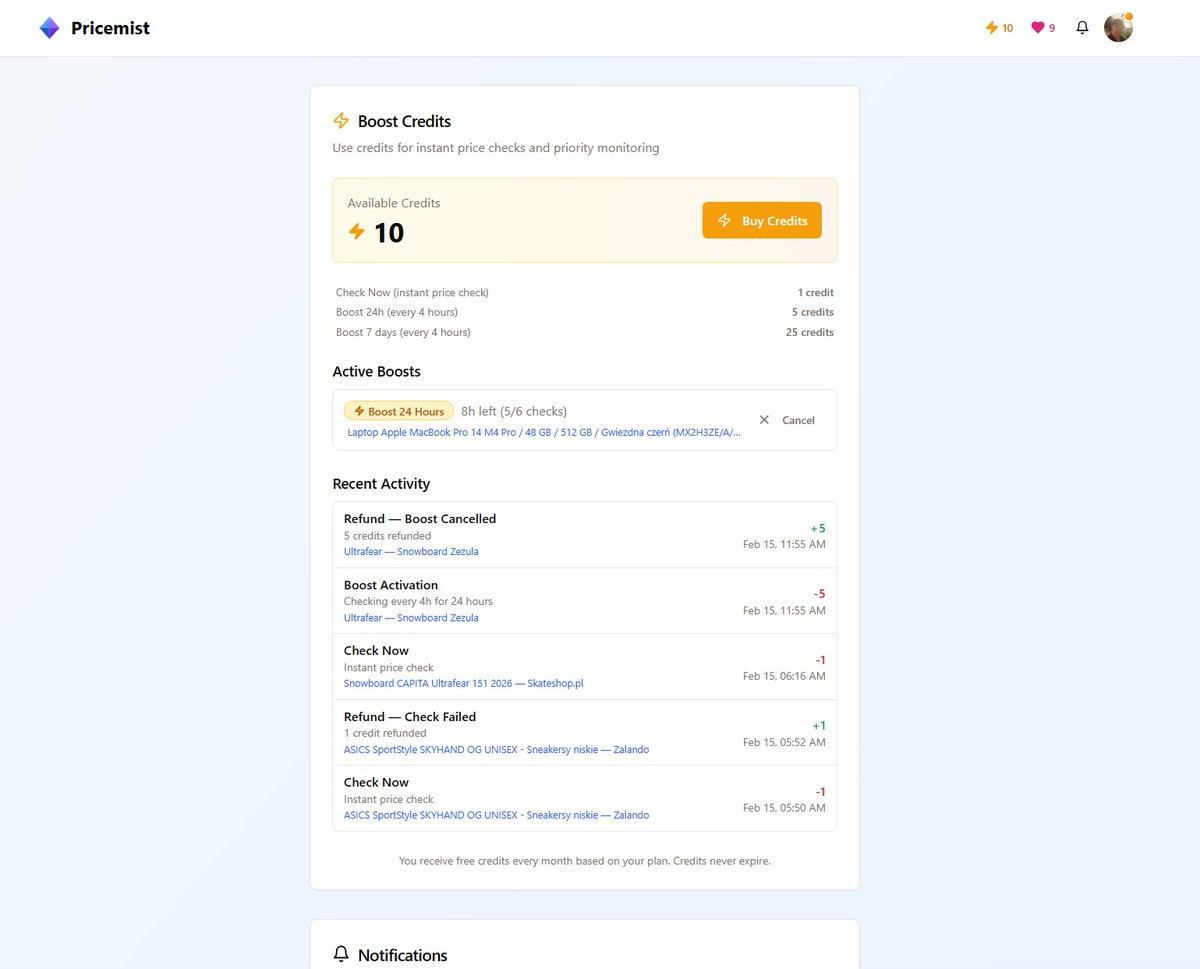
💰 System Credits & Price Check Boosts
I introduced an in-app currency linked with Paddle - Credits. They unlock two key features for users:
Boost 24h/7d - activates intensive monitoring (checks every few hours), perfect for holiday sales, Black Friday, etc.
Check Now - instantly refreshes the product price on demand.
Every new user gets free credits at sign-up and a monthly refill. This drives "aha moments", showcases premium value, and primes them for future in-app purchases. Crucial detail: If a boost fails to find a price (e.g., the store is down), the credit is automatically refunded. You pay for results, not attempts.
🧠 Product Deduplication (Canonical Products)
The second major breakthrough this week. If 50 people track the same iPhone on Amazon, the system doesn't check it 50 times - it checks once and updates everyone.
The result? New users instantly see a rich price history (even from before they joined), and existing users see aligned price points and drop alerts. History is never lost - even if you delete a product and re-add it a week later, your full price chart is right there.
⚡ Stability & Scaling
I redesigned how the system fetches user prices. Instead of hammering the servers all at once on the hour (which caused major bottlenecks), I now spread checks evenly throughout the day to optimize our scheduled "price check budget."
For the user: Spaced-out alerts mean less attention fatigue and fewer clustered notifications that usually scare people away from clicking.
For the system: Worker tasks are distributed smoothly over time, ensuring high stability and minimizing block risks.
I also added a multi-level fallback system - if a simple fetch fails, it automatically scales up to more advanced methods. In practice, this means a significantly higher price-scraping success rate.
🎨 UX & Visuals
The Return of Charts: Switched back to shadcn/ui Chart.js (moving away from TradingView). They are now fully interactive with zoom and pan, and finally look great on mobile.
Better Emails: Price drop alerts now include the store name in the subject line ("Price Drop at Amazon: ..."). Sounds like a tiny detail, but it instantly boosts open rates. This was a highly requested feature delivered straight to my most important user (my wife 😂).
👨🏻🔬What did I learn?
Data sharing and cost optimization are key to scaling. The highest cost in this type of app is data extraction. When you build a system where one scrape serves multiple users, every new user brings value to the rest. Sadly, I caught a few edge cases only after pushing to prod and found myself hotfixing the production database at 3 AM. I missed this on dev/staging - clearly, I didn't grill Claude enough for code reviews and edge cases before deploying such a risky architectural shift.
Pacing builds stability. Spreading out cyclical worker tasks (pacing) is infinitely healthier for the system than a massive bulk check on the hour. The system runs smoother, and the logs are pristine.
Payment webhooks need a 2-3 second delay before refreshing the user-facing UI, so they can see their credits/active premium tier without manual reloading or anxiety. I might be missing a better way to handle webhooks in Django. Let me know in the comments how you approach this!
"Building feels in control. Marketing feels like asking to be chosen."
Week 1 building @pricemist_com - a better way to buy expensive things.
💎 Subscriptions & Growth
Payments: Shipped a full Paddle checkout flow with trial period support.
Plus plan: Introduced premium features and soft-locks that nudge free users toward upgrading.
Billing UX: Refreshed the billing settings page and smoothed out the upgrade flow.
🎨 UX & UI
Profiles: Added avatar uploads - crop, convert to WebP, store efficiently.
Interactions: Inline collection renaming, nav tooltips, and a few layout consistency fixes across marketing pages.
Public collections: Cleaned up header styles and error handling on public-facing views.
⚙️ Infrastructure & SEO
SEO & AI: Added PWA support - Pricemist is now installable - plus an llms.txt so AI assistants can understand what the product does.
Performance: Optimised content rendering architecture on Cloudflare Workers.
Security: Hardened the admin panel with honeypots and rate limiting.
👨🏻🔬 What I learned this week:
React has a real bot rendering problem. It likely killed my SEO and might be why affiliate aggregators kept rejecting me - my landing page and blog content were probably invisible to their crawlers. Also got deep into security-by-obscurity tradeoffs, Paddle subscription basics, paywalls, and webhooks.
Okayy everyone. I'll be writing about building @pricemist_com from the inside. Product decisions, growth experiments, what works, what doesn't.
The mission: make slow shopping the default. Buy less, buy right, buy when the price is actually worth it.
Solo founder. Building in public. Follow along, let's goo 🧱🔨
@noch3f@michuk A Composer 2 model out of Cursor subscription is now very decent and quota is big. In mix with occasional “premium models” used for planning, you can get pretty far