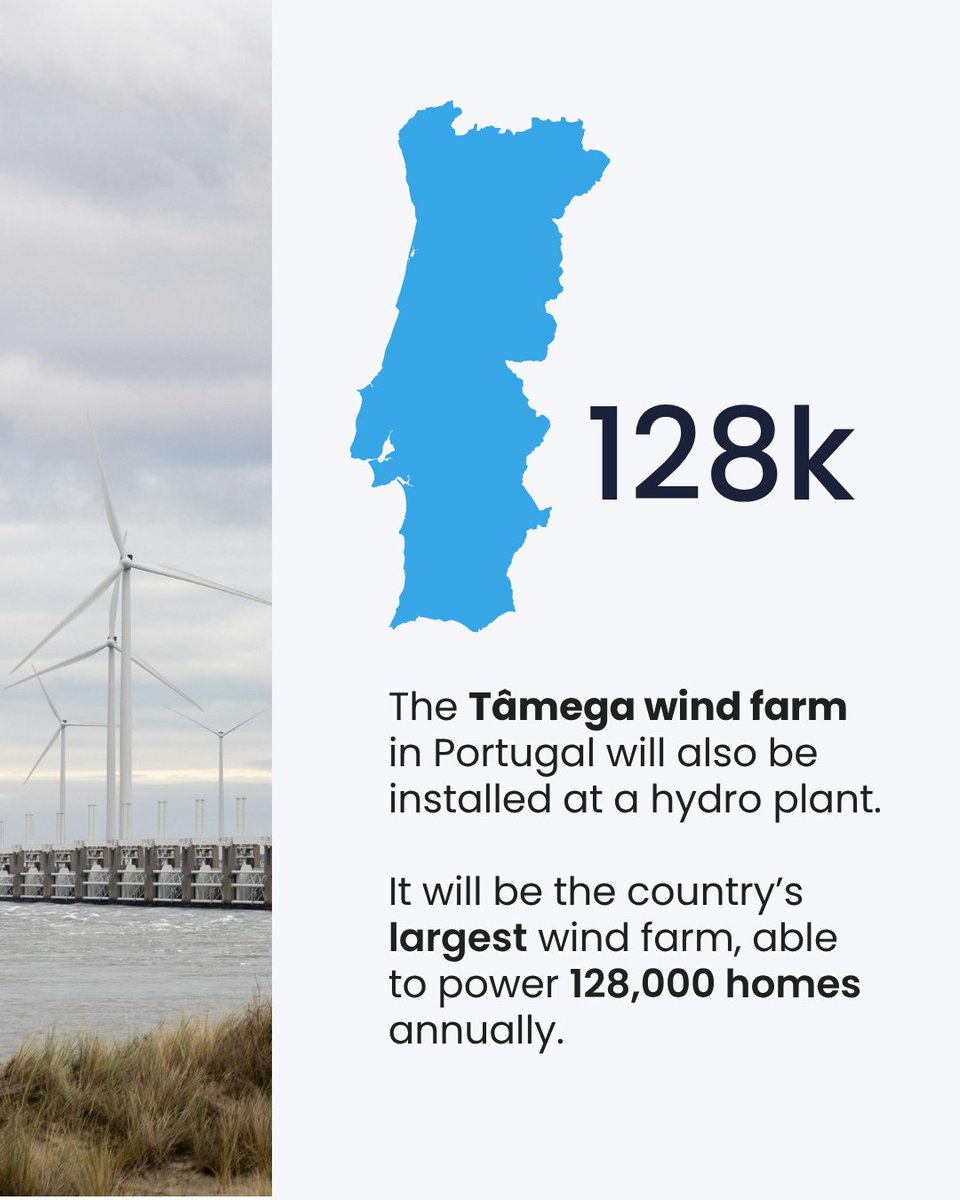
Europe can unlock 25 GW of new renewables by adding them to existing hydropower sites, bypassing grid capacity constraints 🇪🇺
This strategy is called hybridisation – and it’s becoming increasingly important for countries facing gridlock.
https://t.co/El9bFEibxn
According to the IEA, Australia's wholesale electricity prices were about 45% lower, driven by strong growth in renewables & rapidly expanding battery storage reducing reliance on expensive gas generation, delivering exactly what the economics predicted! https://t.co/IpqjnfMJ6G
By combining energy collection, storage and electricity generation in a single, compact and potentially cost-effective device, it transforms an intermittent energy source - the Sun - into a firm one, making solar energy available on demand.
https://t.co/qFWK980dLH
China deployed 400k+ fully electric trucks in 2025. That's an industrial strategy at scale, not culture war. I project global EV truck sales at ~950k in 2026, accelerated by Hormuz oil shock. Expect surprises yearly, until diesel vanishes before forecasters finish lunch. #EV#LFP
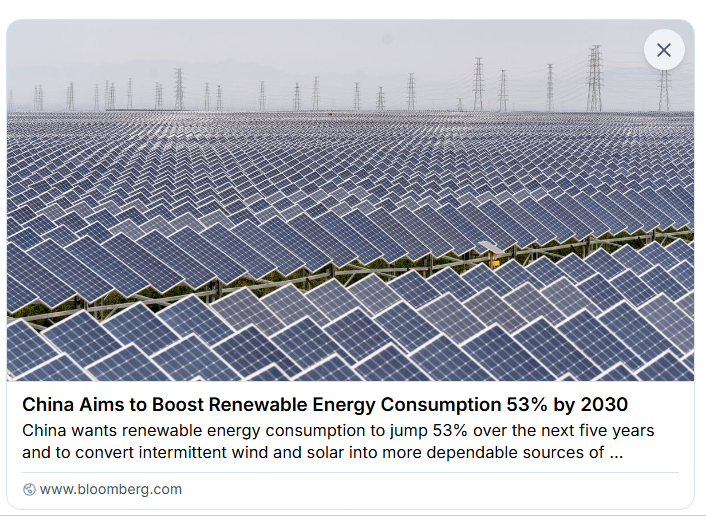
China's updated target: 6T kWh renewable power by 2030, ~50% increase. US total generation in 2025 was 4.43T. Wind & solar to rise from 22% to 30% of total mix. China consistently overshoots & beats its own renewable goals. These targets are destined to be a floor, not a ceiling.
Opinions differ.
Measurements don't.
428.9 ppm atmospheric CO₂.
Every year we delay cutting emissions, the challenge grows, the costs of limiting future warming rise, and the range of available options narrows.
#ClimateChange#ClimateCrisis#ClimateEmergency#NetZero
Britain’s net zero economy is booming, #CBI says
"There are huge costs to not seeing this transition as an economic opportunity."
“There is no tradeoff between economic growth and net zero."
"Quite the opposite. Net zero is the industrial opportunity of the 21st century.”
#EnergySecurity #RenewableEnergy #NetZero #EnergyTransition
https://t.co/pUg6kp0urs
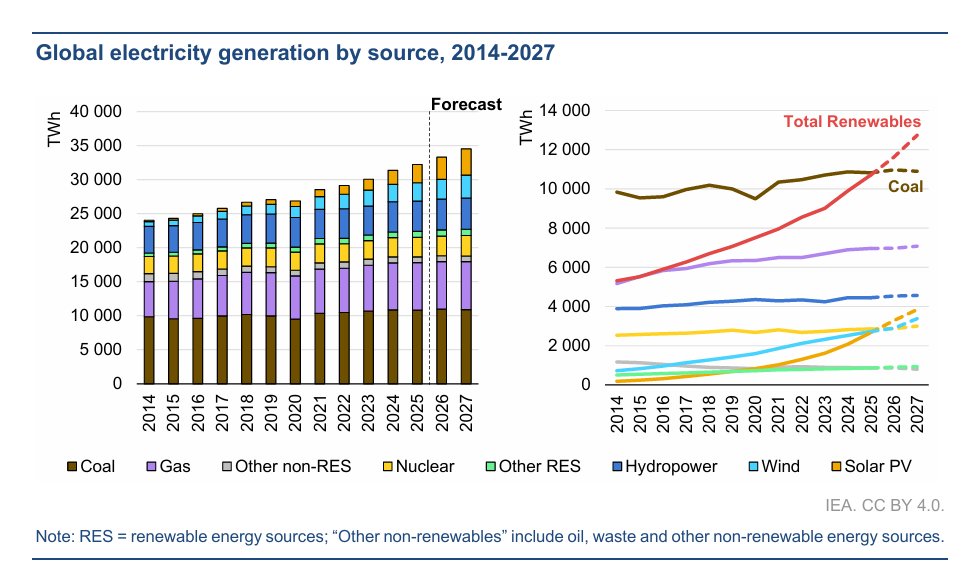
Good morning with good news: Renewables overtake coal in 2026 as world's largest source of electricity, after reaching near parity in 2025.
RE rise to 37% in 2027 from 35% in 2026 & 33% in 2025!
How?
Solar & wind rise to 21% in 2027 from 17% in 2025!
https://t.co/4PncZem2qA
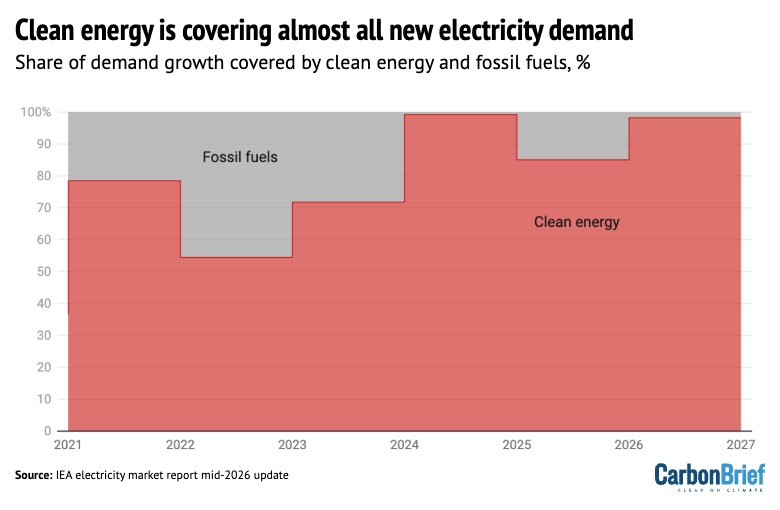
Today, almost all new electricity is coming from clean energy
Once clean-energy growth consistently exceeds the rise in demand, fossil-fuel power will start to decline
Source: IEA's mid-year electricity market update
The obstacle to Africa’s energy transition is no longer the price of clean technology, which has collapsed, but the cost of capital, which has not. A solar plant in the Sahel and one in southern Spain use much the same equipment, benefiting from the same falling panel prices, and powered, in the African case, by a stronger sun. Yet the African plant’s electricity will probably cost more for producers. The reason is not the panels, the sunshine, or the engineering. It is the cost of capital. Financing, not technology, is the obstacle. A generation ago, the reason for slow adoption rested on technology: renewables were expensive and unproven. That excuse is gone. Solar is now the cheapest source of electricity in much of the world, and Africa is the continent with the greatest solar potential on the planet.
FT 22nd July 2026
https://t.co/LGuLvuBA49
Renewables are overtaking coal as the world's largest source of electricity generation, after near parity in 2025.
New @IEA mid-year update: their share goes from 33% to 37% by 2027, solar and wind from 17% to 21%. EU well ahead of global average.
https://t.co/x2kYcEz6Q3
Good morning with good news: China will increase renewable energy generation by 50% to 6 trillion kWh by 2030.
US generated a total of 4.43 trillion kWh in 2025.
RE will rise to ~46% in 2030.
Wind & solar will jump to 30% in 2030 from 22% in 2025.
https://t.co/J2JoG9yAa2
Wow!
Solar surpasses 3 TW of nameplate capacity worldwide.
Wind is over 1.3 TW. Together, they make up 4.3 TW.
For comparison, U.S. average power demand is 0.47 TW, so W+S can now meet a peak of 9x U.S. average power demand or, over a year, 2x U.S. electric energy demand.
Here's more:
Solar added 583 GW in one year (+23.9%)
Wind added 167 GW (+14.4)
Together they added 750 GW.
The world added a NET of only 1.6 GW of nuclear.
https://t.co/84Fnk2P2kd