Throughout the film Little Forest (2018), we notice the lack of Hae=won's mother's presence and are awaiting her arrival the entire time. Why do you think they chose to end the movie without direct confirmation that her mother was the one in the house?
(25:44) In Little Forest, Ki-joo says to Haewon, “You failed your test, quit your job, and don’t talk to your boyfriend.”
Why does Hae-won keep Ki-joo around? Is it because she has abandonment issues?
@kaelynb_ I was also very confused by this scene and his bathroom. However, I assumed that he kept a makeup box in there so that if he ever got caught and they raided his house, it would make sense as to why he has all of those women's belongings. They'll assume a woman lives there.
@RosieRomerooo I wouldn't say she's as corrupt as Ben; she may be a liar but she's not a murderer LOL. I think because of her experiences growing up "unattractive" she resorted to making things up to seem more interesting, though it backfires when there is no evidence to support it.
In Burning (2018) this was a gorgeous shot of their backs as they watch the sunset. Ominous, last moment feeling because Hae-min says this might be her best day yet, and usually in American movies, that means something bad is about to happen.
(1:06:46)
In Burning (2018), what was the significance of Jong-su caring for the last calf in the greenhouse? And then selling it once his father was sent to prison?
In Burning (2018), I find the different states of their homes interesting. While Hae-mi’s home is messy, you can tell someone lives there; it’s warm and lived in. Jong-su’s home gave off very stale, moist, abandoned feelings despite it also being in a similar messy state.
@EmmaOwen27 i feel like this also relates to the theme of gender surveillance that we discussed for decision to leave. at one point, a man asked "are you avoiding me? i kept looking at you." i agree that it felt creepy whenever her back was to the camera and we were forced to watch her.
@EmmaOwen27 i also posted this screenshot because i was fascinated by the way they portrayed her loneliness. the transition from dark and cold to warm lighting stood out to me as well, almost like she is stagnant both day and night.
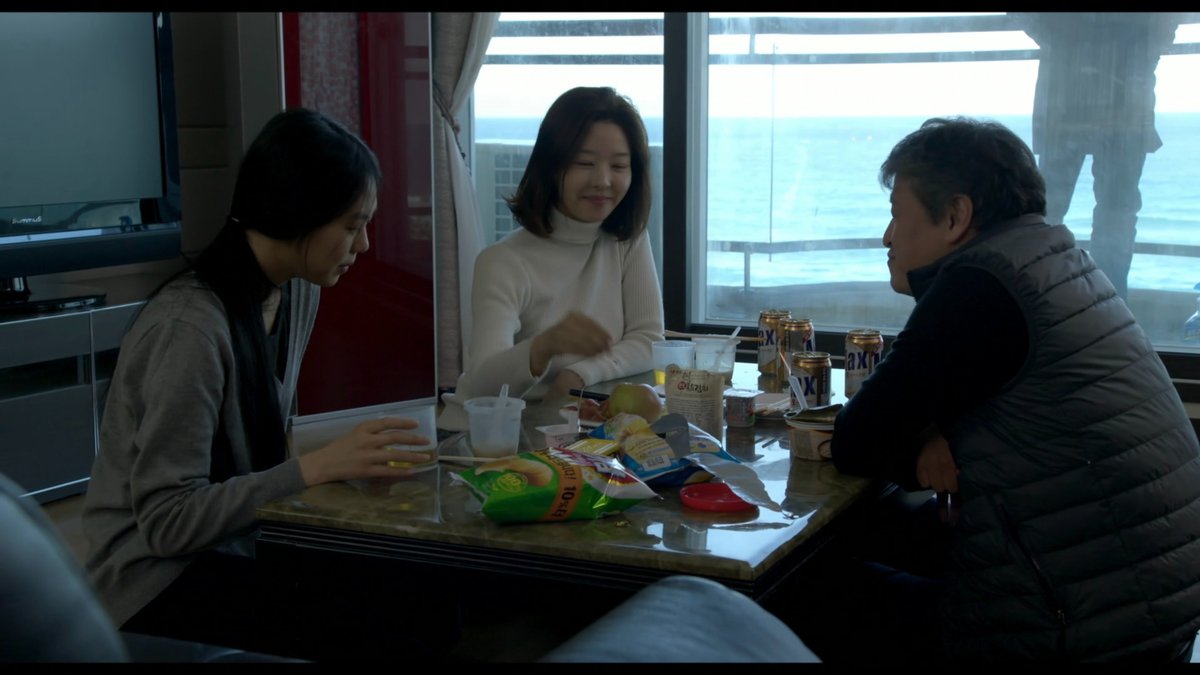
In On the Beach at Night Alone (2017), we see Young-hee and her friends eating lunch together. However, there is a mysterious man behind them. Who was this man? What was his purpose in the movie? How did his presence further or impact the narrative?
1:12:34
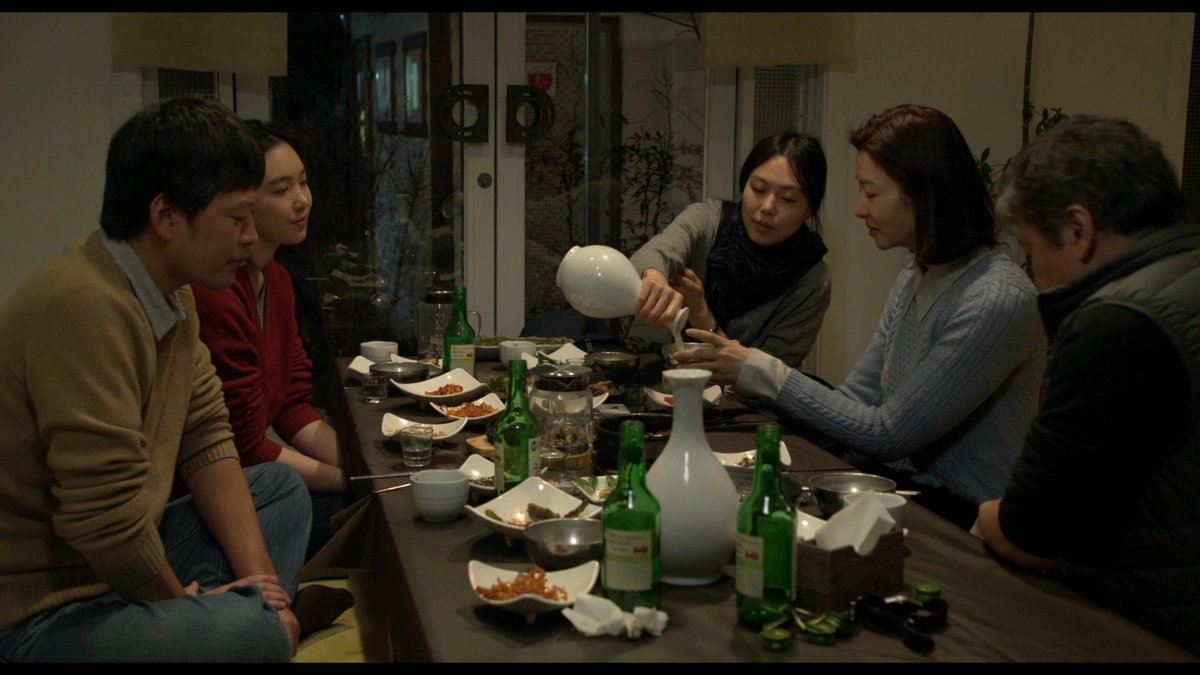
In On the Beach at Night Alone (2017), Young-hee & her friends enjoy dinner together. The director uses a tight frame to portray this gathering, & I have noticed that multiple other films do this as well. What is the significance of using a tight frame for dinner scenes?
50:03
In On the Beach at Night Alone (2017), Young-hee is pictured sitting alone at the cinema. The composition of this really emphasizes how she feels alone. There are rows of empty seats behind her and we know there is no one in front of her because of the edge of the frame.
28:16
@MaxBarnes654528 this is a great observation. i have to admit, when the monster first appeared i was giggling and laughing at its appearance. it was mostly because i thought it looked silly, but also because it lacked the realism we have in cgi today.
@Roryyy_A this moment felt really similar to other endings of films that Bong Joon-ho has made. all of his endings lack closure and are very ambiguous as to what happens next. i wonder if he does this intentionally so the audience can interpret an ending for the characters themselves?
@MaxBarnes654528 yes, i noticed that as well! there were a lot of tight frames, especially in moments of tension and suspense. it aided the audience in being overwhelmed visually
In The Host (2006), this scene has three masks in the background, and it reminded me of the masks on the wall in The Housemaid (1960). I also believe it to be foreshadowing that there were only 3 survivors of the family at the end of the film.
53:33
In The Host (2006), this translation scene seemed eerily similar to the one in Snowpiercer (2013). In both films, Bong Joon-ho depicted a Korean character struggling to be heard by English speakers. How does this relate to the different facets of the auteur theory?
1:23:04
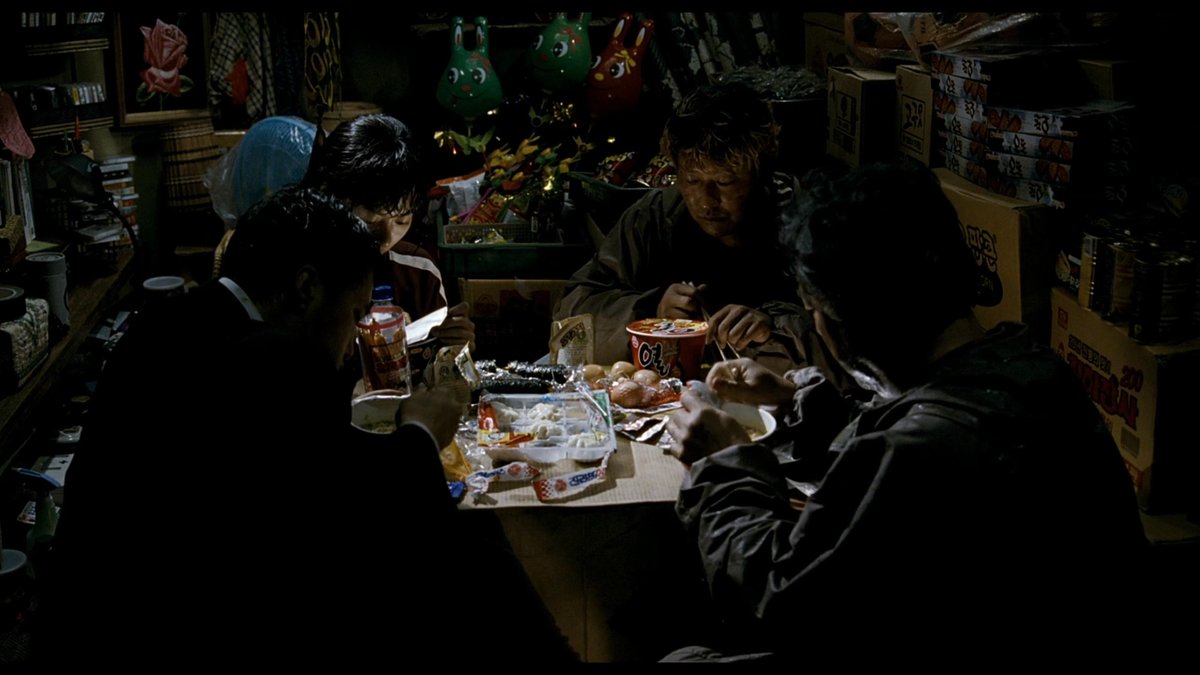
In The Host (2006), we see the family grieving for Hyun-seo from a bird's eye view. I thought this demonstrated well the dynamic of the family; the father kept reaching for his children & was glad to see them all together despite the circumstances. The children grieved alone.