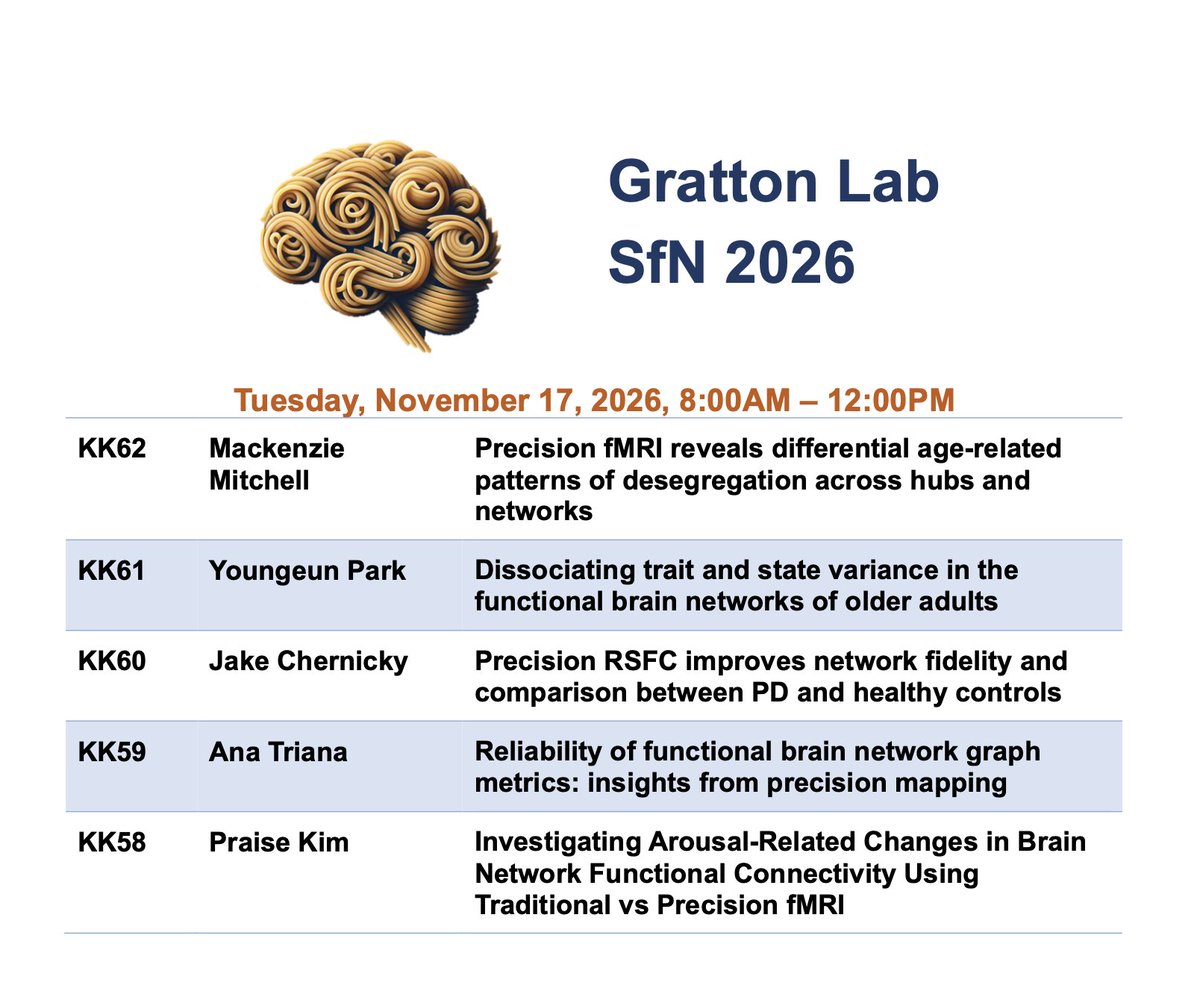
@jakechernicky examines the utility of precision fMRI in Parkinson’s Disease, in a collab with @Campbell_TheLab
Jake compares conventional (group-template, low-data) and precision (individualized, high-data) paradigms on their ability to detect diffs between PD and HC
Excited to share our new work now out in Nature Neuroscience!! We use a whole-brain framework to show that aging and Alzhiemer's disease affect the brain's functional organization along completely separate axes. Paper and thread below 👇
Very excited about this project, led by @zach_ladwig
We show that the individual lateral prefrontal cortex has reliable and highly detailed network organization missed in past group approaches.
Full🧵 coming soon!
🚨 I'm searching for a full-time research coordinator to join my group & work on precision brain 🧠 network and cognitive control projects at both 3T and 7T.
Applications due: Feb. 26
Start date: flexible, as early as June
More 👇
Please rt 🙌
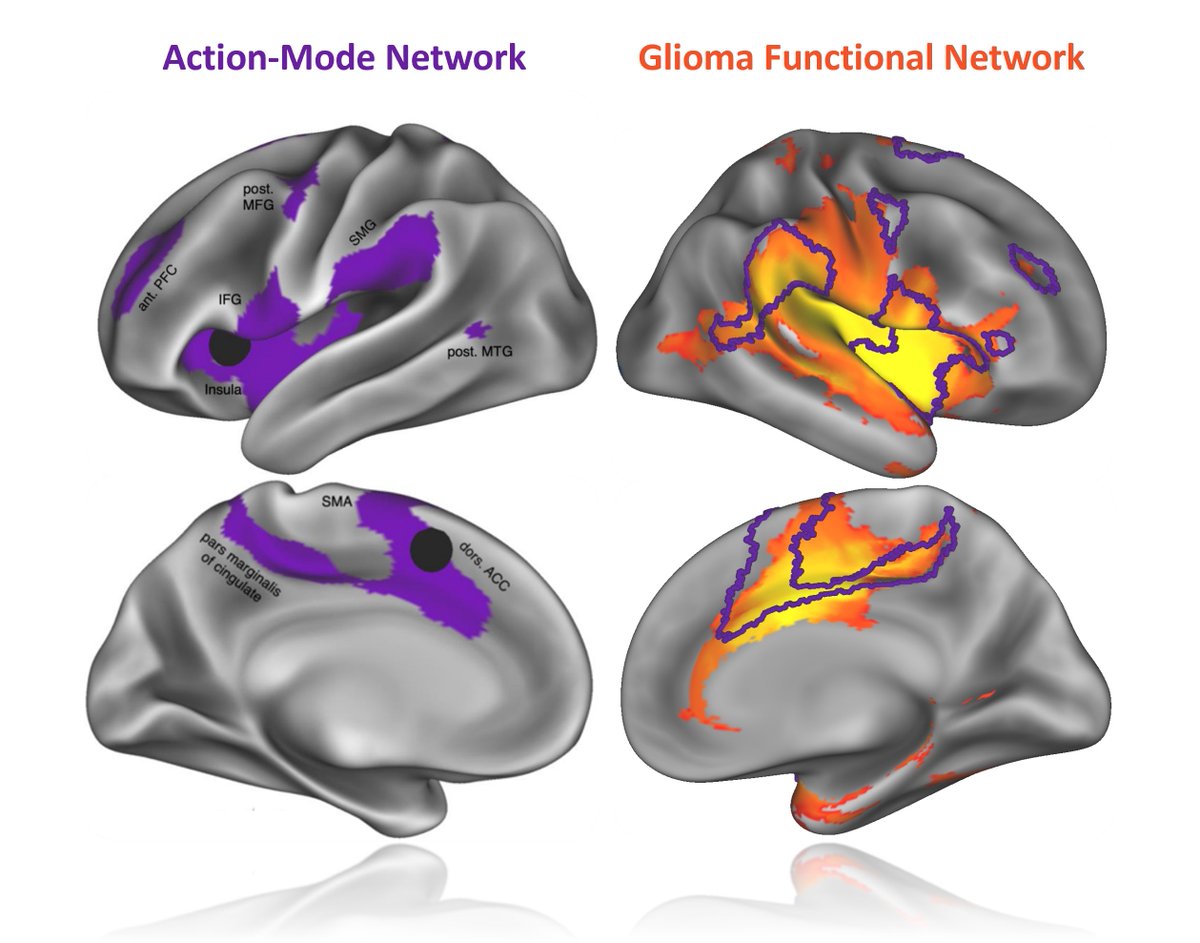
Gliomas do not develop randomly but prefer a specific network: the action mode network -- no matter the tumors are in the cortex or cerebellum. This suggests action-related functional activity may play a key role in tumor growth. @ndosenbach@foxmdphd
https://t.co/Uizts2vuz9
Why do brain 🧠 networks vary? Do these differences shape behavior? If every 🧠 is unique, how can we detect common features of brain organization?
@RodBraga and I explore these questions in our new piece in @AnnualReviews (ahead of print):
https://t.co/pQ8pomgZcJ
🧵👇
📣New preprint from the Braga Lab! 📣
The ventral visual stream for reading converges on the transmodal language network
Congrats to Dr. Joe Salvo for this epic set of results
Big Q: What brain systems support the translation of text to concepts and meaning?
Thread 🧵
🚨 New Preprint 🚨
Targeting intracranial electrical stimulation (ES) to network regions defined within individuals causes network-level effects
By Cyr et al.
Q: Can we use individualized network maps from precision fMRI to modulate a targeted network via ES?
A: Yes!
🧵:
1/11 Excited to share our @Naturestudy led by @Leon_Oo1@csabaorban@ZShaoshi
https://t.co/z51pMIGR5R
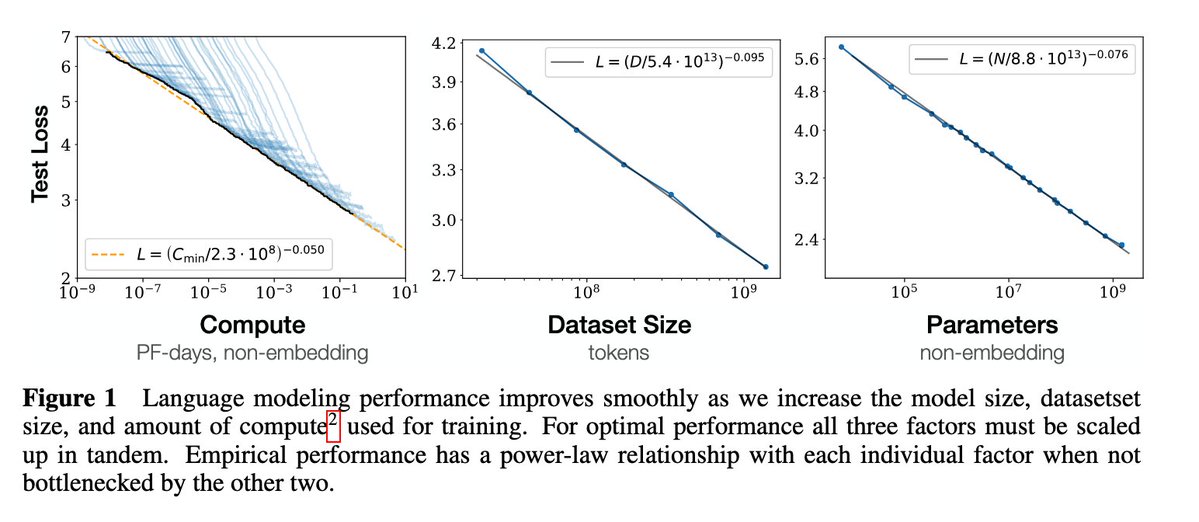
It is well-known that AI performance scales with logarithm of sample size (Kaplan, McCandlish 2020), but in many domains, sample size can be # participants or # measurements...
@bttyeo@andreashorn_ 12/12
I’d like to thank my amazing mentors, @GrattonCaterina & @Campbell_TheLab, my coauthors at WashU: @allydworetsky, Sarah Grossen, Emma Carr, & Dr. Abdulmunaim Eid, as well as the participants who made this work possible.
Please let us know if you have any feedback! 🎆
Excited to share my first preprint investigating the feasibility and reliability of using precision RSFC in people with Parkinson’s disease! 🧠👇
📄: https://t.co/rblcEYB5AE
🧵 Thread ⬇️ 1/12
@bttyeo@andreashorn_ 11/12
🧠 Bottom line: Precision RSFC is feasible, reliable, and clinically promising in Parkinson’s disease.
This approach could explain the huge variation we see across individuals—and help us treat each person more effectively.