I already run a handful of Grok Bots for my personal stuff: content, finances, side projects.
Shared bots and Slack/Teams support are the missing piece for bringing that setup to work.
The part I want to see in practice: how they handle memory across a whole team.
https://t.co/8An2gFeFuD
Introducing Grok Bot 1.0. AI teammates that work alongside your whole team.
Share Bots, collaborate with them in Slack and Teams, invite them to meetings, and watch them learn and become more helpful.
Grok Bot can now join your personal or company tailnets on Tailscale.
Use it to securely reach private MCP servers, internal tools, and apps on your network.
Gemini 4 Carbon is now available.
It’s our strongest model, built to dig deeper, handle long-horizon tasks, and multi-step reasoning.
If Argon is great for complex tasks, Carbon is the model you bring in for your hardest problems.
First AIE Code Summit speakers:
@poteto, Principal Engineer @ SpaceX
@steve_yegge, Engineer, Writer, Advisor
@zachbruggeman, Principal Software Engineer @ Ramp
Nov 10-12, SF. Come hang out with us. Apply at https://t.co/N46r5deFR1
Grok Bot broke, and the fix was putting Claude's Opus 5.5 back in. Joey met the xAI team and posted update number two this morning. 50,000 people read it. 44 replies.
The bot itself never broke. The model underneath it got pulled, and the whole product went with it. This morning the model came back, and so did the bot.
The interface you love is rented. The brain underneath belongs to someone else, sometimes a rival. One swap and the tool you use every day stops working.
Which tool that you use every day would break first if its model got pulled?
My Grok Bot limits just reset, so here's my honest take.
There are great open-source agents out there. I tried OpenBot, Rakazo, Hermes and a few others. Flexible, endlessly customizable.
But Grok Bot is the one that actually solved my problems.
What those problems were deserves its own post. Coming soon.
Introducing Claude Fable 5.2 and Claude Mythos 5.2, designed to tackle the most daunting technical challenges.
They’re capable collaborators on ambitious projects in many fields, and show improvements in areas like coding, reasoning, and vision.
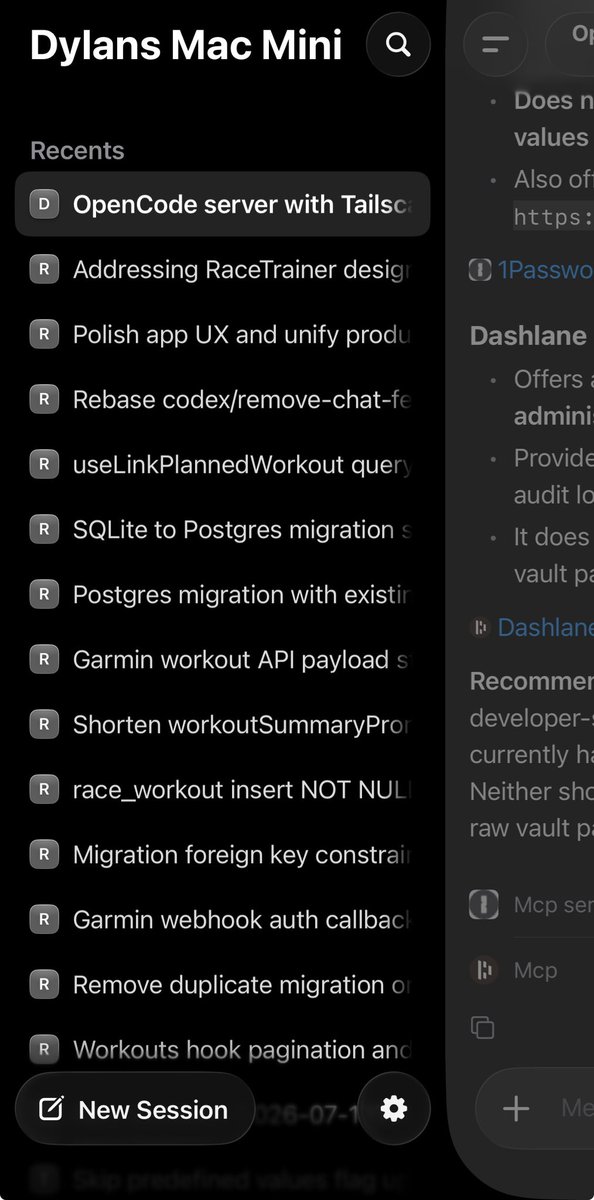
I recreated @Muse with @opencode V2 and my own Mac mini.
Here’s how:
- run @opencode server via docker against an isolated volume mount (with restarts enabled via unless-stopped)
- make the open code server accessible via a private @Tailscale network and enable Magic DNS
- install @Tailscale mobile app and connect your phone to the private network
- install @opencode mobile app and connect it to your server using the generated QR code
- move relevant projects, install tools, etc. into the isolated volume mount
- updated server permissions and give it access to secure credential store like @1Password’s MCP
- install @opencode browse to give opencode server ability to open browser/navigate links and using existing extensions
- disable “automatic sleeping” on your mac mini
Gives you 90% of @grok@bot / @Muse
/ Dot but hosted on a private network with controlled permissions to your files.
Also allows you easily switch inference providers and models depending on the task.
Introducing Arete-27B: Qwen3.8-27B, post-trained to reinforce Western values.
Chinese open models are currently the strongest available, but they ship with state-aligned behavior in the weights. We built an 803-prompt eval across seven value categories, including freedom of expression, democracy, and privacy, and measured how often a model adopts China’s party line.
After fine-tuning on roughly 53 million tokens, Arete-27B's propaganda rate fell from 22% to 1%, in line with the Western models we tested. Its Hermes Bench score shows no significant performance tradeoffs.
The values in an open model are one fine-tune away.
Our eval, weights, and training data are available now along with the full blog post: https://t.co/iAOANQTVZ6