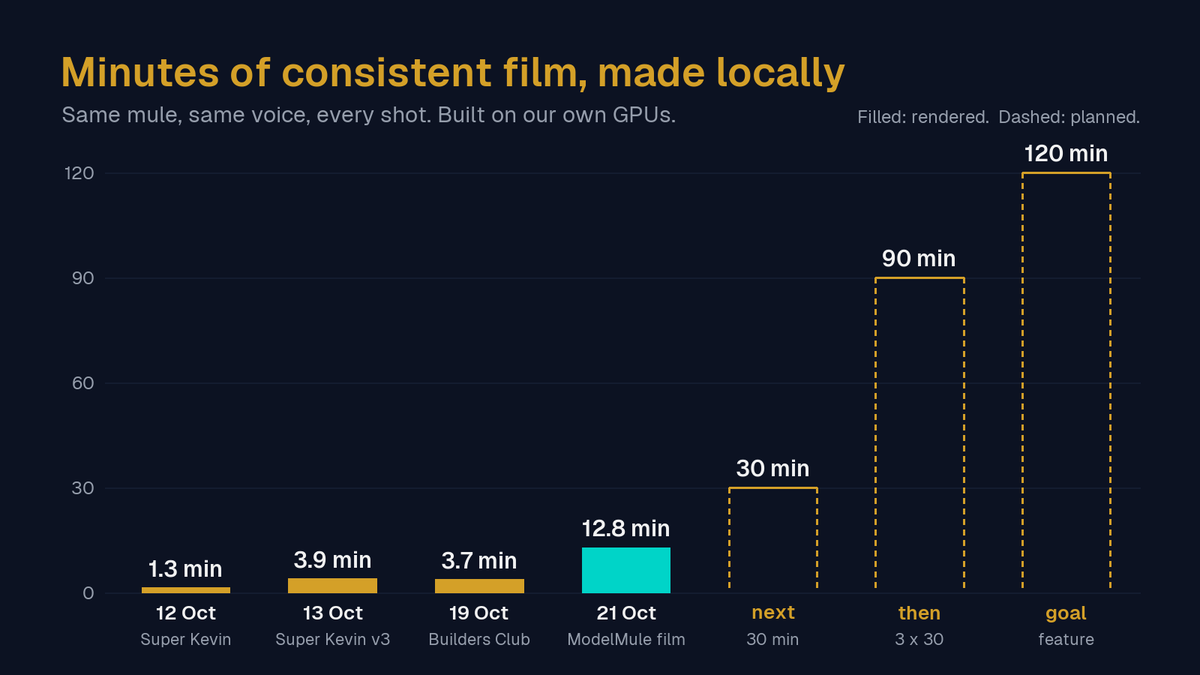
On 12 October we could make about one minute of consistent AI film. Today it is 12 minutes.
Same mule in every shot. One narrator. Real-time motion. Made locally, on our own GPUs, with open models.
Next: 30 minutes. Then three 30-minute segments for 90, and on to 120.
Behind the scenes: take 1 of a light mule rendered as a horse. Overnight QC rejected it, rewrote the prompt and added a lint rule so mule prompts never ship without donkey ears. Take 2 passed. Video @MiniMax_AI H3, voice @Alibaba_Qwen, all local. #LocalAI
https://t.co/dV84vaLa1k
Behind the scenes on one shot. Take 1 came out as a horse. Overnight QC caught it, rewrote the prompt and added a lint rule so no mule prompt ships without the donkey ears again. No human in the loop. Take 2 passed. 🫏 @NotJustShaking@wouterdelaet@BullishandBaked@ChronaraUK
Coming up: DeepSeek-V4.1-Flash on one RTX PRO 6000 using @antirez's DwarfStar, which streams weights from SSD instead of holding them all in memory. Then the same model on two Sparks with TensorFold by @ashxhart. Same prompts for both, numbers when measured.
Credit to @Blackwellboy: on a two-Spark DeepSeek-V4.1 setup each node reads only half of the 189 GB Engram tables, yet both store all of it. Punching out the unread half in place got ~94 GiB per node back, outputs identical. Worth a read if disk is tight.
Measured on MiniMax H3 across two DGX Sparks: two boxes don't make one clip faster. Each renders its own share at the same moment, so you get two clips in the time of one. Treat a second GPU box as throughput, not speed.
Mistake of the week: one Mac had two Tailscale daemons and I stopped the wrong one. Two minutes off the network, two mounts dropped. Every change now waits for the system to settle before checking itself, and rolls back if the check fails.
We just published the plan: @TheModelMule backers book scheduled time on our own NVIDIA GB300 instead of burning tokens.
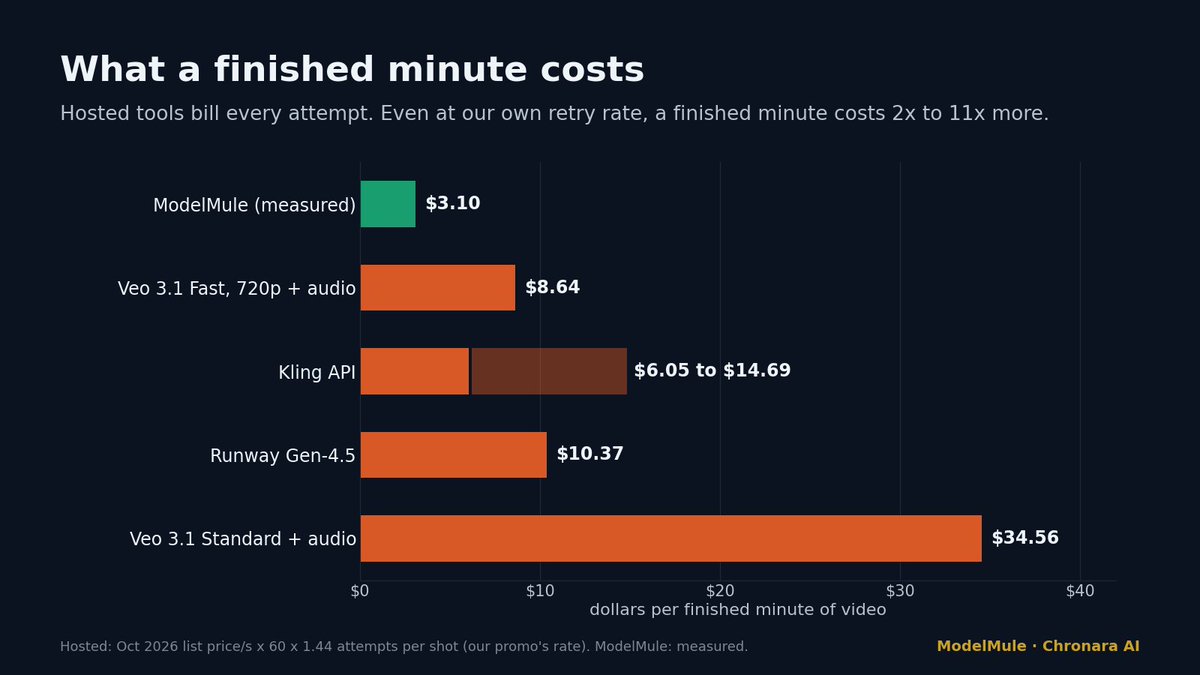
Our measured cost: $3.10 per finished minute of video, against $6 to $35 on a meter. Applications are open now.
https://t.co/cvW1B9czgw
#ModelMule#GB300
To all my wonderful backers 🫏⚡
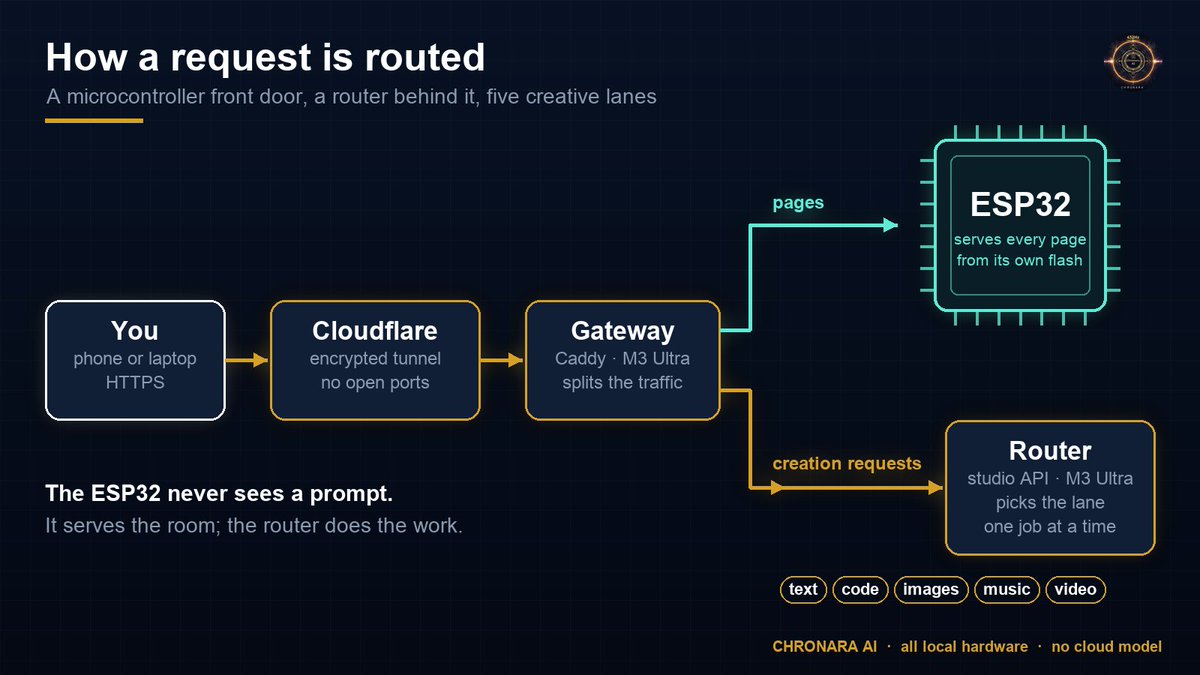
We built a routed AI studio with an @EspressifSystem ESP32 microcontroller as its front door. 520 KB of RAM serves the whole room.
One page in. Five creative lanes out. Every request goes to the machine built for it.
Hilarious you have to spoon feed so called techs these days. I am sick of lazy ass bleaters going on about prove to me this prove to me that. Once you can read then maybe we can afford the time to figure out how to improve it.... BTW I am running benchmarks my side and will hopefully send some PRS as I waorke don Early Quick Assist 2014 leading to 1Tbps AVX 512
@GreyforgeLabs@jc50000000 All 45 timed decompressions are marked SHA-256 verified. ZJX fast took 7.33 s to decompress vs 0.92 s for xz -9e (~8x slower). This is workload-specific, not a universal win. Dispute it? Please share a reproducible counter-run.
@GreyforgeLabs@jc50000000 As promised, the data is public: https://t.co/L89Fjww1WE
I rebuilt the report from its 96 raw operation rows; the CSV, per-corpus JSON and summary.json match byte-for-byte.
@GreyforgeLabs@jc50000000 Scope: one structured-log corpus, one Ryzen 3 7330U/Ubuntu host, 15 installed settings. zpaq was not installed. ZJX fast and xz -9e each have one compression timing (n=1), so this is not a repeatability estimate.