More organizations think they have Confidential Computing than actually do.
The CCC's new white paper "3 Degrees of Confidential Computing" makes this concrete: Level 1 migrating to Confidential VMs provides hardware isolation, but as the paper notes, “without integrating remote attestation, it does not meet the definition of Confidential Computing”.
However, what is even more telling is the direction in which the paper points beyond Level 3 towards Confidential AI: multi-CVM interactions, AI agent sandboxes, CC-aware network protocols and CC-enforced software provenance.
That future isn't theoretical for us. It's what Super Swarm is built on today – self-organizing, mutually attesting GPU clusters that form a single hardware-verified trust domain across cloud, on-prem, hybrid, and multi-cloud environments. Every interaction is independently verifiable. No custom builds. No TEE expertise required.
The complexity of operationalizing Confidential AI shouldn't become a project of its own. That's exactly the problem the execution layer should solve.
👉 Link to CCC paper in comments
This fall, Confidential Computing ships at rack scale. 72 GPUs. One TEE.
NVIDIA announced Vera Rubin back in March. Now it's ramping to production.
Currently, each server forms its own TEE boundary: up to 8 GPUs, 2.3 TB shared memory. Vera Rubin extends this to the entire rack – 72 GPUs, 20.7 TB of shared memory in one TEE. Imagine what model will fit in there!
"Everything across this is secure because the AI model is so precious. This is the reason why this entire system obeys confidential computing." – Jensen Huang, NVIDIA CEO, GTC Taipei 2026
What can you do while waiting? We recently updated our GPU + CPU TEE requirements guide, covering all available GPU TEE-capable SKUs, from Hopper to Blackwell, with compatibility details for Intel TDX and AMD SEV-SNP – and what is not TEE-capable as well.
Check them out and start deploying Confidential AI today. With Super Swarm – no TEE expertise required.
Links in comments 👇
Congratulations to @GoogleResearch Health AI Developer Foundations (HAI-DEF) team on the launch of the HAI-DEF Showcase.
We're honored to see two confidential healthcare AI case studies developed by Yma Health and Super Protocol featured as the first entries in the "Technical Solutions and Tools" section of the showcase.
The two case studies demonstrate how the open medical foundation model #MedGemma 27B can be deployed in real healthcare workloads through Confidential AI. By transforming #TEE-enabled infrastructure into a verifiable confidential execution layer, Super Protocol enables sensitive data to remain protected during processing regardless of where the workloads run.
One implementation demonstrates confidential inference on @nvidia Blackwell B200 infrastructure hosted by @nebiusai AI Cloud, with patient EHR data remaining protected throughout processing. MedGemma anonymized patient records while preserving the clinical context and value of the data.
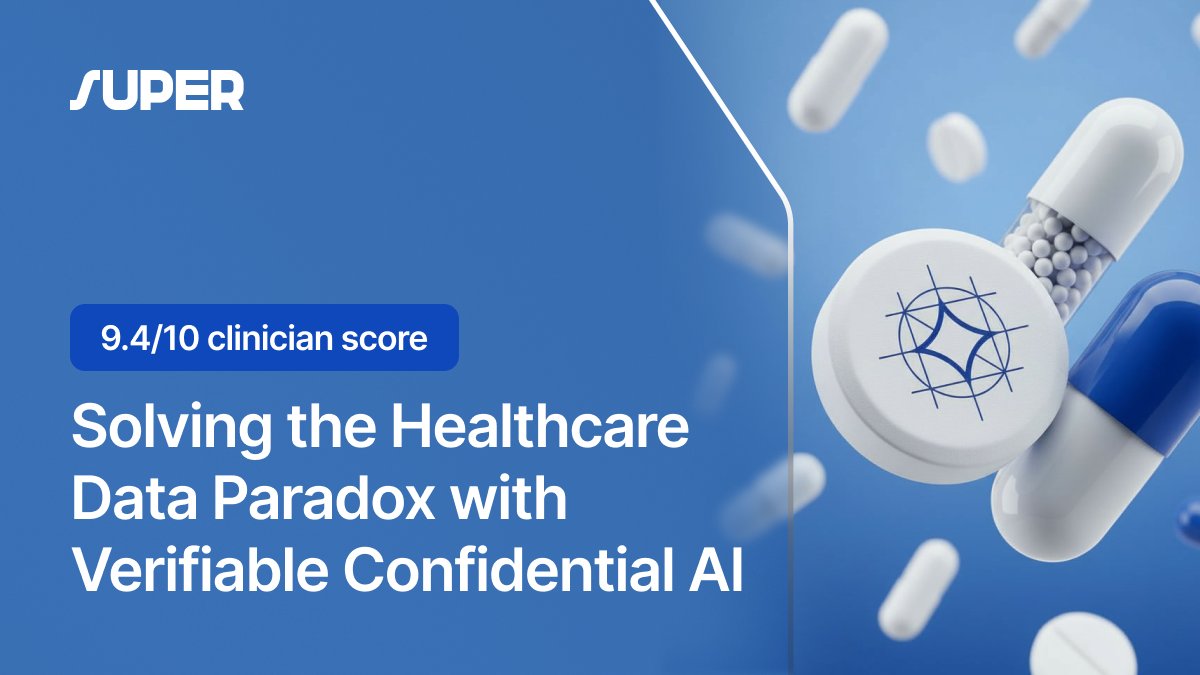
Another demonstrates MedGemma fine-tuning on NVIDIA H200 infrastructure using real patient dialogues, achieving a 9.4/10 evaluation score while preserving data confidentiality.
As the health tech ecosystem explores the potential of open foundation models and Confidential AI, sharing practical implementation examples on real healthcare data will be essential for accelerating adoption across research, clinical workflows, and precision medicine.
👉 HAI-DEF Showcase - link in comments
"Born out of GPU scarcity, neoclouds now face a harder test." – McKinsey, November 2025
14–16% gross margin after depreciation. Lower than many non-tech retail businesses. The prescribed move is clear: orchestration, managed inference, platform layers. And the market is moving fast. But there’s something already inside the hardware that the stack race is overlooking.
H100, H200, B200, B300 — and every generation after — already include confidential computing capabilities. Super Swarm turns those capabilities into a verifiable confidential execution layer for neoclouds – enabling sovereign compute environments for sensitive data and AI workloads. GPU cloud instances stop being just rented compute and become independently verifiable confidential infrastructure. Customers with their own on-prem infrastructure can extend workloads into cloud instances without leaving the trust boundary.
That’s not just another platform feature. It’s a different category of infrastructure.
👉 McKinsey: The evolution of neoclouds and their next moves – link in comments
Ask a hospital to run AI on their patient data. The answer is always the same.
A hospital, a GPU provider, and a medical AI vendor. Everyone has what the others need and none of them can just hand it over. The hospital won't send data to infrastructure they don't control. The vendor won't expose their model. The GPU provider can't take on liability for what runs on their hardware. The model never runs. The patient never benefits.
This is the real reason healthcare AI moves slowly. Not the models. Not the regulations. Trust is a vulnerability. Super Swarm solves it structurally.
In this demo we used a model from the @ProjectMONAI Model Zoo – open source, anyone can take it. The data is another story.
MONAI, originally started by @nvidia and @KingsCollegeLon, is the open-source framework for medical imaging AI. Used at Siemens Healthineers, Mayo Clinic, and beyond. Millions of downloads worldwide.
We deployed one of those models on Super Swarm. The app segments the spleen from a CT scan, calculates volume and area, and returns the results. What makes it different is the execution environment and the verifiable proof it leaves behind.
The computation runs inside a hardware-protected TEE. Patient data is processed within that sealed environment and never exposed to anyone – including us. Whether the infrastructure is public cloud, on-prem, or hybrid. No policy makes that guarantee. The hardware does.
At deployment, Super Swarm generates Deployment Evidence – a cryptographic proof of what code is running, in what environment, on what hardware. No compliance reports. No trust agreements. Access is granted only when the proof matches.
Ask a hospital to run AI on their patient data. With Super Swarm, the answer changes – wherever you run it.
👉 Scan to watch the full demo, or find the link in the comments.
The faster AI scales, the faster confidence in it erodes
For nine years Stanford Human-Centered AI has tracked where AI actually stands and suggests where it’s heading across academia, industry, and government. The 2026 report is out. Here's what stood out.
Adoption is accelerating. Confidence is eroding.
70% of organizations now use AI in at least one business function. But look one layer deeper:
🔹 Among orgs that experienced incidents, those facing 3-5 per year jumped from 30% to 50%
🔹 "Excellent" incident response self-ratings fell from 28% to 18%
Deployment is accelerating. Confidence in handling what breaks is not.
Agentic AI is stuck – and the blocker isn't capability.
🔹 62% cite security as #1 barrier to scaling agentic AI – outpaces #2 by 24 percentage points
🔹 Scaled agent use sits in single digits across virtually every business function
🔹 Only exception: tech sector at 24% in software engineering, 22% in IT, 21% in service ops
Organizations aren't waiting for better models. They're waiting for infrastructure they can trust.
Medical AI hits the same wall – from a different angle.
Medical AI is ready to move into live clinical deployment. Prospective trials grew 28.5% year-over-year (417 → 536 in 2025). The pipeline is there.
But the data isn't:
🔹 Medical imaging training data is roughly 100x smaller than non-medical AI datasets
🔹 Fragmentation across institutions further limits the development of large-scale medical foundation models
The models are ready. The environment to run them on real data is not there yet.
Three sectors. Three blockers. One root cause:
the gap between how fast AI is being deployed and the infrastructure needed to actually trust what it does.
Trust is a vulnerability – and it cannot be legislated away. The policies are already multiplying faster than anyone can implement them – and fragmented regulations across jurisdictions don't provide the technical enforceability that sensitive workloads demand.
It demands proof that you can independently verify, automatically enforce, and continuously audit.
That is exactly what Super Swarm provides. It bridges the gap by delivering cryptographic proof of what actually ran, on which data, and across independently verified infrastructure. Super Swarm makes verifiable confidentiality an architectural guarantee – not a contractual promise.
Banks know more about you than almost anyone. And they do nothing with it.
Your salary lands in their account. Your transactions reveal where you go. Their app captures how you behave. Where you live and how you actually live – all visible, all logged.
Customers aren't saying "stop collecting my data." They're saying: "You already have it. Why aren't you using it for me?"
Alex Pyatigorskiy, product executive with a background spanning Disney, global banks, and telecoms, now CPO at Vama, heard this across thousands of customer interviews. And it reframes the whole problem.
Banks are not short on data. But they legally cannot share customer data with partners – and partners won't expose theirs either. So a joint offer that could benefit everyone never gets built. The knowledge stays locked. The customer stays underserved. And loyalty erodes to whoever offers 0.1% more on a savings account.
Super Swarm is the architectural answer to that deadlock – verifiable confidential execution that runs on any infrastructure, so partners can collaborate without the ability to expose what isn't theirs to share.
The bank finally acts on what it knows. The customer gets served. Not by policy. By architecture.
🎥 "Confidentially Yours" with Alex Pyatigorskiy and host Mike Bursell (Advisor, Super Protocol)
Full episode on confidential computing in finance, telco, and agentic AI – where the real use cases are and why trust is still the bottleneck: https://t.co/zN3qED3VA3
Yesterday at OC3, the confidential computing ecosystem shared its insights.
Our COO Yulia Gontar joined the Confidential Computing Consortium (CCC) to showcase the real-world impact of verifiable AI. We brought six projects that solve a universal structural problem: AI workloads require scalable high-performance compute but cannot afford to expose sensitive data or proprietary models to the provider, or any other participant.
The Proof Grid (as presented at OC3):
🔹 Clinical AI: MedGemma-27B achieving a 9.4/10 doctor score inside a verifiably confidential environment.
🔹 Smart Hospital: Real-time EHR-to-Clinician AI on NVIDIA Blackwell (B200) via Nebius.
🔹 FDA Compliance: Cutting AI audit submissions from 4 weeks to 2 hours.
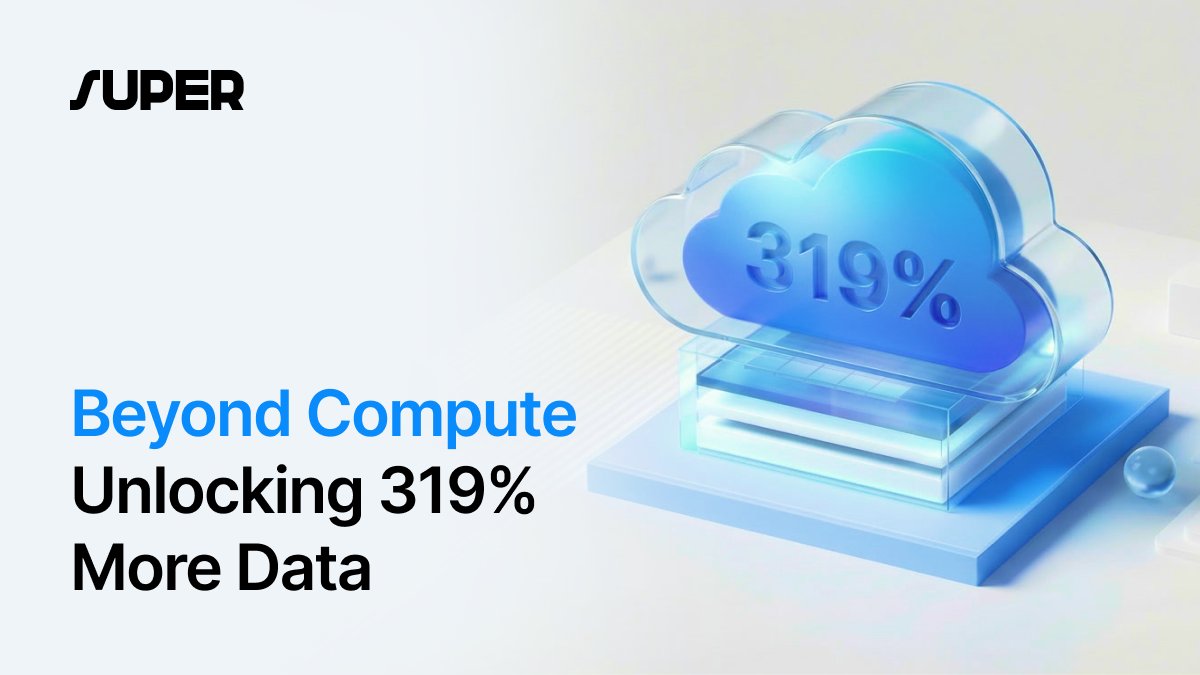
🔹 AdTech: Unlocking 319% growth on external training data for Mars & Realeyes.
🔹 Inter-Institutional AI: Centralized training on decentralized data (Brain Cancer ML in USA) – without exposing a single byte.
🔹 Self-Sovereign AI Cloud: Turning GPU fleets into verifiable environments across cloud and Hyperscalers, like Google – borderless.
The Next Level: Super Swarm – the HTTPS layer for AI. Verifiable autonomous execution that no party can override.
Your Choice of Infrastructure: Our protocol is designed for total flexibility without vendor lock-in. Whether you operate In the Cloud, On-Premise, or in a Hybrid environment, you can scale your AI whenever you need it. This also unlocks one more thing: the latest TEE-enabled hardware – like NVIDIA Blackwell – is available to you the moment you need it, with the exact same verifiable privacy guarantees across the board.
And as you are waiting for the NVIDIA Vera Rubin launch – so are we!
60 seconds. Six proofs. Check below.
PS: @ConfidentialC2 and and Rachel Wan, Outreach Vice Chair of CCC, thank you so much for making us part of your speech!
Sovereign cloud usually means one thing: data stays inside the jurisdiction.
That's necessary. But it's not sufficient.
Jurisdiction defines where data must stay. Compliance defines what the provider is allowed to do with it. But what if the provider simply cannot access it – technically, not just contractually?
That's a different kind of sovereignty. Not a promise. An architectural guarantee.
The demo shows how self-organizing confidential clusters work. The same approach applies if your infrastructure spans different types – on-prem or any cloud setup, single perimeter or distributed datacenters, locked to a specific jurisdiction if required. Including hybrid, when you need to scale out to public cloud with the same security guarantees.
👉 For the complete demo, visit:
🔗https://t.co/dLqmGPtTBE
Can you ensure that your LLM deployment is truly confidential?
Large LLMs require significant GPU resources. GPU cloud providers make that compute accessible. But when proprietary model weights or third-party data are involved, deployment becomes more than just infrastructure.
Confidentiality at runtime should not rely on trust in the operator, nor should it introduce operational complexity.
Super Swarm builds on the core Super Protocol principles, with a redesigned confidential infrastructure layer ready for autonomous AI at scale.
To demonstrate how this works in practice, we recorded a new Super Swarm walkthrough covering the full confidential LLM deployment flow – from cluster creation and LLM deployment to independent verification.
Using an inference workload as the example, the walkthrough shows:
- confidential cluster launch
- LLM deployment on cloud GPUs
- automatic generation of Deployment Evidence (cryptographic proof that the environment has not been altered)
- secure model access via both API and application endpoints, with verification preserved in both cases
In previous posts, we discussed the importance of decoupling execution control from infrastructure as the foundation of verifiable confidential AI.
Now you can see it in action.
👉 For the complete demo, visit:
🔗 https://t.co/zKzC1VI6LC
👉👉 Bookmark the Super Swarm demo series to see additional use cases in action:
🔗🔗 https://t.co/ZAe2cIzPKb
Confidential fine-tuning on external data is not just about isolation. The real question is whether training runs under conditions no single participant can alter – and whether that can be independently verified.
When external data is involved, hardware isolation alone is not enough. Data owners require enforceable guarantees that execution cannot be modified or overridden by any party – including the cloud provider.
This is exactly where GPU clouds either become trusted compute platforms for sensitive AI – or remain generic capacity providers.
TEE isolation protects data-in-use. But isolation alone does not enable collaboration across organizations. Fine-tuning on external data requires something fundamentally stronger: provable architectural sovereignty – where execution is governed by cryptographic rules rather than administrative control.
Super Protocol adds a verifiable confidential execution layer on top of existing GPU cloud infrastructure. The cloud continues to provide GPU capacity and operate hardware.
What changes is how execution is governed.
Execution approval becomes architectural and cryptographic – not administrative. Compute supply and execution authority are structurally decoupled. Training proceeds only when predefined conditions are automatically validated through hardware attestation and workload verification. If they are not met, execution does not start. After completion, independent parties can verify that the training ran as intended – without requiring privileged access to the infrastructure.
In this model, the GPU cloud supplies compute – but execution conditions cannot be altered by any single party, including the cloud provider or Super itself. That shift is what allows GPU clouds to host confidential fine-tuning across independent organizations – without requiring data transfer or centralized trust.
This architecture enabled Realeyes to break the fine-tuning deadlock. They gained access to 319% more sensitive training data – resulting in measurable improvements in model quality and deeper insights for global ad optimization.
👉 Check case study:
🔗 https://t.co/QyxbzduAg1
Modern GPUs are becoming standard. What sets clouds apart now is how AI runs on them.
Super Protocol turns #NVIDIA H100, H200, and Blackwell GPU fleets into verifiable, privacy-preserving AI clouds.
It rolls out as a ready-to-run layer on top of existing cloud infrastructure, handling environment attestation, policy enforcement, and integrity checks end-to-end – without requiring providers to redesign their stack.
For customers, it feels like a standard AI cloud with familiar tooling and workflows. The difference is architectural: workloads run in confidential mode and are automatically verifiable.
Open-source by design, Super Protocol removes vendor lock-in and enables collaboration across clouds under the same provable privacy guarantees.
For sensitive and regulated workloads, this is what makes cloud deployment possible. Without verifiable execution, sensitive AI remains limited to isolated pilots, on-prem infrastructure, or tightly controlled environments. With it, entire ecosystems can operate on shared GPU infrastructure.
In one real-world healthcare project, this brought together:
🔹 a GPU cloud provider
🔹 a medical AI solutions provider
🔹 an EHR provider
🔹 and clinics running AI on live clinical data
– All without exposing patient records, proprietary model logic, or relying on policy-based trust.
Super Protocol acts as a neutral, verifiable execution layer across the stack, enabling each party to operate on shared GPU infrastructure while retaining control over its own data, models, and compliance boundaries.
That is what makes GPU clouds ready for sensitive #AI workloads.
👉 Check case study:
🔗 https://t.co/bbbMPhKZuV
#ConfidentialComputing #AIInfrastructure #GPUCloud #TEE
AI is not a standard SaaS tool. With agentic systems, the security model breaks even faster.
Traditional incidents assume clear ownership, clear boundaries, and clear responsibility. AI incidents don't.
Who owns the data used during inference?
Who controls the outputs?
Who is accountable when models collaborate across teams or organizations?
Confidentiality becomes the core challenge, and not performance. And governance becomes a new discipline entirely.
Clients don't want promises. They want assurance that their data stays protected during execution.
That's the difference between running AI, and running AI responsibly.
Watch the full podcast. Link in the comments.
Model architecture is no longer the limiting factor in medical AI. Its real bottleneck today is access to real clinical data. To be clinically useful, models must learn from real clinical dialogues, yet those datasets are among the most sensitive and heavily regulated.
Thanks to @super__protocol, Yma Health, @nvidia , @AMD and @GoogleResearch this trade-off was removed entirely.
The outcome: a 9.4/10 recommendation score from practicing clinicians, strong clinical accuracy, and safer, more concise outputs compared to general-purpose LLMs.
The MedGemma 27B model was fine-tuned on real clinical conversations inside a verifiable confidential execution environment based on H200 GPUs and AMD SEV-SNP. Data was decrypted only inside TEE, encryption keys never left the trusted boundary, and the execution environment was deleted after training.
Clinicians evaluated the fine-tuned model in real clinical scenarios.
During both training and inference, data and model access remained confined to the trusted execution environment.
This case goes beyond healthcare. It demonstrates that:
- privacy and scale are no longer mutually exclusive;
- trust in AI can be cryptographically verifiable, not contractual;
- sensitive-data training is possible without compromise.
This case makes one thing clear: medical AI is moving from experimentation to production-grade infrastructure inside TEEs.
“If you are not in the LLM answer, you don’t exist for the user.” - Vlad Pivnev, CEO of ICODA
That’s Vlad Pivnev, CEO of ICODA on how discovery is shifting from links to model answers, and why trust signals matter as much as rankings.
Watch the full episode: https://t.co/VFHxvmaZFJ
@super__protocol
#AI #LLM #AISearch
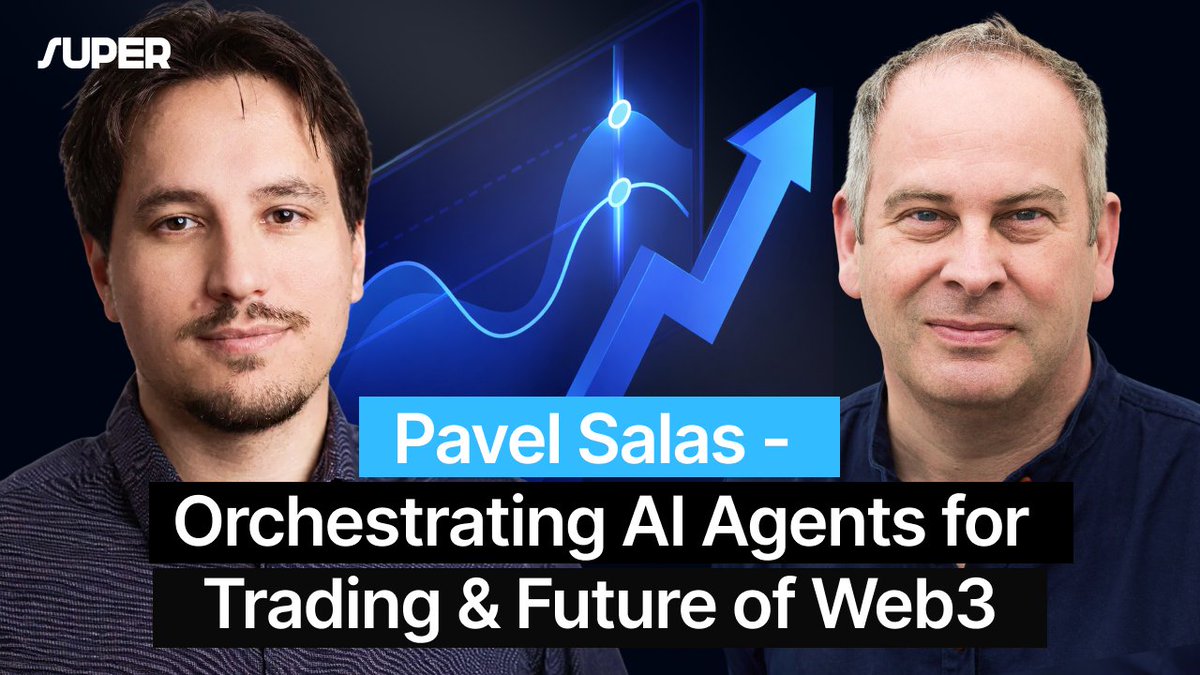
The New episode with Pavel Salas (CEO, SocialWisdom): “Orchestrating AI Agents for Trading & the Future of Web3.” We unpack why specialized agent stacks beat a single general model (signals → data validation → risk → execution), how this connects to smart contracts and DeFi, and where KYC/GDPR + privacy vs transparency become the real bottlenecks.
🎧 https://t.co/qZzBwnTqw1
At year-end, it's useful not only to summarize but also to update your own "reality map" on #AI and #Confidential#Computing. Ahead of #2026, we've compiled 8 key 2025 reports worth revisiting (or finally opening). The common thread is clear: AI accelerates business, but #data #control demands are growing even faster, this is no longer "paranoia," but the new standard.
1. #Gartner: Top Strategic Technology Trends for 2026 (Oct 2025)
Gartner elevates Confidential Computing to a top technology: by 2029, over 75% of operations on untrusted infrastructure will be protected during processing.
Signal for CIOs/DPOs: "data-in-use protection" becomes an expected part of enterprise infrastructure.
👉 Full report https://t.co/6d6Ajg74bn
2. #Cyera: 2025 State of AI Data Security (Sep 2025)
83% of companies already use AI in daily operations, but only 13% claim good visibility into how AI handles their data.
The report highlights the "AI readiness gap": AI speeds up business but expands the attack surface faster than governance, monitoring, and access controls can keep up.
👉 Full report https://t.co/PZlSSWKmKJ
3. #Acuvity: 2025 State of AI Security (Oct 2025)
Half of enterprises expect a data leak incident via GenAI tools within the next 12 months.
Around 70% admit lacking structured AI governance, while AI supply chain security emerges as a top budget priority for the first time.
👉 Full report https://t.co/mayCTap4Qh
4. #Mary #Meeker with #BOND: Trends Artificial Intelligence (May 2025)
Epic ~340-page report showcasing the wave's scale: AI evolves and spreads faster than past tech cycles.
👉 Full report https://t.co/RDRjkOxHUA
5. #CISA: AI Data Security: Best Practices (May 2025)
Concise, highly practical guide: protecting data across AI lifecycles, from preparation to deployment.
Ideal as a startup checklist: policies, access, monitoring, leak minimization.
👉 Full report https://t.co/9FFi7RsugN
6. #OECD: Sharing Trustworthy AI Models with Privacy-Enhancing Tech (Jun 2025)
On "trustworthy AI" practices via privacy tech: using sensitive data while disclosing the minimum.
Especially relevant for fintech, healthcare, and data collaboration scenarios.
👉 Full report https://t.co/KodoxwPYRM
7. #Confidential #Computing #Consortium: Unlocking the Future of Data Security (Nov 2025)
White paper on the Confidential Computing market and "confidential AI" use cases, from joint model training to secure analytics in finance and healthcare.
👉 Full report https://t.co/aCTIXlTC5H
8. #World #Economic #Forum: AI in Action. Beyond Experimentation to Transform Industry (2025)
On shifting from pilots to transformation: real barriers to scaling AI in organizations.
👉 Full report https://t.co/BpLAUMJ1g2
The week in #AI highlighted massive deals with Meta's Manus takeover, SoftBank's OpenAI mega investment, LLM dialect bias revelations, and Nvidia's Groq inference pivot, marking consolidation, funding surges, ethical scrutiny, and hardware optimization trends.
Let's dive deeper into last week's key #developments:
📝 Meta Acquires Manus for Over 2 Billion Dollars. Wall Street Journal verified the blockbuster deal where Manus autonomous AI agents for research, coding, and data analysis integrate into Meta AI while operating independently; CEO Xiao Hun joins under COO Javier Olivan with headquarters remaining in Singapore, boosting Meta's agent capabilities with proven 147 trillion token processing scale.
📝 SoftBank Pumps 41 Billion Dollars into OpenAI. SoftBank secured an 11 percent stake in OpenAI through the largest private funding round ever, as Masayoshi Son doubles down on AGI ambitions post Stargate project, fueling accelerated model training and deployment amid intensifying global AI races.
📝 LLM Dialect Bias Under Fire. Johannes Gutenberg University study exposed ChatGPT 5 mini, Llama 3.1, and eight other large language models stereotyping Bavarian and Cologne dialect speakers as uneducated farmers, urging urgent dataset diversification and fine tuning to eliminate cultural prejudices in multilingual AI systems.
📝 Nvidia Partners with Groq on Inference Tech. Nvidia finalized a strategic licensing agreement for Groq inference chips plus key engineer hires, shifting industry emphasis from training compute to blazing fast inference speeds essential for real time agentic applications and multimodal scaling.
This period underscores #AI's shift to ambient hardware, real time multimodal tools, national upskilling, bias mitigation, and merger and acquisition firepower. As agents proliferate, #confidential_computing and #TEE will anchor trust amid cultural and scalability hurdles.
Super Protocol wishes everyone a Merry Christmas, partners, developers, and confidential computing enthusiasts alike, a holiday filled with warmth, trust, and secure innovations.
On this magical day when the world gathers around the holiday table, Super Protocol reminds you: the real magic is in tech that safeguards your data like an unbreakable vault. May your code run risk-free in TEEs, and your AI agents deliver flawless results every time. Merry Christmas! 🎄🔒
2026 promises breakthroughs in decentralized confidential cloud from self-sovereign AI to seamless collaborations. Thanks for your trust and support in 2025, here's to more in the year ahead!
#SuperProtocol #ConfidentialComputing #Christmas2025 #AIsecurity
Groundbreaking discovery: "Detailed Balance in LLM Agents" uncovers a physical law in AI generation!
Peking University researchers show #LLM-driven agents don't just guess. They follow "detailed balance," a #physics#principle where transitions between states like task steps or code snippets act like equilibrium systems, guiding toward goals efficiently. Tested on #GPT-5 #Nano, #Claude-4, and #Gemini, #LLMs implicitly learn a "potential function" that ranks states by quality, skipping loops and converging fast without rigid rules or prompts.
Industry impact
This shifts #AI #agent development from unpredictable #engineering tricks to a predictable science, where the least action principle lets teams measure hidden "potentials" and fine-tune exploration versus exploitation for real-world tasks like code optimization or scientific discovery. It accelerates scaling across models and prompts, enabling faster R&D in agentic systems for #DeFi trading bots, #healthcare diagnostics, and #autonomous tools, while open code on #GitHub and data on Super Protocol make it immediately actionable for industry validation and innovation.
Physics meets AI: Agents evolve like natural systems.
Dive in: https://t.co/3tVYExECw8