Another by-election on the horizon?
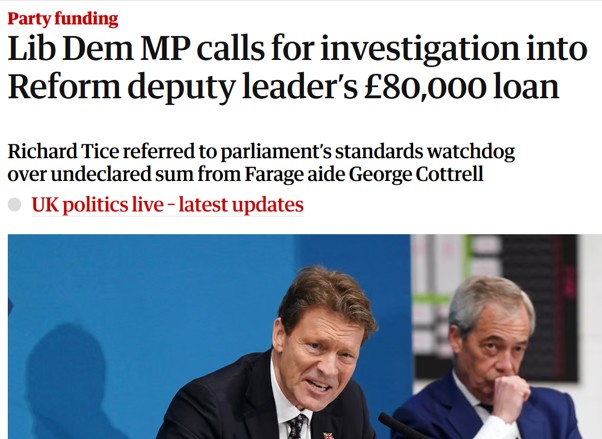
Richard Tice has now been referred to Parliament’s standards watchdog over an undeclared £78,100 loan from George Cottrell.
If the commissioner opens an investigation and a serious breach is ultimately found, Reform could face yet another by-election.
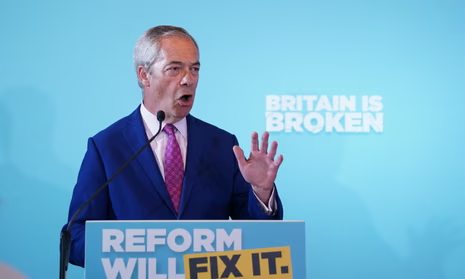
Left: Nigel Farage complaining about Andy Burnham's social care initiative
Right: The Guardian, "Farage’s £5m gift came after saying he needed ‘a million a year’ to stand as MP"
Matt Frei, "Once again, the enthusiasm, the optimism, the engagement"
"Andy Burnham gives good vibes"
"Today it's about social care"
"The issue that every one of our last seven prime ministers has promised and failed to solve"
Andy Burnham, "We're all going to have to give and take if we're going to get to a solution"
"We're all going to have to listen to each other, something we don't do particularly well in politics"
"We're going to have to find common ground here if this is to be a lasting solution"
"Hope a new social consensus emerges about social care"
EXCL: George Cottrell transferred $2m to his mother days before her donations to Reform UK.
Sources say Fiona Cottrell told bankers the transfers, received 24-72 hours before her donations to the party, came from her son.
Another important scoop from @Annaisaac
https://t.co/K8k8D2jqSN
Jolly decent of Richard Tice to keep the Parliamentary Standards Commissioner busy with another case of dodgy dealings while his investigation into my own dodgy dealings is on hold until after the by-election.
The Cap Ferret fire outside Bordeaux was started by a broken down van that caught fire on the hard shoulder.
The only cunt here is you.
And I can smell the yeast infection from here.
John Fetterman: “I don't know why your network’s so pro-Hamas.”
@prem_thakker: “I’m asking you about American public opinion, senator.”
Watch Senator John Fetterman crash out on our political reporter and label our newsroom as ‘pro-Hamas.’
What's eating away at Reform?
It's not one scandal. It's not one poll. It seems to be that voters are beginning to ask a different question.
For the past few years, Reform's political success has rested on a simple and often misleading proposition. That Britain is broken, the establishment has failed and only they can shake the system up.
That is a good message when people are frustrated with the status quo. But there comes a point in every protest movement when voters stop asking, "What's gone wrong?" and start asking, "What would you actually do instead?"
Those are two very different political tests. Reform are beginning to encounter that transition. Questions about donations, transparency and standards matter not simply because of the allegations themselves, but because they undermine one of Reform's biggest political claims. The claim that they represent a a clean break from the way politics has traditionally been done.
At the same time, the level of scrutiny has changed. It is one thing to make uncompromising arguments as a protest movement. It is another to convince people you are ready to run the Treasury, negotiate with allies, manage the NHS and make difficult trade-offs on tax, spending and public services. Their complete lack of delivery at a council level where they have power has amplified this.
Every answer creates new questions. Every promise demands a plan. Every slogan eventually meets reality.
That doesn't mean Reform's support will disappear or that Labour and Conservatives will see a two party system where they competed for office. The frustrations that fuelled their popularity are still very real. Immigration, economic stagnation, declining trust in institutions and pressure on public services have not suddenly gone away.
But political momentum is a fragile thing. The closer a party moves towards government, the less voters reward anger and division and the more they look for competence, consistency and credibility.
That is why this may well be a turning point for Reform.
They no longer can just try and persuade people that Britain is broken. Most voters already believe the country faces profound challenges. Its task now is much harder. It has to persuade people it knows how to put Britain back together.
Winning the argument about what's wrong with Britain is how you become a protest movement. Winning the argument about how to govern it is how you become a government. Reform are discovering those are two very different things.