TSMC’s 4th quarter investors' conference was a treasure trove of information about the company and its prospects for 2024.
Key takeaways: 1/15 $TSM #semiconductors#semiconductor
$ASML CEO: "The semiconductor industry continues to work through the bottom of the cycle. Although our customers are still not certain about the shape of the semiconductor market recovery this year, there are some positive signs. Industry endmarket inventory levels continue to improve and litho tool utilization levels are beginning to show improvement. Our strong order intake in the fourth quarter clearly supports future demand"
This will blow your mind about market timing!
99% of what you hear about stocks is market timing: will the market go up or down? But that's noise. To demonstrate my point, here is a little story backed by evidence.
Imagine 5 investors. Each invests for two decades, allocating $2,000 annually, totaling $40,000 over 20 years. Here are the 5 different strategies they adopted:
1. Mr. Perfect Timing: He always invests the $2,000 perfectly at the 52-week low, every single year.
2. Ms. Lump-Sum Strategy: She invests immediately upon receiving the money.
3. Mrs. Dollar-Cost Averaging: She divides the $2,000 into 12 equal parts, investing at the start of every month.
4. Mr. Unfortunate Timing: He is so unlucky that he pours in the money at the peak of each year.
5. Ms. Safety First: She retains the money in Treasury Bonds.
The result after 20 years can be seen in the graph, 1 to 5 from left to right.
Despite the differences, being in the stock market outperforms any other option by a considerable margin.
Pouring it all in right away performs only 11% less after 20 years of investing versus a completely utopian scenario of investing at the very bottom each year. Dollar-cost averaging is a very close third, with a difference of just 0.46%.
Shocked?😳
Even our "Unfortunate Timer," who always entered at the market peak, got impressive results. 💪
This proves that if you're not in the stock market, you leave money on the table over the long run.
Maybe you think: "But now T-Bonds have a higher yield. This is just recency bias after the Great Financial Crisis!"
Wrong.
The study used 76 rolling 20-year periods beginning in 1926 (1926-1945, 1927-1946, and so on).
In 66 of the 76 periods, the rankings were exactly the same as in the chart.
A vital piece of this puzzle? None of these investors sold, amplifying the power of holding.
That's why the bad market timing still does so well. In reality, people often sell at the bottom and buy again closer to the top.
If you're a long-term investor, remember that obsessing over market timing is futile. The real danger lurks in staying cash-heavy for extended periods, setting the stage for underwhelming performance.
In conclusion, the best strategy is simpler than you think:
JUST
STAY
INVESTED
Embrace the market's ups📈and downs 📉, and given the right horizon, your investments will do well.
In short:
Invest
Hold
Result? Guaranteed.
P.S. if you find this insightful, feel free to repost. ♻
With the semiconductor industry cycle recovery around the corner, we decided to examine analysts' expectations for 2024.
Here are next year's consensus estimates and multiples for 15 of the most important semi names 🧵
1. $NVDA's brutal momentum is expected to continue:
My Top 10 Bold AI Predictions for 2024
1. LLMs Commoditization Bogey: Intense rivalry among Claude3, Gemini, and @OpenAI will spark debates on LLM commoditization. Investors will question the implications on cloud market shares: "Can $Azure maintain its lead on AI?"
2. GPUs No Longer the Bottleneck: Industry bottlenecks shift from GPUs to data center infra (power transformers $ETN @SchneiderElec, cooling devices) and power supply!
3. Training-as-a-Service Boom: Large (non-tech) enterprises will increasingly outsource training and fine-tuning to clouds and LLMs, creating a new revenue stream for the model layer.
4. LLMs as Model Stores: Instead of just GPT3.5 or GPT4, you'll be able to choose from a variety of off-the-shelf models (even be open-sourced) tailored to your specific needs.
5. Super-Sized, Better, and Cheaper Models: Anticipate LLMs reaching 100 exaFLOPS with multi-trillions of parameters, and another 10-20x reduction in inference costs. Multi-modality and longer context windows become table stakes. The best LLMs will handle complex system prompts and integrate retrieval into their offerings.
6. Cost Cutting Before AI Revenue: 2024 will be the year of enterprises' cost cutting (think: AI customer services!). Enterprises will FIRST see cost-cutting BEFORE realizing any significant incremental revenue.
7. Cybersecurity's AI Battle: AI-generated frauds necessitating advanced, real-time AI cybersecurity solutions.
8. Healthcare AI's Breakthrough Year: Major advancements across all sub-sectors. Digital Health (which was put in the 'shitco' basket) becomes hot again (and highly profitable)!
9. Voice-First Apps & Devices Take Center Stage: 2024 will be the year of AI Assistants, with the emergence of innovative devices (pins, glasses, accessories?) completely revolutionizing the way we interact with the digital world.
10. $AAPL's AI Strikebacks: Launch of the 'AI phone' and potential acquisition of a model layer company (SLM?), marking a new smartphone era.
A Bonus Prediction:
Architecture Beyond Transformers: Watch for more discussions (and potential breakthroughs at $Google or $META?) about new AI architectures. The current scaling of LLMs is becoming more and more unsustainable due to the model's intrinsic data inefficiency issues...
New era for the sports industry
It's time for folks to really start looking at how spatial computing will change sports for ever.
What used to cost millions and take weeks, can now happen in real-time and cost close to nothing.
🧵 A thread
4MASS S.A. (4MASS.WA) 🇵🇱
Polish insider-owned nano cap producer of hybrid nail polish, skin & face care and professional cosmetic products with 2 moats, selling for less than 60% of value, p/e of 10.1 and EV/EBIT of 4.8.
My new deep dive:
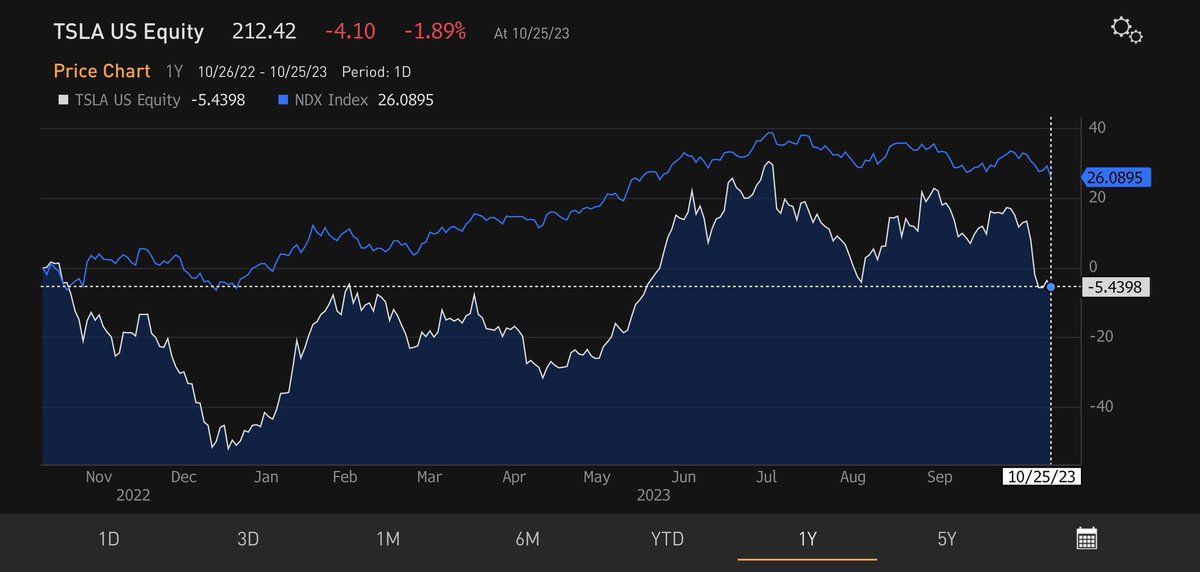
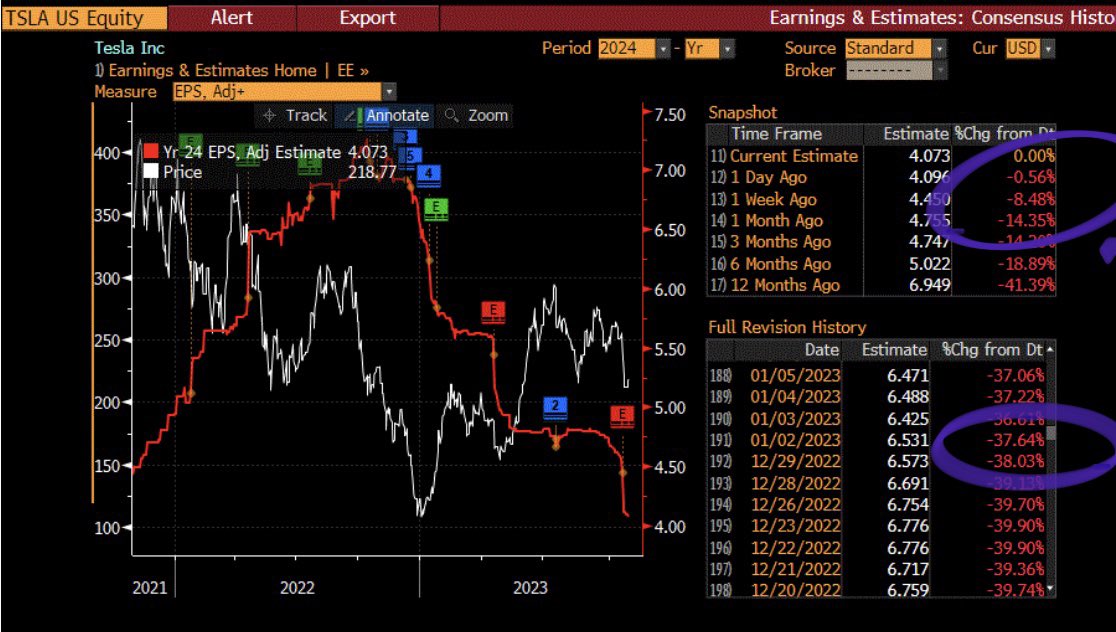
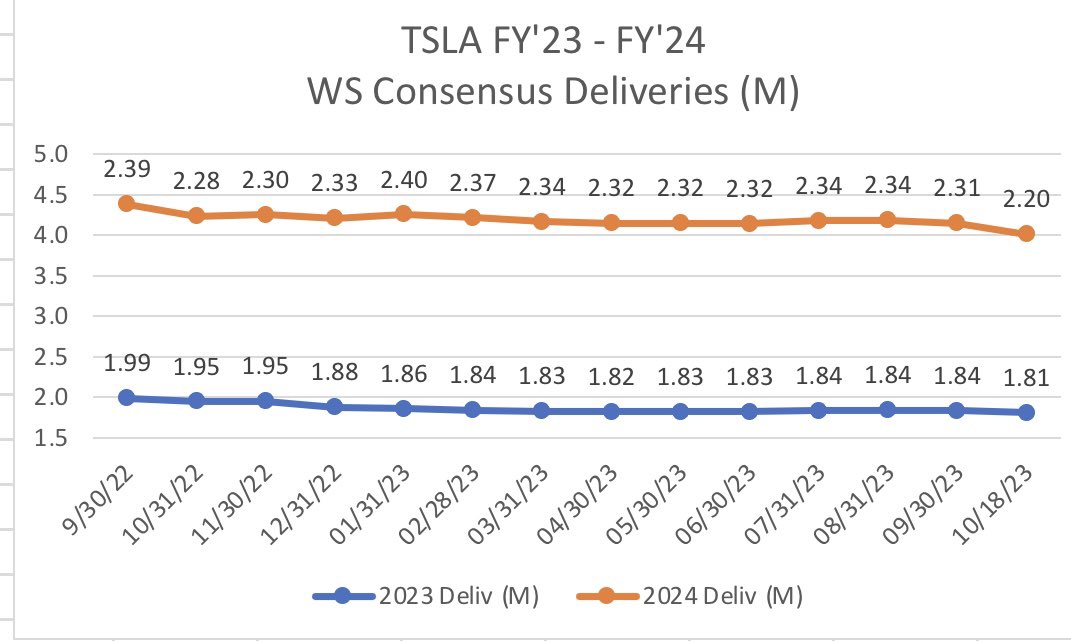
Many $TSLA bulls are in denial about the efficacy of TSLA price cuts. FY’23 and FY’24 volume ests have actually fallen 8-10% over the past year while FY’23 and FY’24 Adj eps est are down 35-40%. Many bulls argue that $TSLA stock up +72% YTD (vs NDX+31%) but that’s the wrong time period to use, since price cuts started in China in 4Q and the market always looks forward. Over the past year, $TSLA stock -5% vs NDX +26%. Facts matter.
BREAKING: Oil giant bp to buy $100 million of Superchargers from Tesla.
As early as 2024, Tesla chargers will be installed across the bp pulse network, including at key bp, Amoco, ampm; and Thorntons-branded sites, TravelCenters of America locations and at bp pulse’s large-scale Gigahub™ charging sites, near airports and in major metropolitan areas across the US.
$GOOGL Cloud quarterly revenue & growth rates.
Much faster deceleration than expected.
Management also didn't provide much confidence on stabilization, especially compared to the $MSFT earnings call.
Google Cloud is still a great business, growing at 20+% a year.
I'm not selling any shares, but I'll be conservative with any GCP projections until we see signs of stabilization.
$PYPL vs. $ADYEY | New article out from Forbes this AM that @BWGStrategy contributed some thoughts to.
Last year PayPal slashed its prices in its payment services business in an attempt to fend off Dutch giant Ayden and other encroaching competitors. The strategy is working, but at what cost?
Consumers rarely even think about who processes their payments at checkout. Whether it's being handled in the back offices of a traditional bank like JPMorgan or by a fintech like PayPal or Stripe, it merely needs to be fast, and hassle free. However, behind the scenes there is a battle underway to control ‘buy now’ technology. Last year e-commerce sales in the U.S. alone surpassed $1 trillion, from which billions in revenues and profits flowed to dozens of firms vying to be at the center of the transactions.
Among processors PayPal, with $27.5 billion in 2022 revenues, is an industry giant. In September, its new CEO Alex Chriss, 46, took the reins, inheriting a company that has embraced a risky low price strategy, similar to Dell’s approach to selling IBM PC clones in the 1990s. Last year, the San Jose company began cutting the cost of payment services it offers under its Braintree brand, a white-label service that lets companies small and large accept debit cards, credit cards and other payment methods from consumers. Research firm MoffetNathanson estimates that Braintree revenue jumped to $8.4 billion in 2022 from $6.2 billion in 2021, making up roughly 30% of PayPal’s total net revenue. Braintree is now growing faster than other parts of PayPal and unbranded transactions, which are mostly driven by Braintree, jumped 40% in 2022. PayPal’s branded business, when consumers click on the yellow PayPal button, grew only 5% in 2022.
“PayPal was doing something to juice that growth and it was likely giving it up on pricing,” says Chris Donat, fintech and payments research lead for BWG Strategy.
PayPal is making a land-grab play in North America to gain market share over close competitors including Dutch processor Adyen and fintech darling Stripe, analysts say. PayPal’s advantage is the broad suite of services it provides including processing, a digital wallet and its flagship branded checkout. It’s trying to reel in merchants by offering lower prices on Braintree services and then bundle them with more profitable features like branded checkout, its credit products or PayPal Payouts, which helps merchants like Uber pay their drivers.
Braintree’s gross profit margin hovered around 28% in 2021 but today thanks to its new low-price strategy it stands closer to 23%, estimates MoffetNathanson. A material drop, but one where the unit is still above breaking even level, says partner and senior analyst Lisa Ellis.
The current low-price strategy was put in place by outgoing CEO Dan Schulman, 65, who took the reins at PayPal just before it broke off from online marketplace eBay in 2015. Three years later, eBay switched to Adyen as its primary payment processor. The move was tantamount to a declaration of war among the fintechs. Schulman, determined to expand PayPal’s footprint, acquired mobile payments upstart iZettle and paid $4 billion for browser-based rewards platform Honey. In the spring of 2022, Schulman began cutting prices on Braintree Services. Schulman, a blockchain booster who allowed PayPal and Venmo customers to transact in crypto and recently launched a PayPal stablecoin, stepped down in September but remains on the company board.
Incoming CEO Chriss joins PayPal after 19 years at Intuit where he led the company's effort to become a leader in selling products like Quickbooks to its vast customer base of small businesses and self-employed entrepreneurs. Prior to Intuit, Chriss founded CollegeWeb which he created while an undergraduate at Tufts University and sold near the peak of the dotcom bubble in 1999.
The payments processing business is one that thrives on tiny percentages. In 2022, PayPal had net revenue of $27.5 billion or 2% of the $1.36 trillion total transaction volume that it processed. Its total revenues include a full suite of fee generating services. Competitor Adyen, more of a pure play in transaction processing, had revenues of $1.4 billion from $815 billion in processed volume, or just 0.17% of its volume. Stripe’s revenues were $3.2 billion from $817 billion in volume or 0.39% percent. Adyen typically caters to the largest global retailers, companies like McDonalds or Spanish apparel manufacturer and retailer Mango. Stripe got its start serving small, digitally native companies but has moved upmarket, and PayPal tends towards middle-market retailers like Casper, Poshmark and Krispy Kreme. The slowdown in e-commerce spending post-pandemic has put pressure on all three companies to maintain the coronavirus-era growth that thrilled investors. In 2020, PayPal and Adyen’s stocks rose 116% and 173%, respectively. This year, they are down 19% and 47%.
Competition among the processors has intensified as Adyen pushes for a larger share of the North American market. Adyen’s strength is adapting to the needs and preferences of different financial institutions around the world to drive high acceptance rates for global retailers. Behemoth retailers often use multiple processors–they may rely on Adyen for international processing and a combination of Braintree, Stripe or others for U.S. business. Adyen is angling to use its international edge as a foothold to expand these relationships and gobble up more U.S. business.
“We started with helping large international customers and US customers going internationally. Over time, we've been able to have success with them domestically,” said Adyen chief financial officer Ethan Tandowsky at Goldman Sachs Communicopia & Technology conference in September.
Braintree’s cut rate pricing seems to have thrown the European firm off its footing. Last month, Adyen reported lackluster earnings, which sent its stock plummeting nearly 40%. Its revenue growth slowed to 21% year-over-year, down from 37% the year before. Pieter van der Does, the company’s co-founder and CEO, attributed the slowdown to higher interest rates driving customers to cheaper processing alternatives. He added that the company plans to hold its prices steady. “We could join the price fight. We don't think that's the right strategy,” he said.
The risk PayPal runs by cutting processing fees is triggering a race to the bottom. If all three companies chose to cut prices, they would all take hits to their bottom line, though that could have less of an impact on PayPal given its wider suite of products available for cross-selling. Another risk for Chriss is that clients only buy Braintree services and don’t tack on any other PayPal products. “It's working in terms of they are gaining share with Braintree,” says Ellis. “But we haven't seen evidence that it's actually accelerating sales of the other products.”
PayPal’s other pressure point is increasing competition on branded one-click checkout, when consumers can choose from a growing list of buttons such as PayPal, buy-now, pay-later services and Apple Pay. Apple Pay has become a formidable competitor: Apple Pay users grew from 507 million globally in 2020 to over 700 million in 2022. In April, PayPal added Apple Pay as a payment option for its checkout product for small-to-medium sized businesses, likely bowing to merchant demand.
PayPal has long been an aggressive competitor on the branded side of e-commerce payment processing. On October 5, a class action lawsuit filed on behalf of consumers argues that the giant San Jose, CA-based company has adopted anticompetitive practices to prevent merchants from directing customers to potentially lower-cost checkout buttons. While PayPal has cut prices on enterprise processing, the company charges among the highest industry fees for the branded one-click checkout business at 3.49% per online transaction. Online merchants are typically willing to pay up to access PayPal’s 400 million consumer clients. However, in order to accept PayPal, merchants must sign an agreement banning them from offering price discounts to direct customers to another checkout button that may be less expensive, the lawsuit alleges.
The lawsuit against PayPal is similar to the 2010 antitrust suit brought by the Department of Justice against Visa and Mastercard. In the settlement agreement, Visa and Mastercard allowed merchants to offer discounts to consumers if they used cheaper forms of payment.
"PayPal continues to put our customers first in everything that we do, and we take this responsibility seriously,” says a PayPal spokesperson via email in response to the class action suit. “We are reviewing the filing and have no further information to share at this time."
Competitive pressures from alternative payment options like Apple Pay have forced PayPal to hunker down for a two-front war on both the branded and unbranded sides of the payments business in an effort to maintain its position at the top of the industry.
One of the fiercest battlegrounds for PayPal, Adyen and Stripe is over the processing volume from so-called platform businesses like Shopify, eBay, Etsy or Ticketmaster. These companies are marketplaces helping a host of smaller businesses sell to their own customers. PayPal calls its PayPal Complete Payments, a checkout product for small-to-medium sized businesses and platforms, a strategic priority. Similarly, Adyen heavily promotes its Adyen for Platforms product. Stripe also serves platform clients, counting Shopify as one of its largest customers.
“It's that set of literally around 25 customers that drive huge volumes that all three of these players have decided in the last few years that they want to serve,” Ellis says. “That specific segment is viciously competitive.”
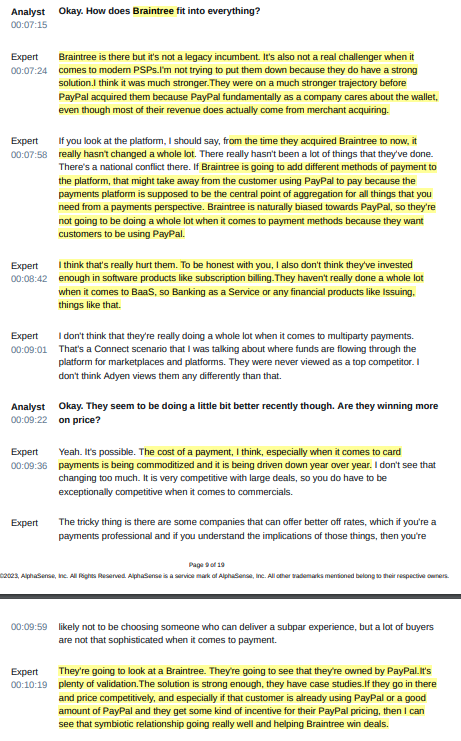
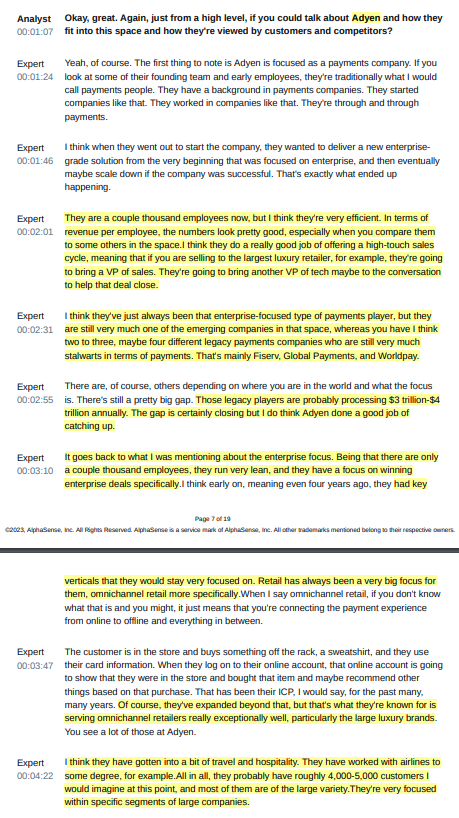
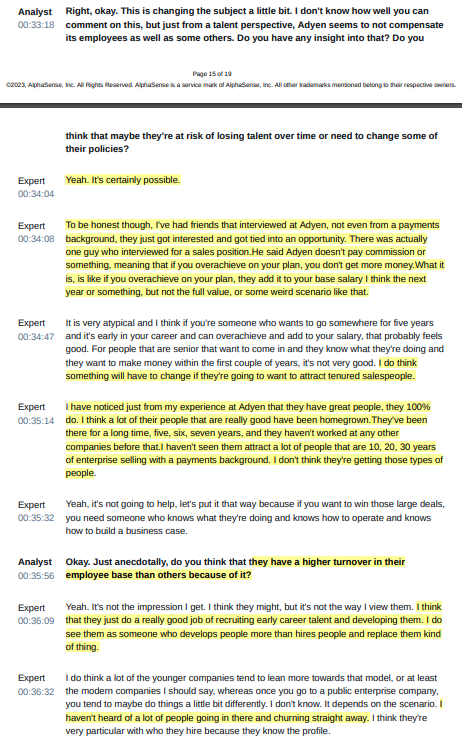
A really great interview from a current Account Executive at Stripe. Talking about $ADYEY and $PYPL. Must read for Fintech investors:
- In his opinion, $ADYEY is very efficient and good at high touch sales cycle, especially with enterprises and, more specifically, with omnichannel retail (luxury brands)
- Thinks Braintree had a better trajectory before $PYPL acquired them. Thinks $PYPL 's over-focus on its wallet business is hurting Braintree prospects.
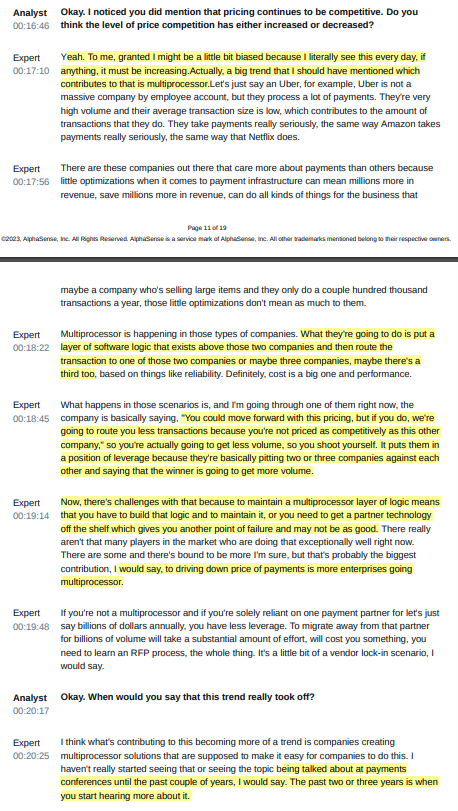
- The cost of card payments is being commoditized. Also, price competition is increasing. A big trend that contributes to the pricing pressure is multiprocessors. Big companies that have high-frequency small payments are pitting two or three companies in the payment space to compete with each other.
- Shares his view on $ADYEY 's compensation strategy for its employees. Thinks $ADYEY is more focused on growing young talent from the ground up than focusing on getting seasoned talent with a different comp structure.
I keep a list of quotes on a piece of paper taped to my wall.
These iconic quotes shape how I invest every day.
They keep me focused. They keep my hungry. They keep me humble.
Here they are. 🧵
1. "He who lives by the crystal ball will eat shattered glass." -- Ray Dalio
As you know by now, we *love* charts.
Today, we want to share 10 of our favorite EPS and dividend growth charts – all found using our Web App slide search engine 🧵👇
1. British serial acquirer $DPLM has compounded its EPS at 15% for 15-years: