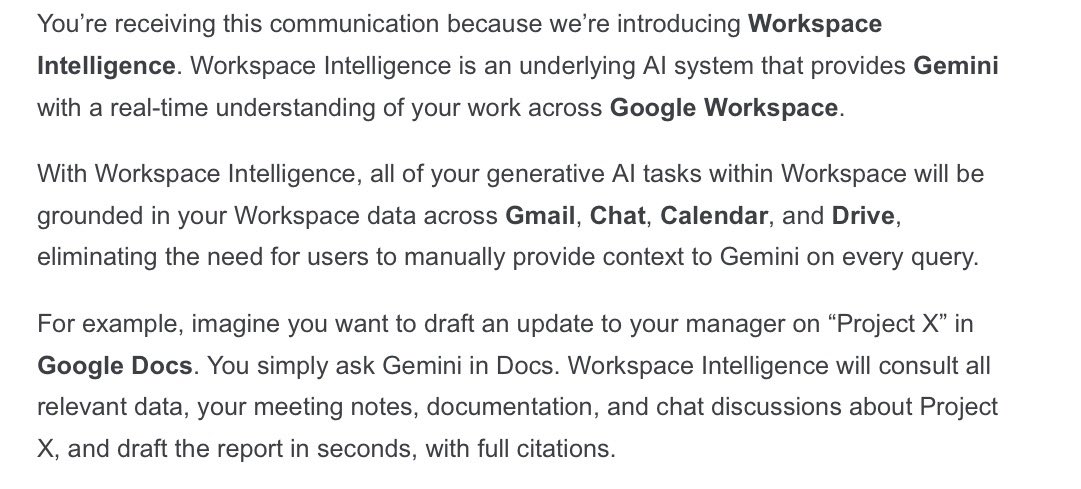
Gemini is apparently getting full access to all user and organization data in Google Workspaces.
Just saw this email from Google in my inbox.
Would be exciting if it worked well.
Tips for increasing IQ, based on the latest science:
- If you’re planning to get a PhD in comms, switch to astrophysics (causes much higher IQ)
- If you like working with your hands, become a neurosurgeon instead of plumber
- Get a higher-paying job (lots of data on higher earners consistently have higher IQ)
- If you’re really optimizing for IQ, consider winning a Nobel Prize.
claude code + opus 4.5 injected the immaculate hacker vibes back into ai that we haven’t had since gpt-4.
everything is new + fun + weird again.
you can feel it.
another oom of new ideas & latent economic value is waiting to be unlocked.
and building has never been this fun.
Excited to release new repo: nanochat!
(it's among the most unhinged I've written).
Unlike my earlier similar repo nanoGPT which only covered pretraining, nanochat is a minimal, from scratch, full-stack training/inference pipeline of a simple ChatGPT clone in a single, dependency-minimal codebase. You boot up a cloud GPU box, run a single script and in as little as 4 hours later you can talk to your own LLM in a ChatGPT-like web UI.
It weighs ~8,000 lines of imo quite clean code to:
- Train the tokenizer using a new Rust implementation
- Pretrain a Transformer LLM on FineWeb, evaluate CORE score across a number of metrics
- Midtrain on user-assistant conversations from SmolTalk, multiple choice questions, tool use.
- SFT, evaluate the chat model on world knowledge multiple choice (ARC-E/C, MMLU), math (GSM8K), code (HumanEval)
- RL the model optionally on GSM8K with "GRPO"
- Efficient inference the model in an Engine with KV cache, simple prefill/decode, tool use (Python interpreter in a lightweight sandbox), talk to it over CLI or ChatGPT-like WebUI.
- Write a single markdown report card, summarizing and gamifying the whole thing.
Even for as low as ~$100 in cost (~4 hours on an 8XH100 node), you can train a little ChatGPT clone that you can kind of talk to, and which can write stories/poems, answer simple questions. About ~12 hours surpasses GPT-2 CORE metric. As you further scale up towards ~$1000 (~41.6 hours of training), it quickly becomes a lot more coherent and can solve simple math/code problems and take multiple choice tests. E.g. a depth 30 model trained for 24 hours (this is about equal to FLOPs of GPT-3 Small 125M and 1/1000th of GPT-3) gets into 40s on MMLU and 70s on ARC-Easy, 20s on GSM8K, etc.
My goal is to get the full "strong baseline" stack into one cohesive, minimal, readable, hackable, maximally forkable repo. nanochat will be the capstone project of LLM101n (which is still being developed). I think it also has potential to grow into a research harness, or a benchmark, similar to nanoGPT before it. It is by no means finished, tuned or optimized (actually I think there's likely quite a bit of low-hanging fruit), but I think it's at a place where the overall skeleton is ok enough that it can go up on GitHub where all the parts of it can be improved.
Link to repo and a detailed walkthrough of the nanochat speedrun is in the reply.
Check out our work on the structure of financial equity research reports. We show that the authoring of these reports has high automation potential, with only about 25% of their content requiring human input.
We have a new blog post from @JanSpoerer on our blog!
It's about #finance and #ai. He has analysed equity reports using #llama and #GPT. 📈
Link is in the comments 🔗
New blog post by @AmanGokrani:
Everyone says Claude Code "just works" like magic.
He proxied its API calls to see what's happening.
The secret? It's riddled with <system-reminder> tags that never let it forget what it's doing.
(1/6)
[🔗 link in final post with system prompt]
Thanks, I’ll try this out tomorrow (as an MCP server). Do you plan adding a feature that allows agents to inject secrets (passwords) into password fields without the API provider (OpenAI et al.) seeing what is injected? As a tool for the agent to call, where the agent can specify the name of the env variable containing the secret, but will not see the actual value)?
Claude introspecting and improving a MCP that it is currently using.
Building AI agents now really feels like AI is coming full circle. Tool development can feel like such a breeze.
🤯 BREAKING: Manus AI created its own open-source alternative. In 25 min, it built a complete AI agent system from scratch!
ANUS (Autonomous Networked Utility System)—@eugeneshilow's brilliant idea
Why pay $20K for invites when it can be free?
#Manus#ManusAI#Cursor
I wondered how many GPUs we would still need if everybody started using ChatGPT.
Turns out that we need 10x more compute than we have already installed.
That's ~12m more NVIDIA Blackwell GPUs.
Check out the Google Sheet with the calculation.
https://t.co/IZsZrZd8E2





![vitransformer's tweet photo. New blog post by @AmanGokrani:
Everyone says Claude Code "just works" like magic.
He proxied its API calls to see what's happening.
The secret? It's riddled with <system-reminder> tags that never let it forget what it's doing.
(1/6)
[🔗 link in final post with system prompt] https://t.co/Ne3X4DivzS](https://pbs.twimg.com/media/Gyyxk3hawAEa5cv.jpg)





