Late 2020s going to be full of breakthroughs communicated as tweets like “lol fine tuned SlopCoder-V7 and it proved P=NP” with a link to fully correct alien math
Thomas Swalla sold Dotmatics to Siemens for $5.1 billion.
Now he and Jared Rosen (10+ years at Insight Partners) are building IO Capital - the first AI-native growth equity firm.
And they just chose @hanoverpark as their fund admin and financial infrastructure.
"If we're going to operate agent-first, our infrastructure has to match. We made a deliberate choice to align IO with partners who share our conviction that AI-native software compounds value. Hanover Park didn't bolt AI onto a legacy platform - they built it from scratch.”
A firm whose investment workflow runs on agents can't run its back/middle office on data silos and manual reconciliation.
Our philosophy: AI prepares. Expert accountants review.
One vertically integrated system of record across fund admin, portfolio intelligence and the LP experience.
Agent-first investment firms will be the ones that survive and thrive in this new era.
Proud to power IO Capital.
"In a world that will become saturated with AI communication, the human touch will matter more than anything to customers. This is a bottleneck that you shouldn't replace - even when agents are high enough quality to do video meetings. One-on-one meeting time with customers is something that shouldn't be automated. The systems around the meetings should be - so that front-liners spend nearly 100% of their time with customers."
Today we reduced headcount by 22%. The business is the strongest it's ever been. So I think it's important to be direct about what I'm seeing and why.
First, I made this decision and I own it. I did it because the way to operate at the highest level of productivity is changing, and to win the future, ClickUp needs to change with it.
Second, this wasn't about cutting costs. Most savings from this change will flow directly back into the people who stay. We'll be introducing million-dollar salary bands. If you create outsized impact using AI, you'll be paid outside of traditional bands.
Most importantly, I have the deepest gratitude for those affected. We're doing this from a position of strength specifically so we can take care of people properly. Everyone affected receives a package aimed at honoring their contributions and easing the transition.
I only see two options: wait for this to play out gradually in the market or be honest about what I'm seeing and act proactively.
THE 100X ORGANIZATION
The primary change is that we're restructuring around what I call 100x org. The goal is 100x output. The roles required to build at the highest level are fundamentally different than they were a year ago.
Incremental improvements to existing systems won't get us there. We need new ones. That means creating enough disruption to rebuild rather than iterate on what's already broken.
The common narrative is that AI makes everyone more productive. It doesn't. Many of the workflows of today, if left unchanged, create bottlenecks in AI systems.
These roles will evolve. But waiting for that to happen naturally means falling behind now.
The 100x org is actually heavily dependent on people - infinitely more than today. This is only possible with 10x people that have embraced and adopted new ways of working.
THE BUILDERS, AGENT MANAGERS, AND FRONT-LINERS
— THE BUILDERS: 10X ENGINEERS
I don't think most companies have internalized what's actually happening with AI in engineering. The common narrative is that AI makes all engineers more productive. That may be true in isolation, but at an organization level - that is the farthest thing from reality.
Here's what we've validated recently at ClickUp: the great engineers, the ones who can orchestrate, architect, and review, are becoming 100x engineers. They're not writing code. They're directing agents that write code. The skill is judgment.
AI makes the best engineers wildly more productive, and everyone else using AI slows these engineers down.
Think about it - the bottlenecks are (1) orchestration - telling AI what to do, and (2) reviewing - what AI did. Everything is leapfrogged and no longer needed.
So who do you want orchestrating and reviewing code?
And how do you want your best engineers to spend their time?
If your best engineers are spending time reviewing other people's code, then this is inherently an inefficient bottleneck. These engineers can review their agent's code much faster than reviewing human code.
The new world is about enabling your 10x engineers to become 100x.
The wrong strategy is to push every engineer to use infinite tokens. Companies doing this are celebrating 500% more pull requests. But customer outcomes don't match the volume of code being generated.
I call this the great reckoning of AI coding, and every company will face this soon if not already.
More code is just another bottleneck to the best engineers, and ultimately to your company's impact as well.
— THE BUILDERS: 10X PRODUCT MANAGERS
Product management and design roles are merging.
Designers that have customer focus, become more like product managers.
And product managers that have intuition for UX become more like designers.
The bottleneck of user research is gone. It takes us just one mention of an agent to kickoff research and analyze results.
The bottleneck of product <> design iteration is also gone. The product builder iterates on their own, along with agents and skills that ensure alignment with quality and strategy.
Also controversial today - I believe that the wrong strategy is to have your PMs shipping code - that just introduces another bottleneck that the best engineers will waste their time on.
To be clear, PMs should be coding but they should do this in a playground to iterate, validate, and scope. That code should not go to production.
Everything outside of managing systems, orchestrating AI, and reviewing output becomes a bottleneck.
That's why the other roles that are critical along with these are the systems managers (to reduce bottlenecks) along with a bottleneck you can't replace - customer meeting time.
— THE SYSTEM MANAGERS
Ironically, the people that automate their jobs with AI will always have a job. They become owners of the AI systems - agent managers. We have many examples of these people at ClickUp.
The underlying systems in which we operate are absolutely critical to get right. I think most companies are delusional to think they can iterate on existing systems and compete in this new world.
You must create enough disruption so that old systems are deprecated entirely. If there's any definition for 'AI native' that's what it is.
— THE FRONT-LINERS
In a world that will become saturated with AI communication, the human touch will matter more than anything to customers.
This is a bottleneck that you shouldn't replace - even when agents are high enough quality to do video meetings.
One-on-one meeting time with customers is something that shouldn't be automated. The systems around the meetings should be - so that front-liners spend nearly 100% of their time with customers.
REWARDING 100X IMPACT
In a world where companies are able to do so much more with less, where does that excess money go?
In our case, much of the savings in this new operating model will flow directly back to those that enabled it.
We must reward people that create productivity accordingly. This aligns incentives on both sides. Plus, in a world where your best people create 100x impact, you can't afford to lose them.
You should aim to retain these employees for decades. The context they have and their ability to efficiently orchestrate and review will be nearly impossible to replace.
Compensation bands of today should be thrown out the door. We're introducing $1 million cash/year salary bands with a path available to nearly everyone in the company if they produce 100x impact by creating or managing AI systems.
THE FUTURE
Nearly every company will make changes like these. The ones that do it proactively will define what comes next.
The future is not fewer people. It's different work, new roles, and better rewards for those who embrace it. We're already seeing entirely new roles emerge, like Agent Managers, that didn't exist a year ago.
ClickUp is positioning to lead this shift, not just internally, but for our customers too. I've never been more certain about where we're headed.
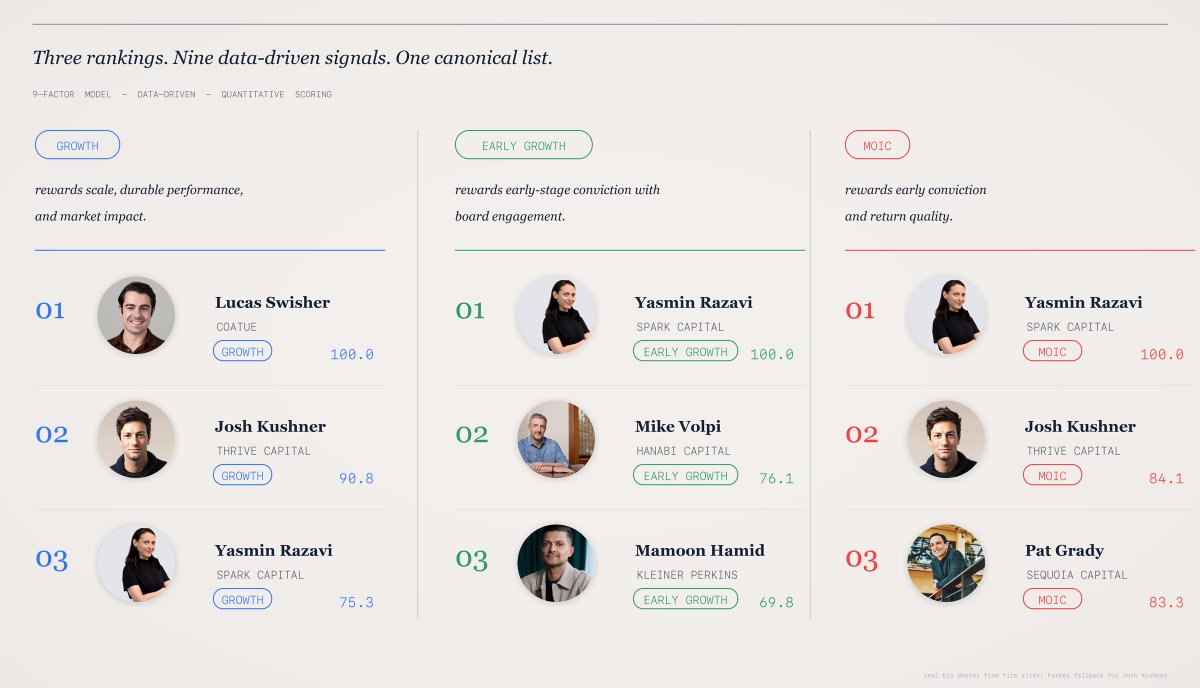
The Nucleus 100 Growth Rankings are live.
6 months of research. 250+ rounds. 94 companies. Every company in the universe raised its first growth round in 2016+ and reached $5bn+
We landed on three flavors: Growth, Early Growth, and MOIC, our best swing at money-on-money. Entry matters. Price matters. Allocation matters.
Lucas Swisher from Coatue took the top spot for Growth, and it tracks. Deel, OpenEvidence, Anthropic, OpenAI, Rippling, Figma, Harvey, and too many more to tag.
Hats off @LucasSwisher1. Monster run.
Yasmin Razavi from Spark landed #1 in Early Growth and MOIC.
Deel at the B and Anthropic at the C are ridiculous standalone calls. Led both, joined the board on both, and that is how you end up at the top of the list.
Bravo @YasminRazavi. Very, very good at investing.
And if you hate the weights, great news.
@reidschryer built the “fine, do it yourself” tool.
Our data, your weighting.
Have fun :)
https://t.co/BIqabY4SQk
I am so fricking bored of guests that go on 10 podcasts and say the same frameworks again and again.
Coatue manages $30BN on the private side. Their growth fund is $7BN. They have investments in Revolut, Anthropic, OpenEvidence, Canva and more.
And yet, the Co-Head of Coatue, Lucas Swisher, never does podcasts.
That changes today. @LucasSwisher1👇
Spotify 👉 https://t.co/qhscYeeeVp
Youtube 👉 https://t.co/sKcHpm5AkC
Apple Podcasts 👉 https://t.co/NypI9ohX9j
Timestamps:
00:00 Intro
01:04 Why Public SaaS Is Getting Crushed in the AI Wave
07:35 Durability of Revenue in AI
15:28 Market Size vs Founder Quality: What Wins?
16:52 Why Price is the Last Thing to Matter
23:32 Mega-Funds Math: Can $5B+ Funds Still Generate Venture Returns?
27:01 What Returns Are 'Enough'? Why 3x Isn't Exciting at Growth
29:54 When Double-Downs Go Wrong: Overestimating TAM and Multi-Product Expansion
32:37 Margin Matters… But at Scale: AI Gross Margins, Cost Curves & Efficiency
37:11 Why it has never been harder to be a seed investor
40:11 Is 'Kingmaking' a Myth: When Capital Helps (and When It Hurts)
45:23 Is Canva Really a Platform Company? Multi S-Curves and Leaning into AI Early
46:52 Lessons from Mary Meeker
50:08 Lessons from Mamoon Hamid
51:34 LP 'Pick One' Games: Mamoon Hamid, Mary Meeker, Insight Partners
53:40 OpenAI vs Anthropic: Who Wins?
59:17 Most Memorable Founder Meeting
01:01:35 Career Decisions & Misses
The first 15 to 20 minutes of this episode are really quite cogent.
Again, the message is really clear. When you pay up for high growth companies and the growth slows even a little, and the belief goes out of the multiple, you're in for a long, hard haul. And we come back to this, I think, a few times before you can be valued on free cash flow. It's a long journey from the hope and the sizzle of a revenue, a forward revenue multiple and a high growth rate to the steady anchor of, you know, 12 times free cash flow. It's a long and tedious journey. And there's a long, flat period for the stock while that happens.
…
I don't want folks to take this the wrong way, but in some ways, I feel like venture and tech is a bit of a scam. And what I mean by that is that our job is to convert very high revenue multiples into cash almost unnaturally through M&A, through public offerings when they haven't earned it in free cash flow. Our job is to find companies worth 20, 50, 100, 200 times revenue and magically convert that to cash. And when it does, that's how we build 5X or higher funds. And that's how we make money. If we have to go to an EPS world, we're dead.
…
That's why it's very hard to fund an old school SaaS company today, because people are just saying, look, you're great. You're going two to five. You're great. You're a profitable company. And again, this is the thing. There's people who rain down a little bit of VCs who kind of project a little contempt. Oh, your little $100 million revenue thing doesn't matter. I can come across as a little callous. And a fairer statement is this. Your $100 million revenue SaaS company is an awesome entrepreneurial achievement. You are to be hugely congratulated. It's magnificent. It's just not something that we can properly finance, because we're just not going to make a public market venture return here.
The only podcast you have to listen to every week.
No politics. Just tech.
- Sam Altman vs Elon Musk: The $100BN Battle
- The Implosion of Thinking Machines
- Can VC Survive Public Market Pricing Today?
- ClickHouse and Replit's New Rounds: Analysed
Spotify 👉 https://t.co/cCY5fAsFTW
Youtube 👉 https://t.co/xitaWv2CyW
Apple Podcasts 👉 https://t.co/u3TXdGaDZv
My 5 takeaways with @jasonlk and @rodriscoll 👇
Timestamps:
00:00 Intro
00:48 Can VC Survive With Public Market Prices Today
14:01 The Implosion of Thinking Machines
24:32 Elon Musk vs. OpenAI: The Legal Battle
43:25 Can OpenAI Win Ads?
01:01:42 ClickHouse's $15BN Deal: Analysed
01:11:58 Replit's $9BN Deal: Analysed
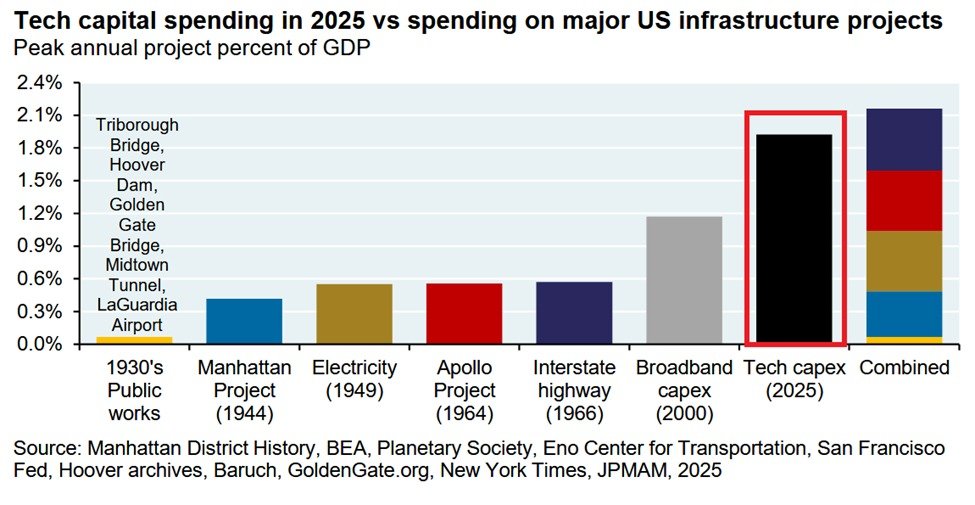
US technology CapEx spend has been massive:
In 2025, tech CapEx as a % of GDP nearly matched the COMBINED scale of the largest capital projects of the 20th century.
This comes as Big Tech CapEx rose to ~1.9% of GDP last year.
By comparison, nationwide broadband development at the beginning of the century made up ~1.2% of GDP.
The rapid expansion of electricity in 1949, the Apollo Moon Landing project, and the Interstate Highway system in the 1960s each represented ~0.6% of GDP.
The Manhattan Project to develop the first atomic weapons in the 1940s totaled ~0.4% of GDP.
The AI investment rush is unprecedented.