My biggest takeaways from Claude Code's Head of Product @_catwu:
1. Anthropic’s product development timelines have gone from six months to one month, sometimes one week, sometimes one day. Part of this acceleration is access to the latest models (i.e. Mythos). Another is shipping new products into “research preview,” making clear it's early, experimental, and might not be supported forever. Another is an evergreen "launch room "where engineers post ready features and marketing turns around announcements the next day.
2. The PM role is shifting from coordinating multi-month roadmaps to enabling teams to ship daily. As Cat puts it, “There should be less emphasis on making sure you are aligning your multi-quarter roadmaps with your partner teams and more emphasis on, OK, how can we figure out the fastest way to get something out the door?”
3. The most efficient shipping unit is an engineer with great product taste. On Cat’s team, many engineers go end-to-end—from seeing user feedback on Twitter to shipping a product by the end of the week—without a PM involved. Also, almost all the PMs on the Claude Code team have either been engineers or ship code themselves, and the designers have been front-end engineers. The roles are merging, and the most valuable skill is product taste, not job title.
4. Build products that are on the edge of working. Claude Code’s code review product failed multiple times because earlier models weren’t accurate enough. But because the prototype was already built, they could swap in Opus 4.5 and 4.6 and immediately test whether the gap was closed. Teams that wait for the model to be ready will always be a cycle behind.
5. The most underrated skill for building AI products is asking the model to introspect on its own mistakes. Cat regularly asks the model why it made an unexpected decision. The model will explain that something in the system prompt was confusing, or that it delegated verification to a subagent that didn’t check its work. This reveals what misled the model so the team can fix the harness.
6. Every model release forces their team to revisit existing products and audit their system prompt to remove features the model no longer needs. Claude Code’s to-do list was a crutch for earlier models that couldn’t track their own work. With Opus 4, the model handles it natively. Features built as scaffolding for weaker models become debt when the model catches up—so the team actively strips them.
7. Anthropic employees build custom internal tools instead of buying SaaS products. A sales team member built a web app that pulls from Salesforce, Gong, and call notes to auto-customize pitch decks—work that used to take 20 to 30 minutes now takes seconds. Their core stack is Claude Code, Cowork, and Slack. No Notion, no Linear, no Figma.
8. People underestimate how much Claude’s personality contributes to its success. As Cat describes it, “When you reflect on everyone you’ve worked with, there’s just some people where you’re like, I really like their energy, their vibe.” Claude is designed to be low-ego, positive, competent, and earnest—qualities that make it feel like a great coworker, not just a tool. This isn’t cosmetic; it’s what makes people want to use Claude for hours every day. The team has a dedicated person, Amanda, who “molds Claude’s character,” and it’s one of the hardest roles at the company because success is so subjective.
9. The future of work is managing fleets of AI agents, not doing the work yourself. Cat sees a clear progression: first, individual tasks become successful. Then people start running multiple tasks at the same time (multi-Clauding). Next, people will run 50 or 100 tasks simultaneously, which will require new infrastructure—remote execution, better interfaces for managing tasks, agents that fully verify their work, and self-improving systems that incorporate feedback. The human role shifts from doing the work to knowing which tasks to look into, verifying outputs, and giving feedback that makes the system better over time.
10. Hire people who lean into chaos and face every challenge with a smile. At Anthropic, there are weeks when a P0 on Sunday becomes a P00 by Monday and a P000 by Monday afternoon. If you get too stressed about any one thing, you’ll burn out. Their team looks for people who can look at a hard challenge and say, “Wow, that’s gonna be hard. But I’m excited to tackle it and I’m gonna do the best that I possibly can.” This mindset—optimism, resilience, and comfort with constant change—is increasingly essential as the pace of AI development accelerates.
Don't miss the full conversation: https://t.co/1wOUHcdYQN
@trq212 Thanks btw, was a very helpful post. Confirmed I wasn't overlooking built in automated context engineering methods (that don't yet exist) but also pointed out mechanics and therefore best practices I hadn't realized.
@trq212@trq212 looking forward to: "Claude will help you handle this itself"
Currently painful manual compaction/clearing, artifact building, and `@` referencing to keep context window usage as low as possible w/in & between sessions w/ 1M window.
This is the change I’ve been waiting for.
Next, I can’t wait (hope for) improved multi agent orchestration with Claude Code.
The dream would be including compatibility with AGENTS.md for Gemini, Codex, and other model driven subagents!
One week into my time at @Anthropic and I have my first feature shipped! 🥳
/powerup is now live in Claude Code - It's an interactive experience with 10 short lessons / demos. Update your CLI (claude update), give it a run, and let me know what you think!
@bcherny@_catwu
Can’t help but think that AI autonomy (lack of human oversight) was true root cause of npm package upload that leaked Claude Code. Despite having an entire system to prevent leaks, it happened to the leading coding AI team in the world. Serious lessons for AI coding teams.
Most people think using Claude Code is about writing better prompts.
It’s not.
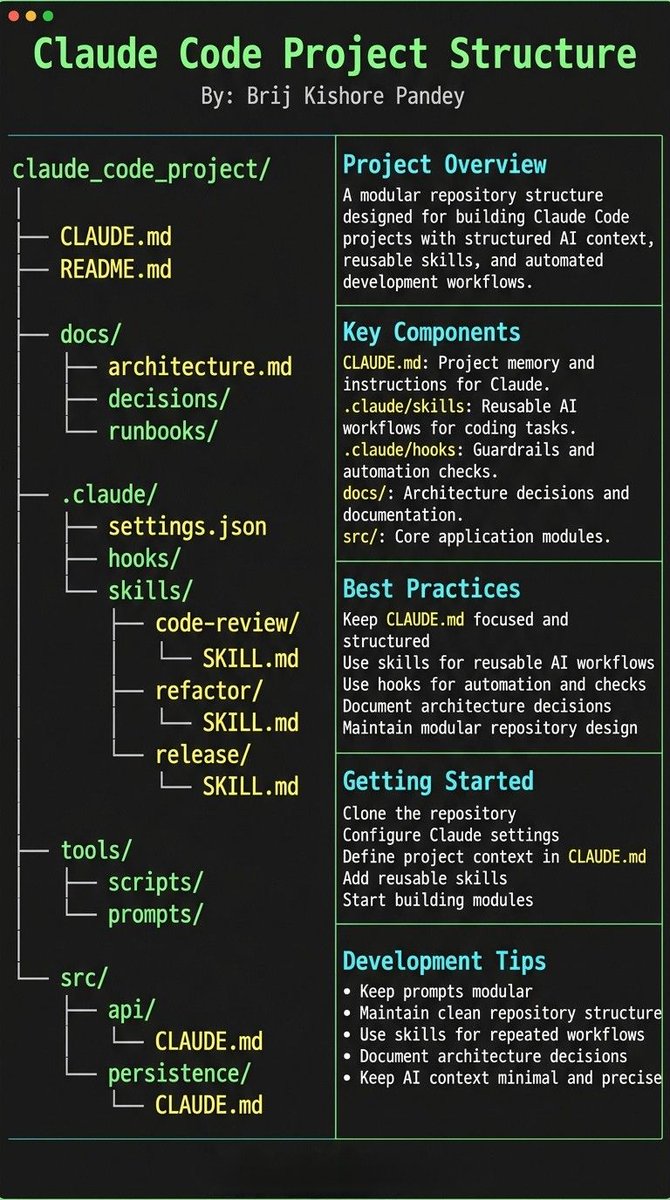
The real unlock is structuring your repository so Claude can think like an engineer.
If your repo is messy, Claude behaves like a chatbot.
If your repo is structured, Claude behaves like a developer living inside your codebase.
Your project only needs 4 things:
• the why → what the system does
• the map → where things live
• the rules → what’s allowed / forbidden
• the workflows → how work gets done
I call this:
The Anatomy of a Claude Code Project 👇
━━━━━━━━━━━━━━━
1️⃣ CLAUDE.md = Repo Memory (Keep it Short)
This file is the north star for Claude.
Not a massive document.
Just three things:
• Purpose → why the system exists
• Repo map → how the project is structured
• Rules + commands → how Claude should operate
If CLAUDE.md becomes too long, the model starts missing critical signals.
Clarity beats size.
━━━━━━━━━━━━━━━
2️⃣ .claude/skills/ = Reusable Expert Modes
Stop repeating instructions in prompts.
Turn common workflows into reusable skills.
Examples:
• code review checklist
• refactoring playbook
• debugging workflow
• release procedures
Now Claude can switch into specialized modes instantly.
Result:
More consistent outputs across sessions and teammates.
━━━━━━━━━━━━━━━
3️⃣ .claude/hooks/ = Guardrails
Models forget.
Hooks don’t.
Use hooks for things that must always happen automatically.
Examples:
• run formatters after edits
• trigger tests after core changes
• block sensitive directories (auth, billing, migrations)
Hooks turn AI workflows into reliable engineering systems.
━━━━━━━━━━━━━━━
4️⃣ docs/ = Progressive Context
Don’t overload prompts with information.
Instead, let Claude navigate your documentation.
Examples:
• architecture overview
• ADRs (engineering decisions)
• operational runbooks
Claude doesn’t need everything in memory.
It just needs to know where truth lives.
━━━━━━━━━━━━━━━
5️⃣ Local CLAUDE.md for Critical Modules
Some areas of your system have hidden complexity.
Add local context files there.
Example:
src/auth/CLAUDE.md
src/persistence/CLAUDE.md
infra/CLAUDE.md
Now Claude understands the danger zones exactly when it works in them.
This dramatically reduces mistakes.
━━━━━━━━━━━━━━━
Here’s the shift most people miss:
Prompting is temporary.
Structure is permanent.
Once your repository is designed for AI:
Claude stops acting like a chatbot...
…and starts behaving like a project-native engineer. 🚀
12 月 22 日に Claude Code Meetup Tokyo を Anthropic さんご支援のもと開催します!
Claude Code の開発者さんとのライブ Q&A の時間も設けています!オフラインのみ!日本で一番 Claude Code の知見共有の集まる場にしましょう!ぜひいらしてください!#aimeetup
https://t.co/baRnLRjIaA
My take: I'm skeptical about managing multiple https://t.co/LzdQEFNcft or other non-branded "knowledge" files across a codebase, especially in teams. How are you handling context/memory management for AI agents? Does this distributed approach scale?