Crazy but true stat of the day:
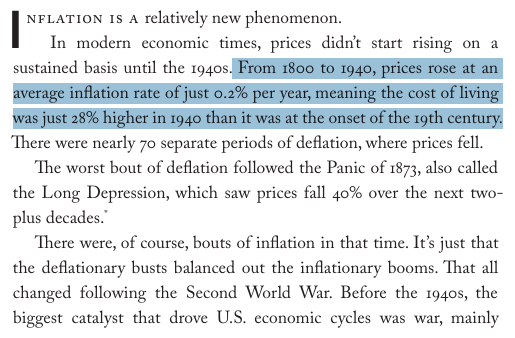
From 1800 to 1940 the annual inflation rate was just 0.2% per year
Prices were just 28% higher in a 140 year time frame
Since 1940 it's 3.7% annually or >2,200% in total
https://t.co/J4QeSCkhrY
Finance does not offer many sure bets. One, for the past few decades, has been that most rich-world sovereign bonds are safe. Today, as public debts mount, that is under threat https://t.co/NW87P3sBJe
We created a model to see just how bad things could get if rich countries had to replace their debt stocks at today’s five-year bond yields. Most governments are nowhere near the primary surplus they would need to keep their debt-to-GDP ratios stable https://t.co/pNZT7p4eiI
This is the earliest known video of Warren Buffett.
He’s 31.
Unknown.
Sitting on a local Omaha station in 1962.
No hype. No predictions. No guru act.Just a young man explaining how markets actually work - before the world decided to listen.Rare footage.
Watch it once.
Scott Bessent’s problem is that the rational pricing of America’s debt, applied to the vast pile of bonds it has issued, makes his interest bill increasingly intolerable. His best option is to slow the pace of borrowing https://t.co/Lpzb6WrwYb
Long-term Treasuries now have a negative total return going back to the start of 2015
It's more than a lost decade for long bonds (and even worse after inflation)
The thing that gets sold hardest to people with money:
Complexity.
Hedge funds. Private equity. Structured notes.
Having more money doesn't mean you need more moving complexity in your portfolio.
It means more people have a reason to sell them to you.
Saw @JoeCarlasare on a podcast saying that financial advisors are adding 2-3% allocation of bitcoin because it now makes sense “from a portfolio construction standpoint.”
So I tested it across 100,000 portfolios using stocks, bonds, gold, and Bitcoin over the last five years.
Using the Markowitz mean-variance framework that underpins modern portfolio theory, Bitcoin added no improvement to the portfolio opportunity set.
The optimizer wanted only about 1–2% Bitcoin in the max-Sharpe portfolio and effectively 0% in the minimum-variance portfolio.
If Bitcoin is now a "portfolio construction" asset, the standard finance framework is not showing it.
My forthcoming book, The Investing Mind, is an extended version of this report. Check it out and don't forget to roll a snowball while you're visiting the site! https://t.co/msnGdLrUjw
Bessent's (and John's) theory rests on the presumption that Treasury knows better than the market where interest rates are headed. By contrast, Treasury debt management had since the 1970s rested on the belief it could not outguess the market, and that borrowing costs would over time be minimized by regular and predictable issuance (and buybacks).
Remarkable criticism of Treasury Sec Scott Bessent by his former boss, Stan Druckenmiller, esp this: "Once markets believe Treasury is defending a price, every rise in yields becomes a test of official resolve, and the operations must grow to survive the tests." https://t.co/ZqIin8qRkM
Stanley Druckenmiller renders an unfavorable opinion of Treasury Secretary Scott Bessent's use of buybacks to defend against higher yields in a market that is functioning normally.
"I have spent five decades trading on a simple premise: Markets aggregate information no committee possesses, and prices are how that information reaches decision makers. The long-term Treasury yield is the most important price in the world. It is also the only fiscal disciplinarian the U.S. has left."
"Every basis point of artificial yield suppression is a subsidy to procrastination."
"Return buybacks to their stated purpose: small, scheduled, off-the-run liquidity operations announced at quarterly refundings, never off-cycle responses to yield levels. Term out the debt honestly and pay the price the market sets."
"If the 30-year must trade at 5.5% to clear, that isn’t a crisis. It is an invoice. Then do the only thing that durably lowers long-term yields: address the primary deficit."
https://t.co/Xe8Vi38WiI
Rather than curing the United States’ debt problems, the AI boom could make servicing the U.S. federal government debt more expensive, writes @krogoff.
https://t.co/vzxJf3FRWK