The rightists shrieking about immigration being an "invasion" are a fringe of American society. Most Americans support immigration, and don't think it's destroying the country.
Let's not be intimidated by a few toxic idiots.
https://t.co/0pjHyPJdvW
In a new Stanford study, law professors by far preferred Gemini 2.5 Pro's responses over those written by their peers when they were unaware of who wrote the answers.
One of the most horrific scenes in human history has been revealed.
A video shows people trying to rescue an injured person and carry him to the hospital; Israel bombed them all and killed them with a missile.
A video the world must never forget.
@tomfgoodwin Hi Tom. That example sounds like a chatbot that isn’t built on governed data with a semantic layer. With well-engineered tables, semantic models and verified queries, AI can provide reliable answers. It's a game changer for non-coders, and for automating performance analytics.
This works really well btw, at the end of your query ask your LLM to "structure your response as HTML", then view the generated file in your browser. I've also had some success asking the LLM to present its output as slideshows, etc.
More generally, imo audio is the human-preferred input to AIs but vision (images/animations/video) is the preferred output from them. Around a ~third of our brains are a massively parallel processor dedicated to vision, it is the 10-lane superhighway of information into brain. As AI improves, I think we'll see a progression that takes advantage:
1) raw text (hard/effortful to read)
2) markdown (bold, italic, headings, tables, a bit easier on the eyes) <-- current default
3) HTML (still procedural with underlying code, but a lot more flexibility on the graphics, layout, even interactivity) <-- early but forming new good default
...4,5,6,...
n) interactive neural videos/simulations
Imo the extrapolation (though the technology doesn't exist just yet) ends in some kind of interactive videos generated directly by a diffusion neural net. Many open questions as to how exact/procedural "Software 1.0" artifacts (e.g. interactive simulations) may be woven together with neural artifacts (diffusion grids), but generally something in the direction of the recently viral https://t.co/z21CP5iQfu
There are also improvements necessary and pending at the input. Audio nor text nor video alone are not enough, e.g. I feel a need to point/gesture to things on the screen, similar to all the things you would do with a person physically next to you and your computer screen.
TLDR The input/output mind meld between humans and AIs is ongoing and there is a lot of work to do and significant progress to be made, way before jumping all the way into neuralink-esque BCIs and all that. For what's worth exploring at the current stage, hot tip try ask for HTML.
Palestinian journalist Ali al-Samoudi was recently released from Israeli prison, where he was held for a year without charge and without a trial. He lost around half his body weight behind bars. “It was a real hell,” he tells @JDiamond1, in this heart-wrenching report.
Everyone who cares about climate should understand this. Texas, with no pro-climate policies, has blown passed California in clean energy. In large part because Texas has less red tape and makes it easier to build.
@RobCross247 Agree that this is a big problem, Rob. But it seems that councils aren't well equipped, or resourced, to solve it. Rather, I would suggest taxation as a tool to incentivise efficient land use. It should be made *too expensive* to hold land in Phibsboro and not use it.
This 8 minute video by Nassim Taleb will show you how a 70-year-old formula used by quants separates top traders from bankrupt ones
Bookmark & watch it. It will change the way you trade forever. Then read the post below
🇱🇧 Lebanon has declared tomorrow a national day of mourning for the 254 victims killed in today’s horrific attacks across the country.
May they rest in peace. 💔
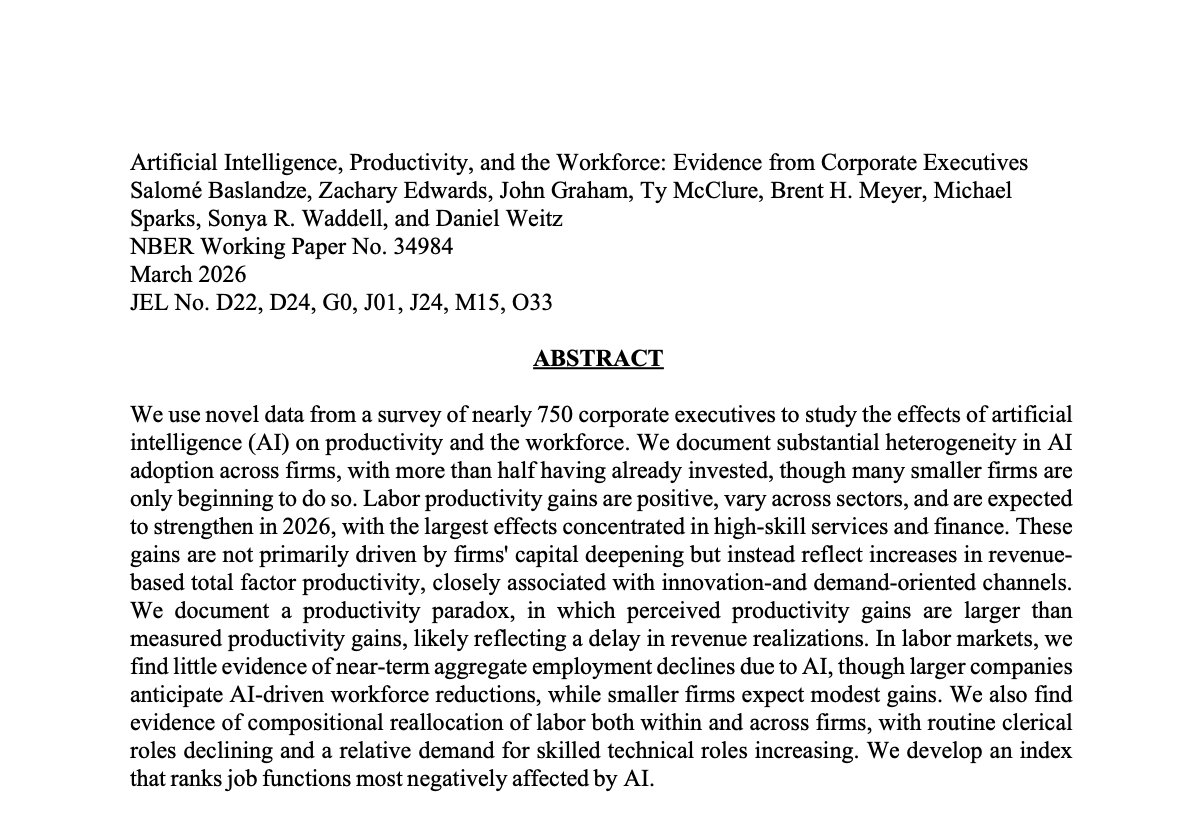
New NBER paper surveys ~750 CFOs on AI’s real effects. Key findings:
-Firms perceive 1.8% labor productivity gains from AI in 2025, but revenue-based measures imply only 0.6%. It's a classic productivity paradox: the benefits feel real before they show up in the numbers. Interesting addendum: what firms report as productivity gains today roughly matches what their revenue numbers imply for next year. The gains may be real, just delayed.
-These gains are not primarily driven by firms' capital deepening but instead reflect increases in revenue based total factor productivity.
-Aggregate job losses are minimal so far. Large firms expect modest cuts; small firms expect slight headcount gains. Net 2026 effect: roughly -0.4% of the labor force.
-The jobs most at risk are office and administrative support. The jobs getting a boost tend to be engineers, analysts, sales roles.
-Productivity gains come mostly from product innovation and better customer reach, not cost-cutting.
At least right now, AI is a growth tool first, a labor-saver second.