I haven’t been this excited
about programming in a long
time.
Natural language allows me to
build WHY structures and
compose them together.
I love building WHY structures
far more than building HOW
structures.
Philosophy is now
programmable.
Code lets you express WHAT and HOW.
Language lets you express WHY.
LLMs can now replace humans in doing
the tedious work of decomposing WHY
into WHAT and HOW.
They are WHY → WHAT + HOW compilers.
WHY used to only exist in
documentation and code
comments.
WHY is now executable.
LLMs are a new type of
execution layer that offer
greater efficiency at the
cost of some accuracy.
It won’t be the right tradeoff
for everything, but it may be
for most things.
Here's a snapshot of another $MSTR analysis that I have been working on for the ATM FUD. Going back to 08-04-2025 using the SEC filings this is what ATM issuances (as a percentage of total volume) have been for $MSTR | $STRK | $STRF | $STRD - I even included $STRC though they haven't been able to utilize the ATM on it yet. Key Point: The ATM on the $MSTR common has been ~1% of trading volume.
How we got here:
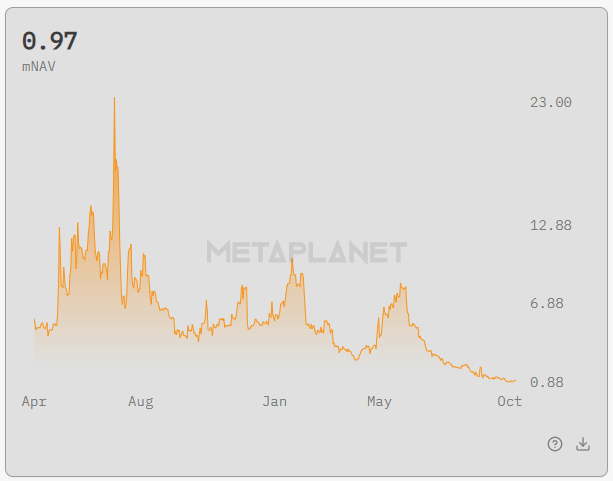
We hit a high in June. Metaplanet was stacking like crazy. MSTR investors piled in. People made life changing money.
Meanwhile, new BTCTCs were popping up daily. Attention got pulled in all directions. Capital rotated in and out of the next shiny BTCTC boasting faster growth and lower days-to-cover.
Then we reversed.
Buying demand got exhausted. People started taking profits. mNAVs declined, leading to slower accumulation, leading to even lower mNAVs. People started blaming the MSWs and IO. Chanos got more attention, stoking fear and doubt. People started questioning the business model. Good news became bad news. Short sellers piled in. Long-term holders capitulated.
Where are we now?
The market is testing us, and we're in the middle of it. Most BTCTCs won't survive. The few that do will go on to be the winner-take-most in their respective capital markets. Attention and liquidity will re-concentrate into the best BTCTCs that emerge from this.
Summary
I believe mNAV is reflexive and self-reinforcing, both on the way up, and on the way down. This is why it has historically oscillated between high and low.
After peaking in June, sentiment reversed, causing a 4-month reflexive downward spiral. We're currently at the very bottom of it. Metaplanet recently touched mNAV < 1, but quickly bounced. Now, Simon has announced a share buyback program.
Where do we go from here? Nobody knows. I'm also asking the same questions you're asking now, but I lean towards sentiment reversing, and mNAVs improving from here, once the market sorts out which BTCTCs are worth re-concentrating capital and attention into.
I do not think mNAV stays at 1, because remaining at equilibrium is not the nature of markets, even if it occasionally touches it.
@ActuallyClimber@ZynxBTC@BrianTGoodman Historical mNAV clearly shows it oscillates between low and high. No evidence of it staying still.
All evidence points to it being self-reinforcing in the direction it’s already moving. Once it hits a limit, it reverses.
What makes you think 1 mNAV is now a permanent state?
James, big fan.
I believe we’re all rooting for the same outcome — for 8 billion people to adopt Bitcoin.
The disagreement is about how this will happen. Two visions have emerged:
Grassroots:
The original vision is for Bitcoin to be a people’s movement — where education about sound money and self custody is how the world liberates itself bottom-up.
Institutional:
The recent rise of BTCTCs represents an alternative vision — one where corporations play a critical role in onboarding the world through the productization of Bitcoin at scale.
Education alone may not be enough to onboard 8 billion people, but meeting them where they’re at with BTC-backed offerings could.
I see both visions as important and complementary, not competitive and zero sum.
We’re all Bitcoiners at the end of the day!
@JesseKobernick A high mNAV isn’t entirely irrational.
1. It supercharges a company’s ability to accumulate, therefore justifying it.
2. Smaller BTCTCs grow faster as a %, justifying a higher mNAV.
So rational arguments exist, even if you don’t like the recursive logic of it.
The non-consensus around BTC treasury companies stems from diverging beliefs about Bitcoin:
Tribe 1
You see Bitcoin as currency — competing with the U.S. dollar, with payments as the killer app. You believe education about sound money and self-custody will onboard 8 billion people.
Tribe 2
You see Bitcoin as capital — competing with gold and U.S. treasuries, with BTC-backed credit as the killer app. You believe corporations will onboard billions through the productization of Bitcoin.
Which tribe are you in?
A lot of talk about high mNAVs never returning.
But high mNAV just means high price —euphoria, animal spirits, bull sentiment.
Betting this won’t return is betting against the nature of markets and human beings.
Volatility of emotions is timeless, fundamental, and cyclical.
Metaplanet will rise again.