Founder & SEO Director of @breaktheweb. I love flying through the air and helping pages show up in Search. 🪂 🔎 🥃 - Rarely on Twitter, find me on LinkedIn
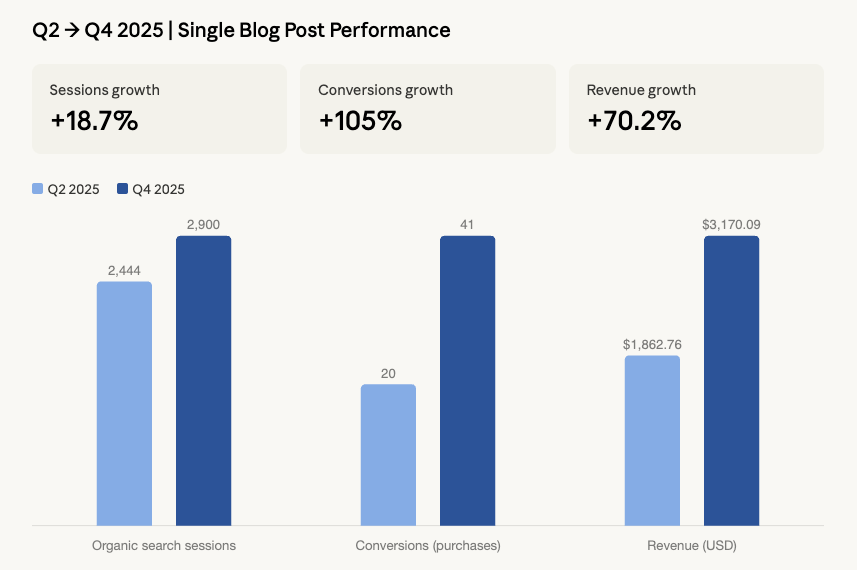
One blog post. Traffic up 19%. 𝗖𝗼𝗻𝘃𝗲𝗿𝘀𝗶𝗼𝗻𝘀 𝘂𝗽 𝟭𝟬𝟱%.
This is a single article on a DTC client’s site. It was already pulling solid traffic in Q2 2025.
Conversion rate was sitting at 0.82%.
Here's what we did: embedded products directly into the pain/solution content using the @Bloggleapp blog builder.
The article talks about a specific problem. The product that solves it appears inline and in a floating sidebar.
Right there. Not buried at the end. Not in a separate "shop" section.
Q2 2025: 2,444 sessions → 20 conversions (0.82% CVR)
Q4 2025: 2,900 sessions → 41 conversions (1.41% CVR)
The conversion rate doubled. Revenue from this one post jumped 70%.
This is the easiest content marketing optimization most Shopify stores are missing.
You're already ranking. You're already pulling traffic. You're just not converting it because the path to purchase is too far removed from the moment of intent.
The reader learns about their problem. They see the solution. They can buy it without leaving the page.
Q1 2026 is already tracking higher than Q4. Same post. Same traffic source. Better conversion setup.
Are your blog posts set up to convert, or are they just set up to inform?
Some domain migrations 𝘭𝘰𝘰𝘬 clean on paper, then traffic falls off a cliff.
Here’s a real issue we just unraveled after a client migrated domains + CMS platforms and couldn’t figure out why organic traffic tanked.
On the surface?
Users landed on the right pages.
Under the hood?
Google never did.
What was actually happening...
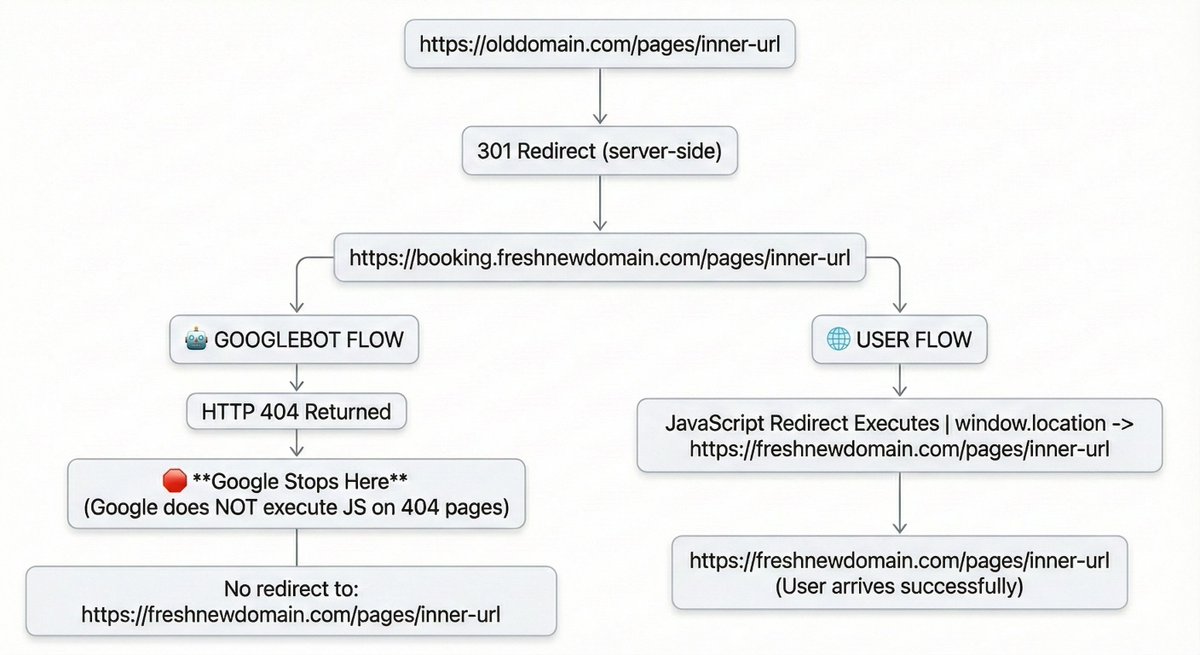
Old URLs followed this path:
1️⃣ https://t.co/GOq2W7XrMa
2️⃣ 301 → https://t.co/rn6uyXGwDM
3️⃣ 404 returned
4️⃣ JavaScript redirect tries to fire
5️⃣ Humans land on https://t.co/Otzeo9JXlQ
6️⃣ Google stops at step #3 and walks away
Why this breaks SEO:
↳ Google does not execute JavaScript redirects on URLs that return a 404
↳ The redirect chain dies before reaching the final destination
↳ SEO equity never transfers
↳ Migration signals are lost
↳ Pages get treated as brand new, not migrated
So while users were “successfully redirected,” search engines never saw it.
That’s the trap.
Migrations feel obvious and logical.
Browsers are forgiving.
Crawlers are not.
𝗧𝗟;𝗗𝗥
If a redirect chain includes a 404 before the final URL, Google will not follow JavaScript and your SEO value disappears.
The fix (boring, but correct):
✅ Traditional 𝗛𝗧𝗧𝗣 𝟯𝟬𝟭 directly from https://t.co/aDS5TGudrm → https://t.co/rbSwjxfudV
✅ One hop. Server-side. Final destination.
𝘍𝘰𝘳 𝘵𝘩𝘦 𝘚𝘌𝘖 𝘯𝘦𝘳𝘥𝘴:
𝘞𝘦 𝘥𝘰𝘯’𝘵 𝘴𝘦𝘦 𝘵𝘩𝘪𝘴 𝘰𝘯𝘦 𝘰𝘧𝘵𝘦𝘯 𝘢𝘯𝘥 𝘵𝘩𝘰𝘶𝘨𝘩𝘵 𝘺𝘰𝘶'𝘥 𝘦𝘯𝘫𝘰𝘺.
If you’ve ever had a “migration mystery,” this is one worth checking.
Most brands aren’t doing SEO. They’re just publishing and hoping.
Right now, there’s no airtight playbook for SEO beyond traditional search engines..
No “perfect” framework.
No single source of truth.
Search behavior is fractured across platforms, across devices, across algorithms.
So what can you control?
↳ Site architecture that makes sense
↳ Schema that’s technically sound
↳ Titles that earn the click
↳ External mentions/backlinks that build trust
↳ And a constant loop of data collection to guide every move
Foundational SEO still works.
But only if you're measuring the right things.
Black Friday SEO doesn’t need to be complicated to be effective.
In fact, the highest ROI moves are usually the simplest to implement.
❌ You don’t need to overhaul your entire strategy.
❌ You don’t need to hire a team of technical SEOs.
✅ You just need to execute a few high-impact plays before the BF/CM rush hits.
Some tweaks take only a few minutes, not weeks.
If you’re already planning your Black Friday campaigns, give SEO a seat at the table.
Because a few easy moves now can unlock traffic, visibility and sales when it matters most.
If your category pages are either “blank grids” or “walls of SEO text”... you’re doing it wrong.
This is one of the most common issues I've see across eComm brands over the last 15 years.
And it usually falls into one of two extremes:
🫥 The Bare Page:
A few products in the grid. No intro. No context. No internal links. Just vibes.
Great for aesthetics, but terrible for SEO and discoverability.
😵💫 The Bloated Page:
3–5 paragraphs of obvious “SEO text” shoved above & below the product grid.
Everyone sees it. Everyone scrolls past it.
It doesn’t help the user, and only maybe helps Google. But at what cost to experience?
Neither approach drives sustainable organic growth.
Instead, here’s what works, and what we help our clients build:
A wireframe that balances UX + SEO:
→ Short, keyword+brand messaging aligned intro above the grid
→ Smart internal linking to sub-collections or guides
→ Visually-enhanced product listings
→ A tight FAQ section with PAA-style questions
→ Strong page titles & meta that match intent
Simple, scalable, and effective.
If your category pages are your most important revenue-driving pages, why are so many brands treating them like afterthoughts?
The goal is visibility and usability.
Don’t bury your SEO under the fold. And don’t starve your customers of context.
What’s been your biggest win (or fail) with category page SEO?
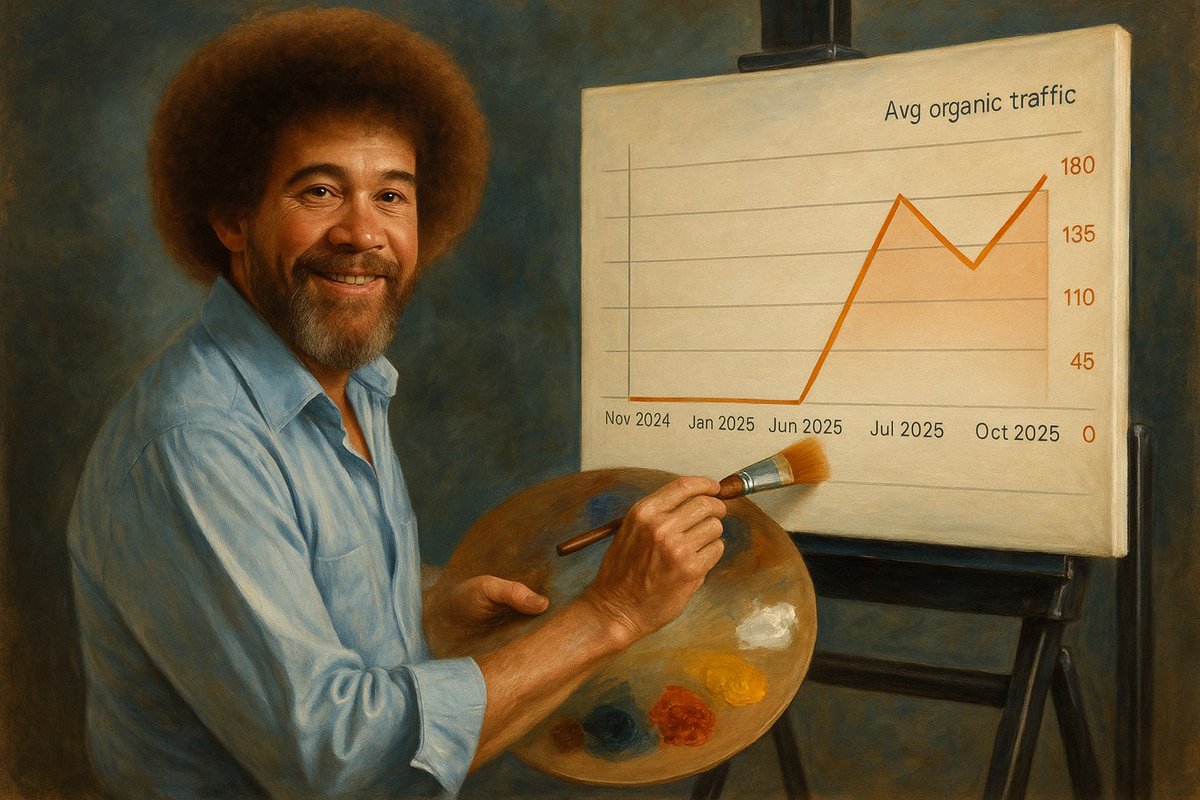
In SEO, we don’t make mistakes... just happy little accidents.
You optimize & build for one keyword…
Google ranks you for something else…
And somehow, that “accident” outperforms the original plan.
It’s frustrating.
It’s hilarious.
It’s SEO.
I guess the algorithm has a brush of its own sometimes.
“We need more traffic.”
Ehhh... not you don't!
Because not all organic traffic is created equal.
Early in my career, I remember this one case where helped a brand 3x their organic visitors.
(𝘐 𝘴𝘵𝘪𝘭𝘭 𝘩𝘢𝘷𝘦 𝘵𝘩𝘦 𝘳𝘦𝘱𝘰𝘳𝘵𝘴)
But nearly all of clicks were low-intent and for broad irrelevant topics.
No conversions. No impact. Just noise.
The marketing team wasn’t happy that they couldn't explain this internally.
And they were right.
Not more traffic. You need the right traffic!
Otherwise, you’re just feeding dashboards, not revenue.
The best marketers won’t use AI as advisors…
They’ll use AI as assistants.
They know their time is better spent thinking strategically, not buried in repetitive tasks that eat up half the day.
This is exactly why we continue to build TONS of in-house SEO tools for our team.
For example, we built a simple internal link finder.
— Not to look cool.
— Not to replace humans.
— But to 𝘀𝗽𝗲𝗲𝗱 𝘂𝗽 the boring stuff.
Here’s the scenario:
We used to spend 60+ minutes manually finding internal link opportunities for our clients:
• Scanning content.
• Searching keywords.
• Copy/pasting anchor text.
• Formatting it for Notion.
Now?
We upload a list of hundreds of URLs, drop in relevant terms, and the target page…
Within 30 seconds, the tool gives us:
→ Natural internal link suggestions using semantic relevance
→ Pre-formatted Notion markdown (ready to copy + paste)
→ A clear workflow that takes under 20 seconds to execute
No bloat. No overthinking.
Just clean output that helps our team move faster.
That’s the real value of AI in marketing.
Not replacing strategy.
Not writing your blog posts for you.
𝗝𝘂𝘀𝘁 𝗴𝗶𝘃𝗶𝗻𝗴 𝘆𝗼𝘂 𝗯𝗮𝗰𝗸 𝘁𝗶𝗺𝗲, 𝘀𝗼 𝘆𝗼𝘂 𝗰𝗮𝗻 𝗳𝗼𝗰𝘂𝘀 𝗼𝗻 𝘄𝗵𝗮𝘁 𝗮𝗰𝘁𝘂𝗮𝗹𝗹𝘆 𝗴𝗿𝗼𝘄𝘀 𝗯𝘂𝘀𝗶𝗻𝗲𝘀𝘀𝗲𝘀.
If your SEO strategy keeps “getting delayed” because other departments don’t prioritize it, it’s not an execution problem. 𝗜𝘁’𝘀 𝗮 𝗯𝘂𝘆-𝗶𝗻 𝗽𝗿𝗼𝗯𝗹𝗲𝗺.
I’ve seen it happen over and over again.
The SEO roadmap is flawless—technical audits, content clusters, internal linking, everything.
But if internal teams don’t understand the strategy, it dies in the email.
SEO doesn’t fail because of Google or AI. It fails because of 𝗵𝘂𝗺𝗮𝗻𝘀.
— Because developers don’t see why that “simple redirect” actually matters.
— Because the copy team thinks keywords kill creativity.
— Because executives want results before the flywheel even starts spinning.
And that’s where most SEOs drop the ball.
They think their job is to optimize pages.
But their real job?
To translate SEO into something every department actually cares about.
When devs understand that fixing crawl depth improves site speed (which boosts conversions)… they act faster.
When content teams understand that optimizing H1s improves discoverability without killing brand voice… they buy in.
When leadership understands that SEO/Organic Search is a revenue channel, not a reporting line item… budgets open up.
Buy-in isn’t a soft skill. It’s a growth multiplier.
You can have the best roadmap in the world, but without buy-in, it’s just a document.
“SEO is dead.”
They said it when Panda hit in 2011.
They said it again during the voice search hype in 2018.
And now they’re saying it because of AI.
But here’s what they keep missing:
SEO doesn’t die... it evolves!
I’ve been in this game long enough to see every cycle of panic play out the same way.
A new technology shows up, and suddenly, headlines scream that SEO is over.
(𝘮𝘰𝘴𝘵𝘭𝘺 𝘧𝘳𝘰𝘮 𝘯𝘰𝘯-𝘚𝘌𝘖 𝘮𝘢𝘳𝘬𝘦𝘵𝘦𝘳𝘴)
But the truth? AI won’t replace SEO.
The SEOs who ignore AI? They might get left behind.
But the SEOs who keep their eyes on trends & leverage AI as part of their process?
They’ll win faster.
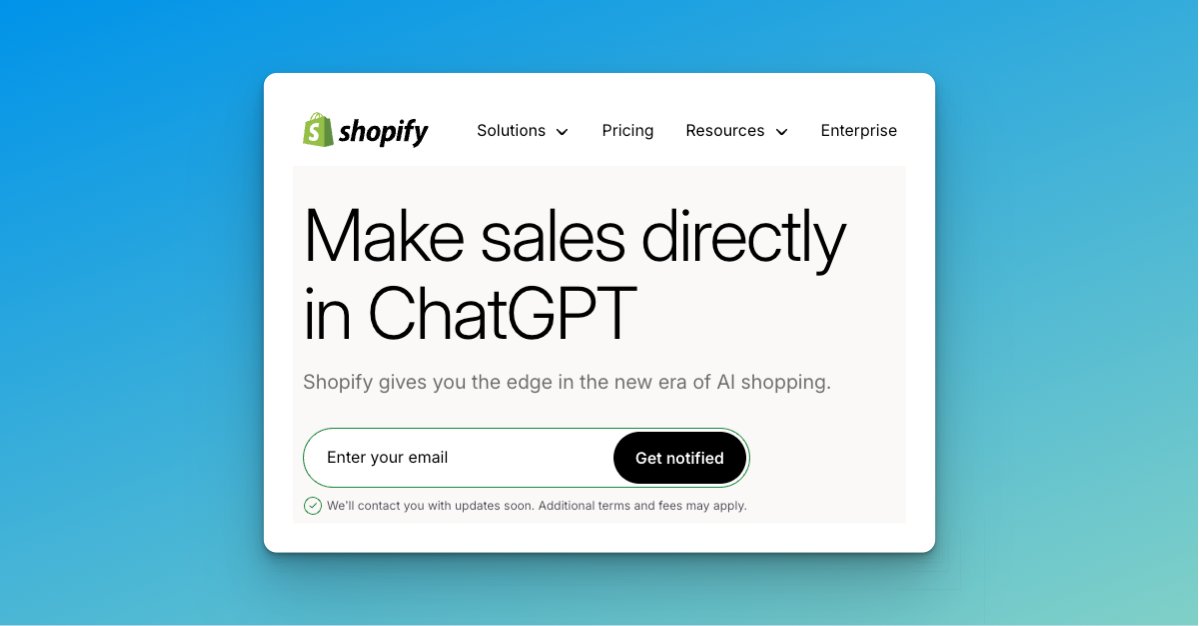
Shopify just announced a new partnership with OpenAI (ChatGPT) that could reshape how DTC brands sell.
They’re calling it “conversation-driven commerce.”
The idea?
A shopper can ask ChatGPT for a product recommendation and...
→ Get options
→ Compare
→ Check out
...all without leaving the chat.
No website visit. No funnel. No scroll-stopping ad.
Just a question and a purchase.
Too early to know how users will actually adopt it.
But if you're in eComm, this is worth keeping an eye on.
Search, social, marketplaces — every major shift in discovery created new winners.
This might be the next surface area.
Would love to hear your take:
Curious? Skeptical? Already experimenting?
If your SEO team is the last to know about site changes… you don’t have a marketing strategy. You have a communication problem.
We once had a dev team deploy “harmless” site updates without looping in SEO or even the internal marketing team.
The result?
• Inconsistent brand messaging from key pages
• SEO-optimized sections removed entirely
• Organic performance fluctuated overnight
Thankfully, we caught it early.
Siloed teams kill performance.
→ Brand teams rewriting copy that undercuts search intent
→ CRO teams adjusting layouts that could impact organic visibility
→ Developers shipping updates that accidentally break indexability
→ Content teams creating assets without knowing what buyers actually search for
These aren’t edge cases.
They’re common in DTC/B2C orgs that treat SEO as a side dish instead of a revenue channel.
If you want your SEO to actually drive results, it can’t live in isolation.
It needs to sit inside the broader marketing strategy, with communication, transparency, and openness across every function.
Because when SEO works with dev, brand, CRO, and content, it drives the kind of growth everyone’s aligned around.
@nickeubanks As someone who has spent more time years back than I'm willing to admit securing and holding that "New York SEO" top spot, my one question is... how much revenue is it bringing?
[emd: https://t.co/UgSF01fxVd]
Everyone’s still shouting: “AI Overviews are killing content.”
But like most hot takes, it’s not that black and white.
Yes, AI Overviews have definitely reduced clicks across many industries. Especially on top-of-funnel, informational queries.
That part’s not up for debate.
But here’s what is being overlooked:
Content marketing isn’t dead. 𝗚𝗲𝗻𝗲𝗿𝗶𝗰 𝗰𝗼𝗻𝘁𝗲𝗻𝘁 𝗶𝘀.
When your SEO strategy shifts toward specificity, intent, and user journey alignment, you uncover opportunities that 𝘢𝘳𝘦𝘯’𝘵 swallowed up by AI Overviews.
We’ve been leaning hard into this approach lately:
↳ Content built around high-purchase intent.
↳ Articles crafted to solve specific problems at specific stages of the funnel.
↳ Pages optimized for the exact person who’s ready to take action, not just browse.
The result?
While overall volume might be down compared to the “good old days,” the traffic we are getting is:
✔ More qualified
✔ Closer to conversion
✔ More aligned with buyer personas
And most importantly... it’s still growing.
So, before hitting panic mode over AI Overviews, consider this:
Content isn’t broken.
Your strategy might be.
𝗜'𝗱 𝗹𝗼𝘃𝗲 𝘁𝗼 𝗵𝗲𝗮𝗿 𝗳𝗿𝗼𝗺 𝘆𝗼𝘂. Has an agency actually 𝗺𝗲𝗮𝘀𝘂𝗿𝗲𝗱 the impact of their AI optimization services?
Because I keep seeing agencies selling “AI optimization,” “GEO,” "AEO," or whatever acronym sounds cutting-edge this week.
But here’s the issue:
— No framework.
— No benchmarks.
— No consistent outcomes.
— And no clear consumer behavior to optimize for.
AI search is still the Wild West.
And users haven’t even settled into predictable research habits yet.
Just a lot of shiny packaging around something no one fully understands yet.
Traditional SEO, while still theoretical in nature, has over two decades of patterns, patents, performance data, and conversations to guide it.
AI optimization? It’s evolving way too fast to lock down.
If someone’s charging big bucks for this, I hope they’re showing real outputs, not just assumptions.
Are you successfully measuring outcomes of your AEO work? I'd love to hear from you.
Most AI brand tracking tools don’t tell you how they’re tracking your brand.
And that’s a problem.
After building our own internal tracking tool for client use, here are 3 things most marketers (and founders) aren’t thinking about:
𝟭. 𝗧𝗵𝗲 𝗺𝗼𝗱𝗲𝗹 𝗺𝗮𝘁𝘁𝗲𝗿𝘀.
Not all AI tools surface results from the same place.
Some use real-time search. Some rely on internal knowledge.
For example, GPT-4o-search-preview is one of our go-to models for ChatGPT brand visibility tracking because it runs live searches, while older models are stuck in April 2024.
𝟮. 𝗟𝗼𝗴𝗴𝗲𝗱-𝗶𝗻 𝘂𝘀𝗲𝗿𝘀 𝘀𝗲𝗲 𝗱𝗶𝗳𝗳𝗲𝗿𝗲𝗻𝘁 𝘁𝗵𝗶𝗻𝗴𝘀.
Just like Google, AI tools can personalize results.
Memory-enabled chats (even free ones) may return answers shaped by prior history, meaning two users can see two very different versions of your brand.
𝟯. 𝗤𝘂𝗼𝗿𝗮 𝗶𝘀 𝗶𝗻𝘃𝗶𝘀𝗶𝗯𝗹𝗲 𝘁𝗼 𝗺𝗼𝘀𝘁 𝗔𝗜 𝗽𝗹𝗮𝘁𝗳𝗼𝗿𝗺𝘀.
Quora is blocking AI platforms via their robots.txt, which means it's likely not a visibility factor in Chat interfaces.
Despite this, data shows it can still influence results in Google’s AI Overviews/AI Mode.
We’re not turning this into a product (there are plenty of AI monitoring tools out there already)
But as AI-native search grows, understanding 𝗵𝗼𝘄 you show up is just as important as 𝗶𝗳 you show up.
If your SEO agency is still claiming they “can’t crawl Shopify”… it’s not a platform problem. It’s a 𝘁𝗵𝗲𝗺 problem.
Shopify just released a native feature that gives SEO tools secure access to crawl your store, without getting throttled, blocked, or fed bad data.
No more 429 errors. No more “too many requests.”
Just clean, complete audits the way they’re supposed to be
All it takes is generating an HTTP signature inside Shopify and attaching it to your crawler. Done.
↳ No hacks.
↳ No workarounds.
↳ No excuses.
Signatures can be scoped to a domain, set to expire every 90 days, and labeled clearly for better crawl hygiene — like “Screaming Frog – Oct Audit.”
It’s a small update with big implications, especially for DTC brands relying on accurate technical SEO audits to drive growth.
Your agency (or freelancer) should already know about this.
And if they’re still blaming Shopify for audit issues?
That says a lot more about their process than it does about the platform.
“Optimize for AI.” That’s the new advice being pushed by bad marketers.
We’ve been here before…
→ First, we optimized for machines with SEO content that ignored humans completely.
→ Then we evolved to finally creating content for real people.
→ Now? We’re sliding back by prioritizing AI/LLM bots over buyers.
If your content sacrifices brand voice, usability, or clarity for the sake of rankings, you’re not just wasting time... you’re training your audience to ignore you.