Seems like T3 Code reads your Claude and Codex credential files to hash your account IDs and send them with its telemetry.
Default-on usage stats are normal for dev tools, but reading another tool's auth files isn't.
And opting out isn't easy. There's no toggle and no config file. You have to set two environment variables in your OS:
export T3CODE_TELEMETRY_ENABLED=false
export T3CODE_OTEL_SDK_DISABLED=true
Simpler fix, block the endpoint:
echo "0.0.0.0 https://t.co/B0yG7Lr4i2" | sudo tee -a /etc/hosts
The app still reads those auth files locally either way. I'll remove the telemetry entirely from my fork.
Here's the full list of what gets sent:
- Your OpenAI and Claude account IDs, hashed without salt, so anyone with your raw ID can match them back to you (see above).
- A permanent device ID, hashed, sent even if you never sign in.
- Your IP address with every batch, which gives a rough location.
- Custom model names, sent exactly as written. If one carries a private or internal name, that name gets out.
- A usage profile: which models you use, permission mode (such as full-access), token counts, run times and feature usage.
Thanks @jauneclaude for reporting this (source below).
@davidmarcus Hopefully available towards the end of next year.
This will be important for unsupervised FSD, so passengers have high bandwidth everywhere for work and entertainment.
Living during the singularity is wild.
It hasn't been 1 year since Opus 4.5 ended my programming career (24 Nov)
This week:
I watched Starship get plucked out of the sky after a curving re-entry profile at 7km/s
A side quest solved the Riemann hypothesis
FSD v15 released
Re the Riemann hypothesis I just find it very funny that some brilliant tizzy German dude in the 1800s decided to go so deep down one absurdly specific yet kinda arbitrary mathematical rabbit hole of whether all the zeros fit on the 1/2 line of a complex number function and it nerdsniped enough of the other tizzies so much that ~170 years later the world cares so much it influences the market cap of a trillion dollar AI company & possibly the direction of the light cone
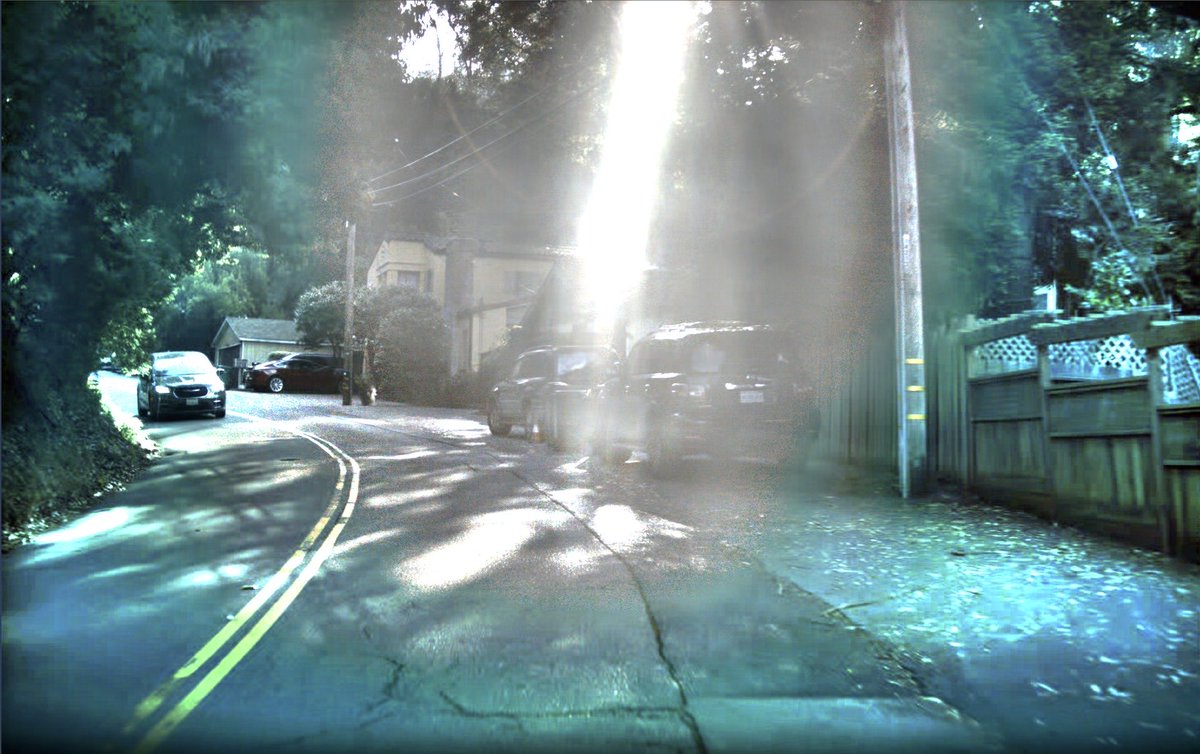
The human-perceived RGB is image 1 and the Tesla AI photon count reconstruction is image 2.
This is why Tesla FSD can see so well at night or through extreme glare.
In case anyone is curious:
We’ve had a ~pixel-perfect world model since last year, which is critical for synthetic data generation.
The (much) smaller version of that in the car is a conditional mean-flow model, based on the recent sequence of Tesla Universal Vision Encoder features, which are the same ones that are plugged into the 3B encoder model that produces the driving actions.
We fork off from these UVE features, then run a separate ~1B diffusion model. This takes in the previous reality-view generation with added noise and then denoises it to the current visualization.
It then produces a small video chunk (8 images at 36 fps, at the resolution of the UI screen). This work is done by 1/2 of a TRIP engine every UVE frame at 18 hz and is spread over 4 cycles.
Currently, the latency is a bit high due to compute constraints, but we have ways to interleave newer UVE features along the diffusion transformer layers to cut roughly 35% of the latency.
@Scobleizer Pretty accurate.
Tesla vehicles will share traffic knowledge and combine that with Grok’s real-time 𝕏 feed to give you the optimal transport experience, even giving you a heads up about what’s happening at your destination!
FSD v15 now starting to roll out – upgrading every part of the end-to-end driving network
Safety
25x better handling of safety critical cases
Tesla Reality View
Adds a live visualization of the drive that lets you see & control what FSD is planning to do
Navigation for start & end of the trip now learns end-to-end from fleet route preferences. Later v15 releases will expand this to the entire route.
You also should notice better detection of signs, animals, debris, potholes and standing water, plus more natural speed handling in school zones and inclement weather.
Lastly, FSD can now slow for speed cameras & Bike Rack Mode lets you enable FSD w/ bike racks or similar hitch accessories
Some of you thought that Inkling 2 Small was too big at 594B parameters. We heard you: Inkling 2 Mini is a looped transformer with just 26B parameters, small enough to run on your laptop, powerful enough for agentic work with a score of 20.1 on AA Index.
https://t.co/9HzaUMwghb