The UK’s Online Safety Act (OSA) aims to enhance online safety by regulating platforms to prevent harmful content, which has stirred up a bit of controversy. While seemingly well intentioned, its implementation creates privacy risks through centralised data collection.
Certain online services are mandated to verify user ages to restrict access to harmful or inappropriate content. Platforms must implement age assurance measures, often relying on third-party providers to collect user biometrics, and/or copies of government issued ID.
The Act applies to a broad range of services such as social media, adult content platforms, gaming services, and online marketplaces. Platforms that do not comply risk significant fines of $18m, or 10% of global turnover. For smaller platforms, potential market exit due to compliance costs.
Read the OSA Explainer
https://t.co/lbr6fYLdHv
As service providers scrambled to implement safeguarding controls, it has become broadly reported that age verification has been widely implemented already. For example, Reddit now uses Persona for age verification, requiring users to submit IDs or selfies.
Learn more.
https://t.co/X8HNVxicp3
Similarly, X has implemented facial age estimation and ID checks for certain features. These methods often involve third-party providers, raising concerns about data storage and potential unauthorised access.
Learn more.
https://t.co/2OXt76ucUS
Adult content platforms must verify user ages to comply with the OSA, often using services like Yoti.
Learn more.
https://t.co/DgKcC0Y50P
Centralised data silos are inherently risky. Earlier this year it was reported 16 billion passwords were exposed in global breaches. Storing IDs, selfies, or utility bills for age checks creates honeypots for cybercriminals, and this increases the risk of personal information being breached.
Learn more.
https://t.co/NWna20hcyr
We believe the Online Safety Act can be implemented with safeguarding measures that protect user privacy and prevent personal data breaches more effectively.
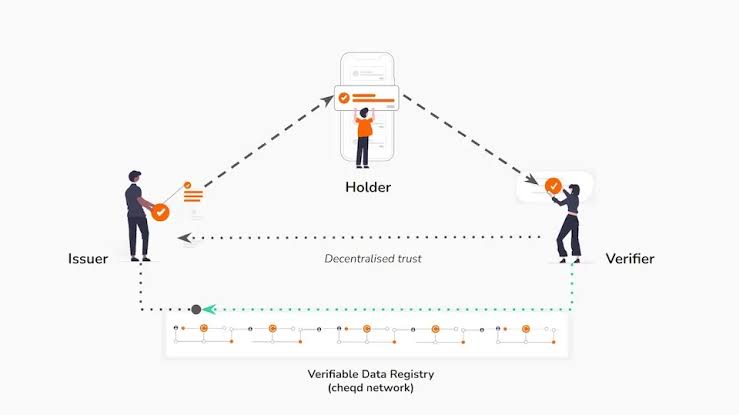
cheqd offers a decentralised, privacy preserving solution using Verifiable Credentials(VCs). With these credentials, users can prove information about themselves without having to provide more than needed. For age checks, platforms only need to know if the user is over the age of 18.
Leveraging Self-Sovereign Identity principles, users can have more control over their data. Users hold VCs in secure digital wallets and share only necessary information via Zero Knowledge Proof (ZKP) or selective disclosure.
Learn more.
https://t.co/ZcXTvZsyPW
cheqd’s infrastructure allows credential issuers to create commercial models, building a sustainable ecosystem. Verifiers access trusted data, users retain control, and regulators see compliance. All working with current, and emerging standards.
Online safety and privacy need not conflict. By adopting Verifiable Credentials on cheqd, platforms can comply with the OSA while eliminating data silos.
Verifiable Credentials can also be used in a variety of other use cases, like Digital Product Passports (DPP).
Digital Product Passports are digital records that aggregate and store data about a product and footprint in the supply chain. This enables manufacturing and logistics companies to show a complete picture of the quality of a product, and any ethical practices associated with the creation and shipping.
Learn more:
https://t.co/YDFMjydKeM
These principles also apply to AI Agents. As agent functions continue to evolve, we need a way to verify the purpose of an agent, any permissions they have, and if it can be trusted. We’ve built a first of its kind Agent Trust Solution for this purpose
https://t.co/dAX18TW7DE
Want to learn how you can implement Verifiable Credentials for private verification?
Contact us: [email protected]
What were you doing when $qnt was $4 and siachain news.
Well, what are you doing with $cheq at $0.03 and a parallel commercial model to #EBSI for enterprise.
What you gonna do?
Wait and miss?
Already aped?
all you have to do is find the future market narratives nobody believes will happen in present day and allocate heavily before everyone else, repeat ad infinitum, simple
🔥cheqd Needs You!🔥
🎉We made it to #StartinBlock Top 100 at Paris Blockchain Week. What an achievement!
➡️Repost this to boost our chance to get into the Top 10 & pitch on April 11th at @signalweek
✅Like ✅RT
https://t.co/8ZGu348bpc
Not having #vAI [Verifiable AI] for the future of #AI in general and also #GenAI is like not having KYC to regulate AML CTF Travel Rule laws.
I've always been on the backfoot with #crypto and AI because i've never really seen where it is going from a Regulatory perspective to control it.
I think with recent developments its quite clear, it is subject to the same data privacy laws as any other sector.
I see it only being a matter of time as the #GDPR requirements combined with eIDAS 2.0 coming into shape for EU will have major influence on GenAI.
The beauty of this is that eIDAS 2.0 already comes with blockchain based solutions be it Permissioned Hyperledger Besu / Fabric Like #EBSI, or permissionless Qualified Electronic Ledgers like @cheqd_io.
cheqd builds on Open Source, Open Standards like #W3C Decentralized Identifiers [DID's] and Verifiable Credentials [VC's].
DID's and VC's themselves are not blockchain, but they gain significant use cases for decentralized solutions when combined with public blockchains, like cheqd. $Cheq
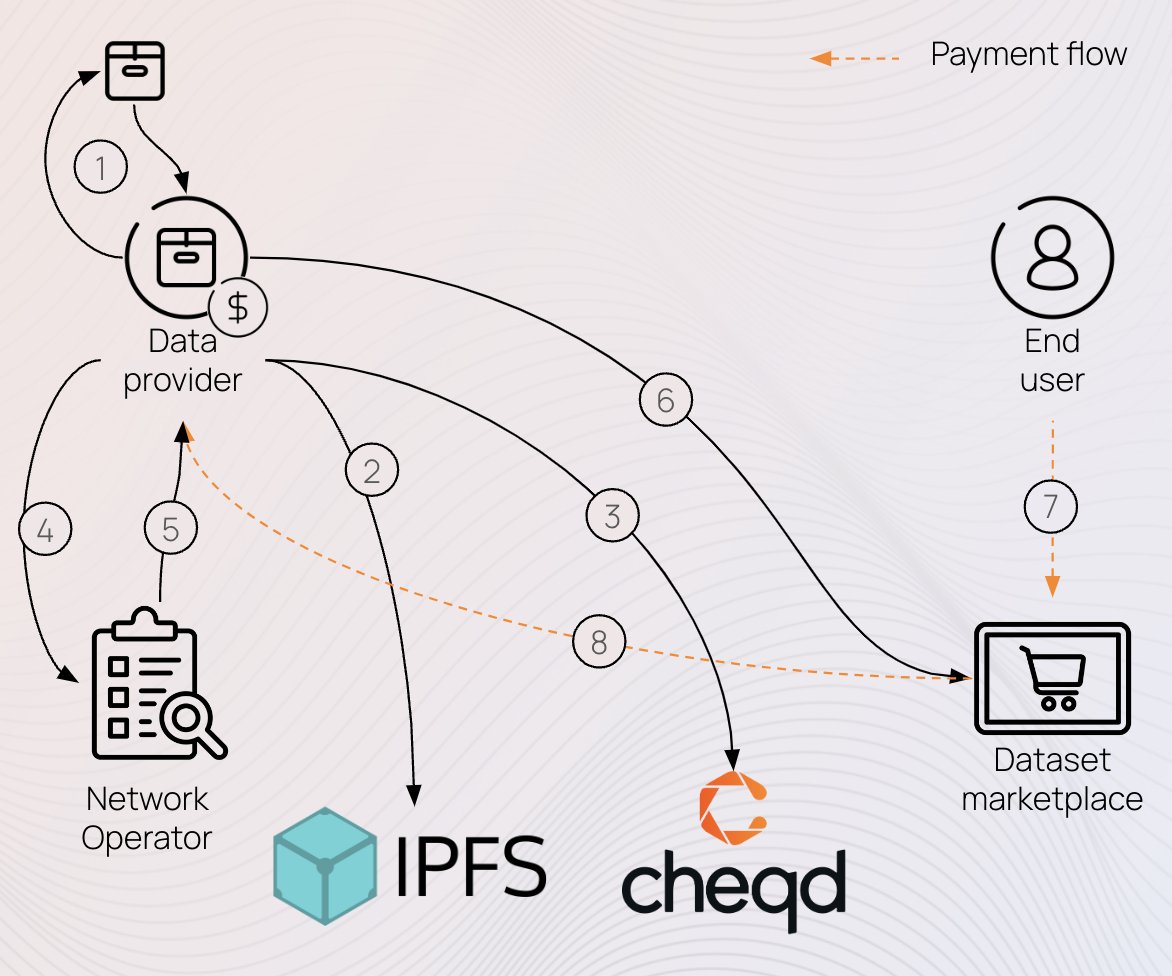
There is a variety of tools cheqd are building to allow for a Trusted Data Market via Verifiable Credentials and DID-Linked Resources combined with Decentralized Data Storage.
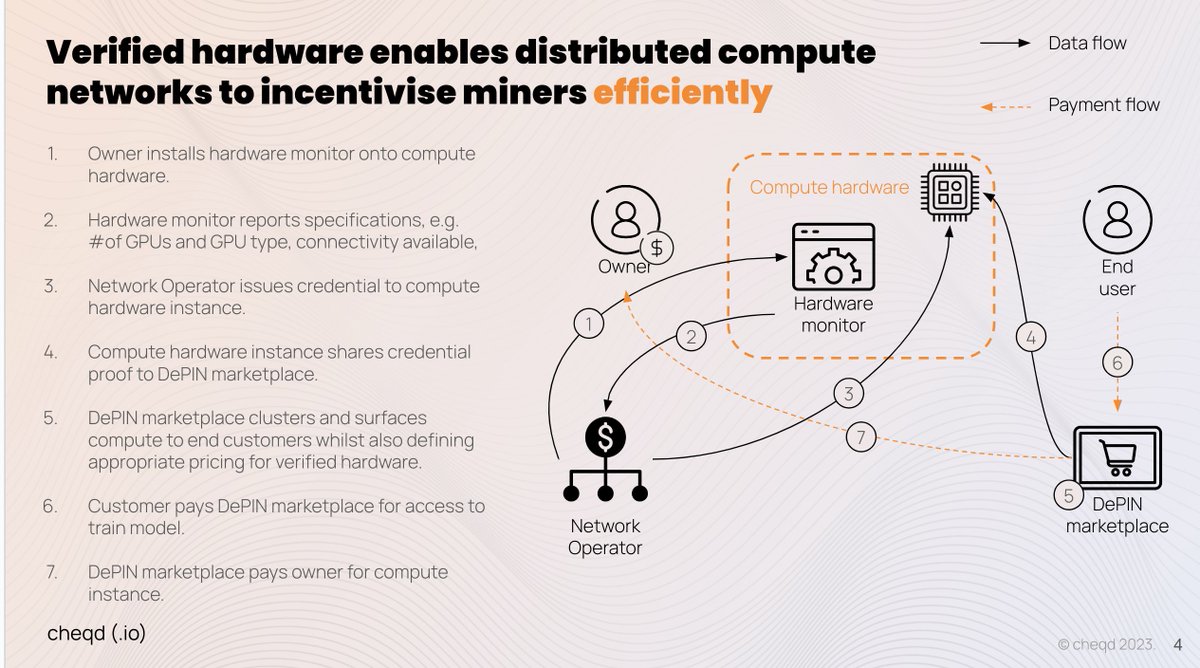
Verifiable Hardware
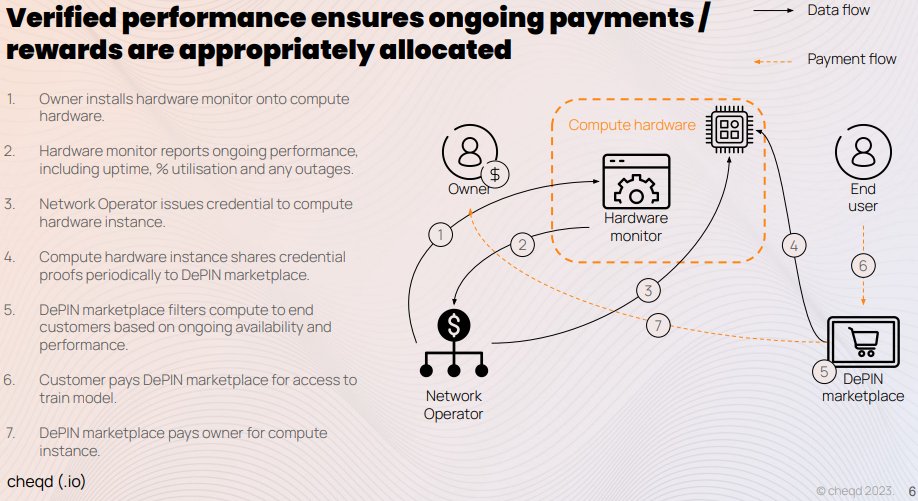
Verified Performance
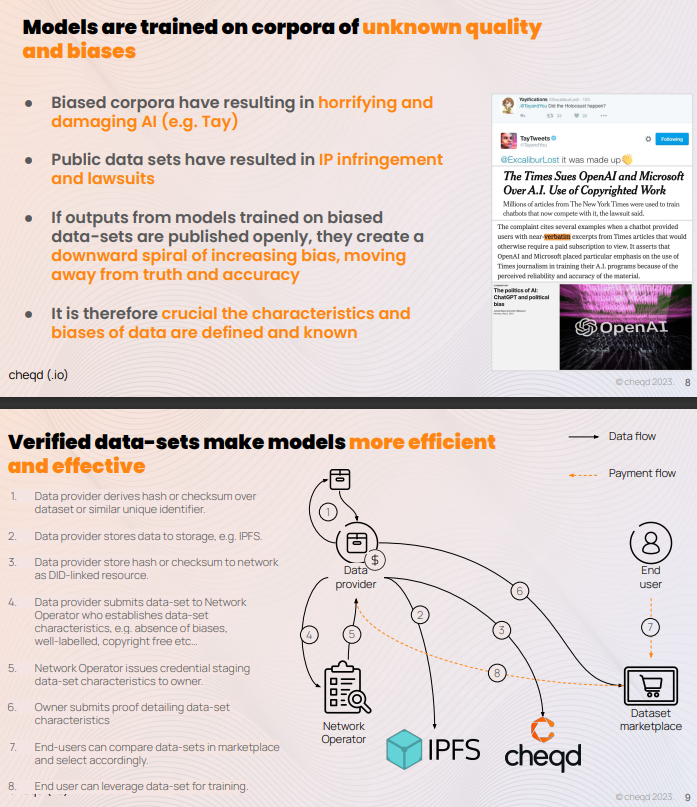
Verified Data-sets
It is extremely important to plant the seeds now within your platform to front run the inevitable necessity of providing a trust layer and to protect your data and intellectual property.
@opentensor@akashnet@Fetch_ai@SingularityNET@oceanprotocol@origin_trail@oraichain@autonolas $tao $akt $fet $near $rndr $grt $agix $trac $prime $ocean
Who am I to talk about AI problems when giants in the space like @brian_armstrong , CEO of @coinbase , are already pointing out that verification and provenance of information should be the main focus in the development and deployment of AI?
It's clear that the AI is evolving rapidly, with new challenges and opportunities that are coming fast.
Armstrong's insights into the necessity for a digitally native currency for AI transactions and the crucial role of authenticating the source of digital content highlight the complexity of these challenges.
And TBH, that's where $CHEQ comes in, offering a solution that seems tailor-made for these exact issues.
🟠 @cheqd_io innovative approach to creating a verifiable AI - #vAI ecosystem addresses the core problems identified by Armstrong.
🟠Securing AI's infrastructure - Verifiable hardware
$CHEQ ensures that the computing infrastructure that powers AI is verifiable and robust.
Verified hardware means that they ensure that the computers running the AI tasks are up to the task and can be trusted. This is essential for the efficient and secure operation of AI systems, especially those that require real-time data processing.
🟠 Reliability - Verifiable hardware monitoring
Also, $CHEQ introduces verifiable hardware monitoring, leveraging Verifiable Credentials (VCs) to monitor the status, location, and performance of these computational resources. This is must have for creating optimised networks of computers (clusters) that can handle the intense demands of training AI models with reduced latency and increased throughput.
🟠Data integrity - Verifiable datasets
Data integrity is everything and $CHEQ tackles the issue of data integrity with verifiable datasets. This solution ensures the data feeding into AI models is accurate, copyright-compliant, and free from biases that could lead to misinformation.
Armstrong's concern over the authenticity of AI-generated content finds a direct solution in $CHEQ's framework, promoting the development of AI models that are both powerful and trustworthy.
🟠The dawn of verifiable AI - vAI:
$CHEQ is enabling a future where AI operations are transparent, data provenance is clear, and digital content can be authenticated, encouraging an environment where AI and blockchain synergise to create verifiable and reliable AI systems - vAI.
Why #DeAI needs #vAI
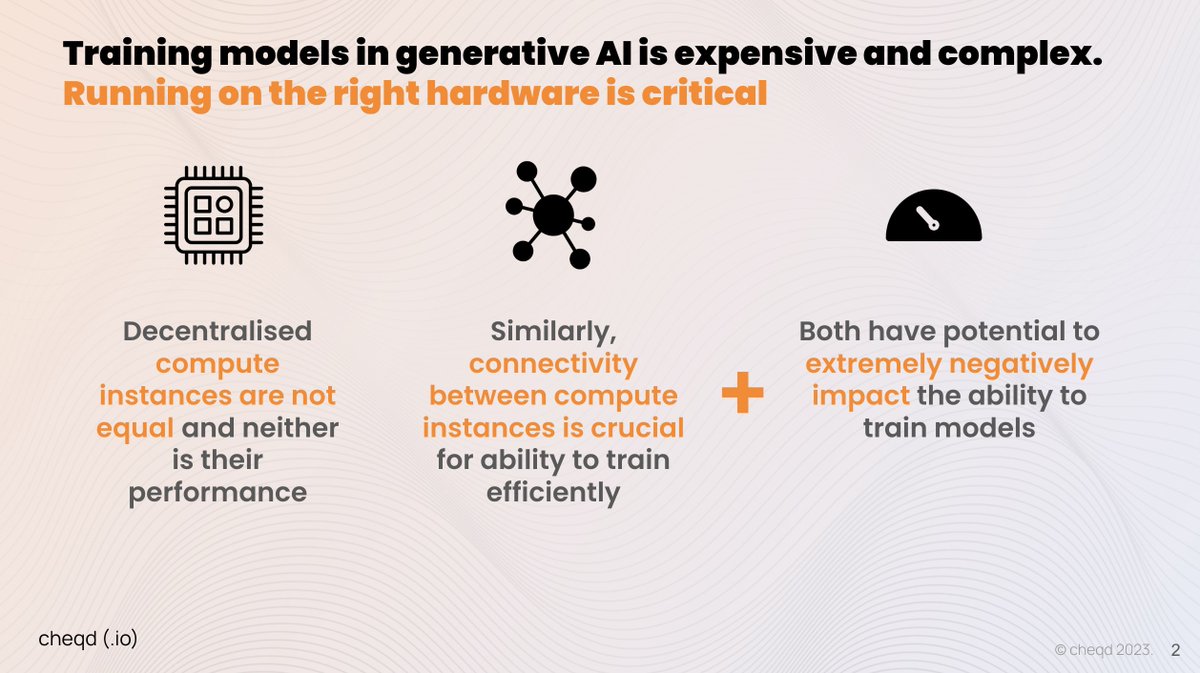
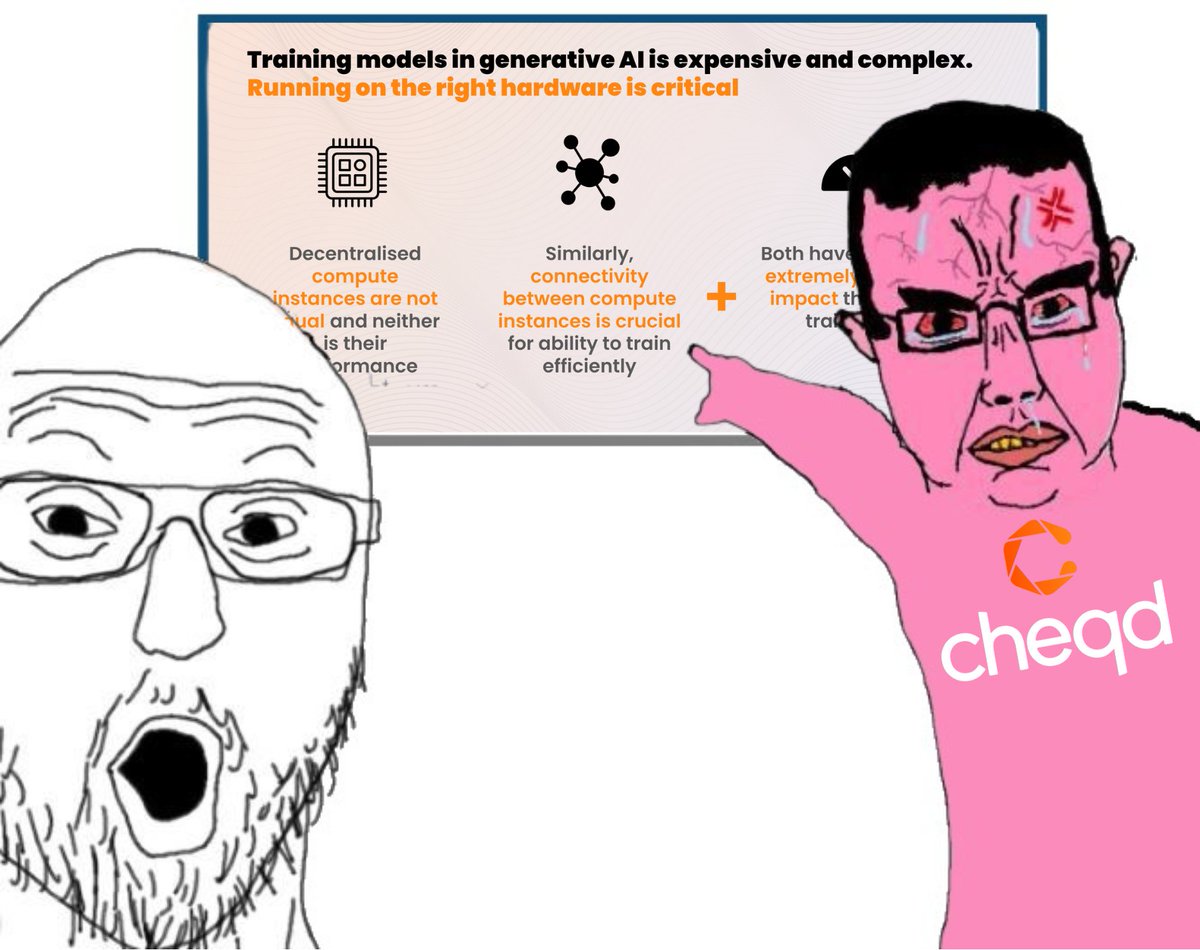
Training models in generative AI is an incredibly expensive and complex operation.
Location, internet speed & computing hardware are all incredibly important to making these Decentralised computing networks function
You can't just simply let anyone join the network and mess it up.
One example worth mentioning is with latency - currently the majority of LLMs will be computed using servers in close proximity to each other - the further away they are the harder it is to work completely in sync.
Because of this, the location of cloud computing nodes for $AKT, $TAO, $AGC, $RLC and many others will be crucial to ensuring efficient computing power - different clusters will be needed based on their proximity to each other.
But how to ensure this information is freely available?
This is where $CHEQ can come in.
Using #VerifiableCredentials, computing instances and hardware can gain a digital identity, allowing others to interact with them based on relevant information, e.g. Graphics Card, Latency, Downtime, Location etc.
Imagine you are running a subnet that requires a huge amount of computing power - you need to know that the computers in your system are up to the job - verifiable credentials can in this base be used to represent that computer on the network.
This all makes the process of coordinating such complicated tasks way, way easier, because you know who is in your network and what tools you have at your disposal.
What's more, networks can reward good actors and strong performers, increasing the incentives to create high quality computing instances.
This is all still new, but I know for sure that this is something $CHEQ is doing and can make available for any #AI project on the market.
#vAI = verifiableAI = @cheqd_io
Remember that.
Don't Let Them Drink Your Milkshake:
https://t.co/2LfBN6yW2e
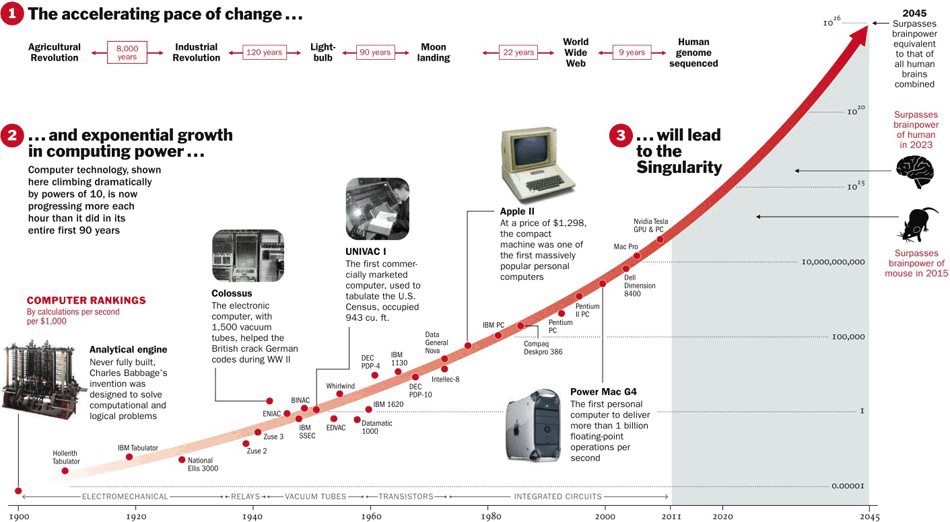
Since the advent of TCP/IP as a communications method, we've seen a torrential flood of increase in recorded entropy, at a rate that is not possible to be encompassed via human reckoning. Human generated messages alone have exponentially multiplied decade after decade, with electronic communication only serving as a means to facilitate what seems like an inevitable trend.
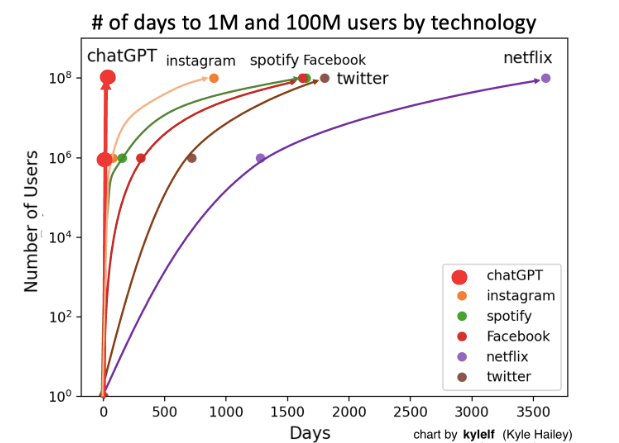
The advent of LLMs, and their rampant adoption cycle, has been even faster in their race for users.
https://t.co/1zz6C09rBj
Synthetic data generation is only going to get faster from here, with machine to machine communication cycles taking up more and more of the bandwidth we have. There are many quandaries that arise from this, namely:
+ Can I trust who I am talking to is who they say they are?
+How do I achieve privacy in a world that is continually scraped for content and training data?
+Who benefits from this data I generate on a moment by moment basis, and how can I claim this back?
+How does AI not just recursively degenerate into incestuous feedback flows, taking it further and further away from truths grounded in reality?
+How do we understand AI, from its basic principles, before AGI/ASI/"The Singularity" becomes an inevitability?
+How do we, proponents of the decentralized web, form vast distributed compute networks to rival centralized systems and the models that run on them?
The list goes on and on here. Millions of years of data are now being generated in an instant, and, more than ever, we need essential context to frame and defang the torrential outpour of content that has come to dominate our lives.
In this I believe we have to now broach the topic of Verifiable Credentials (or VCs for short.)
VCs have the potential to act as the new base layer for the advent of computational data markets, trusted data markets, and reputation markets, codifying and contextualizing the means by which we act on and through the internet, and thereby in the algorithmic mechanisms (not exclusive to LLMs) we are participating in the generation of.
If data is the new oil, then seizing the means of production (issuing VCs) allows anyone to participate in the Oil Rush of their own information.
AIs are data hungry entities, constantly crying out for new inputs and computation to digest said inputs into their corpus. Additionally, the future of governance of said models are being fought out through massive movements in market valuations of startups, publicly traded companies, and even entities like $TAO (Bittensor) which deploy novel tokenomic methods to foster a more decentralized approach.
Regardless of the form of these LLMs, LAMs, or any other myriad of forms of Generative AI (GenAI) that will emerge down the line, they are in desperate need of high quality data.
This is where $CHEQ comes in.
$CHEQ has built the primitives of credential issuance, revocation registries, and credential payment rails, in order for users to manage the complete lifecycle of verifiable data streams, erecting guardrails around the lifeblood of GenAI.
Simply put, this means we can trust where data is coming from, and the creators of that data can be recognized and remunerated when it is used.
$CHEQ has already established replicable, sustainable business models around reusable KYC/AML credentials, and can do the same thing for the Web3 GenAI data market in three key areas:
1. Verifiable Hardware; this enables decentralized distributed compute networks to better incentivize verified tiers of miners based on GPU and hardware specs. This is critical for incentivizing edge compute to join AI Web3 compute networks. Think how CHEQ can power and verify hardware for miners to be incentivized by networks like Bittensor, Akash, and Gensyn.
2. Verifiable Hardware Monitoring; VCs created to verify geo-location of mining rigs, uptime, performance metrics. Assuring four 9s levels of dependability is essential for going toe to toe with the likes of AWS. No less is acceptable. By enabling projects to build “clusters” of connected machines, we can minimize latency and maximize throughout for training ai models. This is critical for distributed computing networks in Web3 to crystalize around Web3 GenAI models.
3. Verifiable Datasets; The creation of reputation markets around quality attestations of datasets allows for the ambient creation and training of decentralized GenAI models. Each model can train on data that mitigates against hallucinations, copyright issues, and privacy leaks, all the while honing the quality of the output of responses to user queries.
The need for these sorts of decentralized utilities has never been greater, and only $CHEQ is well positioned to fulfill these market needs. Speaking as someone who has been in $QNT since the beginning, I can testify that this utility is just as important as bringing CBDCs into the world. Infact, as seen with the release of EIDAS 2.0 (which $CHEQ is deeply embedded within), digital identity primitives are a prerequisite toward the adoption of CBDC.
I have no doubt that some groundbreaking announcements, partnerships, and technical developments are coming down the pipe for this project, and it has cemented itself as a key holding of mine in the coming bullrun.
Doubt this project at your peril; a public utility of this scale, mediated by such a team, will be a beast to behold.
$CHEQ is pushing through key resistance as we speak..
There is a lot of air above until ATHs
Top trending project for past few days on @coingecko
Accumulation is over.. Expansion is beginning 🔥
Its time for my @cheqd_io TA.
After a two years of accumulation, so much building and progress by team, $CHEQ is finally ready for the take off.
$CHEQ is on a mission to restore confidence in the digital world, utilising DID and verifiable credentials to guarantee that all data and interactions on the blockchain are both secure and verifiable.
Every AI project $TAO, $FET, $RLC, $AKT, $VRA, $AIOZ, $GLM hinges on the reliability and integrity of its underlying data, and that's where $CHEQ comes into play.
LFG 2024 this is our year !
As a real person and not AI, I’m building my portable #reputation and taking it everywhere. Sign up and build yours too!
Spread the word – https://t.co/KItmx1fQXU
#TrustWeb3#IamReal