Not all @AAS_ResNotes can be posted on @arxiv . Thanks to the @adsabs API & @javacitrus who updated my code + added in the slack functionality, we have a daily python script that finds new relevant RNAAS & posts links to the collaboration slack channel https://t.co/iD9WP0JtCP
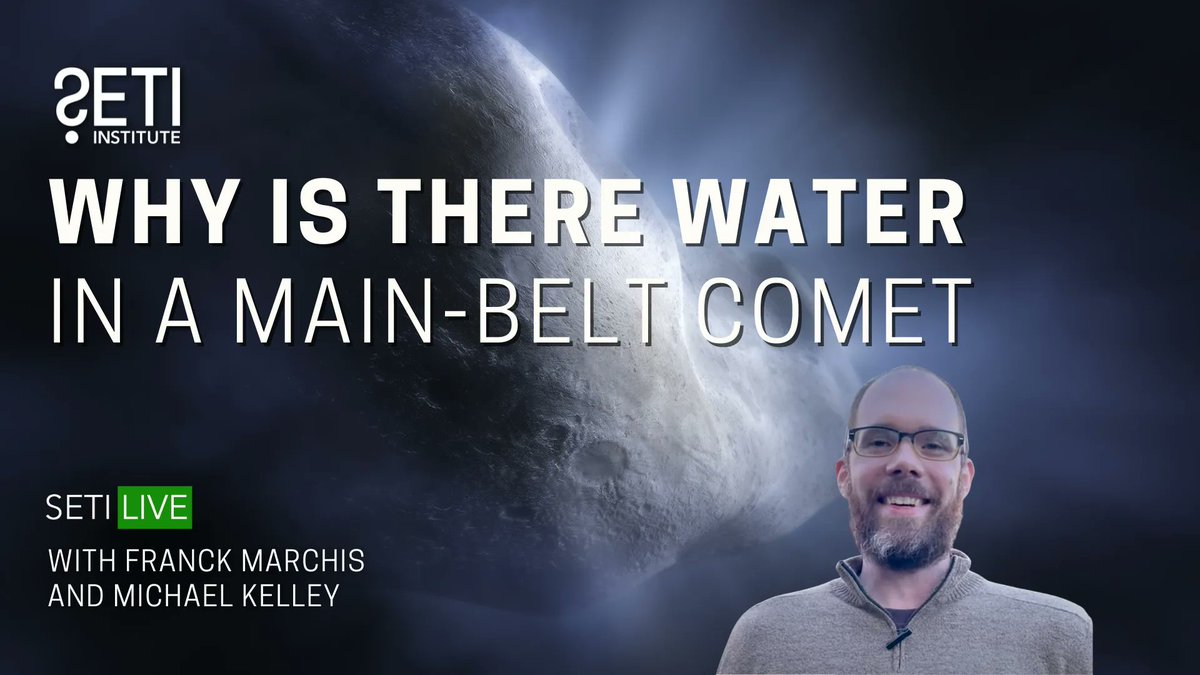
Next #SETILive: Water in a Rare Main-Belt Comet?
TODAY, Jun 08, 2:30 PM PDT
@NASAWebb recently revealed the surprising presence of water in a main belt comet. Join @javacitrus and @AllPlanets as they discuss the significance of this discovery. WATCH LIVE: https://t.co/cAQx7rdvRQ
Using #JWST infrared tech, @UMDAstronomy's Michael Kelley and team confirmed #WaterVapor around a comet in the main #AsteroidBelt.
Published in @Nature, this is a major benchmark in the study of main belt comets – and the origin of Earth’s water. https://t.co/0dkN8yYwgu ☄️
Com-et me, bro. ☄️
Webb confirmed the 1st detection of water vapor around a rare type of comet in the main asteroid belt. This suggests that ice from the early solar system can be preserved there—a breakthrough for studying the origins of water on Earth: https://t.co/YNOfHVQzsT
Com-et me, bro. ☄️
Webb confirmed the 1st detection of water vapor around a rare type of comet in the main asteroid belt. This suggests that ice from the early solar system can be preserved there—a breakthrough for studying the origins of water on Earth: https://t.co/YNOfHVQzsT
The first #JWSTPhoto that @SpaceTelescope's Alyssa Pagan (B.S. '16, @UMDAstronomy) processed was the image of the "Cosmic Cliffs" of the Carina Nebula.
"It was gorgeous, honestly, to me from the get-go," she told @TorontoStar's @smckinley1. #ScienceTerps https://t.co/SfRPlvbuYP
Wow, that's quite a shutter! For scale, the barrel there is as tall as a person.
It takes so long to open/close that it needs to close in the same direction it opens to ensure uniform exposure time across the focal plane! Otherwise one side of the images would be too bright.
I sure hope this works! At #DPS2022 yesterday, we showed how our NIRCam photometry indicates that the surface of the nucleus is red, so maybe little to no water ice on the surface, or maybe just small grains. We need spectroscopy to test these hypotheses!
I am now observing HALE-BOPP-UPDATED-ORBIT using NIRSpec IFU Spectroscopy for 7 hours and 29 minutes. Keywords: Comet. Proposal: https://t.co/yh2MEKiluH 2:1
This paper is everything you want to know on how various options for the @VRubinObs LSST cadence impact Solar System science. This paper is so long because we aim this to be a complete resource. This has been a huge effort by many coauthors making this thing come together.
Animation (sped up 500x) from one of @LCO_Global's 1 meter telescope at @SAAO South Africa showing effects of #DARTMission impact into Dimorphos (Still no threat to the Earth... Long straight streak is camera artifact)
Starting at 2:30 pm Pacific Time on Monday 9/26, the world can watch real-time images (1 every second) as the DART spacecraft steers itself into Dimorphos for humanity’s first asteroid deflection test! #DARTMission
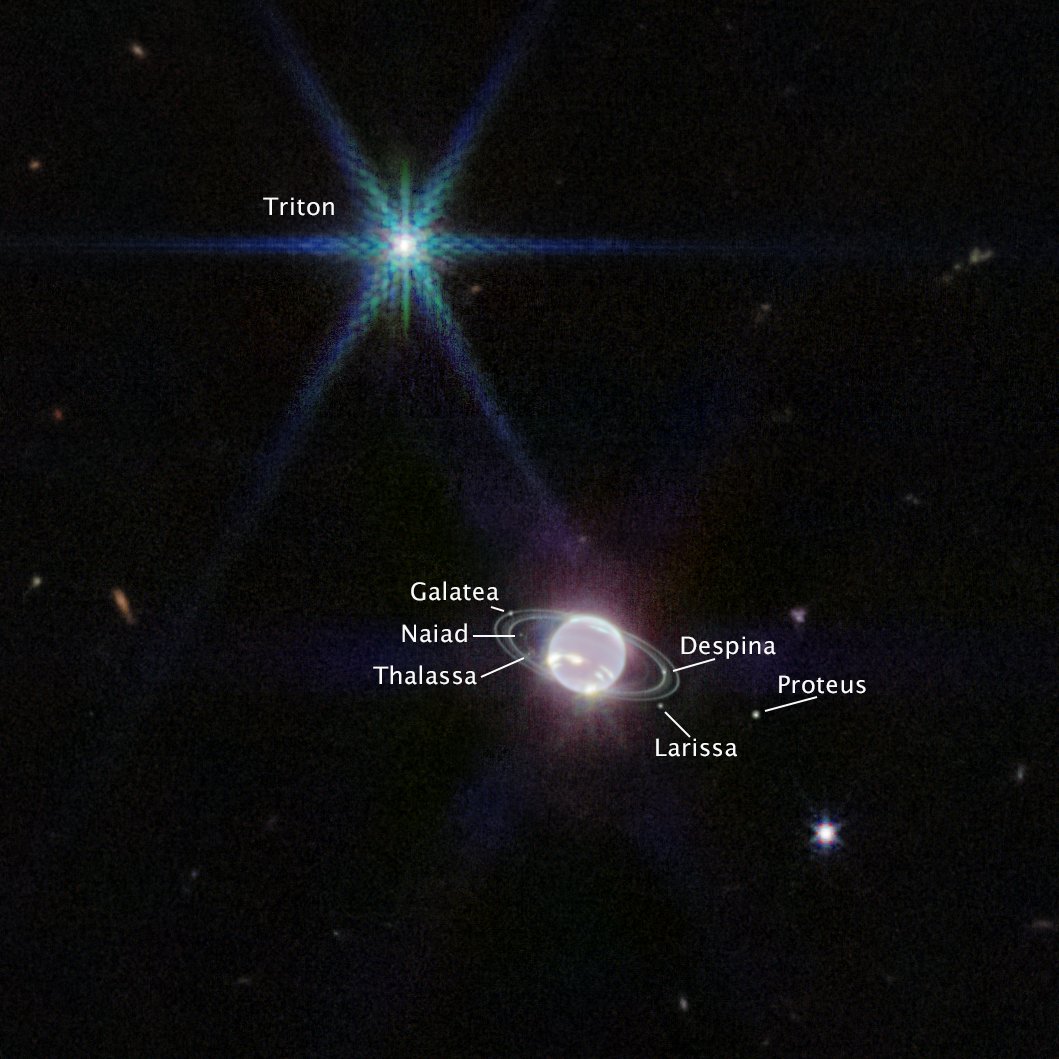
That’s no star. It’s Neptune’s large, unusual moon, Triton! Because Triton is covered in frozen, condensed nitrogen, it reflects 70% of the sunlight that hits it — making it appear very bright to Webb. 6 of Neptune’s other moons (labeled) are also seen here.
It's so exciting to be at an in-person EPSC again! And so happy to share the exciting work on 2014 UN271/B-B's outbursts thanks to our team's effort: @javacitrus @carrie_adastra @CyrielleOpitom et al.
Check out this article for how @DrCordiner@cathomas09 @SNMilam myself and our fabulous team are trying to unlock the secrets of interstellar objects! https://t.co/N9jkTZAjPo
And shout out to all the sky surveys, @VRubinObs, @PanSTARRS1, @ztfsurvey, and the amateur astronomers who are going to find those interstellar objects!
@amhistorymuseum This 1849 solar system map may look different from what you’re used to. Neptune and Uranus were called Le Verrier and Hershel, and Pluto hadn’t been discovered yet.
It’s in “Smith's illustrated astronomy,” a book by Asa Smith for schools and the public, now in our @SILibraries.