Head of Research @Liquid_Capital_ | Deep macro tracking thesis narrative flow | Backing asymmetric early stage plays | DMs open for high signal pitches
PIERS MORGAN: “Is it unthinkable that someone like [Tucker Carlson] could become the new face of the Republican Party?”
TIM DILLON: “Certainly not. I don't think it's unthinkable … I think Trump's damaged the Republican brand for years to come.”
Doing a talk at a BN Fund AGM in 20 mins.
On this exact square in London 12 years ago, I was an intern at a wealth management firm.
I was useless. I hated it.
1 year later I started 20VC, following my greatest passion; startups and venture.
1 year after that, I made $1M in a weekend through the pod to pay for Mum’s MS medication.
Just find what makes your heart sing and always look after your mama! 🤣
Whether it’s existing consulting firms, new ones that emerge, FDEs from agent vendors, or new internal agent engineering roles, the amount of work that is going to be created to implement agents in enterprises will exceed anything we imagine today.
The complexity of implementing agents in any existing organizations is very real. When I talk to large enterprises, as you move from a chat paradigm to agents that participate in meaningful workflows, there are a number of things they need to do.
First, you have to get agents to be able to talk to your data securely across your systems. In many cases, enterprises have decades of legacy infrastructure that contain the valuable context for AI agents. That’s going to take a ton of work to go modernize and move to systems that work well with agents.
Then, you need to ensure that you’ve implemented agents with the right access controls and entitlements, the right scopes to be safely used, and have ways of monitoring, logging, and securing the work that they do.
Next, you need to actually document the processes in the organization in a way that agents can utilize for doing the work. You also need to figure out what the new workflow looks like when agents and people are working together on a process, and who steps in where. Just replicating the old workflow will mute the gains. Oh and you likely need to create evals for your top new end-state processes.
Finally, you have to keep up with a rapidly changing set of best practices and architectural shifts happening in the agent space. While it’s fun for people to change their personal productivity tools on a dime, it’s 100X harder to do this in a business process. The speed of change is a blessing and a curse right now for anyone trying to keep a stable system design.
All of this means that individuals and companies that develop expertise on the above set of components (and more) are going to be needed to help organizations actually implement agents at scale. This is also the rationale for vertical AI agents right now that can go in deep on a business domain and help bring automation to it.
This is a huge opportunity right now whether you’re doing this internally or as an external business provider.
"$400M ARR growing 30% used to be great. It is not anymore.
In today’s market, the bar is much higher, you need to be on a path to $1B+ growing 40% to generate real outcomes.
Anything below that risks becoming a “good company” with a bad IPO." @jasonlk
Do you agree with this and how do you do think about it @parkerconrad@awxjack@chetanp@gradypb
Sam Altman Says CEO’s Who Talk About AI Taking Everyone’s Jobs Are ‘Tone Deaf’
“Someone said to me just yesterday that … GPT 5.5 in Codex can accomplish in an hour what would have taken me weeks two years ago … and I have never been busier in my life.”
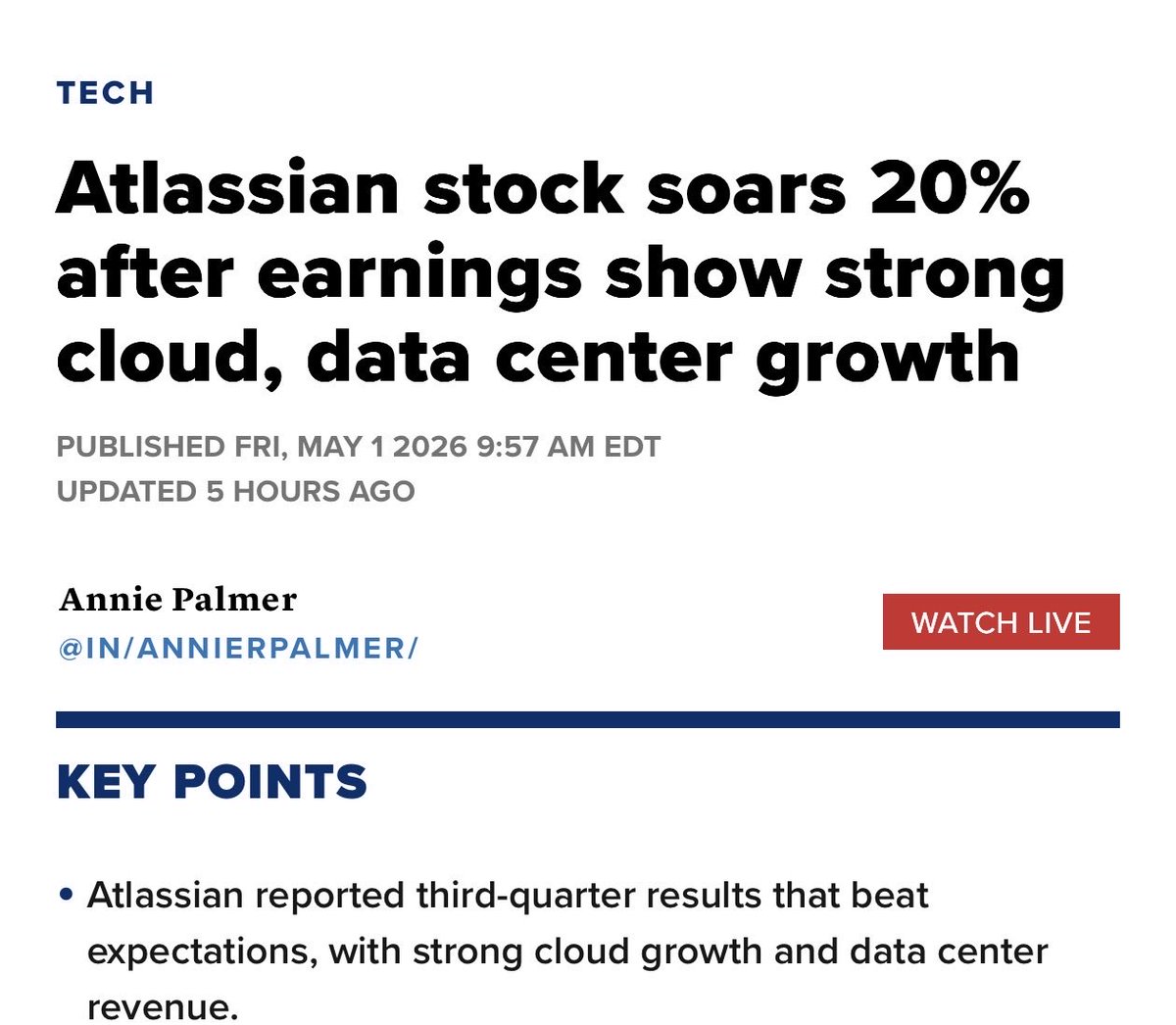
Atlassian’s results surprised Wall Street, but it shouldn’t be a surprise. The simple heuristic for the future of software is that when there are 100X more agents than people, which parts of software will grow because agents are doing more work that the underlying software is tied to.
If the world generates more code, generates more leads, reviews more contracts, processes more invoices, creates more designs, transacts with more payments, and so on, what are the underlying systems that are managing that work? That will give you a hint as to what happens next.
These agents still need guardrails, security, compliance, workflows to be tied to, data stored, and so on. Those parts of the system of record ecosystem will only go up over time in a world of 100X more untrusted (and trusted) agents used in your workflows.
love the idea that you’re not really qualified to run for office in california until you’ve spectacularly failed in some lower office for at least a decade or so
I’ll admit before yesterday I didn’t know there was a law on the books requiring that states draw special little racial enclaves. Sounds completely psychotic to me.
Will keep saying this, but software jobs aren’t going away. Agents are the single biggest form of leverage for anyone technical in history. Probably has never been a better time to be technical in terms of being able to accomplish something solo, in a team, or company.
We think that most of the world’s software has already been built and that agents will just reduce work from an existing pie. In fact, we are about to experience 100X more software than before.
Think about how many apps you regularly use that need to get better. How many legacy on prem systems that have to get replatformed for the cloud. How many SMBs never could hire developers. How many security issues are about to be uncovered and need to get patched. How many IT organizations are about to bring automation to workflows they never could have automated. How much data is about to processed and connected in most organizations. This is all what the agents will be working on.
And every one of those agents will need a person to kick them off, manage their work, orchestrate them, and get their output into a workable and useful form. That person will generally need to be technical (or become technical quickly), and this will create a huge amount of opportunity for anyone up to the task.
Why investors need to give CEOs better comp packages:
"We went public in 21. First year, the stock went up to about 40BN market cap. In 2022, we fell 92% to a little under $4 billion market cap.
For the life of the company, I had only taken equity. I had taken no compensation. At the bottom in 22, I made a decision and that was for the first time to ask for compensation.
I felt like I'm public. Turning this company around is a big task, and I'd like to align myself with investors to say, I'm gonna get paid, but I'm only gonna get paid if the stock recovers.
In order for me to get paid anything, the stock had to clear a certain price.
CEOs who are founders originally started a business taking really big risk. If the belief is that the CEO should then never get compensation ever again, it's completely flawed logic." Adam Foroughi, @AppLovin
What are your single biggest lessons/advice on this @vkhosla@bhalligan@infoarbitrage@taavet@elonmusk?
“There is a self-hatred in the West that can be considered only as something pathological.
The West attempts in a praiseworthy manner to open itself completely to the comprehension of external values, but it no longer loves itself; it now only sees what is despicable and destructive in its own history, while it is no longer able to perceive what is great and pure there.”
— Cardinal Joseph Ratzinger (Pope Benedict XVI), “The Spiritual Roots of Europe”
🚨 $XRP: Franklin Templeton's Head of Digital Assets recently stated they didn't buy $XRP "to speculate." They bought it because they "NEEDED TO USE IT" within a potential addressable market. "That was our tipping point." 🔥
Centrifuge V3.1 is live.
Issuance is just the starting point. With V3.1, Centrifuge becomes the first protocol to run accounting, pricing, and reporting fully automated onchain.
Distribution across 10 networks in a single transaction.
https://t.co/xsZQvWtPKe
We’re thrilled to announce that @Ripple is partnering with Aviva Investors to bring traditional fund structures to the XRP Ledger. This marks our first collaboration with a European investment management firm to tokenize real-world assets (RWAs) at scale.
By leveraging the speed, low cost, and sustainability of the #XRPL, @avivaplc Investors is looking to the future of asset management.
We’re excited to work together throughout 2026 to bridge the gap between institutional finance and blockchain utility. 🚀
Read more about how we’re transforming the ecosystem:
https://t.co/Kyimy7mg3i
The IPO playbook is changing. The next era will be issuer-led distribution that reaches demand where it lives today.
Legacy rails AND onchain.
@hiltnerjim shares the vision with @therollupco’s @Robbie_rollup:
Just in: @Ripple's institutional prime brokerage platform adds @HyperliquidX support, letting clients trade onchain derivatives and cross-margin DeFi with traditional assets.
Hyperliquid, meet Ripple Prime: https://t.co/xZnpJ9Q5jQ
We’re now enabling institutions to access onchain derivatives liquidity through @HyperliquidX in a streamlined and secure way. Customers can also efficiently cross-margin crypto with all asset classes supported by our prime brokerage platform.
Institutions, welcome to the onchain economy.