Congratulations, Vithya! We are proud of you for embodying commitment, determination and perseverance; for inspiring thousands of young people & bringing laurels to Coimbatore and Tamil Nadu with your stellar representation of Bharat. Best wishes & Blessings. -Sg #AsianGames2026
When you know the oneness of life, when you realize the unity of existence, there is love in your heart and the Divine in your experience. #SadhguruQuotes
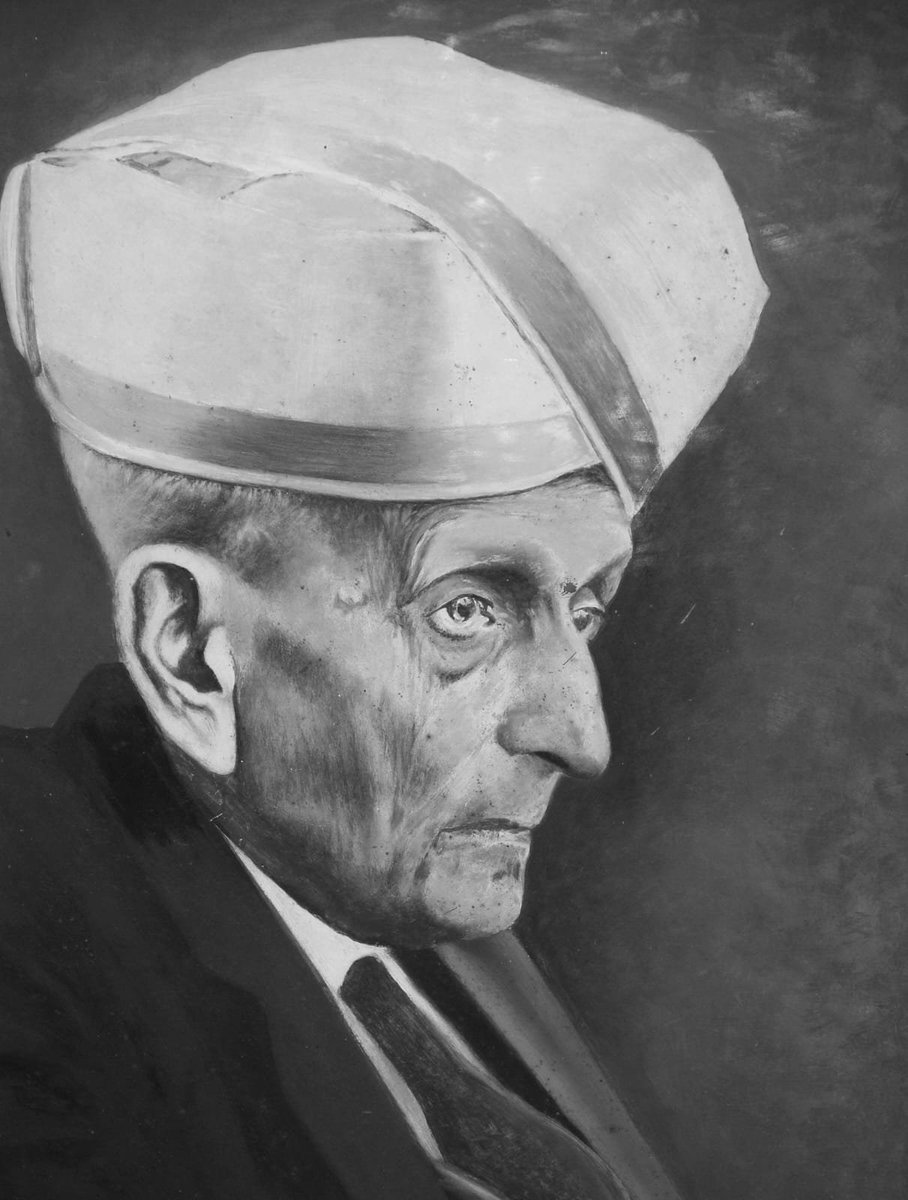
Sir M Vishveshwaraih born in Muddenahalli, a village very close to our ancestral home. An inspiration to every Engineer. Engineering skills are vital for creating a Bhavya Bharat. May we grow many more great engineers. 🙏🏽 - Sg #EngineersDay
Stri Shakti! Congratulations to the T20 Women’s Team of Bharat on your record 8th Asia Cup title. Well played & well deserved! Best wishes & Blessings. -Sg @BCCIWomen
THE CHARGE AGAINST ISHA
After Isha announced Kalabhairava processes for those affected by the Tibet floods, the familiar criticism appeared:
“Where is this exact ritual in scripture?”
“Which text gives Sadhguru this procedure?”
“Isn’t this simply an invented Isha ritual?”
Fair question.
But some traditionalists are asking it using a framework Sanatana Dharma itself never required.
I attended the Kalabhairava process today, at the Isha Yoga Center in Coimbatore, in person. In fact, hundreds of people did, both the residents of the place and people like me who came from outside.
Having been to the Isha Yoga Center a few times on the occasion of Sadhguru's birthday (3rd September), this is the most somber I have seen the place in over 2 decades. There were no usual celebrations, and even the air seemed to be in a quiet mourning for the departed.
The Kalabhairava process was done only for those families that wanted it - not all the 80 that went missing in the Nepal floods - and in the presence of the family members.
Of course, every person who attended the karma was advised to take a bath, and have a change of clothes after the process was over, along with receiving the asthi prasadam.
The process, drawing from the energy of the space, was quite a powerful one that shook many. Anyone who has really experienced a surge of energy in any place would instantly understand what I'm talking about.
If one has an opportunity to attend such a process, they should. Even if one does not understand or perceive any energy surges within their systems, it would still act as a very powerful reminder of our own mortality.
May Kalabhairava ease the pain of both the departed and the living. Shambho!
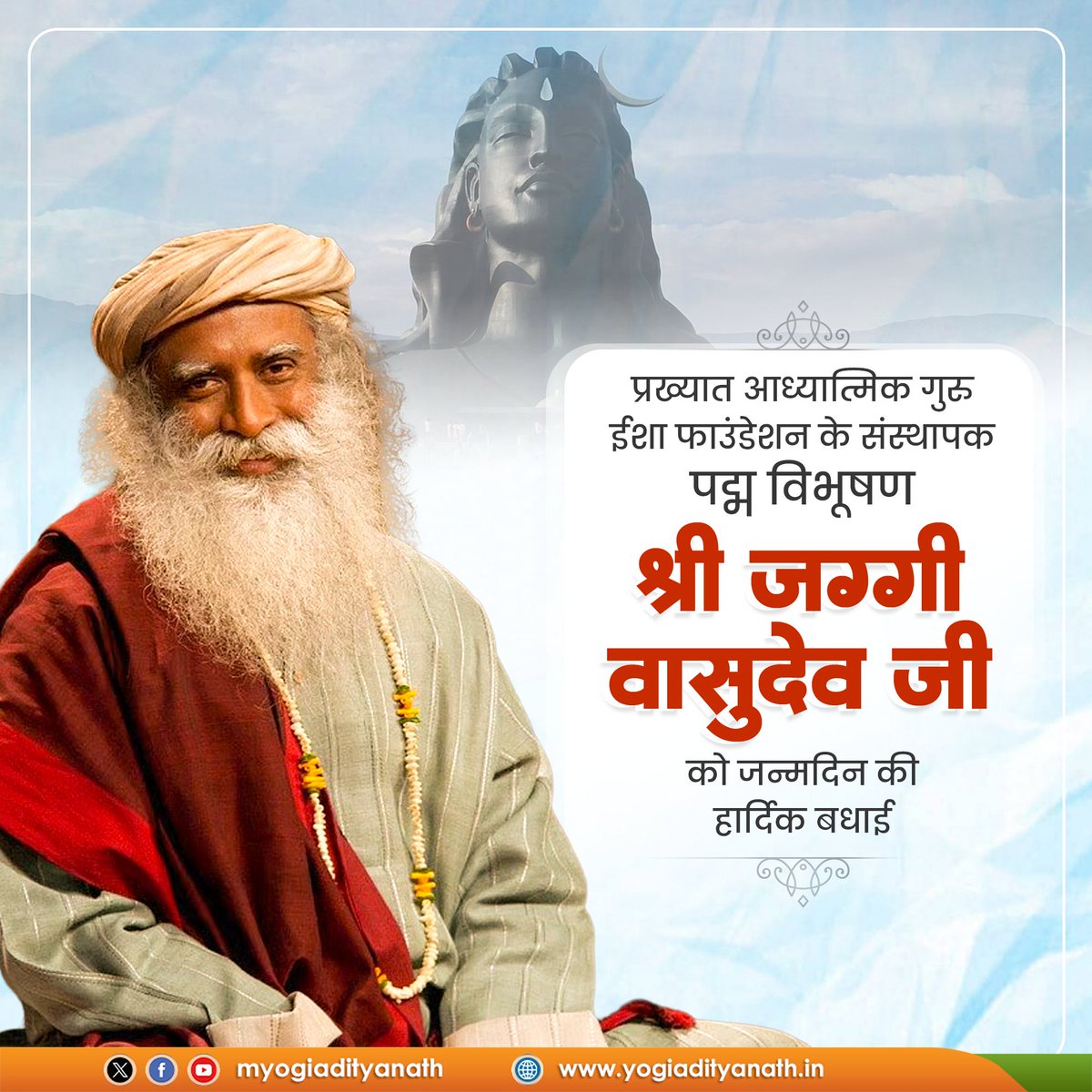
विश्वविख्यात आध्यात्मिक गुरु, @ishafoundation के संस्थापक, 'पद्म विभूषण' श्री @SadhguruJV जी को जन्मदिन की हार्दिक बधाई।
आध्यात्मिक चेतना के जागरण, प्रकृति संरक्षण तथा लोक-कल्याण के प्रति आपका समर्पण समाज के लिए प्रेरणास्रोत है।
देवाधिदेव महादेव से प्रार्थना है कि आप उत्तम स्वास्थ्य, सुदीर्घ एवं यशस्वी जीवन के साथ अपनी साधना, सेवा और ज्ञान से मानवता को निरंतर आलोकित करते रहें।
Just look at how the ecosystem is working hard to protect China's interests and making sure no one is thinking about the real questions of how China built so many dams & tunnels there recklessly.
Suddenly, a Guru gets the blame for a disaster, but not the nation state that may have actually caused the disaster itself by its reckless action!
The entire attention is being shifted elsewhere folks. Gullible traditionalists are also falling for this narrative.
This is the Dimagi Naxalism our PM was pointing out in his Independence Day speech.
@ArunKrishnan_ Extremely vile. He also twisted the very statement of not letting anyone die as some kind of life insurance, taking it totally out of context.
https://t.co/jMW5sYcCYd
Some articles don't merely make you think. They make you remember.
I just read the Times of India column “When a Master Weeps, a Seeker Learns.” I finished reading it, but couldn't immediately move on. The columnist's experience of seeing a Master weep touched something very personal in me and, almost instinctively, my thoughts went to my own Guru, Sadhguru.
As a seeker, I have often looked at Sadhguru with a mixture of awe, surrender and curiosity. How can someone remain so deeply rooted within himself and yet be so intensely involved with life? How can one speak about the impermanence of everything and still be deeply moved by human suffering? Perhaps the article helped me understand something I have felt but never quite articulated: realisation does not make the heart cold.
We often imagine a realised person as someone whom nothing can touch. But perhaps transcendence isn't about becoming incapable of feeling. Perhaps it is about being able to feel deeply without becoming a prisoner of those emotions. That is something I have sensed in Sadhguru. When his voice softens or emotion surfaces while speaking about suffering, I don't see weakness. I see an immense sensitivity that hasn't been lost in the journey beyond oneself.
The article also made me confront something I don't always want to think about: everything I love here is temporary. People will leave, bodies will age, relationships will change, and one day even the Guru in physical form will not be here. Yet knowing this doesn't make life meaningless. It makes every moment more precious.
Perhaps that is the real lesson hidden in a Master's tears. Not how to escape grief, but how to remain fully alive even when the heart hurts. Not to become detached from life, but to participate in it completely while knowing that nothing can be held forever.
That's why this column stayed with me. I wasn't merely reading about someone else's Guru. I was thinking about mine, and feeling a quiet gratitude for having a Guru who teaches me not to run away from the human experience, but to live it totally, consciously and joyfully.
When a Master weeps, perhaps the seeker doesn't merely learn about grief. The seeker learns how precious it is to be alive.
Namaskaram, @SadhguruJV ji 🙏
https://t.co/4DfzT79dOG
There are a few basic problems with this argument.
First, the writer’s personal medical emergency is being presented as though it proves that Sadhguru abandoned him. He developed a serious altitude-related problem, was taken to a hospital for treatment, and eventually returned home. Being separated from a group because you require medical attention is not evidence of a broken promise. It is precisely what medical and logistical arrangements are meant to address.
Second, the entire argument is built around a claim Sadhguru supposedly made - that he has some mystical power to prevent people from dying. He has never claimed that. What he has said is that every possible care would be taken to ensure that people return safely. There is a very obvious difference between taking every possible precaution and claiming supernatural control over life and death.
Sadhguru is a yogi. His work is about offering yogic tools to help people live more consciously and exuberantly in this life. It is dishonest to turn that into a claim of physical immortality and then attack him for something he never promised.
Third, the post itself gets a basic fact wrong. It says that Sadhguru has been to Kailash 51 times. At the recent In Solidarity with Nepal event , Sadhguru referred to this as his 21st visit to Kailash. If we are going to build an argument around someone's words and experiences, perhaps we should begin by representing them accurately.
And finally, what happened at Gyirong was a devastating natural calamity. Kailash has never been an ordinary tourist destination. The pilgrimage has always involved enormous physical hardship and the unpredictability of nature. Yet generation after generation, for centuries and millennia, people have undertaken this journey because of what Kailash means to them.
That is precisely why I find it difficult to understand the need to turn this particular tragedy into an attack on one person.
When a natural calamity strikes, and a post selectively focuses on one individual while making so many incorrect claims about what he said and what actually happened, it stops looking like genuine concern for the people affected.
Whether it is for views, personal vengeance, or some other reason known only to the person writing it, using the suffering and uncertainty of grieving families to build a personal narrative against Sadhguru is deeply distasteful.
A tragedy deserves facts and compassion - not a predetermined narrative.
Toolkit got activated 😭😂
Kailash Manasarovar yatra is so arduous in the pas, always a few will die in every group that embarks the journey
Isha has changed this fate with extreme discipline & diligent planning, thinking through every minute detail. This is what Sadhguru meant
@bindu_t@SadhguruJV True! What most Isha meditators have is trust in Sadhguru to take them beyond spiritually and not physical safety. That’s a simple aspect most people are missing.
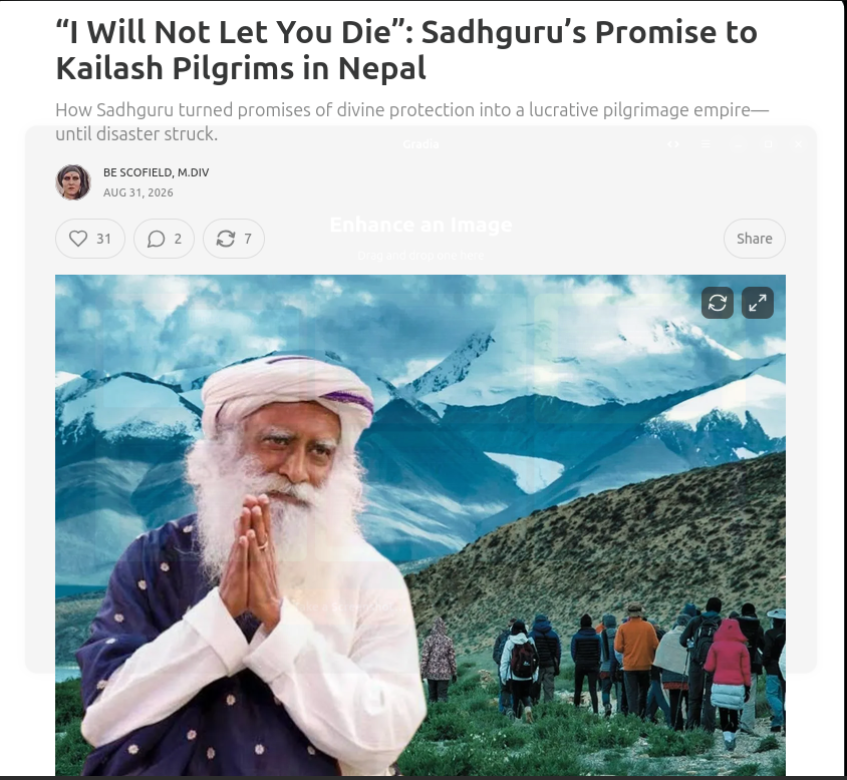
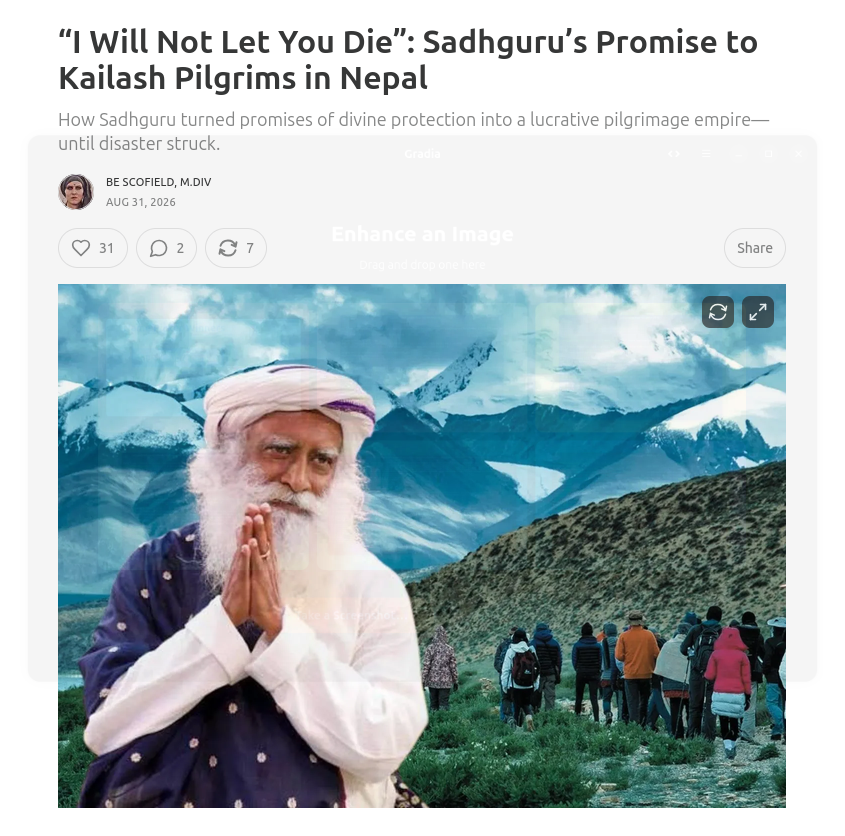
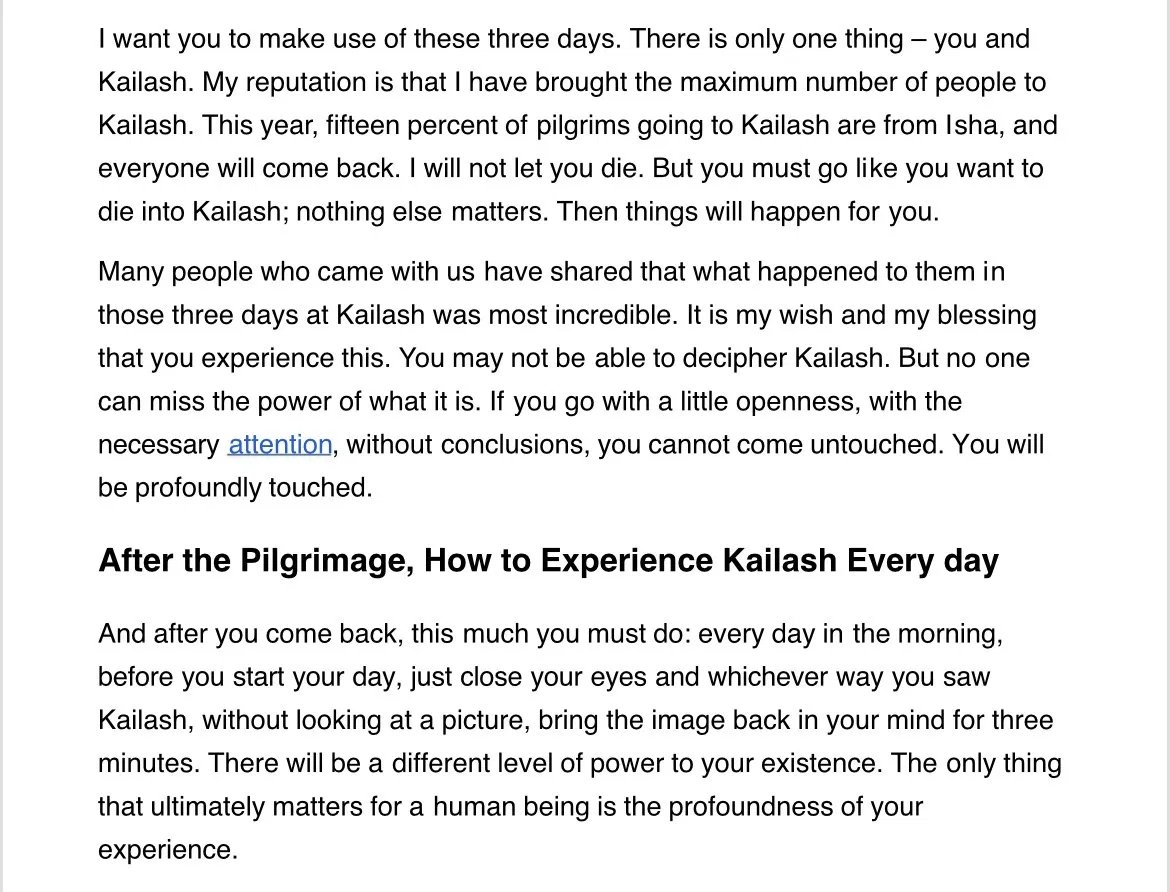
The line everyone is passing around as having said by Sadhguru is "I will not let you die."
Four words, ripped clean out of the paragraph they live in, and held up as proof that a man sold pilgrims a guarantee against death, and therefore owns their deaths when a glacier came down.
So read the paragraph. It's public - Isha has published it. The link is below.
https://t.co/z0xYiuo5xy
It's from a talk at the foot of Kailash in 2017. The entire address is about one thing: surrender.
He tells the pilgrims this is not a tour or a trek, and that a pilgrim doesn't go to conquer the mountain. He goes to wear himself down, to become less than he imagines himself to be.
And in the very same breath as "I will not let you die," he tells them to enter Kailash as though they came to die into it, to lose the self completely, to hold nothing back.
You cannot honestly read one half of that sentence as a literal promise about the body while ignoring that its other half begs you toward a death of the ego. The two only make sense together, and together they say something every mystical tradition has said for millennia: do not be afraid of dissolving here and so let go entirely.
That is not an insurance clause. It is the oldest instruction a spiritual teacher gives.
"You are safe, so surrender" is the language of a guru speaking to a disciple's fear. It is not the language of a brochure warranting your safe return, and judging it by that standard is a crooked rewrite and not a reading.
Just step back and look at what Sadhguru is being blamed for. A section of glacier broke off a Himalayan peak and hit the valley with enough force to register as an earthquake. Witnesses thought it was a bomb. More than nine hundred people are dead, of every faith and none. No sentence spoken in 2017 turns that back.
Taking a teaching about surrendering the ego, recasting it as the cause of false hope, and then presenting the bill to one man in the middle of a natural catastrophe is not honesty about the dead. It is using them to settle a score.
Read the whole passage. Then decide who did the twisting.
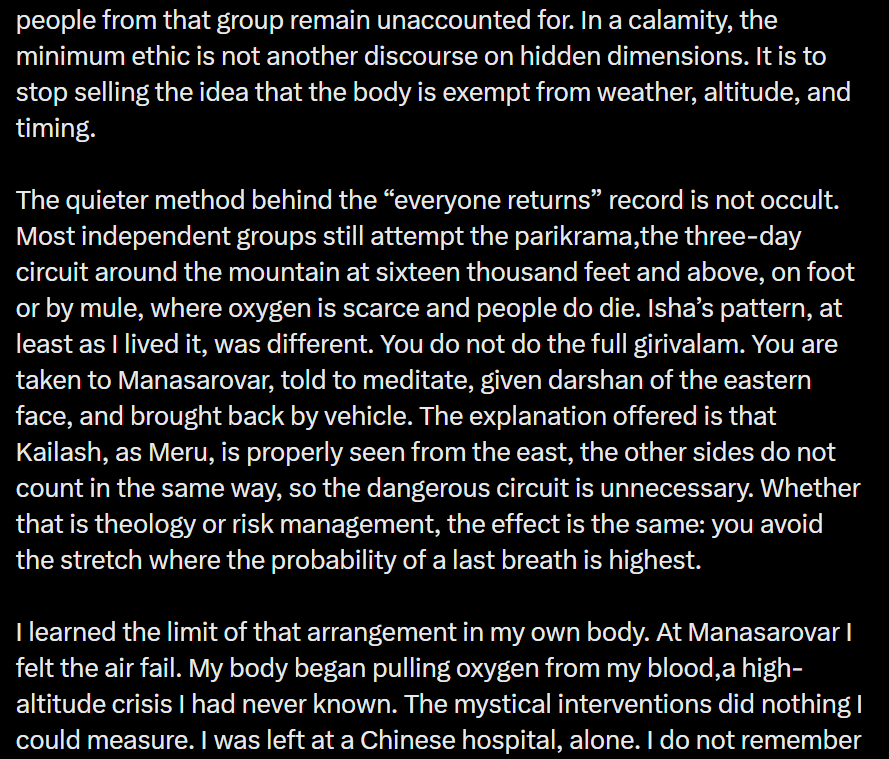
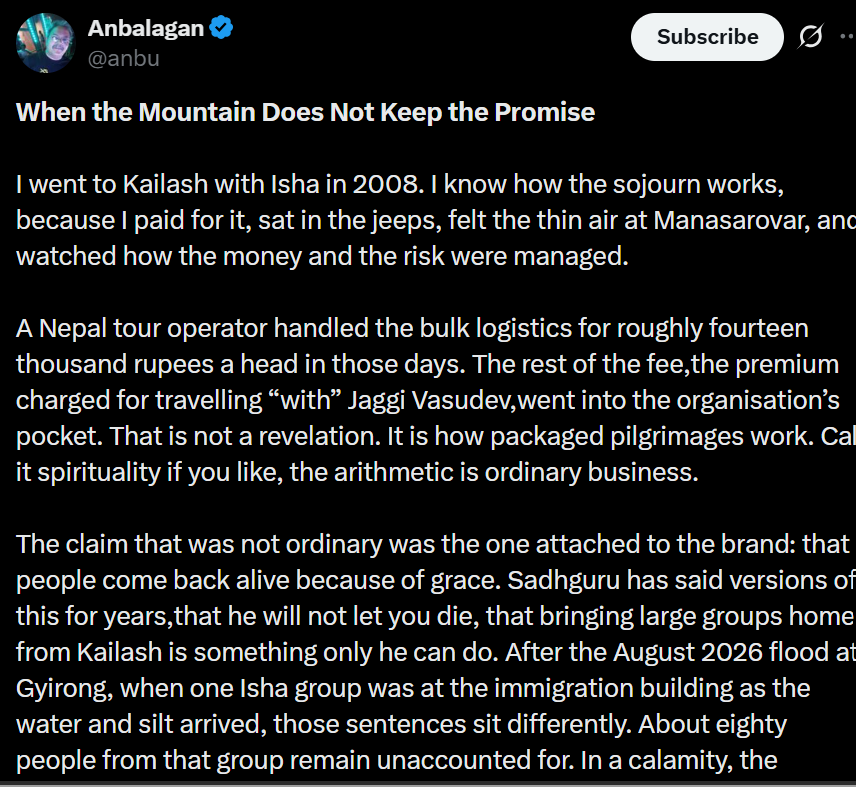
As someone who had also paid to travel to Kailash with Isha, sat in those jeeps, and felt the thin air, I want to clear the air a bit. Let me also be equally plain about what happened this month, because the facts don't support the story you're building on them Mr. @anbu .
On August 26, a glacier failed near Langtang Lirung with enough force to register as an earthquake on seismometers. Witnesses mistook it for a bombing. It sent ice, rock, and debris down the valley in minutes, and it did not check anyone's itinerary or faith on the way.
More than nine hundred people are dead across Nepal, thousands are missing, and the dead include tourists and pilgrims of every nationality and religion.
This was not a pilgrimage that went wrong. It was a regional catastrophe, and one group of pilgrims happened to be standing at the border at the exact wrong minute.
You want to hold a man responsible for that. But notice what you're actually asking.
A commitment to get pilgrims safely to Kailash and back is an operational promise. It is about acclimatisation, medical support, sequencing, choosing safer routes, and by your own account those logistics were run well.
A glacier collapse of seismic magnitude is not in that category. No operator on earth "manages" that away.
Blurring the two, treating competent logistics as if it were a guarantee against physics, is the sleight of hand your whole post rests on.
And if this were about a leader shielding himself while exposing his followers, the timing and facts refute it. Another group that included Sadhguru was due at that same crossing a day later. He was on the same road, in the same window.
And when the Indian government pressed him to fly out to safety, he refused, choosing instead to travel by road toward the disaster site itself, to support the rescue effort and help open a land route for the hundreds of pilgrims still stranded in Tibet.
Whatever else you believe, that is not a man standing safely apart.
On your own near-death at Manasarovar: I'm glad you came home. But you say what brought you back was medicine and descent. That is the safety system doing exactly what it's for, that is, getting a person off the mountain and to care. That isn't evidence the arrangement failed you. It's evidence that it actually worked.
Even granting that the language of grace and protection has been used over the years, here is what that language does not do: it does not make attending voluntary against a person's will, and it does not exempt anyone from the weather. Adults choose this pilgrimage knowing the Himalaya is the Himalaya.
What is owed to the families right now is not a debate about hidden dimensions, and this isn't a debate about business models either.
It is search, rescue, and honest information. That is what is actually happening: appeals to the Chinese authorities for access to the site, coordination with embassies and ministries, families being contacted directly, and standing in solidarity with them for their unfortunate loss - which Isha has been doing.
The mountain does not keep promises. Neither of us disputes that. But turning a glacier's collapse into one man's broken vow isn't judgment. It's classic blame game at the time of grief, searching for someone to be held accountable and settling on the wrong name.
Inspired by the original post: https://t.co/xDhY4bDInG
As sentiment on social media turns overwhelmingly against China, China's pets like this Pissant Bhushan have been activated to divert everyone's attention. Expect more to follow suit.
This is exactly the Dimagi Naxalism that our PM had warned about a few days ago.