Context engineering is turning into the real moat in AI agents.
Manus hit a ~$2B exit.
OpenAI built Kepler to operate across 600+ PB / 70,000 datasets.
Same playbook: they engineered context.
I've written about it there: https://t.co/TKbXg53bX6
Hot take: most “Context Graph” talk is still theory.
Try this: run ONE workflow this week and log a decision trace (goal → tools → decisions → approvals → outcome).
That’s your first context graph.
https://t.co/PPEI0r4WwS
Andrew Ng (@AndrewYNg) on how startups can build faster with AI.
At AI Startup School in San Francisco.
00:31 - The Importance of Speed in Startups
01:13 - Opportunities in the AI Stack
02:06 - The Rise of Agent AI
04:52 - Concrete Ideas for Faster Execution
08:56 - Rapid Prototyping and Engineering
17:06 - The Role of Product Management
21:23 - The Value of Understanding AI
22:33 - Technical Decisions in AI Development
23:26 - Leveraging Gen AI Tools for Startups
24:05 - Building with AI Building Blocks
25:26 - The Importance of Speed in Startups
26:41 - Addressing AI Hype and Misconceptions
37:35 - AI in Education: Current Trends and Future Directions
39:33 - Balancing AI Innovation with Ethical Considerations
41:27 - Protecting Open Source and the Future of AI
As amazing as LLMs are, improving their knowledge today involves a more piecemeal process than is widely appreciated. I’ve written before about how AI is amazing... but not that amazing. Well, it is also true that LLMs are general... but not that general. We shouldn’t buy into the inaccurate hype that LLMs are a path to AGI in just a few years, but we also shouldn’t buy into the opposite, also inaccurate hype that they are only demoware. Instead, I find it helpful to have a more precise understanding of the current path to building more intelligent models.
First, LLMs are indeed a more general form of intelligence than earlier generations of technology. This is why a single LLM can be applied to a wide range of tasks. The first wave of LLM technology accomplished this by training on the public web, which contains a lot of information about a wide range of topics. This made their knowledge far more general than earlier algorithms that were trained to carry out a single task such as predicting housing prices or playing a single game like chess or Go. However, they’re far less general than human abilities. For instance, after pretraining on the entire content of the public web, an LLM still struggles to adapt to write in certain styles that many editors would be able to, or use simple websites reliably.
After leveraging pretty much all the open information on the web, progress got harder. Today, if a frontier lab wants an LLM to do well on a specific task — such as code using a specific programming language, or say sensible things about a specific niche in, say, healthcare or finance — researchers might go through a laborious process of finding or generating lots of data for that domain and then preparing that data (cleaning low-quality text, deduplicating, paraphrasing, etc.) to create data to give an LLM that knowledge.
Or, to get a model to perform certain tasks, such as use a web browser, developers might go through an even more laborious process of creating many RL gyms (simulated environments) to let an algorithm repeatedly practice a narrow set of tasks.
A typical human, despite having seen vastly less text or practiced far less in computer-use training environments than today's frontier models, nonetheless can generalize to a far wider range of tasks than a frontier model. Humans might do this by taking advantage of continuous learning from feedback, or by having superior representations of non-text input (the way LLMs tokenize images still seems like a hack to me), and many other mechanisms that we do not yet understand.
Advancing frontier models today requires making a lot of manual decisions and taking a data-centric AI approach to engineering the data we use to train our models. Future breakthroughs might allow us to advance LLMs in a less piecemeal fashion than I describe here. But even if they don’t, the ongoing piecemeal improvements, coupled with the limited degree to which these models do generalize and exhibit “emergent behaviors,” will continue to drive rapid progress.
Either way, we should plan for many more years of hard work. A long, hard — and fun! — slog remains ahead to build more intelligent models.
[Original text: https://t.co/SHRN5JDvTW ]
All my practical Claude Code tutorials and interviews in one list:
TUTORIALS
Build a movie discovery app in 15 min:
https://t.co/Uvu5Z2eRZM
Build a YouTube research agent in 15 min:
https://t.co/JkSfuZWM3L
Build a family activity finder in 35 min: https://t.co/uHXRYPQ3uO
INTERVIEWS
How the Claude Code team ships | Cat Wu (Product Lead): https://t.co/KEZO8FnjPW
From design to code with Claude Code | Meaghan Choi (Design Lead): https://t.co/ey5ilyn2Kt
AND COMING TOMORROW...
Automate your life with Claude Code in 50 min | Teresa Torres
📌 Subscribe to my YouTube for more extremely practical AI tutorials: https://t.co/Ggqaa3F11Z
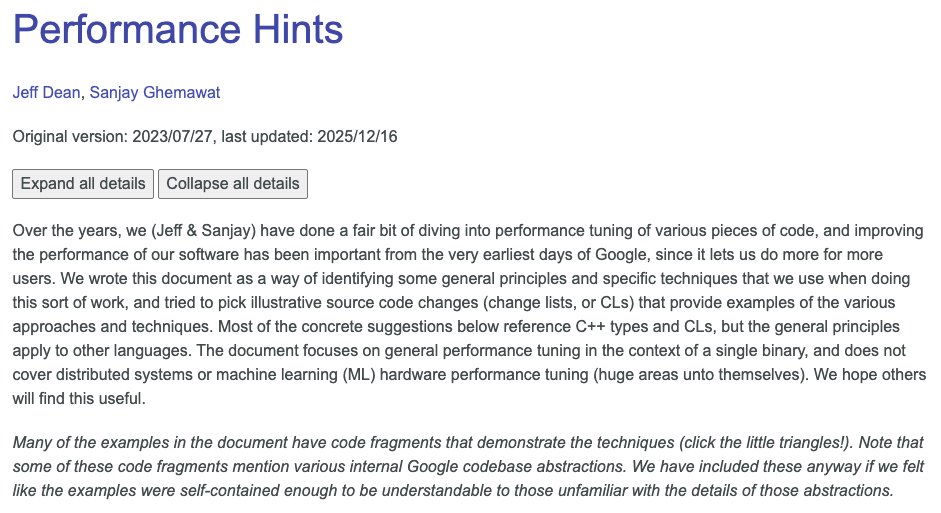
Performance Hints
Over the years, my colleague Sanjay Ghemawat and I have done a fair bit of diving into performance tuning of various pieces of code. We wrote an internal Performance Hints document a couple of years ago as a way of identifying some general principles and we've recently published a version of it externally.
We'd love any feedback you might have!
Read the full doc at: https://t.co/jej95g236P
Most voice AI demos look great.
Then they hit production… and forget who you are.
The problem usually isn’t the model.
It’s memory that was never designed, only bolted on.
🧵 The hidden craft of Voice AI: memory that actually works 👇
Why this matters for Voice AI:
Faster responses (no 20k-token prompts)
Fewer hallucinations
Real continuity: “last time you said X, today you asked Y…”
Easier compliance: you’re not hoarding raw audio/text forever
Memory hygiene = product quality and risk management.
Most voice AI demos look great.
Then they hit production… and forget who you are.
The problem usually isn’t the model.
It’s memory that was never designed, only bolted on.
🧵 The hidden craft of Voice AI: memory that actually works 👇
A simple pattern that works in practice:
After each call, ask the LLM:
What did we actually learn about this user?
What ongoing tasks or promises exist?
What can we safely forget?
Then store only those distilled pieces in your memory store.