This is the equivalent of BYD paying for their own self driving car accidents, take the downside to reduce early adopter hesitation until it becomes inevitable, it also changes the usage behaviour early days which might improve its likelihood of success
AI should earn its keep. Introducing the AI Productivity Guarantee.
If Devin delivers less engineering value than you’re paying for, Cognition will fund your usage until it does, up to $10 million.
It’s time for the AI industry to stop maximizing tokens and start maximizing productive output.
one use case of dynamic workflow is to take the genuine ambiguous leafs of your design and pursue them all in parallel worktrees with /goal to produce better information to inform your design.
I share your excitement.
This feels like it addresses a lot of the frustration around probabilistic procedural tasks, where we kept banging our heads against the half-statefulness of .md files and context-based state tracking.
Less “LLMs emulating applications and occasionally copping out.”
More “just-in-time applications harnessing LLMs.”
The exciting part is whether we can take this beyond dev-only workflows and turn it into an app-building primitive.
Generative BE?
I feel we might be missing the bigger trick here.
Been writing some ideas in this direction:
https://t.co/YjCS4rkuRW
Claude was first to the line with remote control to your dev box sessions, but codex now is far ahead, so good it replaced my telegram claws for many things.
They need to redesign the app and make the execution surface just a property of a chat, no need to complicate things this much.
start a chat + attach to an existing chat.
OpenClaw 2026.6.1 is live 🦞
🪟 native Windows node host
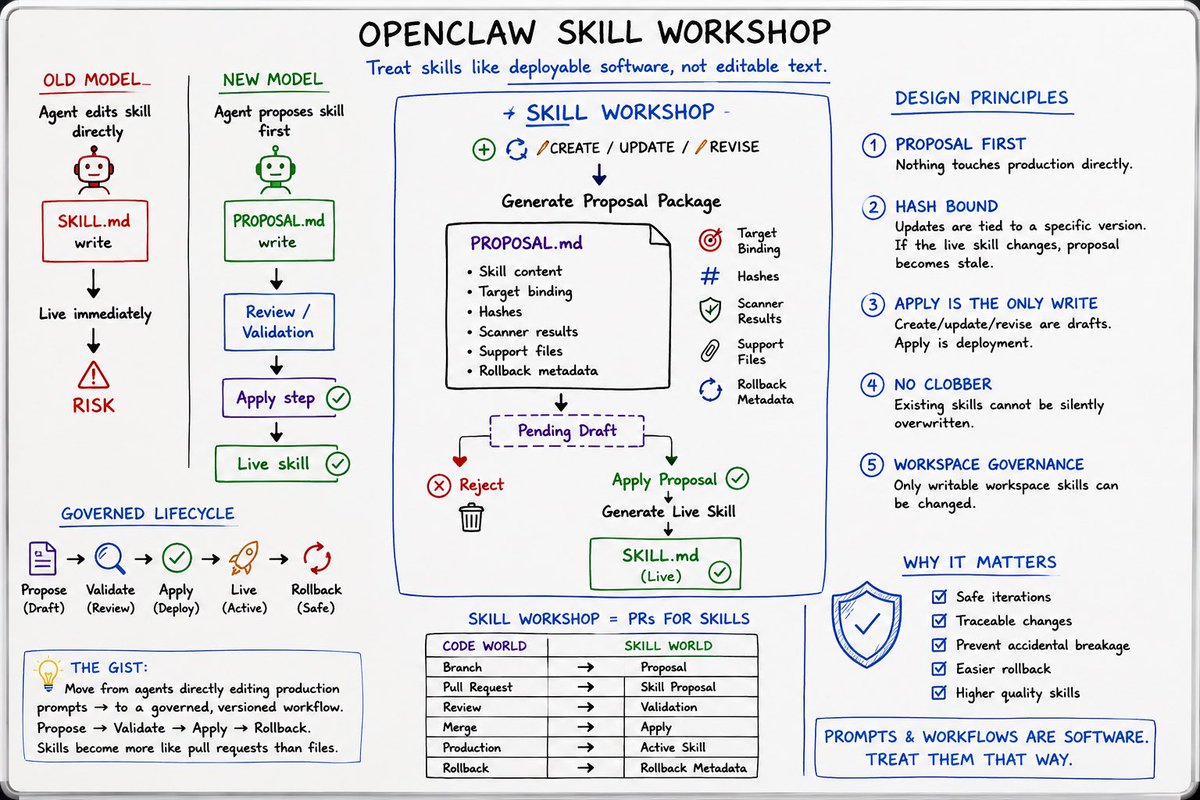
🛠️ Skill Workshop for self-learning agents
📋 Workboard orchestration
🧠 MiniMax M3 support
Windows joins the cluster. No penguin costume required.
https://t.co/xgCOdENFgQ
The cost of software is not only the cost of implementation. It is also the cost of discovering what the software should be.
Dynamic workflows are a sneak peak on how apps can adapt around the outcome the user is trying to achieve and become formidable learning environments.
@OpenAIDevs is there a way via the codex desktop app to connect remotely to an other codex desktop instance as I do with mobile?
I use a macmini dev box + mbp on the go
Product feedback from agents won’t look like human user feedback.
My guess is that it’ll look like a new kind of user research infrastructure for agents.
For example, today an agent can hit a problem, the error message can point it to a GitHub repo, the agent can open an issue, and a maintainer bot can respond. This can happen in a matter of seconds.
Useful. 100x faster. But that isn’t the full story. It’s still just a self-diagnosis, and that diagnosis can be wrong, ill-advised, or just slop.
Most importantly, it doesn’t close the product loop.
To build products that agents use well, you need the signal the “issue → test → fix” loop throws away:
1/ the path taken
2/ the cost of getting there
3/ the friction that repeats across runs
A bug report tells you what failed, but it can hide several missteps along the way.
It doesn’t show the wrong information it read, wasted turns, retries, dead ends, unnecessary tool calls, or brute-force workarounds.
With humans, this signal is slow and expensive to get.
You get it through interviews, usage analytics, support tickets, and session replay.
Because state is explicitly built for an agents to operate, all of the raw material for a rich feedback is already there:
1/ what the agent wanted to do
2/ what the agent saw
3/ what the agent did
That creates a huge opportunity to build products that improve faster: continual learning flywheels, synthetic consumer factories, and product feedback loops that move at agent speed, not user speed.
TLDR: as agents become consumers, user research becomes infrastructure.
WDYT? 🤷♂️
Here's a claude code workflow harness to clarify your writing.
It maps every concept foundations-first, grounds the facts from your own notes and code, isolates the opinions only you can answer for, interviews you on those, then makes minimal edits.
👉 https://t.co/v6LAvpVqco
@trq212 inspiring @trq212 🙏 loved the clarity and the idea. Been using it since launch and really clicked.
I wrote a follow up, imagining the same idea applied at runtime 👇 LMKWYT
https://t.co/JF6vVtDN4j
skills and workflows (i.e. just in time harnesses) are likely going to converge into the same thing I believe and hopefully get widely adopted by other code agents.
Have a go at saving a .js workflows alongside a skill, instead of relying on the "overarching" harness to enforce your procedure, you can have your own portable self-contained skill-specific harness that goes with it.