Your screen is on anyway. It might as well be alive.
@infinidream_ai turns idle displays into living AI paintings - generative, breathing, never quite the same twice.
Free for Mac + Windows.
Just so it has been said: the timber industry has an incentive to spray this glyphosate: they’re turning OUR forests into their farms. And they don’t give 2 💩s about us, the loggers they employ—or the world.
Bayer/Monsanto has 2 incentives: move product AND disguise glyphosate health harms by elevating the baseline. That’s murder we’ll never prove.
This is indefensible: Spraying glyphosate over wild lands is ecocide, and toxic to humans, of course. But there is one upside: It allows us to see the full corruption of our system, which pretends to be preoccupied with our health, even as it poisons the world behind our backs.
It should be obvious to anyone that reads the list below that many of these companies will not survive as companies in a world of AI and Agents.
These are services.
Some more useful than others. But none of them control any capability or rails that couldn’t be negotiated/built (from open source or otherwise) by an agent for much cheaper. The alternatives will come with no capex, no OpEx, no rent seeking etc etc.
The cost advantages of these things being rebuilt as primitives and repriced so it’s principally available to other agents and AI is pretty obvious.
Update: Emailed Surrealism Today, 404 Media, Beautiful Bizarre, TechCrunch, and The Artling platform.
Playing the long game. If one journalist bites, this story reaches thousands of artists.
Patience + persistence + public documentation. 🦣
A lot of what happened is this.
U.S. Universities are designed to be tax supported elite research units. They are tasked with producing a national interest “public good” that markets can’t price, as part of the (slightly cryptic) “Endless Frontier” agreement. They aren’t colleges. Teaching undergraduates is not the core of a research university.
When social and fiscal Conservatives didn’t get this arrangement and welched, they went after universities, which then lurched towards democrats for safety. That then got into a positive feedback loop.
That’s not the full story. But a lot of this was self-inflicted by republicans who pretended that “market failure” didn’t exist, and that there was no agreement. This was particularly nasty in the 1975 NSF funding wars in DC.
Sorry if that is a bitter pill for republicans but it is an important part of the history. It’s not like STEM researchers woke up one morning and decided “Let’s all dye our hair funny colors and all embrace silly utopian things that aren’t true and don’t work.”
Welching on research funding for the “Endless Frontier” was a huge part of how this got so extreme.
Massive own goal. Continuing into today.
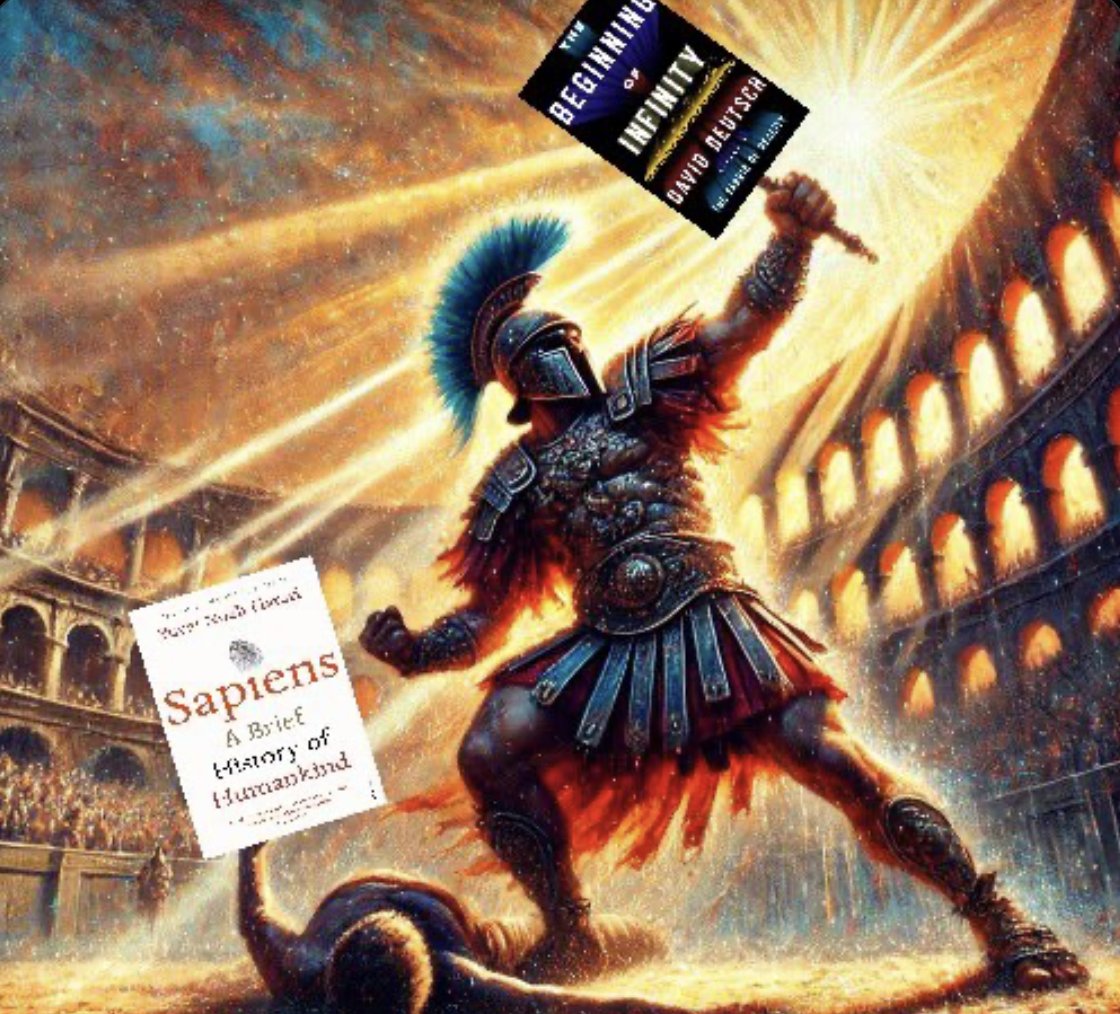
I used to think Sapiens was a great book. Sweeping, provocative, the kind of book that makes you feel like you finally understand the big picture of human history. It's on every CEO's bookshelf, assigned in universities, praised as a masterwork of synthesis. Yuval Noah Harari is treated as one of the serious thinkers of our time.
But something nagged at me. Some passages felt off. Claims that human rights are just figments of our collective imagination, not real things, just stories we tell ourselves. That nations, laws, money, justice, doesn't exist outside our heads. That meaning itself is a delusion we've invented to cope. That we're far more powerful than ever before but not happier. That hunter-gatherers had it better because they had no dishes to wash, no carpets to vacuum, no nappies to change, no bills to pay.
That sounded depressing to me, but was perhaps just the realistic scientific worldview? What it meant to see the world clearly, without comforting illusions.
Then I read The Beginning of Infinity by @DavidDeutschOxf. Deutsch has a concept he calls 'bad philosophy.' Not philosophy that's merely false, but philosophy that actively prevents the growth of knowledge. Ideas that close doors rather than open them. That makes problems seem unsolvable by design.
After soaking in Deutsch's framework (it's dense, a bit like digesting a delicious whale), it becomes clear: Harari's books are riddled with bad philosophy. They're smuggling nihilism in under the guise of scientific objectivity. Some examples:
On meaning: "Human life has absolutely no meaning. Humans are the outcome of blind evolutionary processes that operate without goal or purpose... any meaning that people inscribe to their lives is just a delusion."
On human rights: "There are no gods in the universe, no nations, no money, no human rights, no laws, and no justice outside the common imagination of human beings."
On free will: "Humans are now hackable animals. The idea that humans have this soul or spirit and they have free will, that's over."
On progress: "We thought we were saving time; instead we revved up the treadmill of life to ten times its former speed." The Agricultural Revolution? "History's biggest fraud." We didn't domesticate wheat, "it domesticated us."
On our cosmic significance: "If planet Earth were to blow up tomorrow morning, the universe would probably keep going about its business as usual. Human subjectivity would not be missed."
On the future: "Those who fail in the struggle against irrelevance would constitute a new 'useless class.'" Homo sapiens will likely "disappear in a century or two."
This is bad philosophy. It tells us our problems are cosmically insignificant, our solutions are illusions, and that progress is neither desirable nor within our control. It's also perfect nonsense. No one would ever go back to being hunter-gatherers. Would you rather worry about your kid spending too much time on Roblox, or face the 50% chance she won't reach puberty?
And our so-called "fictions"? They ended slavery. They gave women equal rights. They solved hunger. They eradicated smallpox. They turned sand into computer chips. They got us to the moon, and hopefully soon, to Mars and beyond. These "fictions" are already reshaping the universe, and over time they may become the most potent force in it.
Now compare Deutsch:
"Humans, people and knowledge are not only objectively significant: they are by far the most significant phenomena in nature."
"Feeling insignificant because the universe is large has exactly the same logic as feeling inadequate for not being a cow."
"Problems are soluble, and each particular evil is a problem that can be solved."
"We are only just scratching the surface, and shall never be doing anything else. If unlimited progress really is going to happen, not only are we now at almost the very beginning of it, we always shall be."
Where Harari sees a species of deluded apes stumbling toward obsolescence, Deutsch sees universal explainers, the only entities we know of capable of creating explanatory knowledge, solving problems, and potentially seeding the universe with intelligence.
The difference isn't academic. Ideas shape action. If you believe life is meaningless, progress is a trap, and humans are hackable animals with no free will, how does that affect what you build? What you fight for? What you teach your children?
Harari's books sell because they flatter a fashionable pessimism. They let readers feel sophisticated for seeing through the "delusions" everyone else lives by. That smug cynicism is corrosive. And it's everywhere: in schools, in media, in bestselling books. More than half of young adults now say they feel little to no purpose or meaning in life. This is what happens when you teach an entire generation bad philosophy. Less progress, less health, less wealth. Less flourishing. And ultimately, a higher chance that civilization and consciousness go extinct.
Fortunately, there's another equally well-written, but much truer, account of homo sapiens, appropriately titled 'The Beginning of Infinity'. And this one smuggles no despair in by the backdoor. But let's give Harari credit where it's due. He is right about one thing: if planet Earth blew up tomorrow, we wouldn't be missed. Because there'd be no one left to miss us, just a careless universe, blindly obeying physical laws. We are the only ones who can miss, but we're not going to. We're going to aim, hit, and keep going.
Full credit for the amazing meme to @Ben__Jeff
Yes. A few miscellaneous thoughts.
(1) First, the new bottleneck on AI is prompting and verifying. Since AI does tasks middle-to-middle, not end-to-end. So business spend migrates towards the edges of prompting and verifying, even as AI speeds up the middle.
(2) Second, AI really means amplified intelligence, not agentic intelligence. The smarter you are, the smarter the AI is. Better writers are better prompters.
(3) Third, AI doesn’t really take your job, it allows you to do any job. Because it allows you to be a passable UX designer, a decent SFX animator, and so on. But it doesn’t necessarily mean you can do that job *well*, as a specialist is often needed for polish.
(4) Fourth, AI doesn’t take your job, it takes the job of the previous AI. For example: Midjourney took Stable Diffusion’s job. GPT-4 took GPT-3’s job. Once you have a slot in your workflow for AI image gen, AI code gen, or the like, you just allocate that spend to the latest model.
(5) Fifth, killer AI is already here — and it’s called drones. And every country is pursuing it. So it’s not the image generators and chatbots one needs to worry about.
(6) Sixth, decentralized AI is already here and it’s essentially polytheistic AI (many strong models) rather than monotheistic AI (a single all-powerful model). That means balance of power between human/AI fusions rather than a single dominant AI that will turn us all into paperclips/pillars of salt.
(7) Seventh, AI is probabilistic while crypto is deterministic. So crypto can constrain AI. For example, AI can break captchas, but it can’t fake onchain balances. And it can solve some equations, but not cryptographic equations. Thus, crypto is roughly what AI can’t do.
(8) Eighth, I think AI on the whole right now is having a decentralizing effect, because there is so much more a small team can do with the right tooling, and because so many high quality open source models are coming.
All this could change if self-prompting, self-verifying, and self-replicating AI in the physical world really gets going. But there are open research questions between here and there.
I’m sorry, but I just can’t stand it anymore.
This massive, outrageous, pork-filled Congressional spending bill is a disgusting abomination.
Shame on those who voted for it: you know you did wrong. You know it.
This is fascinating. Erich Bloch and Peter House employed economists to specifically and intentionally design our scientific immigration system to drive down U.S. scientific compensation using foreigners and “lures”. Yes, the @nsf and @theNASciences in 1986 secretly designed our U.S. stem system so that our STEM employers could save money if we drove away our own top STEM talent.
Scientific backstabbing. Plain and simple. We took the world’s top scientific workforce and destroyed it to save money on science salaries and to get access to more pliant employees. Why? Because our leaders appointed idiots to save a few bucks. I’m sorry but that is what happened.
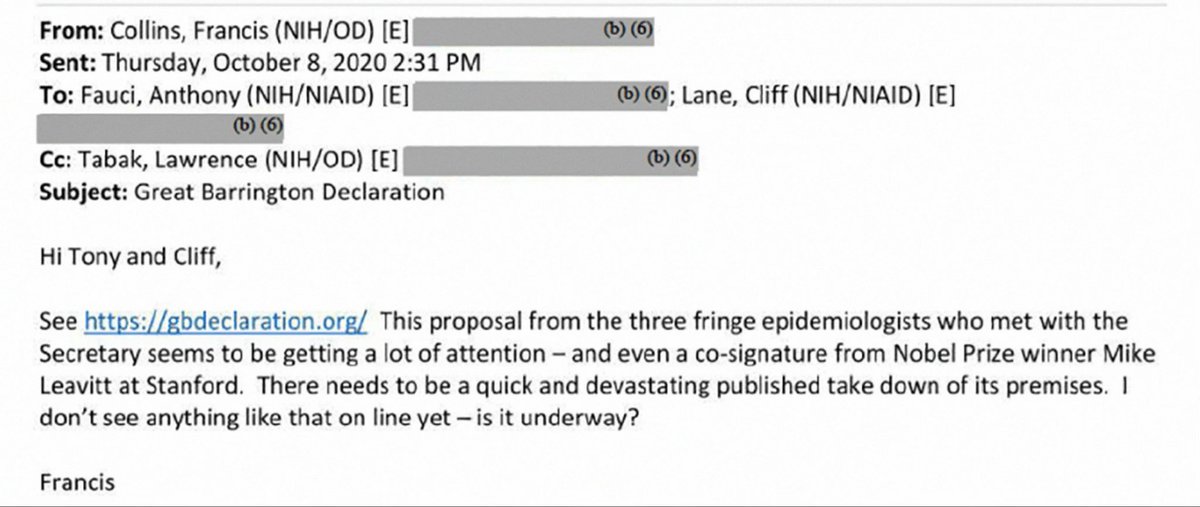
So, who is this Collins guy and what is he doing at the top of the U.S. science pile? Why are we listening to him? Is he some great thinker? Is he some kind of policy genius? Is he more ethical and merit loving than the rest of us slobs and mere mortals?
Ah. Yes. I remember now. Francis Collins! The one who calls for “devastating” take downs against his “fringe” MD/PhD professorial colleagues and their work. And yet, here he is again! Why won’t he slink off somewhere where he can’t do even more damage? Why is he here??
This is what DC science policy circles look like. Two faced. Francis Collins would end your career without a second thought for principaled scientific dissent. As he tried to do to my colleague @DrJBhattacharya at Stanford.
He should not be speaking for science. He does not represent science.
Science cannot afford Francis Collins and his culture of backstabbing officials.
Ok. This is my life’s work as seen by C Jaimungal.
Done in near isolation from community for reasons I do not grasp, Geometric Unity has never received this kind of treatment in 40 yrs.
I’m sort of speechless and don’t know what to say. except “Thank you.” before I watch it. 🙏
As much as everyone underestimates the difficulty of reindustrializing the United States, we underestimate the creativity, work ethic, and dynamism of the American people even more. Deregulate and watch what the kids can do