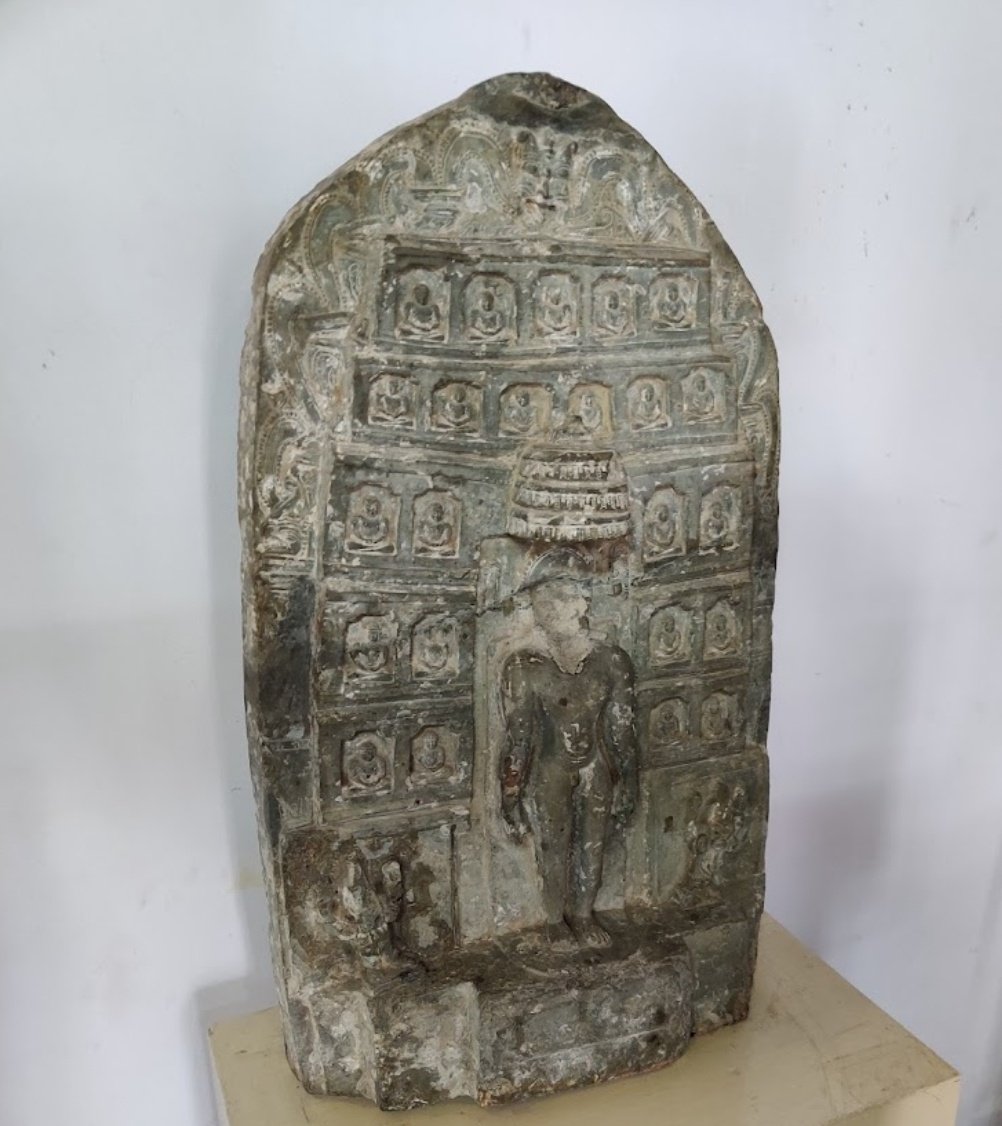
Greek philosophy is downstream of Indian philosophy, transhipped through Phoenician ports.
Around 950 BC, Hiram of Tyre and Solomon of Israel signed a treaty to send joint fleets down the Red Sea to the Gujarat coast, and for a full century the ships ran on a three-year cycle. Phoenician crews wintered in India for months waiting for monsoon winds to change. Their trading counterparts were Jain merchants, already teaching atomism, impermanence and that every living thing has a soul.
Ships returning to Sidon carried gold, ivory, peacocks, cinnamon and Indian ideas. Two generations later Kanada was teaching atomism at Dwarka on the Gujarat coast, and by the fifth century BC Leucippus was teaching it in Miletus, on the Ionian one. Democritus, who worked the theory out in detail, is recorded by Diogenes Laertius as having "made acquaintance with the Gymnosophists in India."
Greek philosophers who followed, worked in the same ports where the Phoenician ships berthed. Thales, born to a Phoenician family in Miletus, taught that the world was made of water and floated on it in the manner of a ship. Anaximander taught that air was the breath that animates each life, close to the Upanishadic vayu and prana. By the fifth century BC the animal and human sacrifice that filled Homer’s epics had gone silent in mainland Greece and the doctrine that stopped it had travelled on Phoenician ships from a coast where it had already stopped.
Textbooks call the coincidence a Greek Miracle. Historians should talk of cause and effect - not miracles.
Link to full Substack essay with sources in the replies below.
This is our civilisation — but India’s civilisation was never the creation of one tradition alone. Jainism is one of its oldest continuous intellectual and cultural streams, and without Jain heritage, the story of India is incomplete. For more than two millennia, Jains contributed profoundly to ahiṃsā, vegetarian ethics, anekāntavāda, logic, philosophy, mathematics, astronomy, grammar, literature, education, manuscript preservation, art, sculpture, architecture, trade and philanthropy. Jain monks and scholars wrote in Prakrit, Ardhamāgadhī, Sanskrit, Apabhraṃśa and regional languages, while Jain authors played a major role in the development of classical Kannada and Tamil literary cultures.
Look at the physical landscape of India: Shravanabelagola, Ellora’s Jain caves, Udayagiri–Khandagiri, Mount Abu’s Dilwara temples, Ranakpur, Shatrunjaya–Palitana, Deogarh, Sonagiri and countless Jain sites across Tamil Nadu, Karnataka, Maharashtra, Gujarat, Rajasthan, Madhya Pradesh, Bihar, Bengal and Odisha. Jain communities also preserved vast manuscript collections and supported schools, libraries, hospitals, charitable institutions and animal shelters.
And Jainism was never merely a religion of today’s wealthy merchant communities. There were and remain Jain communities rooted in different regions, languages and social backgrounds, including Tamil Jains, Kannada Jains, Marathi Jains and the historic Jain communities of eastern India. Jain heritage belongs to the civilisational history of India as a whole.
So celebrate Indian civilisation but don’t erase one of its oldest pillars to do it. India’s story is not diminished by acknowledging Jainism; it becomes more complete. 🇮🇳
#jainism
PATRICK SOON-SHIONG: “We have in our body a gene called p53 that actually prevents cancer from occurring.”
“Guess what COVID does? It knocks down p53.”
Were We All Deliberately Poisoned!?😧
Daily Routine of Chandragupta Maurya
The following thread would delve on the daily routine of Chandragupta Maurya.
Chandragupta (322-298 BCE) was the first emperor of India, who unified the country, from the mountains of Afghanistan to southern Mysore. 🧵
@ByRakeshSimha •“There is no compulsion in religion.” (Qur’an 2:256)
•“If your enemy inclines toward peace, you also incline toward peace.” (Qur’an 8:61)
•“Repel evil with what is better.” (Qur’an 41:34)
न कोई राज्य डरा पाया,न कोई सत्ता झुका पाई —
ऐसे युग पुरुष, दिगंबर वेशधारी तपस्वी
📍सिटीचौक, औरंगाबाद | 19 मार्च 1946
निज़ाम के शासन में भी जब निडरता ने दिगंबर वेश धारण किया चारित्र चक्रवर्ती आचार्य 108 श्री शांतिसागर महाराज जी का ऐतिहासिक विहार।
#Jainism
To,
Indian Hotel Co Ltd
Tata Group Co
Mumbai
Subject: *Appeal to Reconsider the Establishment of Taj Palitana Palace in Palitana.*
*Dear Mr. Chandrasekhar & Board of Directors, IHCL.*
I trust this message finds you in good health and high spirits.
I am writing to express my sincere concern regarding the recently announced Taj Palitana Palace in Palitana, Gujarat. While the Taj Group’s unparalleled legacy in promoting India’s cultural heritage and luxury hospitality is widely admired, I respectfully urge you to reconsider this decision, as it may inadvertently conflict with the sacred identity of Palitana and the deeply held values of its spiritual community.
Palitana holds a revered place in the *"hearts of millions of Jains"* and has been officially designated as a holy city by the Government of Gujarat. Nestled at the base of the hallowed Shatrunjay Hills, Palitana is home to over 900 Jain temples, drawing countless pilgrims each year. These devotees strictly adhere to the core tenets of Jainism—ahimsa (non-violence), purity in thought and diet, and abstention from intoxicants—as they undertake their sacred journey.
While the Taj Group’s commitment to showcasing Gujarat’s rich heritage is commendable, the establishment of a luxury hotel in Palitana risks disrupting its spiritual sanctity. Luxury hospitality, by its very nature, involves offerings, services, and activities that may not align with the deeply rooted traditions and ascetic way of life embraced by the local community and pilgrims. Even with the utmost care, the operational demands of such a property could inadvertently alter the serene and sacred environment that makes Palitana a global symbol of peace and devotion.
The Tata Group has long been celebrated for its ethical leadership, cultural sensitivity, and deep respect for India’s diverse traditions. Across its illustrious portfolio, Taj Hotels has successfully blended grandeur with local values, demonstrating an unwavering commitment to responsible tourism. Reconsidering this decision would further strengthen Taj’s global reputation as a beacon of ethical and culturally attuned hospitality.
I earnestly request that the Taj Group explore alternative locations in Gujarat where such a venture would be more fitting—allowing you to celebrate the state’s heritage while respecting the unique sanctity of Palitana.
We trust that the Tata Group will weigh this heartfelt appeal with the compassion and wisdom that has long defined its legacy.
Yours sincerely,
(Your Name)
🙏 👆 🙏
Request everyone to send Email to below email Ids to
*"Save Palitana Tirth"*
from becoming a tourist destination.
Email ids :
*[email protected]*
*[email protected]*
*[email protected]*
Unbelievable 👏👏🙌
Delighted to see a foreigner doing 4 Jatra, that is climbing 3839 steps of Shaswat mahatirth Girnar 4 times a day & Ayambil 😯
He pronounced so well 😀"Jai Jai Shree Neminath" 🙏
#99Yatra#Girnar#Navvanu
Hey everyone! ☕️
We’re working on choosing a name for our coffee Shop, and we’d love your input! Which one do you think fits best?
Vote below and let us know your thoughts and if you have any other suggestions we could consider! 🗳️
Sorry for the error!
As soon as I started eating like Jains before Sunset my sugar levels became normal.
Jainism is not just a religion, it is a life saver, it is the way of life on this earth.
@sergioa94679493 Those are the greatest beings to take birth in the cosmos, they are called the Tirthankaras who propagated the Jain way of living. Jainism is the most ancient religion/philosophy/way of living which has the ultimate wisdom of the kevalis (omniscient souls)
Julian is free!!!!
Words cannot express our immense gratitude to YOU- yes YOU, who have all mobilised for years and years to make this come true. THANK YOU. tHANK YOU. THANK YOU.
Follow @WikiLeaks for more info soon…