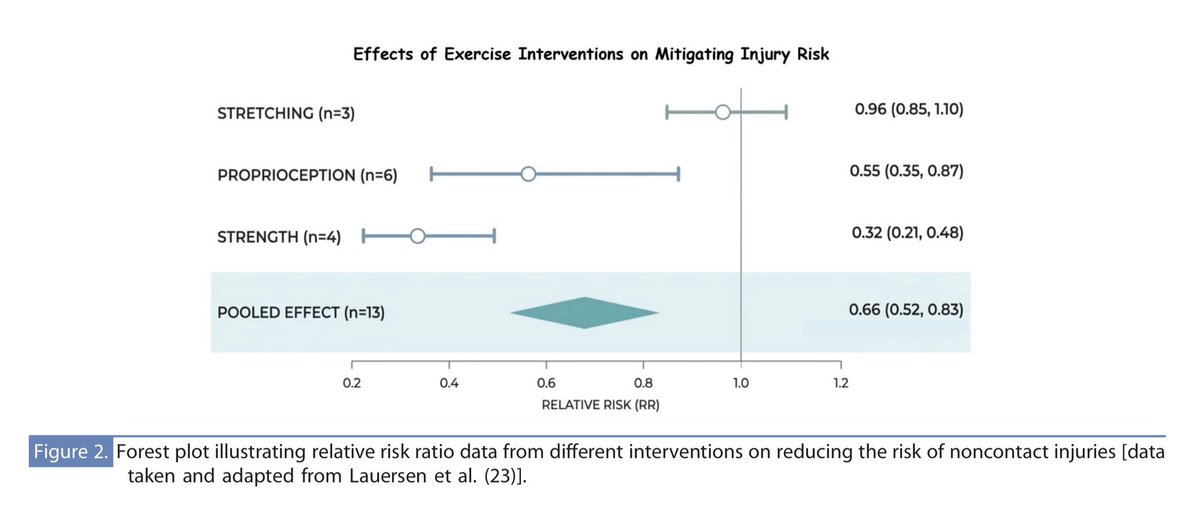
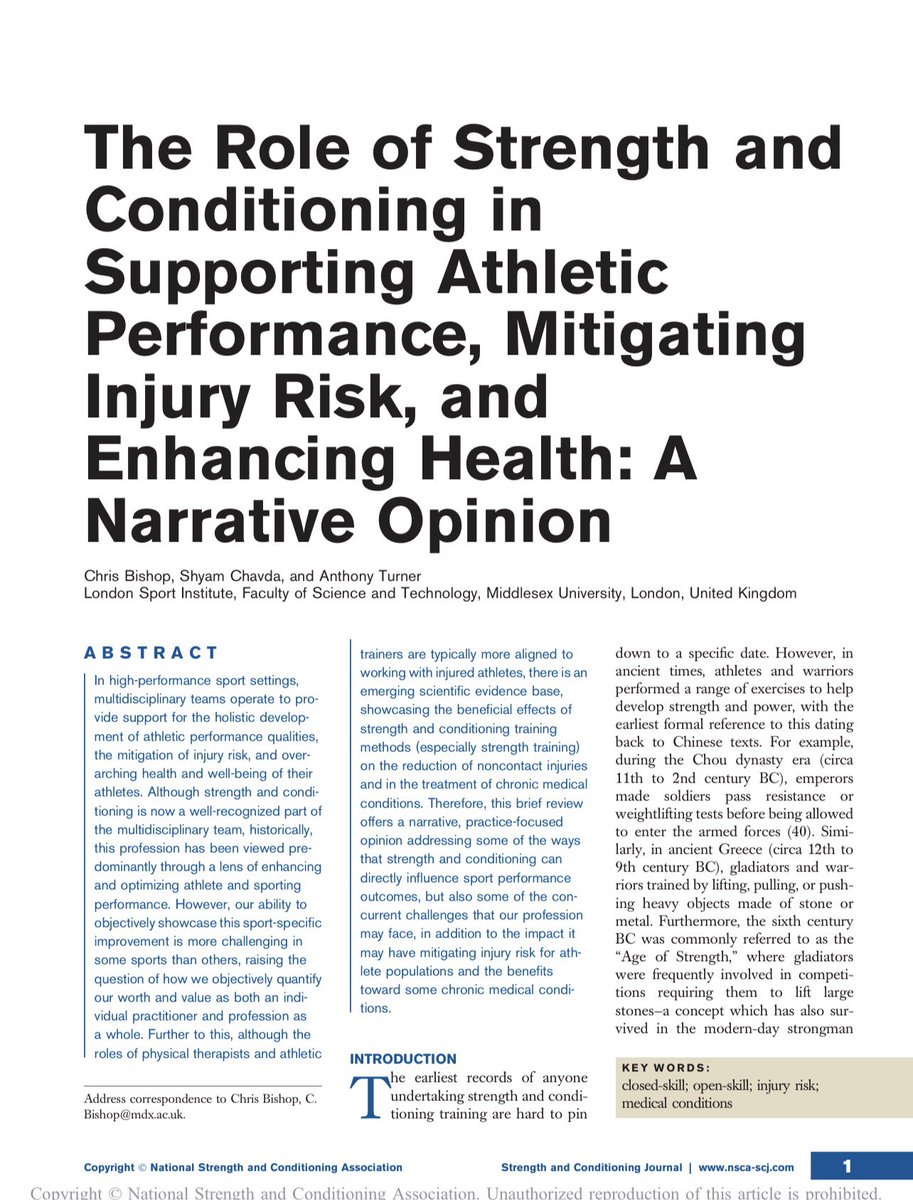
📄 New paper now online ahead of print in @NSCA’s #SCJ.
🔑 It challenges the notion of S&C being aligned purely to “athletic performance” and how the evidence base for injury risk and over-arching health is arguably greater.
🔗 Link to full text here: https://t.co/9VLNTv4TiK.
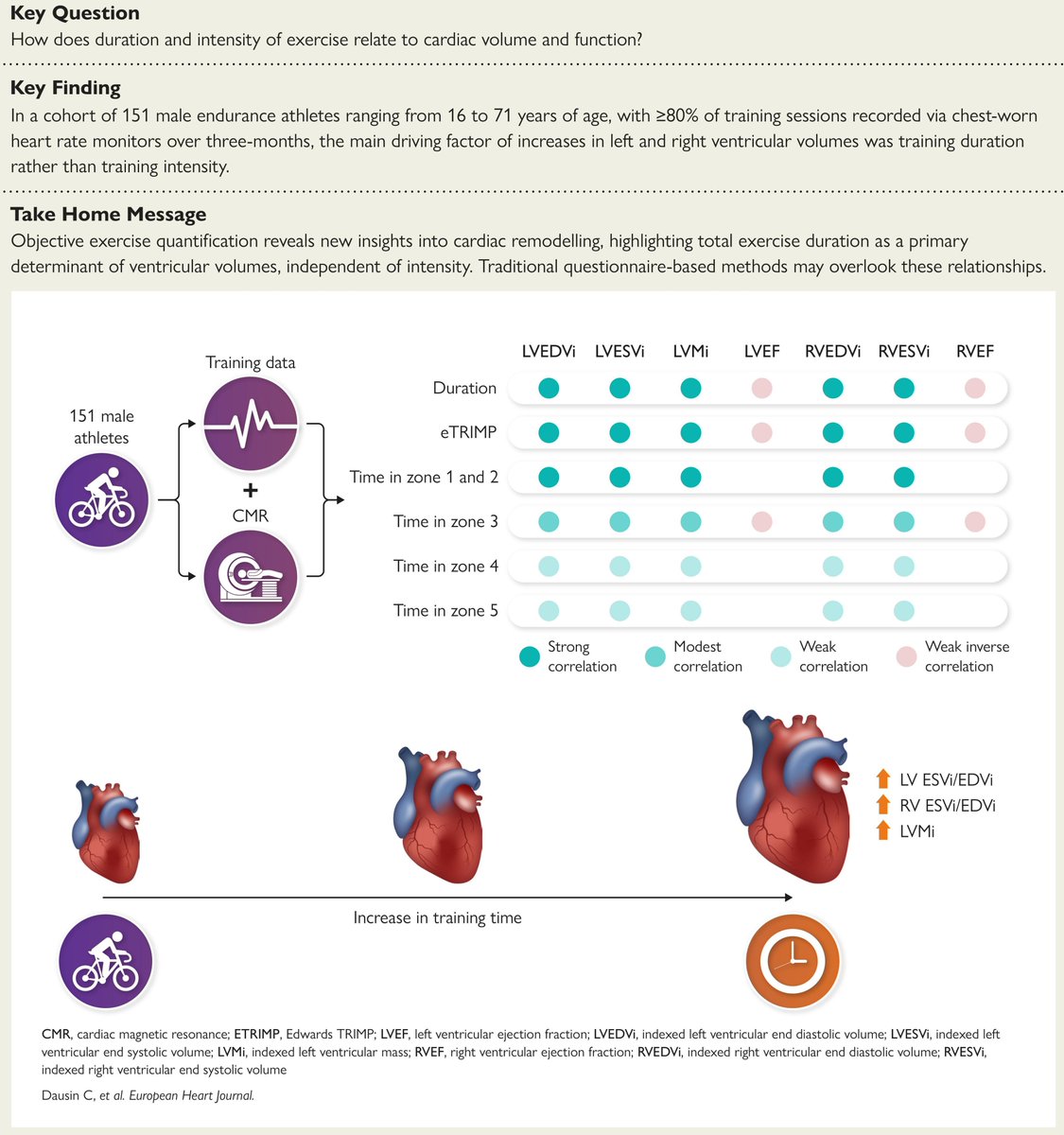
Cardiovascular adaptation to training load in endurance athletes: a longitudinal study
https:/academic.oup.com/eurheartj/advance-article/doi/10.1093/eurheartj/ehaf/1018/8416519?login=true
#Cardiacremodelling#Exercise#intensity#Sportscardiology
A question I get all the time:
"I have a busy life, and I only have a few hours to train each week. Shouldn't I make them count by going harder?"
No.
See, your body doesn't separate training stress from life stress.
If you're carrying a full-time job, poor sleep, family responsibilities, and financial stress, your "stress bank account" is already running too low for high-intensity training....
You're broke!
Your adaptation reserves are already being spent!
My latest...
Why Too Much Intensity Breaks Athletes:
Understanding Adaptation Energy
Much Ado About Zone 2 https://t.co/FEguHuVt7b
Influencers can’t get enough of Zone 2 training. So why did @gibalam publish a research paper challenging Zone 2 for the general public? In this episode, we go through a critical examination of Zone 2.
https://t.co/K9DWIYUh4S
This one finds that strengthening the hip flexors and hip adductors is most beneficial for maximizing running speed as these muscles maximize step frequency during sprinting.
Seventeen years later, I still think icing muscle injuries is a bad idea — and now I have even better data to prove it – Sports & Fitness Science https://t.co/2Ard8Cv3h4
🆕Epidemiology of ACL injuries in the "Top 5" @UEFA Leagues ⚽️
➡️"Most ACL ruptures occurred through non-contact mechanisms, typically during defensive actions, particularly while pressing an opponent"
👉D. Ortiz-Sánchez et al. 2026 🇪🇸
📂Open Access: https://t.co/UurDPallLh
Labral Tears Of The Shoulder in Adults:
Labral tears are among the most overcalled/overtreated findings in my specialty. They're almost never the source of pain in adults... not never, but almost never. Thus... the gap between what shows up on your MRI and what's actually causing your pain is wider than you think.
A higher reactive strength may be a contributor to adaptation to sprint training
In this study, field sport athletes with higher baseline reactive strength had greater improvements in speed ability following an 8 week sprint intervention.
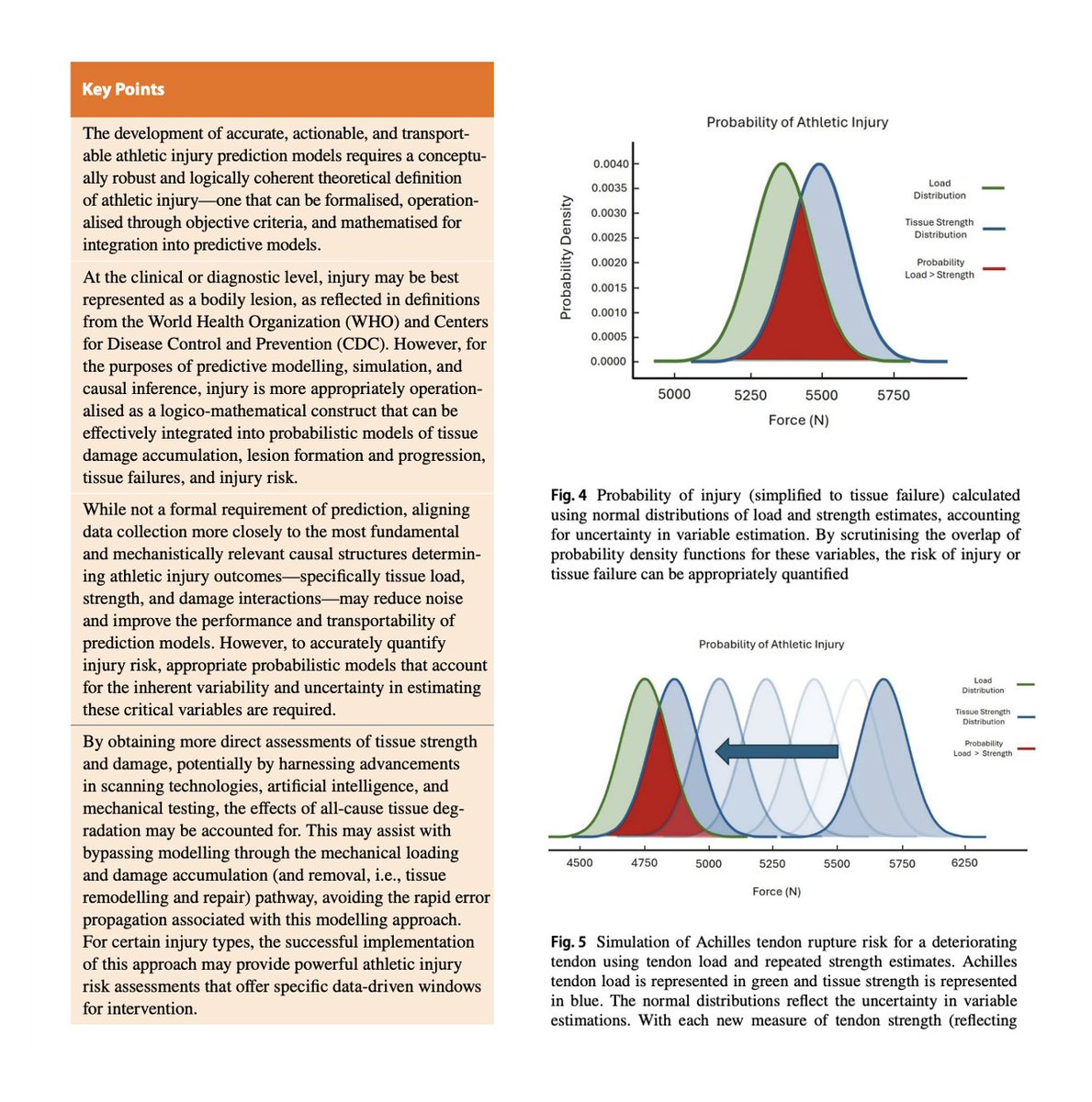
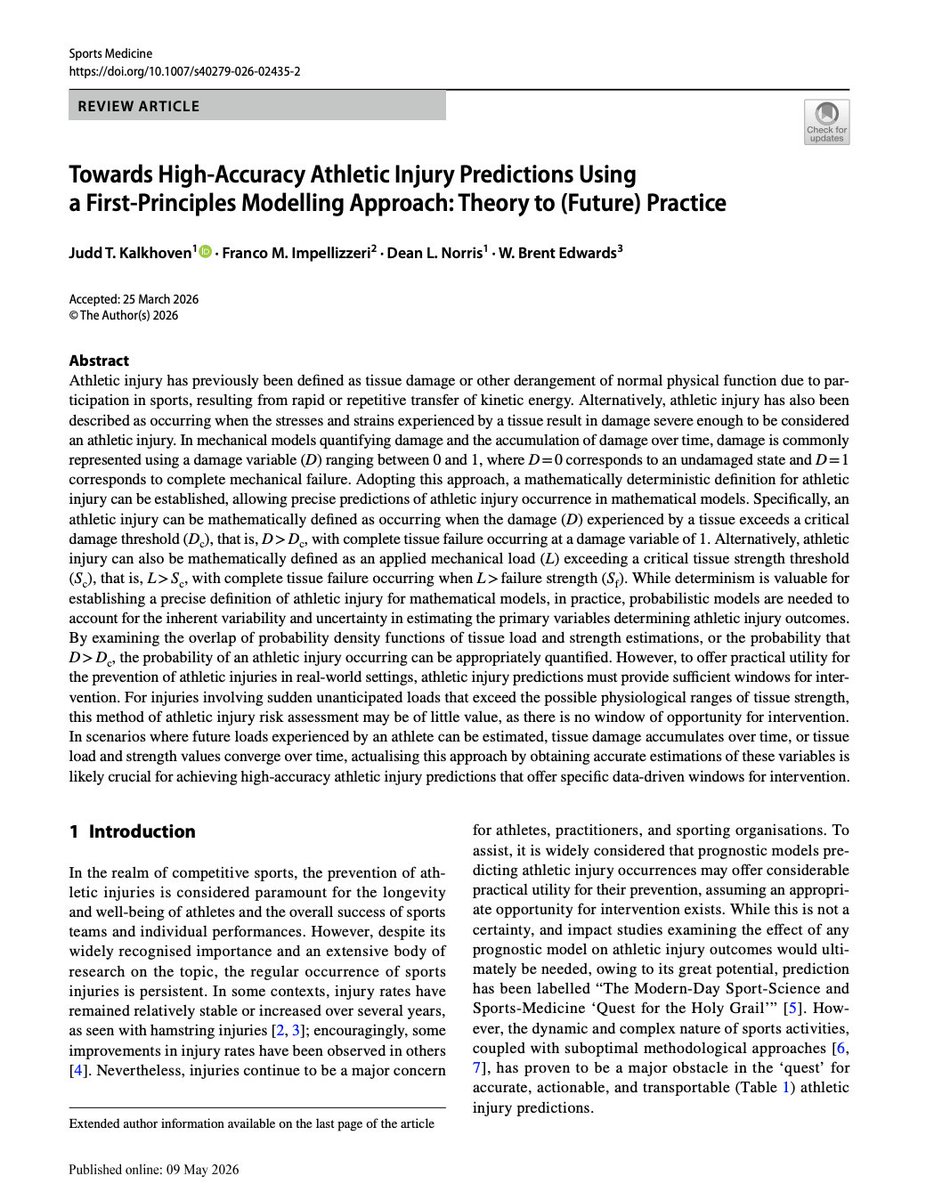
🆕"This article aimed to provide a conceptual framework, based on fundamental principles, that would enable effective predictions to be made about sports injuries"
➡️Bear in mind ⚽️
👉@KalkhovenJudd@francoimpell@DNorrisSC@edwardswb 2026🇦🇺
📂Open Access: https://t.co/qEpyBllbyk
Good question:
Why doesn't zone 3 lead to sustainable adaptations?
So, what happens, physiologically, in zone 3?
1/ Heart rate increases/filling time decreases.
Many athletes will have lower EDV (end diastolic volume) when doing z3 vs z1 work - less of that all-important "stretch" stimulus on the heart that leads to long-term cardiac remodeling.
2/ Athletes burn a lot less fat and a lot more glycogen.
Because of this, training tolerance in this zone is significantly reduced. And, more importantly, the impetus placed upon the body to improve fat oxidation is not present. That is, athletes who are already "carb burners" just become better "carb burners"
3/ Zone 3 is stressful, leading to activation of/strengthening of the "Fight or flight" sympathetic nervous system.
With too much z3, HRV ⬇️& the strength of the athlete's recovery system goes with it. Over time, the athlete becomes very sympathetic dominant & gets locked into "stress mode" - if this goes on too long, it leads to failing adaptation and overtraining.
######
This is why, for sustainable improvement, zone 1 should be the focus.
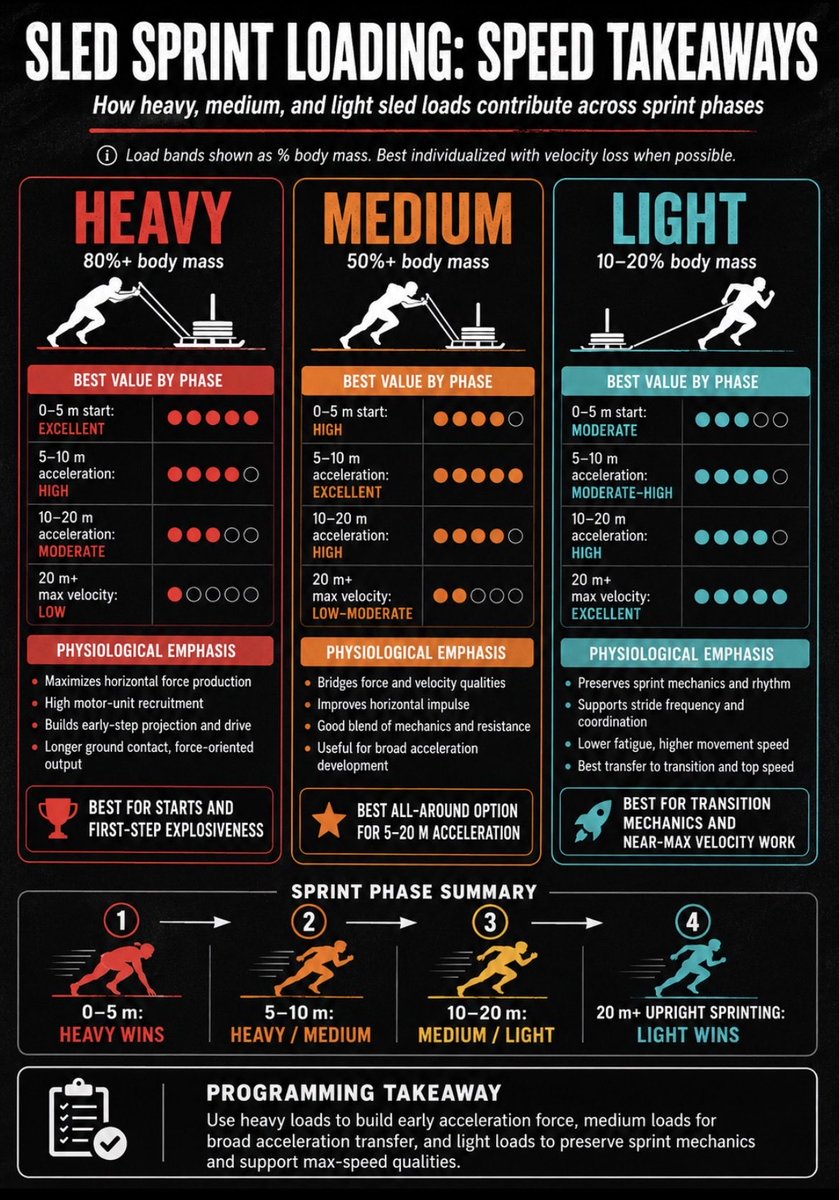
Don’t train only one end of sprinting.
Heavy sleds = force + projection
Medium sleds = acceleration bridge
Light sleds = rhythm + speed mechanics
The best sprint programs train the whole force–velocity curve.
Petrakos et al., 2016; Cahill et al., 2020.
📊 Fuerzas musculares al correr (x peso corporal):
Sóleo: 6.5–8.5x
Cuádriceps: 4.5–5x
Isquios y flexores cadera: hasta 9x en sprint
Glúteo máx: 0.5–2.25x
💡 ENFATIZA entreno de sóleos, quads, isquios y flexores para rendir y prevenir lesiones 🏃🏻♂️
https://t.co/OjbMDkbZd5
From the archives:
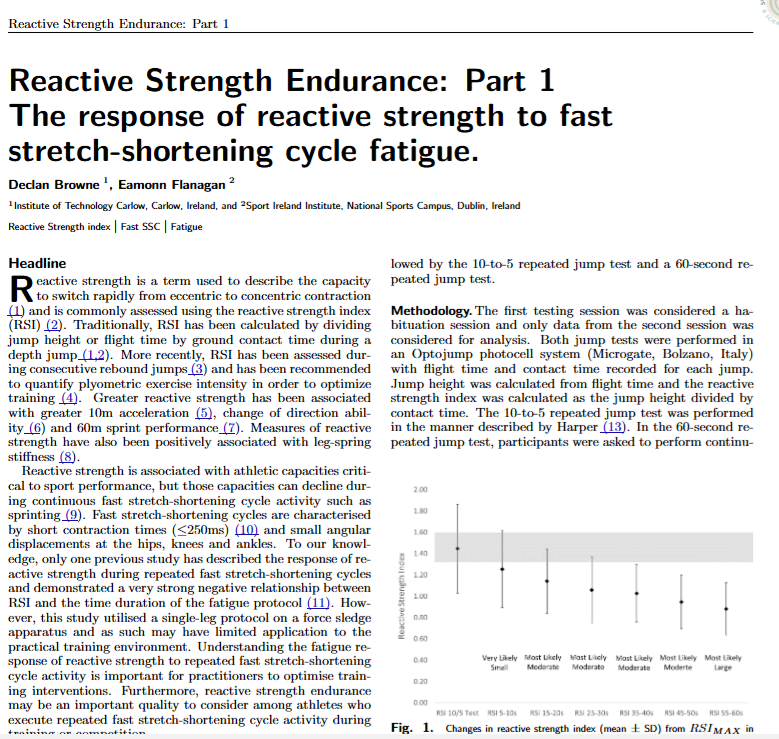
Reactive Strength Endurance:
The response of reactive strength to fast stretch shortening cycle fatigue
Paper from 2018 with implications for extensive plyometric work
Summary notes below 👇
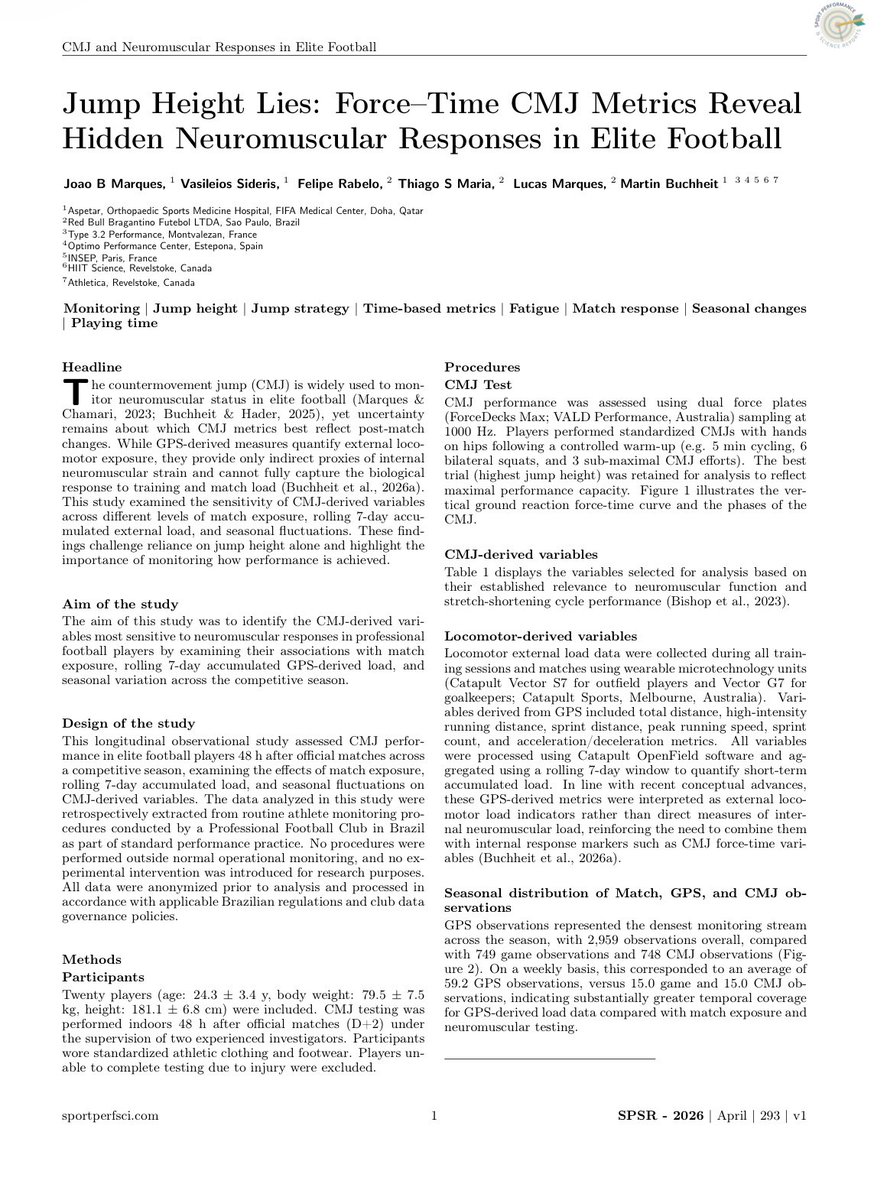
This paper is helpful because it gets at a simple but important monitoring problem: jump height is easy to understand, but it may not tell you what is actually happening neuromuscularly. The authors are not saying the countermovement jump is useless. They are saying that if we only look at the final outcome of the jump, meaning how high the athlete jumped, we may miss meaningful changes in how that jump was actually produced. That is the real value of force time metrics. Jump height tells us what happened. Force time metrics help us understand how it happened and what it may have cost.
One of the major findings was related to match exposure. Players who played more minutes, especially those above 70 minutes, showed greater impairments in force time variables compared with players who played less than 40 minutes. The changes showed up in longer contraction time, longer time to braking phase, reduced RSI modified, reduced concentric mean force, reduced early concentric impulse, and reduced concentric peak force. In plain language, the players could still jump, but they were producing the jump differently. Their rapid force production was impaired even when jump height did not clearly change.
This is also why standardization matters. If we are going to use CMJ data, the athlete needs to be cued the same way every time. My preference is simple: “jump as high and as fast as you can.” That encourages maximal intent, and without maximal intent, the data becomes much less useful. The same thing applies to squat jumps. If one athlete holds the quiet phase with discipline on a clear 3, 2, 1 count, while another athlete is loose, inconsistent, or starts negotiating the strategy before jumping, then we are adding error into the system. Over time, that decreases our ability to compare the data and make meaningful decisions.
That is the bigger lesson for me. Monitoring is not just collecting numbers. It is collecting numbers under a standardized process so the data actually means something.
We have three papers published on the IMTP in order to help withj the standardization of the method. We chose to do this to increase the utility of the test and insure valid and reliable data are used for training decisions. We are working on many more IMTP concepts - #IMTP
Brilliant research from @Hoenig_tim and colleagues in @BJSM_BMJ has given us a great overview of return to sport times for low and high risk bone stress injuries. See paper for details 🔗 https://t.co/BaQXGABx1v