In @SurvivalEditors w/ Ethan Kapstein: Europe’s rearming & US shift to other theaters allow a better #NATO division of labor—EU industry/land power + US R&D/strategic enablers—to meet members’ regional AND global goals. Pace Kagan, we’re all Martians now! https://t.co/WXiZCNvZLC
I personally believe it would have made an enormous difference, as I argued in the piece below. Ukraine needed modern weapons to better match Russia’s capabilities, especially at the start of the war, before China, North Korea and Iran got involved.
https://t.co/lOSTqFCyHT
@alessionaval@tshugart3@TXNatSecReview The 7th Fleet at the bottom of the ocean would seem to be a more effective dismantling of US security guarantees to Japan and ROK.
This @WSJ article’s maps undercut its claim that Taiwan's conquest will allow China to “dominate the region’s strategic waterways, project military power widely into the Pacific and more aggressively pursue its contested maritime and territorial claims." https://t.co/RKxrZDKiNu
Dominating the water- and airspace far into the Pacific is a prerequisite for a successful PLA invasion, not vice versa. In the @TXNatSecReview, I argue that Taiwan does not change the military balance either way. https://t.co/4nZ78Wia3h
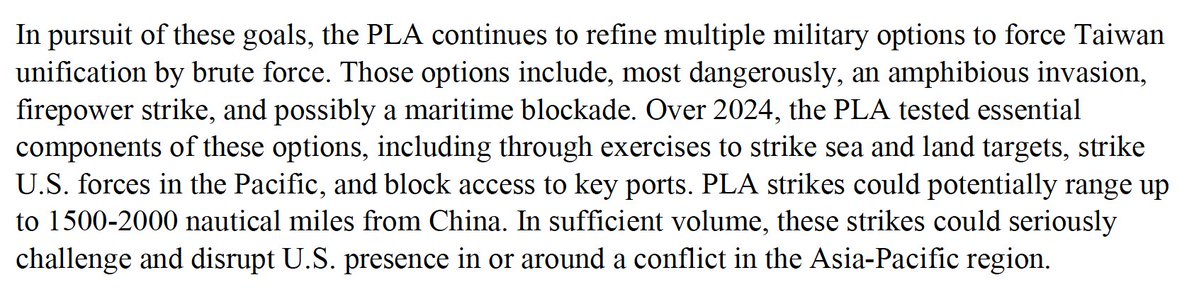
As @tshugart3 notes, the just-released China Military Power Report assesses that current mainland PLAN capability could "seriously challenge and disrupt" U.S. forces out to 1500-2000 nm. Taiwan bumps out these range rings by a vanishingly small margin.
https://t.co/7DEIWFZYIe
The new report also states that China has been practicing components of all of its options to force Taiwan unification, including strikes on U.S. forces in the Pacific that could "seriously challenge and disrupt" them out to 1500-2000 nm.
Elsewhere I've argued that the fleet is a nation's grand strategy manifest in steel, because it endures for decades. The late Cold War's carrier-centric Navy defined unipolar power projection. Procurement decisions like these are thus very consequential. https://t.co/sELOcg3jwx
On the "Golden Fleet" and the new "battleship" class, @samlagrone and @MalShelbourne do great work detailing the proposed specs from @NAVSEA in @USNINews. Given the numbers it's hard to see how US Navy's "distributed maritime operations" is feasible.
https://t.co/GYcwJLF1Vb
Distributed Maritime Operations is not possible with these future crewed classes alone. It will require a new concept of operations or *lots* of fast, robustly networked, uncrewed vessels loaded w/ missiles. That was probably always the case to an extent, but this burns bridges.
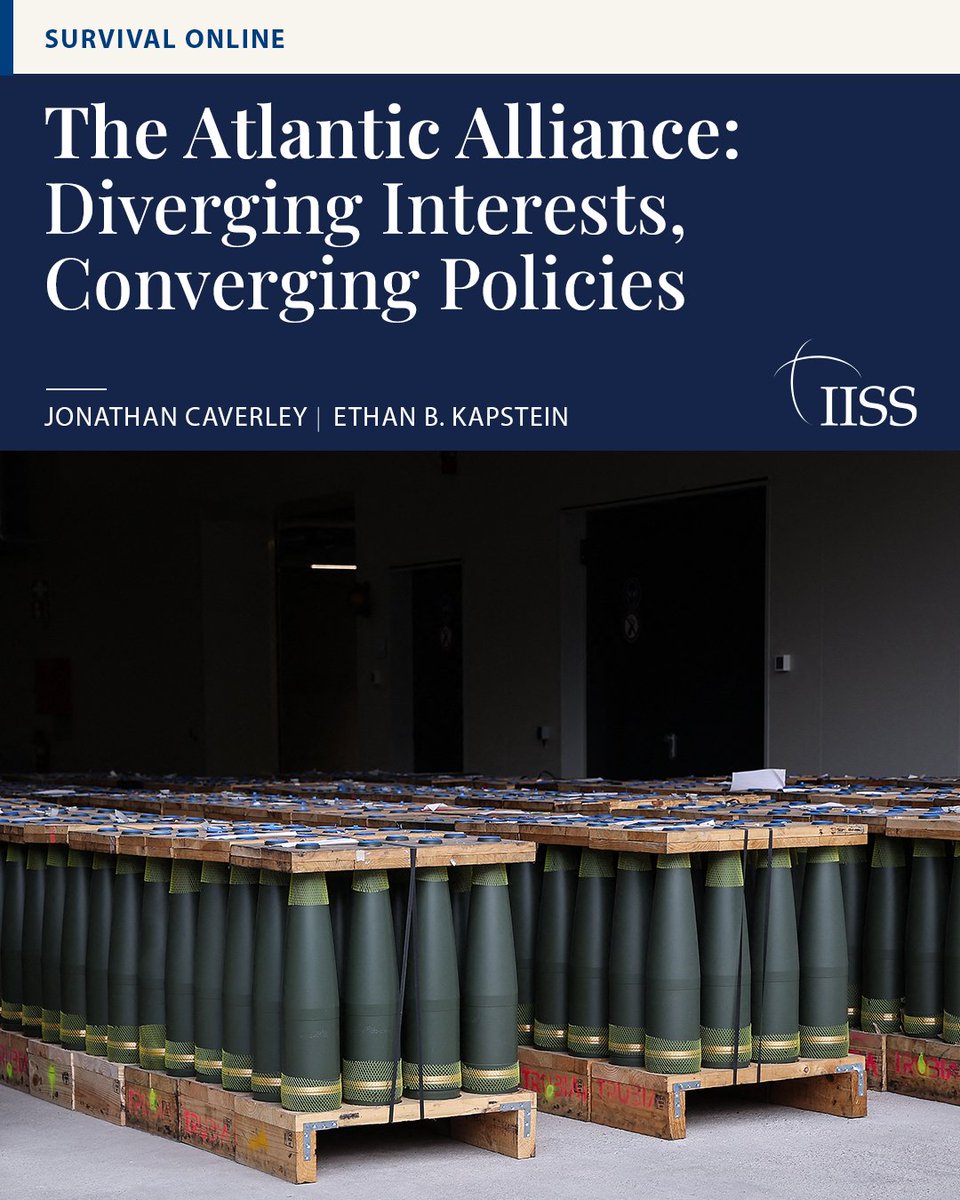
Diverging defence priorities, coupled with European rearmament, are reducing the free-rider problem that has long strained the relationship between the United States and European NATO | Analysis by @jcaverley and Ethan B. Kapstein | FREE TO READ | https://t.co/3wigZCR8VW
Diverging defence priorities, coupled with European rearmament, are reducing the free-rider problem that has long strained the relationship between the United States and European NATO | Analysis by @jcaverley and Ethan B. Kapstein | FREE TO READ | https://t.co/3wigZCR8VW
Diverging defence priorities, coupled with European rearmament, are reducing the free-rider problem that has long strained the relationship between the United States and European NATO | Analysis by @jcaverley and Ethan B. Kapstein | FREE TO READ | https://t.co/3wigZCR8VW
If (a big if) South Korea has decided it needs nukes, for deterrence & strategic stability, it's better they be in a survivable, second-strike nuclear submarine. Improved conventional deterrence via a larger US submarine industrial base could be a secondary, stabilizing effect.
Two thoughts on this news, besides🤷♂️. First, the expense of ROK nuclear-powered submarines only makes operational sense to me for a South Korean nuclear deterrent. While understandable at some level, proliferation is never a happy development.
Trump said the US will share tech with South Korea to build a nuclear-powered sub.
Trump said it will be built at the Philly Shipyard, owned by South Korea’s Hanwha. The yard isn’t currently equipped to handle nuclear material or build military ships. https://t.co/BiaFSjRJck
Second, if (a big if) South Korea helping to fund an additional U.S. shipyard that can produce submarines would be an *enormous* development in the (very) long-term Indo-Pacific balance. I'm not sure it is worth the price in terms of proliferation, but...