Introducing Claude Managed Agents: everything you need to build and deploy agents at scale.
It pairs an agent harness tuned for performance with production infrastructure, so you can go from prototype to launch in days.
Now in public beta on the Claude Platform.
I’m proud that so many of the world’s leading companies have joined us for Project Glasswing to confront the cyber threat posed by increasingly capable AI systems head-on.
https://t.co/pn3HSVsThP
NEW EPISODE: @jack & @roelofbotha unpack @blocks 40% staff cut and rebuilding the entire company as a mini-AGI.
This isn’t “use AI to make people more productive.” It’s making the company itself the intelligence.
If you’re a founder or operator wondering what work looks like in the next 5 years… this is the episode.
The evolution looks like:
• Manager mode = Pyramid 🔺 (command & control)
• Founder mode = Flat ➖(founders decide fast)
• Dorsey mode = Circle 🔵 w/ AI at the center, humans at the edge, and decisions flow from customer inputs → AI → humans steering it
I’ve tried killing org charts before. Brutally hard. But we never had these tools.
This is rewriting the CEO playbook for the AI era.
Buckle up.
00:00 Existential Dread & Hope
02:56 AI Replaces Hierarchy
07:22 Block’s New Three Roles
26:47 Flattening the Company, Fast
35:23 Getting the Board to Buy-In, Fast
36:50 Building a Great Board
41:29 Founder CEO Lessons
48:18 Second Acts & Conviction
56:22 Timeless CEO Traits
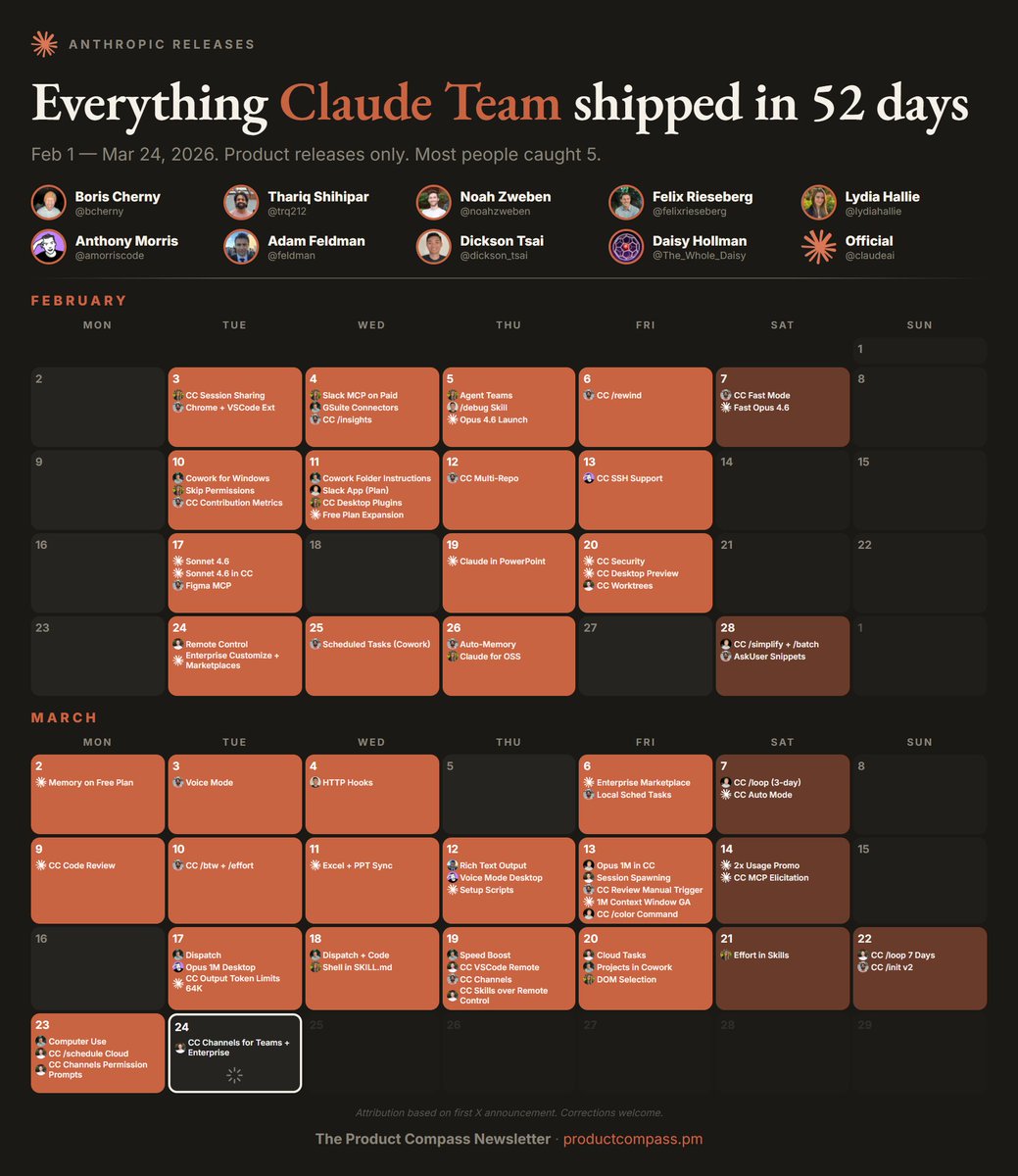
73 product releases in 52 days. That's not a launch cadence — that's a different kind of company.
I tracked every Anthropic release from Feb 1 to Mar 23 by going through @bcherny, @trq212, @noahzweben, @felixrieseberg, @lydiahallie, @amorriscode, @feldman, @dickson_tsai, and @claudeai. Built a calendar with first-announcement attribution.
Look at the acceleration. February had bursts with gaps between them. March 9 onward is almost every single day — Code Review, Channels, Dispatch, Computer Use, back to back.
The individual features get coverage. The shipping velocity doesn't. It should.
The comfortable middle is over for software.
Growth has stalled but true profitability still hasn't arrived — most of the sector is stuck: too slow for a premium growth multiple, too diluted for a fortress multiple.
a16z's David George says CEOs have 12-18 months to pick exactly one of two paths: https://t.co/JFhnWI4BE6
I don't think most PMs realize the PRD is becoming obsolete.
For the last decade, the PM's core artifact was a qualitative spec. Clear requirements, user stories, acceptance criteria. The engineering team interpreted it, built something close, and the PM spent two weeks reconciling what shipped with what they wrote.
The best AI companies replaced that entire loop with evals. A set of inputs your product needs to handle. A task that generates outputs. A scoring function that produces a number between 0 and 1. No ambiguity. No interpretation gap.
Ankur Goyal built the eval platform behind Vercel, Replit, Ramp, Notion, and Airtable. An $800M company. He walked through building an eval from zero on this episode and the score went from 0 to 0.75 in under 20 minutes. That's a PM shipping a measurable quality bar before a single line of product code exists.
Here's the part that changes the PM role permanently. When the product passes the eval and users still hate it, the eval is wrong. That's on the PM. Evals make PM judgment quantifiable in a way PRDs never did. You can't hide behind "the spec was ambiguous." There's a number now.
Six months ago, PM interviews asked "how do you use AI in your workflow." The next wave of interviews is going to ask you to write an eval. The PMs who can encode user intent as a scoring function are building the one skill that survives every model change, every framework swap, every agent rewrite.
Write the eval.
🚨: After 48 years of travel, NASA 's Voyager 1 is nearing one light-day from Earth, almost 16 billion miles away.
A proud milestone for humanity, and a humbling reminder of how small we are in an infinite universe.
I heard an incredible analogy from a VC friend that I can’t stop thinking about.
“The moat in software was the cost of building software. And Claude Code just mass produced a bridge.”
It’s wild when you think about the impact of this.
The SaaS boom produced a few dozen billionaires and a bunch of zero sum winners.
But the AI SaaS era will mass produce millionaires.
There will be fewer ServiceTitans hitting $5B valuations, and instead there will be 50,000 companies doing $500K-$5M each, run by 1-3 people with deep expertise and huge margins.
To be clear, I believe that the total value of software goes up, and the number of companies created goes up exponentially.
But the number of people who capture the value also goes up 100x.
I don’t believe in the “SaaS is dying” headline, I think it’s missing the point.
It’s simply that the power of SaaS is changing hands.
Microsoft is about to sue its own golden child.
$14 billion invested. Exclusive cloud rights. The most important AI partnership in history.
And Sam Altman just went behind their back with a $50 billion Amazon deal.
Here's why they're betraying each other:
When Microsoft first invested in OpenAI in 2019, they locked in ONE rule above everything else...
ALL access to OpenAI's models must go through Microsoft's Azure cloud. No exceptions.
That deal made Azure the backbone of the AI revolution. Every company using ChatGPT's API was paying Microsoft for the privilege.
It was the smartest infrastructure play of the decade.
Then last month, OpenAI quietly signed a deal with Amazon.
$50 billion. AWS becomes the exclusive third-party cloud provider for Frontier, OpenAI's new enterprise AI agent platform.
$138 billion committed to Amazon cloud services.
Microsoft found out and got really angry....
A person familiar with Microsoft's position told the Financial Times today: "We know our contract. We will sue them if they breach it. If Amazon and OpenAI want to take a bet on the creativity of their contractual lawyers, I would back us, not them."
That's basically a declaration of war.
And here's where it gets crazy:
OpenAI and Amazon are trying to build a technical workaround. A system called the "Stateful Runtime Environment" that runs on Amazon's Bedrock platform.
Their argument is that the system "only" handles memory and context for AI agents using enterprise data on AWS. It doesn't technically "invoke" OpenAI's core models through Amazon.
Microsoft's response: Bullshit.
The workaround violates the spirit of the deal even if it technically dances around the letter.
Amazon knows they're on thin ice too. An internal memo leaked showing Amazon told employees exactly what language they can and can't use. They can say Frontier is "powered by OpenAI" or "enabled by OpenAI." But they CANNOT say customers can "access" or "invoke" OpenAI models on AWS.
When you're coaching employees on which verbs to avoid, you know you're in trouble.
But here's the thing everyone seems to forget:
OpenAI is planning an IPO this year.
They just closed a $110 billion funding round last month.
So if Microsoft sues, the IPO timeline is DEAD.
You can't go public while your biggest partner and investor is suing you for breach of contract.
Elon Musk is already suing OpenAI separately for abandoning its nonprofit mission.
Two active lawsuits from two of the most powerful people in tech. Against one company trying to IPO.
Good luck with that S-1 filing.
But WHY did Altman do this?
Microsoft gave OpenAI everything. Capital. Infrastructure. Distribution. Enterprise customers.
And Altman's response was to secretly build an escape route through Amazon...
Because he saw what was coming:
Microsoft launched Copilot. Their own AI product. Competing directly with ChatGPT.
Microsoft started building their own models. Hiring their own AI researchers. Reducing dependency on OpenAI.
So Altman did the same thing back. Found another cloud provider. Started building leverage.
Both sides were preparing for divorce while still living in the same house.
So the $50 billion Amazon deal was just an insurance policy against the day Microsoft decides it doesn't need OpenAI anymore.
And Microsoft caught him packing his bags.
What happens next:
The companies are still talking. Trying to resolve this before Frontier launches.
But Microsoft has made their position clear. Litigation is on the table.
If this goes to court, it sets a precedent for every AI partnership in the industry. Every cloud deal. Every exclusive licensing agreement.
The entire AI infrastructure map gets redrawn.
Sam Altman built OpenAI on Microsoft's money, Microsoft's cloud, and Microsoft's trust.
Then he signed a $50 billion deal with their biggest competitor.
In any other industry they'd call that what it is.