Just trying to serve the founders, teams, and technologies of the future everyday. But it’s especially cool when you get this kind of feedback cc’d to your CEO on a competitive deal.
VCs don't fund ideas. They fund stories about ideas. The best founders aren't pitching what the company does. They're pitching what the world looks like when it works.
fwiw there is already a graveyard of 2021 vintage VC funds that decided that entry prices didn't matter because they were investing in the biggest opportunities ever
This is a new paradigm for interacting with Claude that is significantly more "inline" with all the other human activity org-wide. Once you do all of the under the hood engineering work to make this "just work" (e.g. across tools, integrations, compute environments, memory, security, etc.), Claude basically joins the team in a seamless way - you can talk to it as you would talk to a person and it can help with a very large variety of workloads.
Imo this is the 3rd major redesign of LLM UIUX. The first paradigm was that the LLM is a website you go to, the second was that it is an app you download to your computer. This third one is that it is a self-contained, persistent, asynchronous entity with org-wide tools and context, working alongside teams of humans. It really takes a while to wrap your head around it, but it works and it is awesome.
AI may make intelligence cheaper.
But that does not mean building AI companies gets cheaper.
The bottleneck is shifting to compute, data infrastructure, workflow design, and specialized supply chains.
The next moat may be less “model access” and more “harness quality.”
You are far more dangerous to your startup than competitors are. A hundred times more startups die from poor execution by their founders than are killed by competitors.
Truly a pleasure to be on @ThePeelPod with @TurnerNovak.
An in-depth pod going truly under the hood at @chamaeleonvc, sharing our unique operating model and insights, including those coming from our own Mantis internal platform.
If you are interested in my thoughts on VC, LPs, quant and AI augmentation in Venture capital, among many other topics, this is a great listen.
Excited to share how Anthropic's data team has automated 95% of business analytics queries with Claude. Blog post covers how we approach evals, ablations, and online validation!
After 15 years of investing, we realised that truly exceptional founders have something impossible to fake: deeply unconventional lives.
We analysed 15,000 founders using five binary signals to measure this: odd hobbies, early signs of exceptionalism, extreme life choices, unusual geographies, non-linear careers. These sum to give a 0-5 score per founder. Whether someone started coding at 10, speaks five languages, climbed Everest or quit a safe job to live in Chile, the signal was deviation from the mean.
Rather than focusing on IQ or EQ, we call this metric the Outlier Quotient, or “OQ”. When forecasting founder success, it turns out that OQ was the single most predictive variable in our entire classification model, trained on ~70 different factors.
Our OQ score had zero correlation with having worked at a top-tier company or attending an elite university. The signals most VCs rely on aren’t just noisy, they’re blinding. The best founders don’t signal like everyone else, they don’t think like everyone else, and they certainly don’t build like everyone else.
If you want to spot breakout talent before the rest of the market, stop screening for conformity. Back the founders the system was built to filter out.
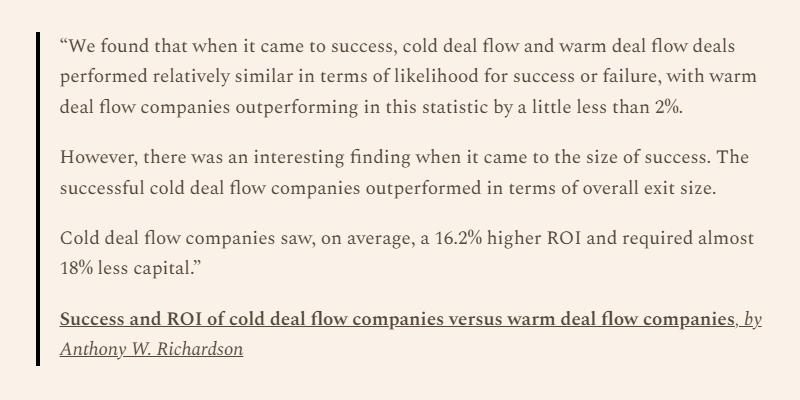
That being said (and to manage expectations a bit), most cold outreach messages suck. Some pointers to make them suck less:
> acknowledge cold messages are needle in the haystack stuff
> your message should absolutely include why *you* are great for the problem the you’re solving (a remarkably high number of emails I get tell me nothing about the founder. Note that pre-seed is primarily underwriting the founder)
> spell it out to the investor why you believe the should care. There are 2 solid ways of doing this: 1) most VCs are quite public with their opinions (by design), and connect what you’re doing with something that investor has gone on record caring about and/or 2) connect what you’re doing with an existing portfolio position. (however, a lot of the time I see a founder say “I saw you invested in X, so you should like my startups which is doing exactly what X is doing”. This is a bad way to do it, as most VCs are unlikely to back a competitive company (esp from cold email). Instead your message should be how your startup might be complimentary to what they’ve already deployed money in)
On one side, you have the VC, with a network.
On the other, the founder, without.
Just to get the attention of the VC, the founder must navigate a network of strangers to find someone who believes in their idea enough to agree to pass it on.
And then they hope the VC, hearing this idea from a second-hand source, also sees the potential.
Who does this nonsense work well for?
It works reasonably well for founders with "obvious" ideas that have some recognisable "pedigree", who are perhaps gifted with charisma.
However, none of these attributes are positively correlated with returns.
They are positively correlated with generating faster markups, so it also works well as a filter for the scaled venture platforms who sell allocation to LPs.
But, for most founders, it's a massive waste of time and a painful distraction to be forced to play this ridiculous ego-driven relationship game.
The first thing any new VC should pledge is to not waste founders' time, because it is infinitely more precious than any VC's time.
The arrogance of making founders jump through hoops for a chance at raising money is insane. Unless you believe your customers are LPs, rather than founders.
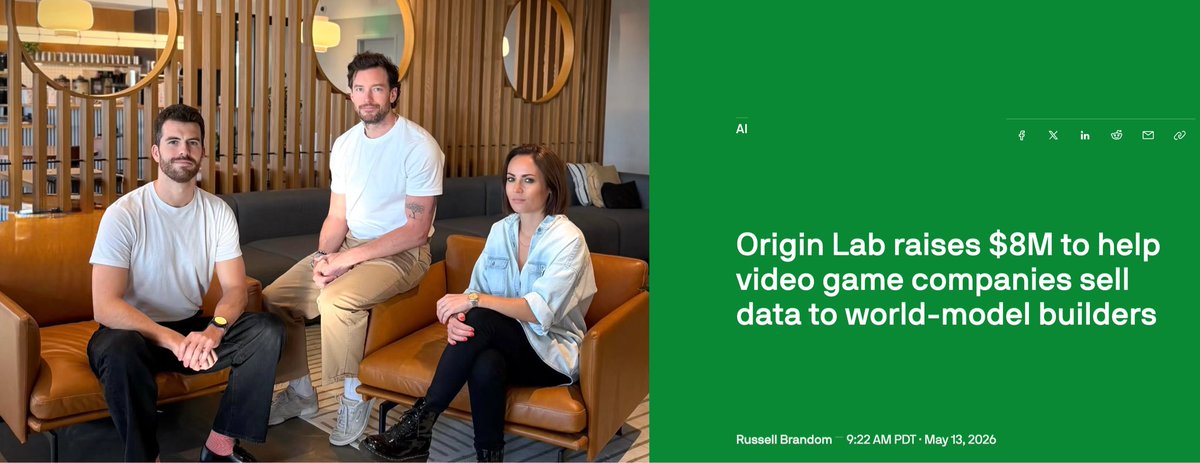
The bottleneck for world models is data. And unlike LLMs, world models will need fully licensed training data, a lot of which is going to come from video games. Origin Lab is building the bridge between AI labs and the industry sitting on it. Congrats on the $8M seed, thrilled to be backing this team!
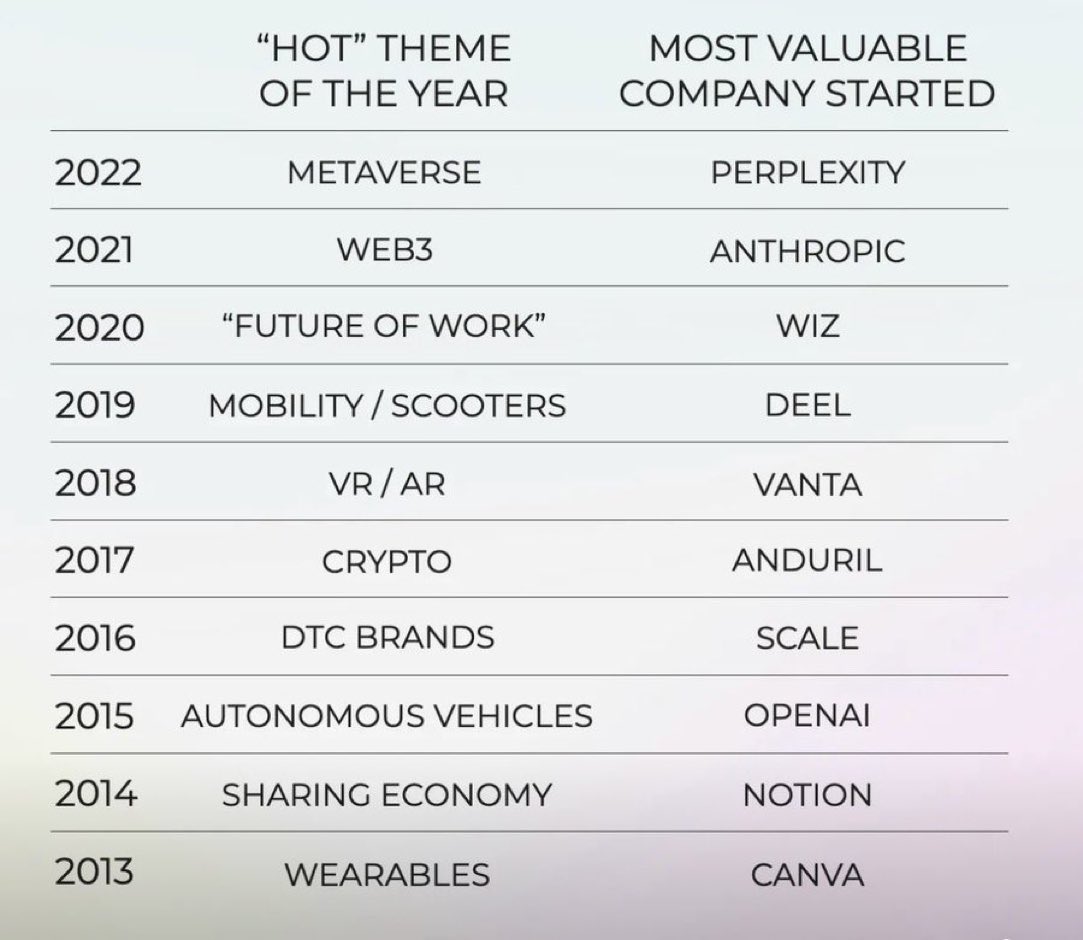
I’d bet most of these companies got funded primarily on the founder, not the theme. The “hot” theme of the year almost never produced the most valuable company of the year. The outlier founder did, usually working on something the consensus hadn’t caught up to yet.
Exceptional founders see the future before everyone else. Too many VCs try to predict the future and then find founders to align with it. But for most truly transformational companies, the bet is on the founder who has seen a future few else have.
Chuckling because I was making this argument to my colleagues two days ago.
It’s truly awesome to be operating closer to the speed of the future. It’s what I love about working in venture capital and it’s particularly what I love about the AI age.
The AI age brings so much learning, agency, and opportunity to the forefront in new and exciting ways EVERY SINGLE DAY.
a founder has three jobs. everything else is serious amounts of noise.
1. you have to tell the story. roughly in three registers. first investors need inevitability. customers need to *feel* what you do/stand for. & your team needs a mission worth their best years.
2. you must secure the capital before you need it. running out of money is running out of options. you have to be relentless about it.
3. you must obsess over the product. product is the story made accessible for everyone. every shipped detail is a sentence back into the narrative in point number one.
this is the entire job.
everything else you either delegate or kill. early on with a really small team, delegation is a huge tax so you have to learn to kill more than you delegate.