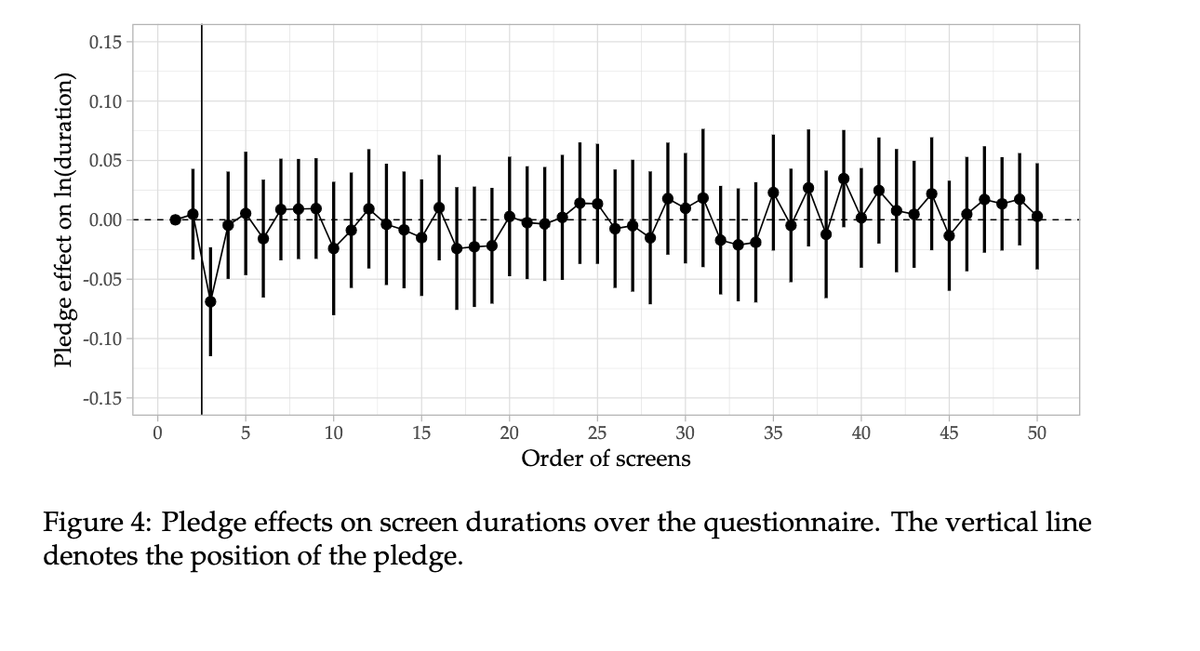
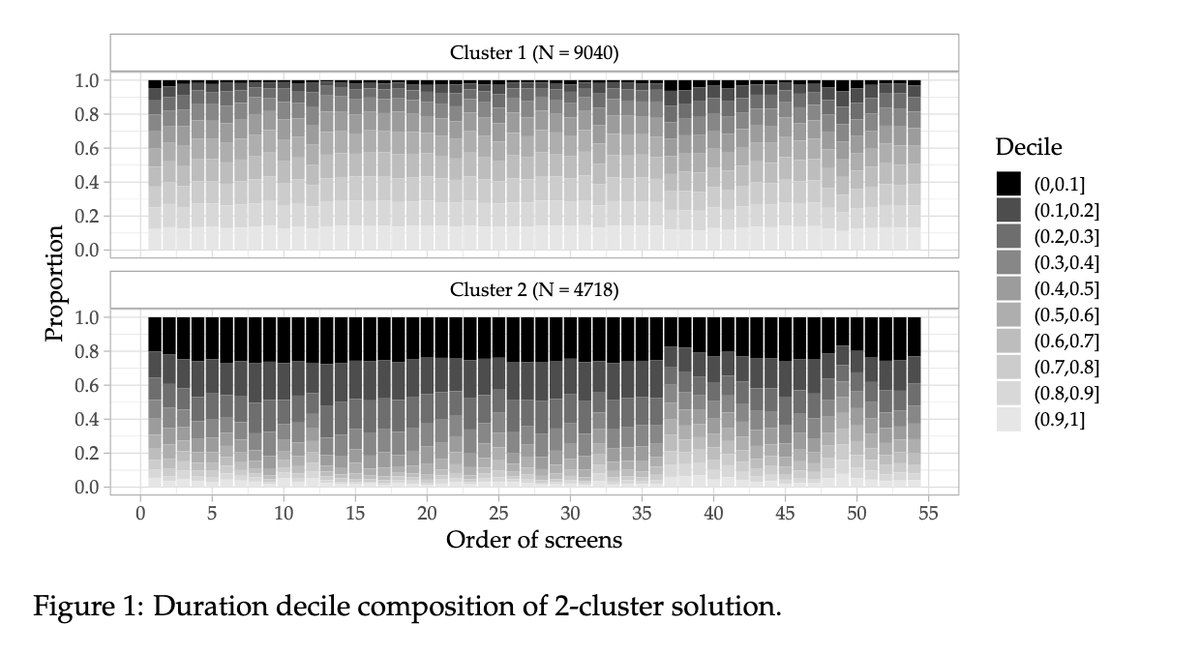
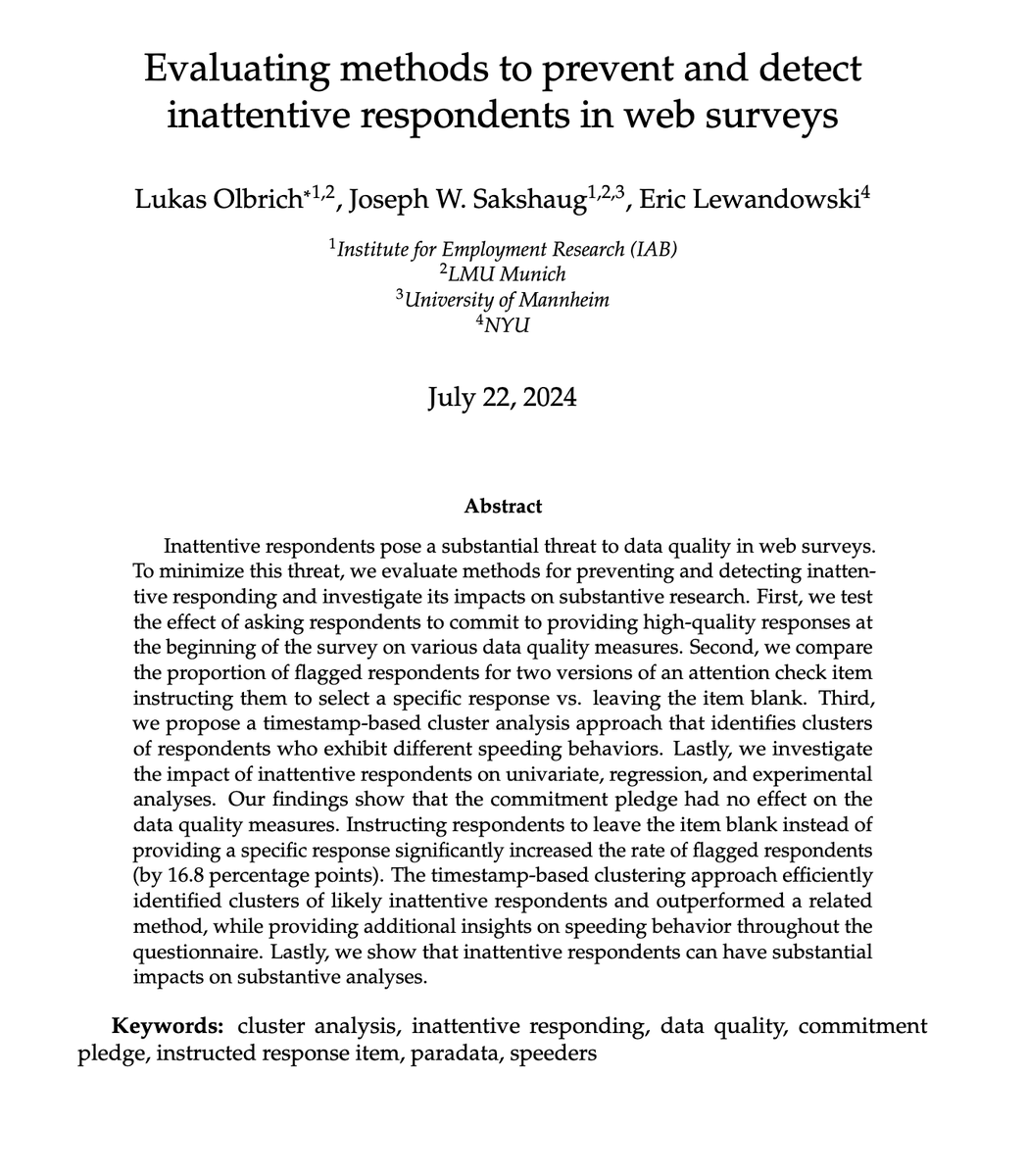
This new working paper looks like a must read for those who run surveys.
It outlines the problem of inattentive respondents and explores potential solutions.
"Inattentive respondents can have substantial impacts on substantive analyses."
https://t.co/Xg1k6xTAvT
📣Hey you! Yes, you! Our new report authored by @jdbaron@NeelamEjaz@iva_trako Mary Bend & Jessica D. Lee, "Breaking Barriers, Improving Futures Challenges and Solutions for Girls’ #Education in #Pakistan" is out!
🔽Download it now: https://t.co/ujKixLggzh
@WBG_Gender
#Facebook's marketing data isn't just about 'likes' anymore—it's a goldmine for social research.
Dive into our blog to learn how we crafted the innovative rsocialwatcher #R package, an open tool that streamlines access to Facebook's Marketing API.
👉 https://t.co/Tlecj3FFrA
I just heard Professor Karen Macours at @the_IDB talk about an intervention to reduce menstrual stigma in schools in Madagascar and its striking impacts on student learning (but not through reduced absenteeism). https://t.co/8Lo1renawH
📣Hey you! Yes, you! Our new report authored by @jdbaron@NeelamEjaz@iva_trako Mary Bend & Jessica D. Lee, "Breaking Barriers, Improving Futures Challenges and Solutions for Girls’ #Education in #Pakistan" is out!
🔽Download it now: https://t.co/AZ6eV6SpEO
@WBG_Gender
🏫The path to effective school grants may not always be smooth, but with a clear vision, careful planning, transparency and accountability, we can maximize the impact of these valuable resources
Insights by @jdbaron & Jessica Lee: https://t.co/p7zdSROW5b
#FundEducation
🗨️ "There's a stark contrast between those who believe #technology will solve every issue, even replacing #teachers, and those who see it as mere distraction" - @jdbaron@WorldBank in our #EdTech podcast with @haanimazari & Gouri Gupta @CSF_India
🎧https://t.co/r4SwTWy7RK
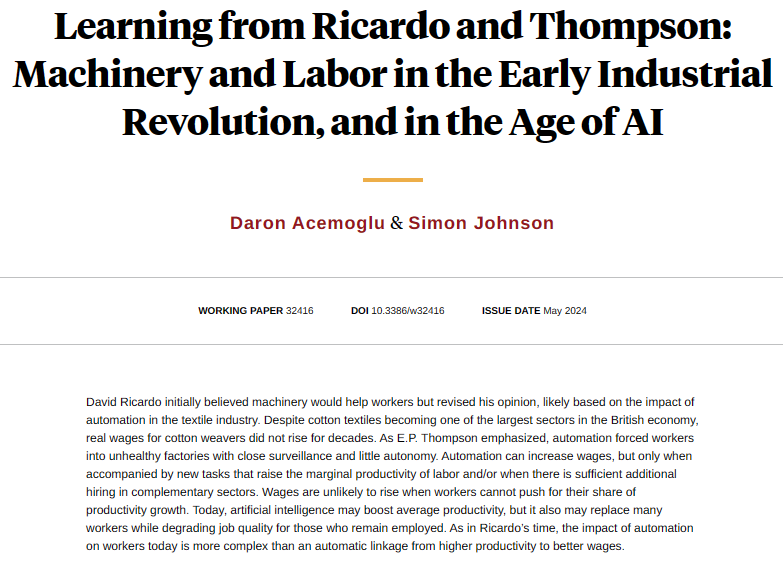
Artificial intelligence may boost average productivity, but it also may replace many workers and degrade job quality for those who remain employed, from @DrDaronAcemoglu and @baselinescene https://t.co/NxNkUIaLpI
🌏How are families addressing #ClimateChange in #Pakistan?
Families are relying on the schools to fulfill this role. Almost all households in the survey said they support #education about climate in schools.
🆕Blog by @jdbaron & @AsadSaher: https://t.co/WbFszdVcjf
🌏🤔 Over 80% of Pakistanis are concerned about climate change, yet action remains limited. Why is this? Our latest policy brief dives into this crucial issue. Discover, engage, and be part of the change. #LivablePlanet#COP28 [https://t.co/7M9SHTytyt]
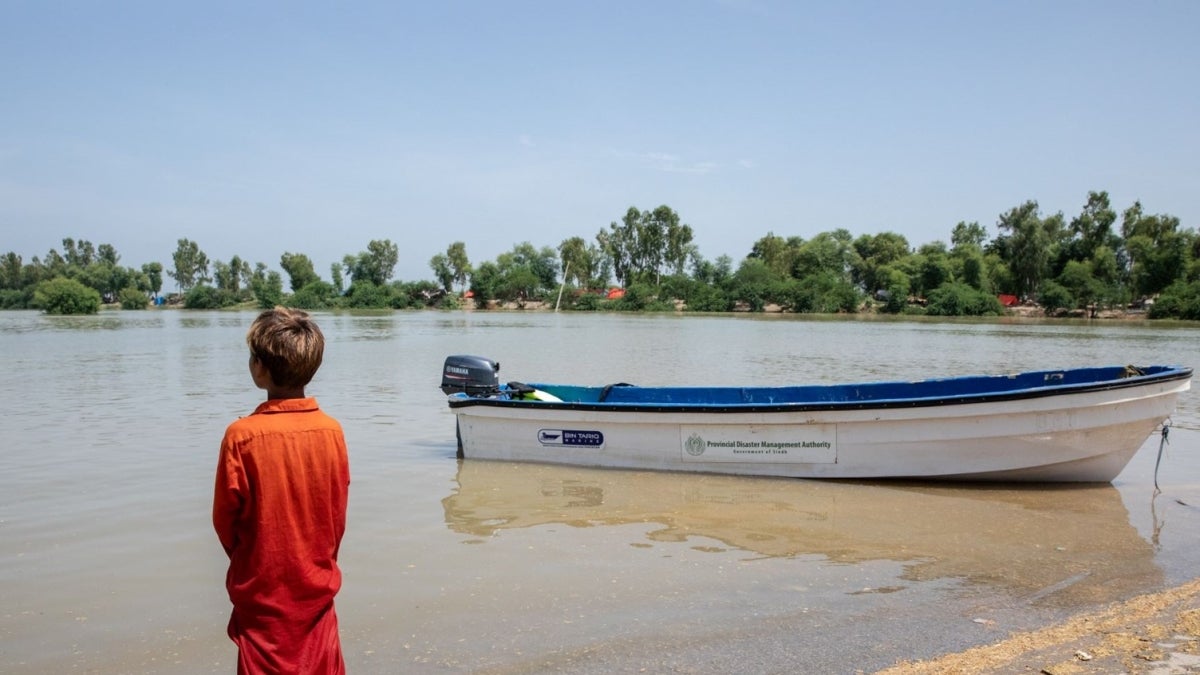
During the #floods of 2022 access to education was disrupted for more than 3.5 million children in the country. Read what our analysis says in our new blog: https://t.co/b8Bb83NwUN
WB Pakistan’s contribution to public dialogue on economic and human development challenges in face of climate change: Check out our outreach program to discuss the most pressing reforms for Pakistan’s long-term development at https://t.co/hDT6xSk53V #ReformsForABrighterFuture
During the #floods of 2022 access to education was disrupted for more than 3.5 million children in the country. Read what our analysis says in our new blog: https://t.co/b8Bb83NwUN
I just published a "short communication" in the Economics of Education Review (https://t.co/2VEpQWy4Ep).
Just a reminder that there are lots of outlets where economists can publish short papers. Here are 60: https://t.co/8DvWuvsIKW.
6 months post-flood in #Pakistan, 92% of households reported uncertainty about when their local school would reopen (lots of them are used as temporary shelters).
@jdbaron@Freya_Perry1 L. Dahlin explain how we can make #education systems more resilient: https://t.co/7EBxpooDbP









![jdbaron's tweet photo. 🌏🤔 Over 80% of Pakistanis are concerned about climate change, yet action remains limited. Why is this? Our latest policy brief dives into this crucial issue. Discover, engage, and be part of the change. #LivablePlanet #COP28 [https://t.co/7M9SHTytyt] https://t.co/71bYKcnU0H](https://pbs.twimg.com/media/GAgnez8XIAAp7RP.jpg)