What is Google’s TPU?
A TPU (Tensor Processing Unit) is Google’s custom AI chip, designed from scratch for the giant matrix multiplications that modern models live on. GPUs were built for graphics first.
TPUs were built for deep learning from day one.
At Cloud Next ’26, Google unveiled its 8th generation, and for the first time it ships in two flavors. TPU 8t is built for training, where raw throughput wins. TPU 8i is built for inference, where latency and chip-to-chip speed matter most.
Both still share the same Axion CPUs, liquid cooling, and software stack, so code written for one runs on the other.
The diagram below is a quick study guide to what’s the same, what’s different, and why, based on our understanding of published Google articles.
🍃 Let's use Spring Boot to build games, because why not? by Alexander Chatzizacharias @ Spring I/O 2026
▶️Video: https://t.co/p49mAa0Ows
🔗 Slides: https://t.co/jYN2lFA9ed #springio26
Flutter 3.44 marks a massive milestone for the Material and Cupertino libraries.
These libraries have been frozen, representing the final set of updates to these libraries within the core framework before they transition to standalone packages 🐛🦋
Canonical will now serve as the lead maintainer and strategic steward for Flutter Desktop 🧡
With their deep technical expertise, @Canonical will lead the Flutter Desktop roadmap and oversee the maintenance of our Linux, Windows, and macOS embedders.
This #JavaOne session highlights the progress of JEP 528, which brings core dump and minidump support to jcmd.
Watch now for a deep dive into the future of JVM crash analysis and post-mortem diagnostics. https://t.co/pMzBQmdPG9
Quarkus Agent MCP is a standalone MCP server that lets AI coding agents create, manage, and work effectively with Quarkus applications. Extension authors can ship coding skills that agents pick up automatically.
Learn more in Phillip Krüger's post: https://t.co/gQpZx8DcpJ
With JDK 27 introducing hybrid key exchange schemes that combine ML-KEM with traditional ECDHE algorithms, Java applications can gain TLS-layer protection against the _harvest-now, decrypt-later_ threat without rewriting business logic.
In this episode of the Inside Java Newscast, @ammbra1508 explains post-quantum hybrid key exchange for TLS 1.3 and demonstrates how a Java application can take advantage of it. https://t.co/c7XTbU79o0
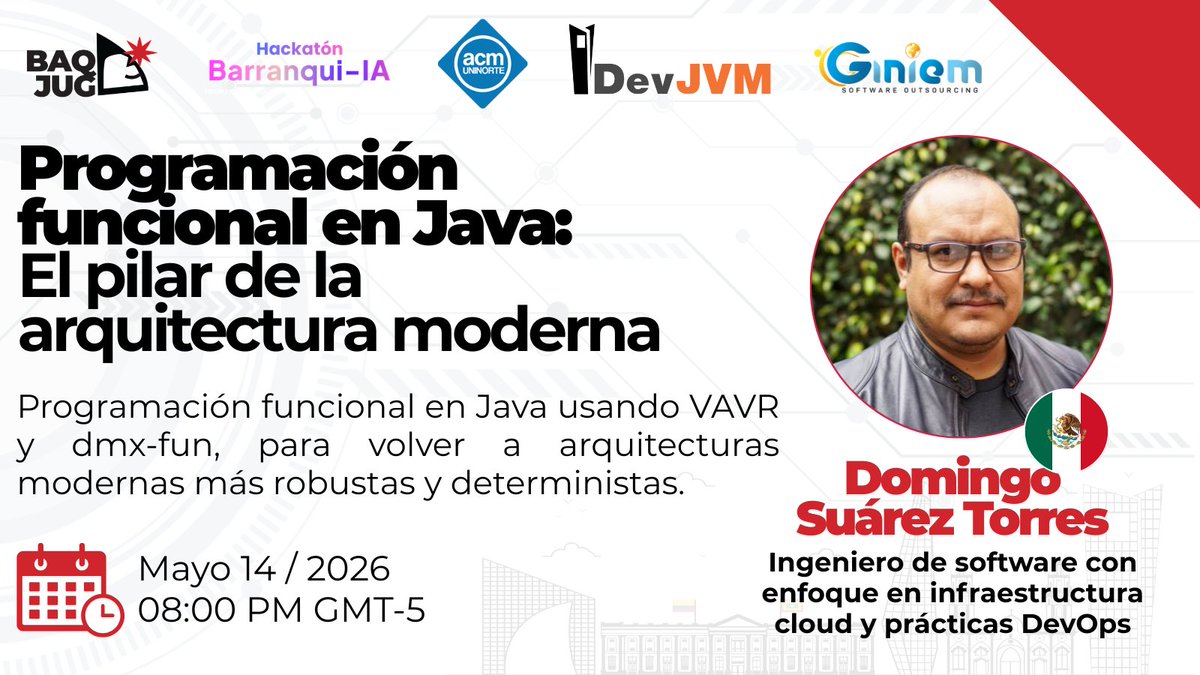
¡Comunidad, es MAÑANA! ⏰ A las 8:00 PM (GMT-5) nos vemos en el canal con @domix para hablar de arquitectura moderna en Java.
¡No falten!
👇 https://t.co/jxSw9ML0Vp
Static agent diagrams age fast. This piece shows how to expose a live LangChain4j workflow from Quarkus with topology HTML and an SSE run feed.
https://t.co/c5vki3yUWI
#Quarkus#LangChain4j
¿Código más limpio, predecible y sin efectos secundarios en Java? Es posible. ☕✨
Descubran el poder de @vavr_io y dmx-fun con Domingo Suárez en nuestro próximo live.
¡Justo en una semana! Preparen sus preguntas para el Q&A. Link del stream: https://t.co/jxSw9ML0Vp #JVM#java
I’ve just published the release notes for dmx-fun 0.0.15.
Quarkus + JTA transaction propagation, new HTTP/Jakarta/Micrometer modules, plus BOM and SBOM support.
Making functional programming in Java more practical, one release at a time.
https://t.co/qniD34Muh0
How to migrate the legacy project to Spring Boot by Sergei Chernov @ Spring I/O 2026
▶️ Video: https://t.co/80G9F0G3ta
🔗 Slides: https://t.co/mSrNWIdMaX
🛠️ Repo: https://t.co/Tmuojwon3B #springio26
The real challenge in software engineering had always been specification.
Not typing. Not syntax. Not even architecture in the abstract. The hard part was agreeing what should exist, what should never happen, which tradeoffs matter, what the system is allowed to forget, and what “done” means when the world is messier than the ticket.
https://t.co/XjdrvlNYBR
If you're using Spring AI, you have the integration layer sorted. Keep your #Spring beans, and add Koog, the JVM AI agent framework from @JetBrains, on top for the following:
✔️ Graph workflows
✔️ Crash recovery
✔️ History compression
👇 https://t.co/q3lAegcMqO
dmx-fun 0.0.14! Mientras que las versiones anteriores desarrollaban el sistema de tipos principal, esta se conecta con los frameworks e infraestructuras sobre los que se ejecutan las aplicaciones Java en producción: Spring Boot, Micrometer y Resilience4J.
https://t.co/pyjslArsZx