🚨We're recruiting for a Commissioning Editor
🌱Join us in playing a vital role in bringing new ideas to Applied Ecology
🌏Commission new Reviews, Perspectives, Practitioner's Perspectives & Policy Directions as part of a global team
🔎Find out more below: https://t.co/ywSm6T9SBs
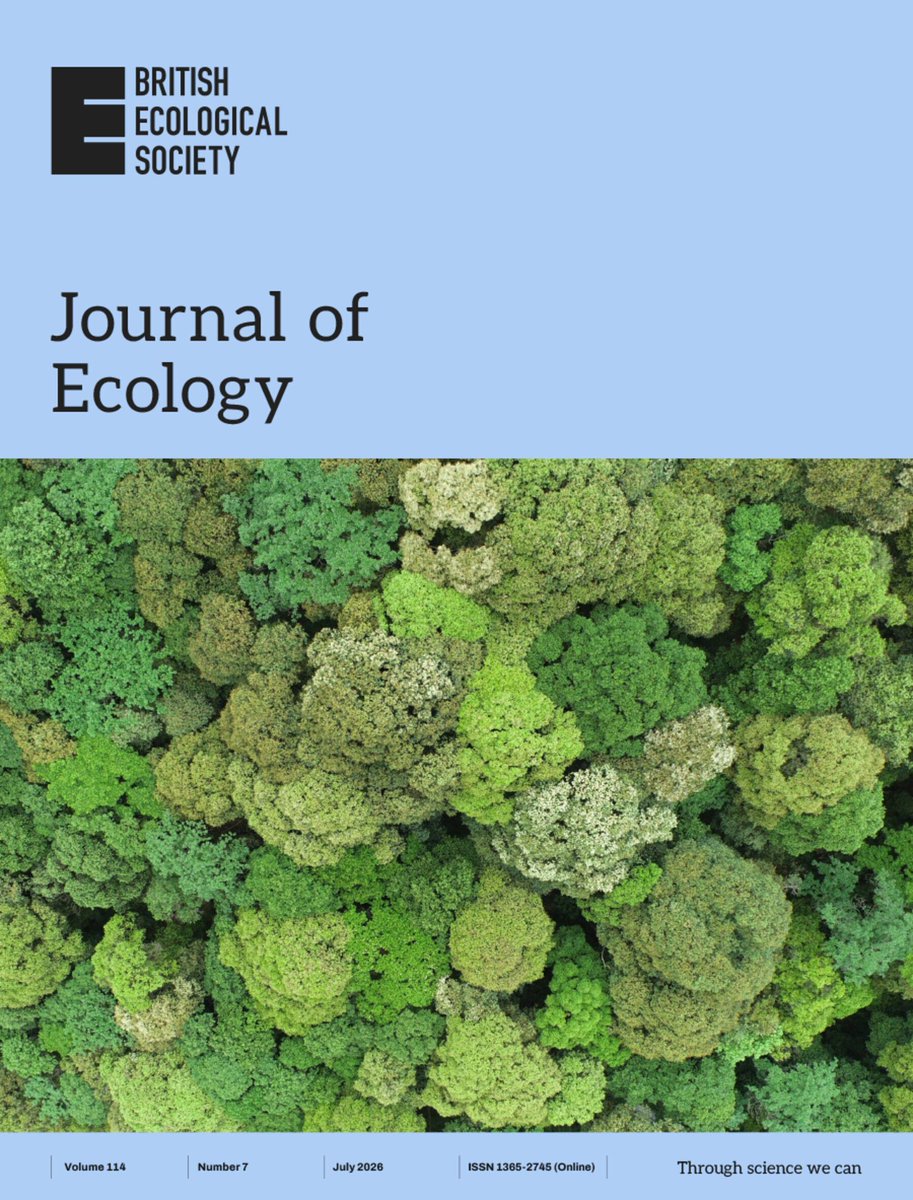
🌳 The July issue is out now! 👉️ https://t.co/WOKF1QRjdF
🍃The image shows an "Aerial view of a species-rich subtropical evergreen broadleaved forest in Tiantong, Zhejiang, China." Read the article by Chen et al. 👉️ https://t.co/LHwOfzAOm8
📢 Call for proposals!
This Special Feature explores the advancement of ecovoltaics - the development of ecologically informed photovoltaic (PV) designs that co-prioritise PV electricity generation with ecosystem function 🌿💡
⏰ Submit by 31 July
https://t.co/xUWfxviCw9
🐝 Individual pollinators are more specialized than expected, with niche partitioning and sex-based differences helping shape plant–pollinator networks from individuals to species👉️ https://t.co/r1xdpam9kF
🌳 Novel forest ecosystems reshape pollination and seed dispersal in central Portugal. Landscape complexity drives changes in connectivity, functional diversity, and interactions, with distinct effects across ecological processes👉️ https://t.co/buZXNWQAdK
🍃Canopy has 67% more herbivores than understorey — but not more leaf damage! Resource dilution decouples abundance from herbivory in beech forests. Vertical structure & woody plant diversity drive layer-specific effects 👉️ https://t.co/q25Uxv8IVP
🌳How do species adapt across environments? In Acacia tortilis, plasticity, more than trait means, diverges across the savanna to desert environmental gradient, with distant desert-edge populations converging in their plastic responses 👉️ https://t.co/77x8I9OLDJ
🌳Tree species in forests of the eastern U.S. respond to deviations in climate from local long-term means. Whether this reflects genetic adaptation or more rapid acclimation has significant effects on expected forest response to climate change👉️ https://t.co/ZSi4jiO03r
🌼A 12-year species-removal experiment in a Tibetan alpine meadow shows that biodiversity loss reshapes flowering phenology by advancing flowering, delaying senescence and extending flowering duration, mainly through competitive release👉️ https://t.co/5JbZjXtl4Y
🌱 Researchers measured offspring bulb size, number, and location for over 100 species of Oxalis and identified a size/number trade-off similar to that found in seeds and variation in traits of offspring produced from an individual plant👉️ https://t.co/fsVhhddgxI
📖Published📖
Read our new research article 👉 Complete elliptic Fourier descriptor normalization and its application in quantitative morphological analysis 🥬
https://t.co/UIhqkkk8bF
📰 On the blog: Drought and nitrogen addition: How they jointly shape interactions among plant, arthropod, and soil nematode functional groups in temperate grasslands - https://t.co/GCPDF84wWC
🔍 Article: https://t.co/rouJ1s3dP0
🌳 Saturated pairwise Gibbs point process models provide a new tool to explore the spatial structure of species-rich communities of sessile species. Researchers applied them to a seasonal tropical forest in western Thailand with ~300 tree species 👉️ https://t.co/Z2G2pRTUaS
🌿A shift in plant investment strategy from tall, resource-acquisitive vegetation at warmer, drier sites to short, more conservative vegetation at cold, wetter sites regulates ecosystem carbon exchange 👉️ https://t.co/5l1lifeb9l
📣 We're recruiting for an Associate Editor with data integrity expertise!
📊 join us in improving the clarity, transparency, & accessibility of ecological research.
🌿 more information on the role and how to apply can be found here 👉️ https://t.co/mvzz44w2ml
25 years, 4 colonies: research shows that earlier Arctic snowmelt advances hatching in little auks, but fitness consequences are mixed. Will earlier breeding help in future?
📝 paper: https://t.co/0roTKaaiFz
🎙️ podcast: https://t.co/byH6xo4epr
🧊 blog: https://t.co/Vdf1RrYeZE
🔥Fires increases precipitation use efficiency and the sensitivity of production to precipitation changes in the North American Great Basin. These effects are mediated through shifts in plant composition from shrub systems to annual dominated systems 👉️ https://t.co/TjQClb9ksC
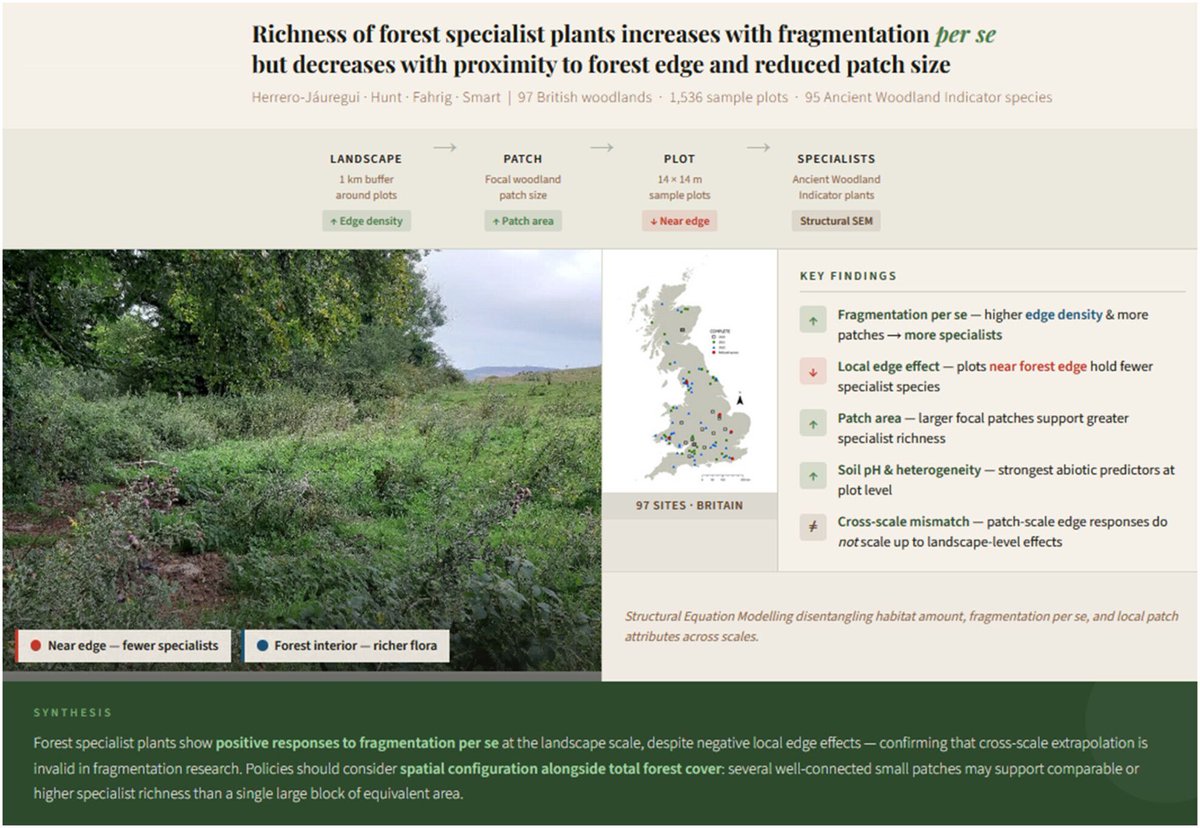
🌳 Woodland landscapes with more edges and heterogeneous plots support higher specialist plant diversity, even when local edge effects are negative. Scale matters in fragmentation research 👉️ https://t.co/h3l1GyKckQ