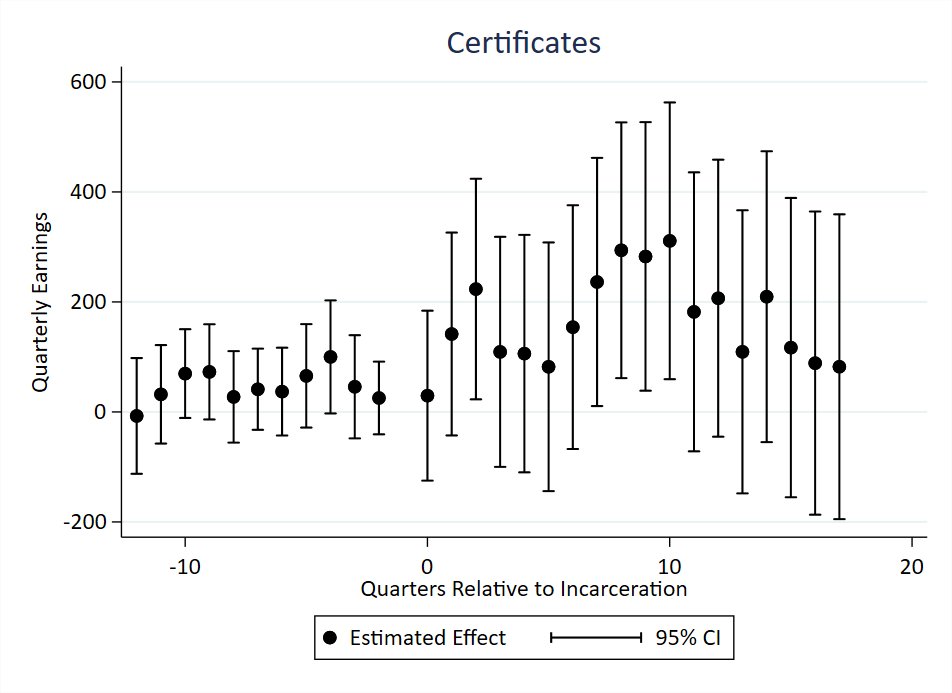
We find that the GED increases earnings by about $450/quarter and that vocational certificates increase earnings by about $250/quarter after release. For vocational certificates, the effects are largest in construction and skilled manufacturing.
We study the effects of these degrees on earnings using linked correctional and UI records in WA. We implement a difference-in-differences design that compares changes in earnings after incarceration for prisoners earning degrees to those who enroll without completing a degree.
Excited to have new descriptive work on teacher licensure forthcoming at AERJ. We (@CEDR_US@zjin_12@RoddyTheobald) assess relationships btwn licensure tests and teacher VA in MA and assess some concerns about implications for teacher diversity.
https://t.co/vMUy5EPdCc
Tests of teacher content knowledge are predictive of student achievement gains. This relationship does not differ based on teacher race/ethnicity, although teachers of color do retake tests at lower rates.
Excited to release a new working paper, "Teachers and school climate: Effects on student outcomes and academic disparities", joint with @brbackes, @cedr_us, and @RoddyTheobald.
We find that teachers who positively contribute to school climate also improve student outcomes. In addition, teachers who disproportionately improve the perceptions of students of color have outsize effects on their learning gains.
@vkoganpolisci@brbackes@caldercenter@RoddyTheobald@CEDR_US We haven't, but the very nice paper by Opper and Mulhern does. The timing of testing in high school makes it a little difficult to estimate teacher effects on t+1 test outcomes.
Job alert🔥, the fire indicates that it's with us, @caldercenter! Lots of interesting work, but, in particular, studies focused on teacher preparation and how prep experiences translate into workforce outcomes for teachers and students:
https://t.co/Mb7oG9qyMT