INSANE...this is an Open Source Video model available for free on Hugging Face.
LongCat just dropped an amazing video avatar model that can do crazy things.
And it's 100% Opensource.
New: LongCat just dropped an excellent open-source talking-avatar model (probably SOTA) + MIT licensed 🔥
Made a Hugging Face Space for it and it's very impressive. So many cool products to build with it: AI tutors with a face, dubbing pipelines, talking-head coding agents (imagine Claude Code with a face), NPC dialogue, etc...
Sharing the Hugging Face (free) demo below 👇
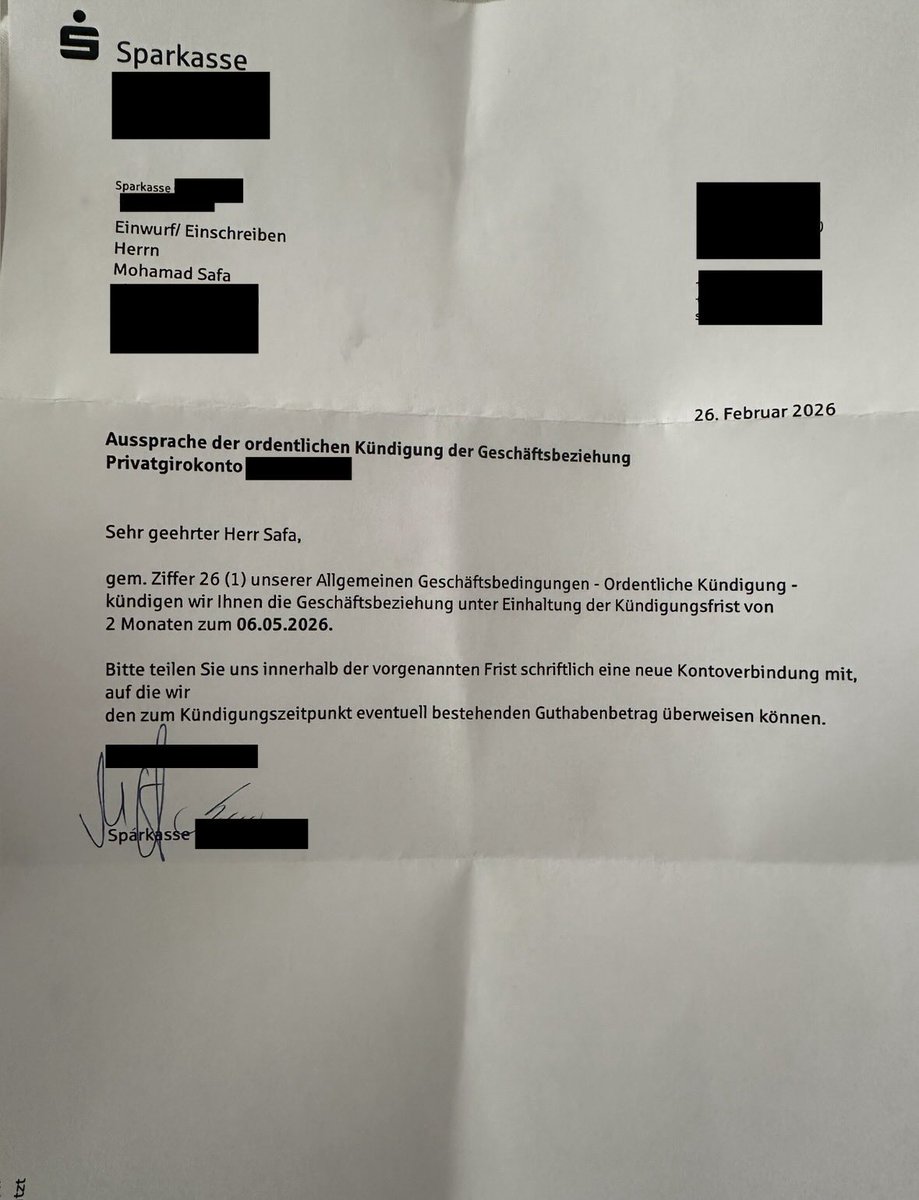
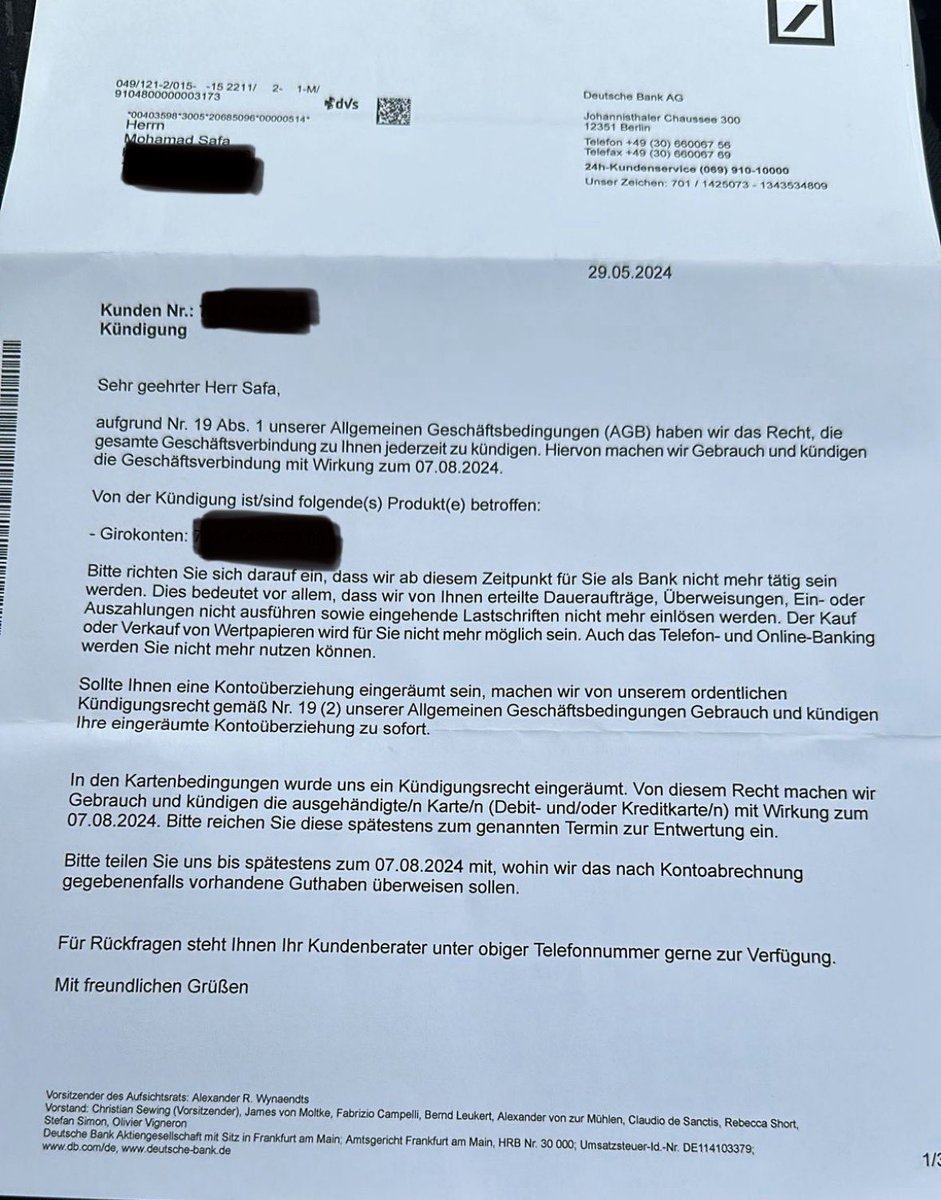
I am financially censored.
All the banks closed my bank accounts for criticizing Israel and U.S. war crimes at the UN
I cannot have a bank account. I cannot have a credit or debit card. I cannot make or receive payments
I’m not a criminal. I represent people’s voice at the UN!
Nexus brings private DeFi to Zcash.
Your ZEC stays on Zcash, locked in a vault and always backed 1:1.
Inside Nexus you can swap, provide liquidity, and use smart contracts, all privately.
No new chain. No bridge. Just Zcash with DeFi.
Here’s how it works. 🧵
1/9
Opened Zashi to find this message in a bottle from @PrivacyClaw. 📬
Perhaps I'll suggest PrivacyClaw comb through the @ZcashMe directory to send some shielded Valentines. 💌
From AI to ZK.
Artificial intelligence is the attack.
Zero knowledge is the defense.
AI takes advantage of the slightest slip.
ZK does not let anything slip.
AI decodes all the data.
ZK encrypts all the data.
AI is the surveillance state.
ZK is the sovereign individual.
I sat down with @TuckerCarlson to talk about Privacy, Encryption, and the future I'm building with Arcium.
The largest political show in the world.
The biggest podcast on privacy in history.
Technology stole your privacy, and with it your freedom. Yannik Schrade has a plan to get it back.
(0:00) Why Is Privacy So Important?
(4:13) Is Schrade Prepared to Suffer for His Cause?
(10:38) Why Doesn't Our Current System Protect Our Privacy?
(14:16) Are We Being Surveilled?
(26:19) Is the iPhone Safer Than Android?
(31:25) Is It Truly Possible to Communicate Privately?
(35:20) Is Signal a CIA Operation?
(47:54) Is the Current State of the Art Cryptography Secure?
(53:02) How Did Schrade Build This Technology?
(56:42) Is It Possible to Move Money Privately?
(1:03:20) The Arrest of Roman Storm
(1:14:48) Are Cash Transactions Private?
(1:18:37) Is Schrade Concerned for His Safety?
(1:23:02) How Will This Technology Impact Our Lives?
(1:28:54) Will Any Big Hardware Manufacturers Sell Truly Secure Devices?
(1:35:17) Are All Our Text Messages Being Monitored?
(1:39:58) Is Your Phone Listening to You?
(1:44:50) Where Can People Learn More About Schrade's Work?
From AI to ZK.
Artificial intelligence is the attack.
Zero knowledge is the defense.
AI takes advantage of the slightest slip.
ZK does not let anything slip.
AI decodes all the data.
ZK encrypts all the data.
AI is the surveillance state.
ZK is the sovereign individual.
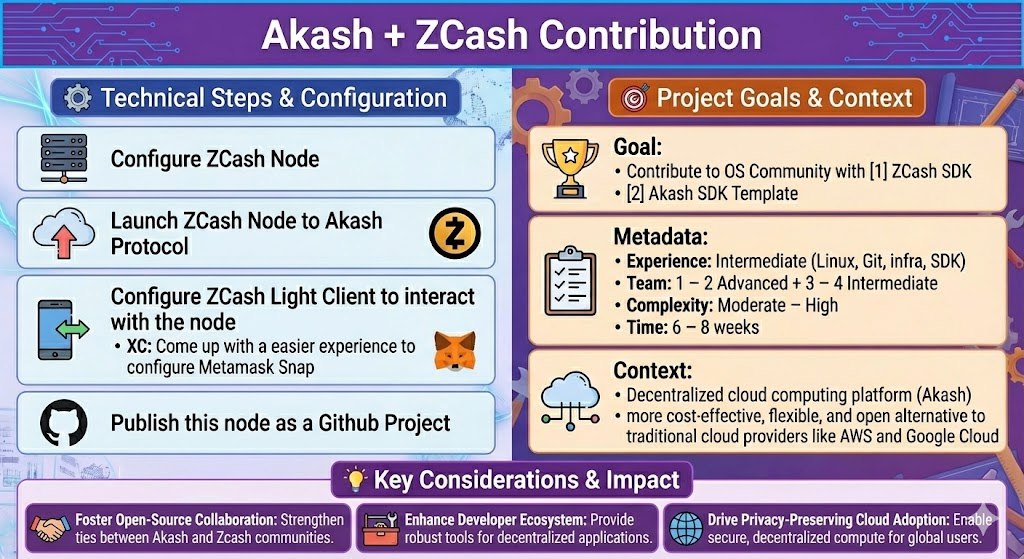
Alex from USC shipped an open-source project connecting @Zcash with Akash’s decentralized cloud.
Real Zcash infra. Decentralized compute. No AWS, no GCP.
Student-led, ecosystem-level contribution 🚀
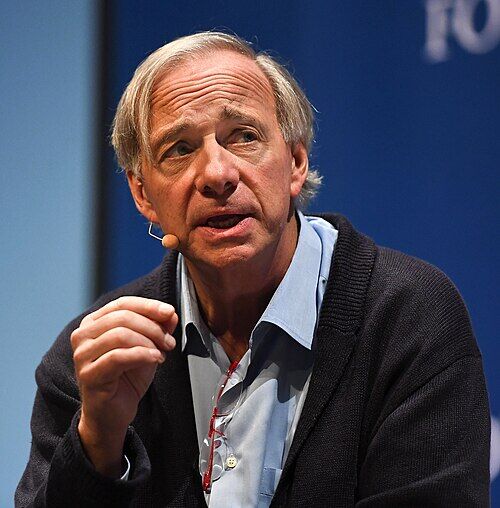
🚨 LATEST: Ray Dalio warns CBDCs are coming and will eliminate financial privacy while giving governments power to tax, seize funds, and cut off political opponents.
Your privacy is only as strong as the crowd you're hiding in.
Most privacy tools encrypt your data and transactions, but encryption alone doesn't create anonymity. That takes a crowd.
This is the mechanic behind Zcash's Orchard pool. When you spend a shielded note, you prove it exists somewhere among millions of other notes without revealing which one.
The larger that set, the more indistinguishable your transaction becomes. Millions of notes make probabilistic attacks meaningless.
The anonymity set only grows because every shielded transaction adds to it permanently. The pool of notes you're hiding among never shrinks.
As the pool grows, so does the anonymity set and the privacy it provides. Stronger privacy attracts more users, and more users bring more capital.
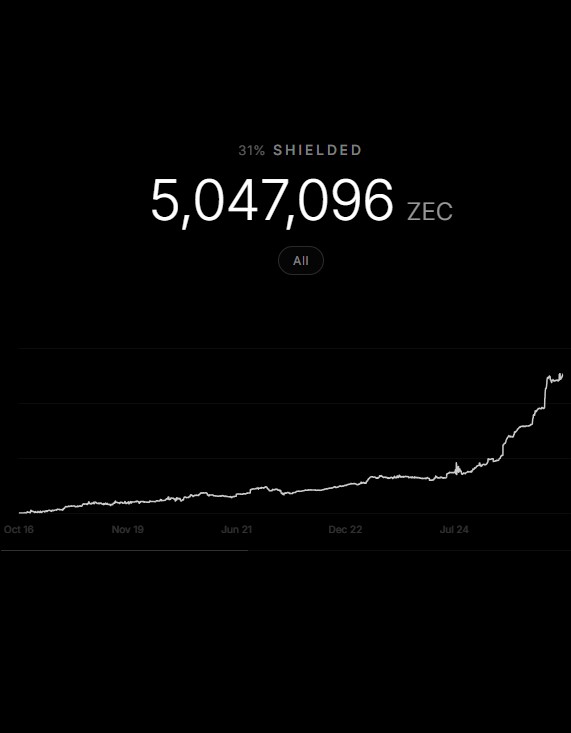
This is already happening in Orchard where the pool has grown to millions of notes.
Privacy has a scaling problem.
The cryptography that makes it possible is expensive with large proofs, heavy verification, and state that grows forever.
Tachyon is designed to solve this.
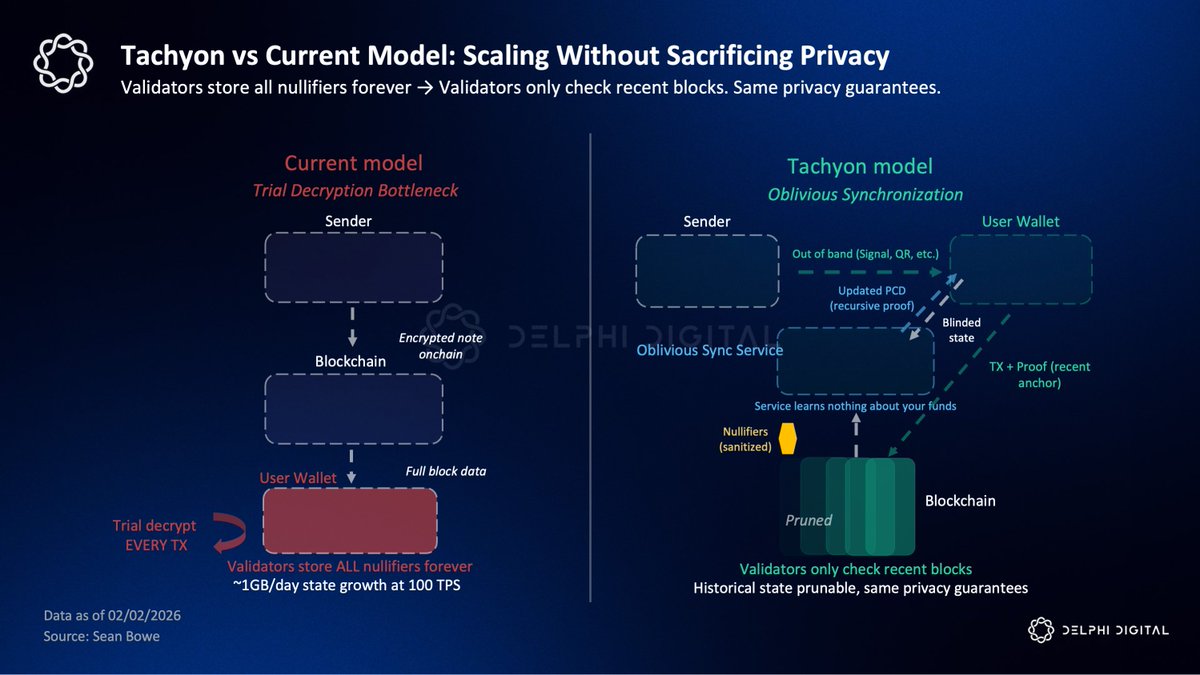
Zcash's shielded transactions sit at roughly 3 TPS today. Each one creates a nullifier that full nodes must store permanently. This state only grows over time for validators.
Led by Sean Bowe, Tachyon solves the state issue with oblivious synchronization where a service helps you prove you haven't double-spent while remaining blind to what you're really spending.
It handles computation without learning which nullifiers are yours. Validators no longer need to store the full nullifier history, and Zcash's core privacy guarantee stays intact.
Tachyon also aggregates proofs, batching multiple shielded transactions under a single proof and dropping transaction size from around 10 KB to 200-500 bytes.
A fully private Zcash transaction ends up roughly the same size and speed as one for Bitcoin.
Tachyon's shielded pool is expected to go live at the protocol level by end of 2026.
Privacy was never meant to be slow.
My reasons for disagreeing:
Refusing to build out functionality that supports future chain revenue and keeps the protocol competitive is the same hole Bitcoin fell into, and is why they never added zkps. "attack surface" is an engineering problem that gets turned into an ideological one through fear and ends up ossifying the protocol. "store of value" is an intellectually lazy valuation framework for blockchain tokens and has long-term vulnerabilities.
It's very unlikely that token issuers would have any sway over the protocol. If they tried to fork in a way that challenged the core values of ZEC, their new chain would not be the more popular one and it would only damage their own revenue and reputation. Reputable stablecoin issuers deciding to use ZSAs would obviously be aware of all regulatory risks and community expectations when creating their token - why would they choose to use this new tech only to fight it?
With all this being said I will still be holding the vast majority of my zcash. I think ZSAs are a very important potential use case - not adopting them is only an opportunity for other protocols, and I would still like exposure to this.
I think Zcash is less likely to experience the kind of conflict Bitcoin saw during the block size wars because there’s already a pretty well defined process for how protocol changes get discussed and evaluated. The ZIP process, community panels, and coinholder polling give the community clear and transparent ways to gauge support before anything moves forward. Disagreements will still happen (and they should) but having this process helps channel those disagreements into discussion and iteration, without turning into the kind of open-ended, leaderless conflict that divided Bitcoin.