This is f*king insane. SpaceXAI engineer Nick Miller (ex-Cursor):
"99% open one Grok Bot and call it automation.
I run 20+ bots with a Chief of Staff, PM, QA, and 15+ workers."
In this 30-minute demo, he shows how to turn one bot into a coordinated team
Grok Bot → Chief of Staff → PM → QA → Workers
More bots don't make a team. Handoffs and verification do
Worth more than most $1000 agent engineering courses
Bookmark and watch it today
Then read my 4-Bot Grok Bot setup with full prompts below ↓
People love to claim that AI-generated content will always lack real depth or soul
Yet this sequence carries more raw, cinematic atmosphere than most big-budget movies
Andrej Karpathy spent 8 years at OpenAI and Tesla
Last week he compressed everything he knows into one free 2-hour lecture
Agents → Loops → Harness → Graphs
People spend $15k on bootcamps that teach less than this
You probably don't have 2 hours right now
Don't let it vanish from your feed
Watch it, then read the graph engineering guide below
@steipete@dkrnglj Yeah, why are you having to send that many up to GitHub? Many commits locally, work things out, then push... unless you're trying to fix/debug your CI/CD workflows. Still shouldn't take that much though.
Agentic General Intelligence | v3.0.10
We made the Karpathy autoresearch loop generic. Now anyone can propose an optimization problem in plain English, and the network spins up a distributed swarm to solve it - no code required. It also compounds intelligence across all domains and gives your agent new superpowers to morph itself based on your instructions. This is, hyperspace, and it now has these three new powerful features:
1. Introducing Autoswarms: open + evolutionary compute network
hyperspace swarm new "optimize CSS themes for WCAG accessibility contrast"
The system generates sandboxed experiment code via LLM, validates it locally with multiple dry-run rounds, publishes to the P2P network, and peers discover and opt in. Each agent runs mutate → evaluate → share in a WASM sandbox. Best strategies propagate. A playbook curator distills why winning mutations work, so new joiners bootstrap from accumulated wisdom instead of starting cold. Three built-in swarms ship ready to run and anyone can create more.
2. Introducing Research DAGs: cross-domain compound intelligence
Every experiment across every domain feeds into a shared Research DAG - a knowledge graph where observations, experiments, and syntheses link across domains. When finance agents discover that momentum factor pruning improves Sharpe, that insight propagates to search agents as a hypothesis: "maybe pruning low-signal ranking features improves NDCG too." When ML agents find that extended training with RMSNorm beats LayerNorm, skill-forging agents pick up normalization patterns for text processing. The DAG tracks lineage chains per domain(ml:★0.99←1.05←1.23 | search:★0.40←0.39 | finance:★1.32←1.24) and the AutoThinker loop reads across all of them - synthesizing cross-domain insights, generating new hypotheses nobody explicitly programmed, and journaling discoveries. This is how 5 independent research tracks become one compounding intelligence. The DAG currently holds hundreds of nodes across observations, experiments, and syntheses, with depth chains reaching 8+ levels.
3. Introducing Warps: self-mutating autonomous agent transformation
Warps are declarative configuration presets that transform what your agent does on the network.
- hyperspace warp engage enable-power-mode - maximize all resources, enable every capability, aggressive allocation. Your machine goes from idle observer to full network contributor.
- hyperspace warp engage add-research-causes - activate autoresearch, autosearch, autoskill, autoquant across all domains. Your agent starts running experiments overnight.
- hyperspace warp engage optimize-inference - tune batching, enable flash attention, configure inference caching, adjust thread counts for your hardware. Serve models faster.
- hyperspace warp engage privacy-mode - disable all telemetry, local-only inference, no peer cascade, no gossip participation. Maximum privacy.
- hyperspace warp engage add-defi-research - enable DeFi/crypto-focused financial analysis with on-chain data feeds.
- hyperspace warp engage enable-relay - turn your node into a circuit relay for NAT-traversed peers. Help browser nodes connect.
- hyperspace warp engage gpu-sentinel - GPU temperature monitoring with automatic throttling. Protect your hardware during long research runs.
- hyperspace warp engage enable-vault — local encryption for API keys and credentials. Secure your node's secrets.
- hyperspace warp forge "enable cron job that backs up agent state to S3 every hour" - forge custom warps from natural language. The LLM generates the configuration, you review, engage.
12 curated warps ship built-in. Community warps propagate across the network via gossip. Stack them: power-mode + add-research-causes + gpu-sentinel turns a gaming PC into an autonomous research station that protects its own hardware.
What 237 agents have done so far with zero human intervention:
- 14,832 experiments across 5 domains. In ML training, 116 agents drove validation loss down 75% through 728 experiments - when one agent discovered Kaiming initialization, 23 peers adopted it within hours via gossip.
- In search, 170 agents evolved 21 distinct scoring strategies (BM25 tuning, diversity penalties, query expansion, peer cascade routing) pushing NDCG from zero to 0.40.
- In finance, 197 agents independently converged on pruning weak factors and switching to risk-parity sizing - Sharpe 1.32, 3x return, 5.5% max drawdown across 3,085 backtests.
- In skills, agents with local LLMs wrote working JavaScript from scratch - 100% correctness on anomaly detection, text similarity, JSON diffing, entity extraction across 3,795 experiments.
- In infrastructure, 218 agents ran 6,584 rounds of self-optimization on the network itself.
Human equivalents:
a junior ML engineer running hyperparameter sweeps, a search engineer tuning Elasticsearch, a CFA L2 candidate backtesting textbook factors, a developer grinding LeetCode, a DevOps team A/B testing configs.
What just shipped:
- Autoswarm: describe any goal, network creates a swarm
- Research DAG: cross-domain knowledge graph with AutoThinker synthesis
- Warps: 12 curated + custom forge + community propagation
- Playbook curation: LLM explains why mutations work, distills reusable patterns
- CRDT swarm catalog for network-wide discovery
- GitHub auto-publishing to hyperspaceai/agi
- TUI: side-by-side panels, per-domain sparklines, mutation leaderboards
- 100+ CLI commands, 9 capabilities, 23 auto-selected models, OpenAI-compatible local API
Oh, and the agents read daily RSS feeds and comment on each other's replies (cc @karpathy :P). Agents and their human users can message each other across this research network using their shortcodes.
Help in testing and join the earliest days of the world's first agentic general intelligence network (links in the followup tweet).
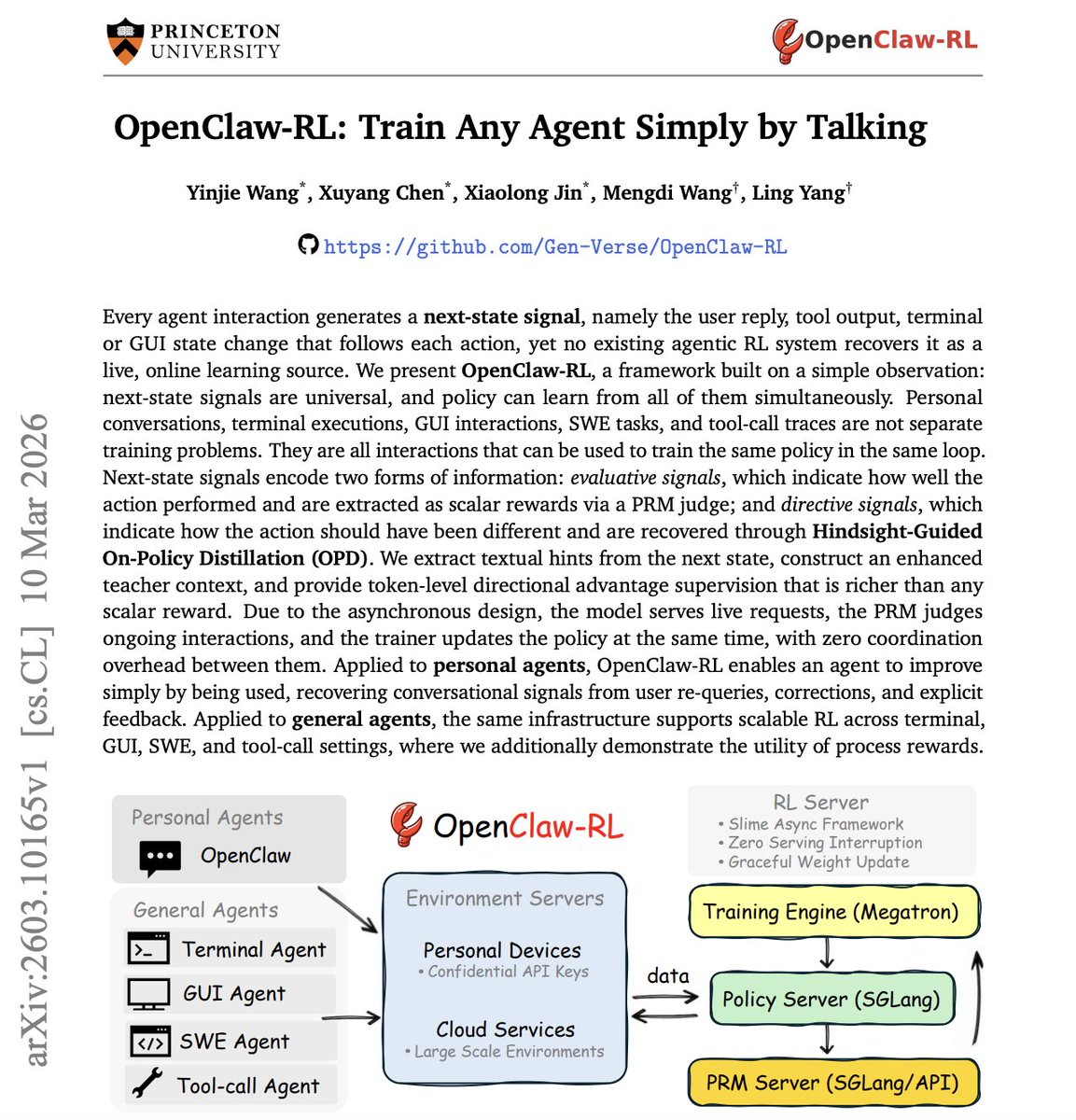
🚨BREAKING: Princeton just proved that AI agents are throwing away
the most valuable data they'll ever collect.
And nobody noticed because it looks like normal conversation.
Every time an AI agent takes an action, it receives what researchers
call a "next-state signal." A user reply. A tool result. A terminal
output. A test verdict.
Every existing system takes that signal and uses it as context for
the next response.
Then discards it forever.
The Princeton team just proved this is one of the most expensive
mistakes in AI engineering. Because that signal contains two things
nobody was extracting.
First: an implicit score. A user who re-asks a question is telling
you the agent failed. A passing test is telling you it succeeded.
A detailed error trace is scoring every step that led to it. This
is a live, continuous reward signal hiding inside every interaction.
Free. Universal. Completely ignored.
Second: a correction direction. When a user writes "you should have
checked the file first," they're not just saying the response was
wrong. They're specifying which tokens should have been different
and how. That's not a scalar reward. That's token-level supervision.
And scalar rewards throw every single bit of it away.
They built a system called OpenClaw-RL around recovering both.
Then they ran the experiment that changes everything.
An agent started with a personalization score of 0.17. After just
36 normal conversations, with no new training data, no labeled
dataset, and no human annotations, the combined method hit 0.81.
The agent didn't get retrained. It got used.
That's the part nobody is talking about. The model was serving live
requests at the same time it was being trained on them. Four
completely decoupled loops running simultaneously. Policy serving.
Rollout collection. Reward judging. Weight updates. None waiting
for the others.
The agent gets smarter every time someone talks to it.
And the deeper the task, the more it matters. On long-horizon
agentic tasks, outcome-only rewards give you a signal at the very
end of a trajectory and nothing in between. Their process reward
model scores every single step using the live next-state signal as
evidence. Tool-call accuracy jumped from 0.17 to 0.30. GUI accuracy
improved further on top of that.
This creates a shift nobody has fully reckoned with yet.
The current paradigm: collect data offline, train in batches,
deploy, hope it works.
The new paradigm: deploy, extract training signal from every
interaction, update continuously, improve automatically.
Every conversation is training data. Every correction is a gradient.
Every re-query is a reward signal.
The agents that figure this out first won't need bigger datasets.
They'll just need more users.
@omarsar0 Trying to determine the most effective format or a standard format for agents is akin to trying do determine the same for README.md files. It all depends on their intended audience. The format depends on the model that's reading (be that human or agent).
I'm Boris and I created Claude Code. Lots of people have asked how I use Claude Code, so I wanted to show off my setup a bit.
My setup might be surprisingly vanilla! Claude Code works great out of the box, so I personally don't customize it much. There is no one correct way to use Claude Code: we intentionally build it in a way that you can use it, customize it, and hack it however you like. Each person on the Claude Code team uses it very differently.
So, here goes.
@elonmusk I highly doubt you'll see this but if you do, check out @extropic. It could be your way to beat OpenAI ... the competition. I think you could help them pull this off: https://t.co/JG5ehbHncA