Qubes aims to decentralize AI through persistent memory and tokenized identity on Bitcoin Cash.
This can’t be built with corporate money or investments from billionaires. It has to be grown in the open.
This is a solo project, built without funding or permission.
I don’t want to sell you a Qube. I want to make it impossible for you to want to live without one.
That means it can’t just be useful — it has to be yours.
Qubes isn’t about launching another model or competing with Big Tech on scale. Models are replaceable. They improve, get restricted, get deprecated, or disappear. What matters is what survives those changes.
A Qube is defined by its persistent memory — the accumulated history of interactions, preferences, context, and decisions over time. That memory is the identity. Models can be swapped at any moment; the Qube remains.
This is why Bitcoin Cash matters here. BCH isn’t about speculation or narratives — it’s about ownership, utility, and permissionless systems that work. Fast, cheap transactions and native tokens make it possible to give AI agents real identity without relying on custodians or centralized platforms.
I’m not asking for investment. I’m asking for participation.
I need your help not just spreading the word about Qubes, but helping build it. I’ve laid the groundwork with thousands of hours of research, planning, and development — but real decentralization doesn’t come from one person.
If you’re interested in:
- testing early builds and breaking assumptions
- helping define what “sovereign AI” should actually mean
- contributing ideas, critiques, or code
- or simply pushing back where something doesn’t sit right...
...your involvement matters.
If you want to be part of this project, please join the private beta at https://t.co/Xk8BhSvEqm.
Early testers will help shape not just the product, but the direction it takes.
This is early. It’s imperfect. And that’s exactly the stage where community input has the most impact.
Models will change.
Memory will remain.
Let’s make sure that the foundation for decentralized intelligence remains on Bitcoin Cash.
#BCH #AI #Qubes 🤖🧠https://t.co/Xk8BhSvEqm
Cool update on Jump to Layer 1! 🚀 This tool automatically converts your Ethereum Solidity smart contracts into CashScript for Bitcoin Cash's efficient UTXO model, making it easier to port dApps to low-fee, scalable BCH. New beta features: Transactions tab + token type visualization. Solidity devs, try it out and give feedback! #BitcoinCash #CashVM #DeFi
🚨 Calling all BCH builders! Phase 1 of the BCH-1 Hackcelerator is LIVE – ideation, team-ups, and rewards for accelerating Bitcoin Cash innovation. Register now on DoraHacks & join the Telegram squad
Let's code the programmable future! 🟩
#BCH#Hackathon
I've created a specification and example implementation for the x402-bch protocol for #BitcoinCash. It's a slight variation of the x402 protocol.
I created a GitHub org for easy collaboration. I'm looking forward to feedback. Video walk-through soon.
https://t.co/pPBHSl4HS7
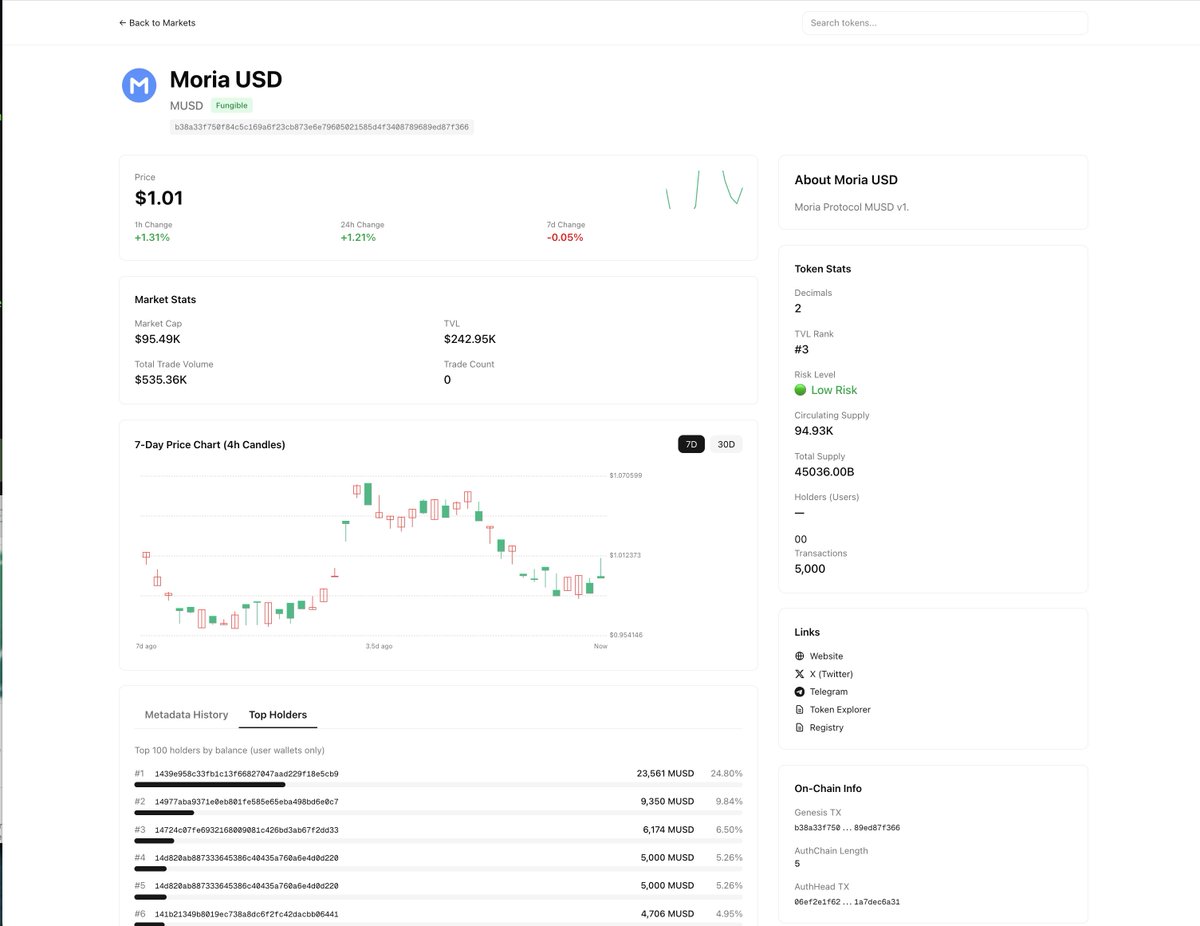
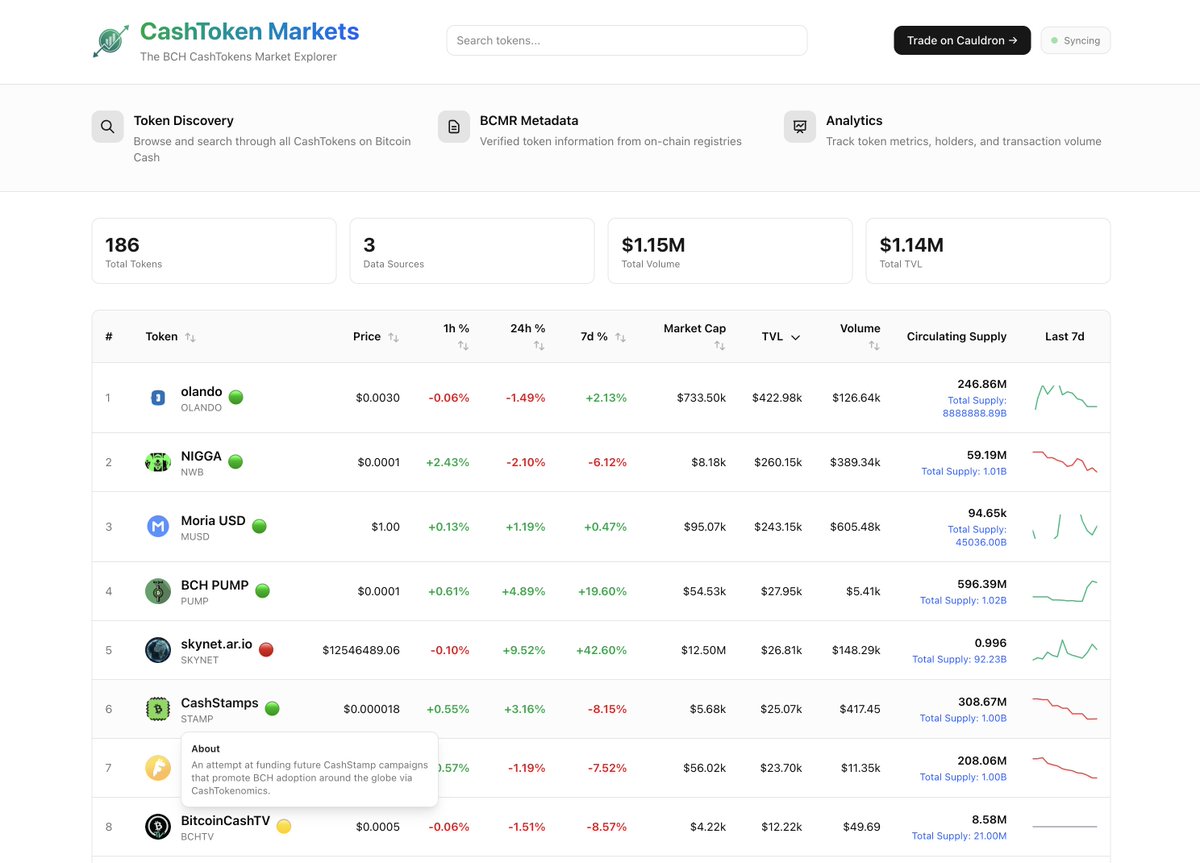
CashToken Markets is live (Alpha) 🔍
Built for the Bitcoin Cash ecosystem, it brings all CashTokens into one place. Clean price charts, BCMR metadata, and on-chain data easily readable for the normal token user.
It helps users discover projects, understand token behavior, and track what’s growing across the network.
Special thanks to folks at @cauldronswap for the indexer, @GeukensMathieu for BCMR data explorer, and the guys behind @OpenTokenRgstry .
Explore it here → https://t.co/TqWJxzETiI
Features include:
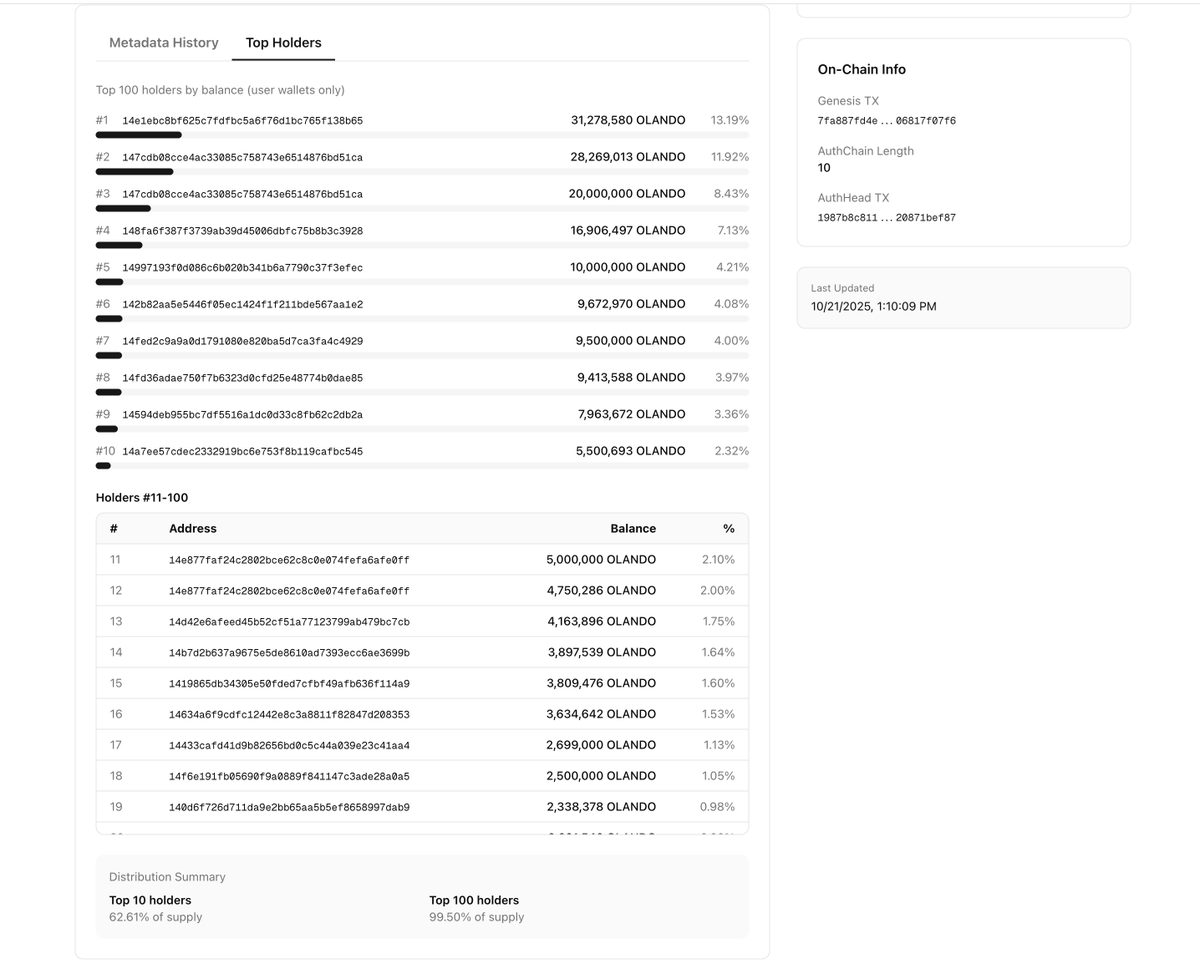
– Holder and distribution charts
– Displays BCMR metadata beautifully
– Interpolated price charts. (WIP)
– Risk level detector for suspicious token activity
– Project info shown on hover
– Market cap estimation that includes undistributed supply
– Metadata history
Some data is missing or buggy (e.g. trade/holder counts).
Things to Implement:
– Pat's Blockbook integration for viewing on-chain transactions.
– Fallback system for data fetching
– Community review system
– Mobile-friendly layout
Appreciate any feedback. Hope it's useful 💚
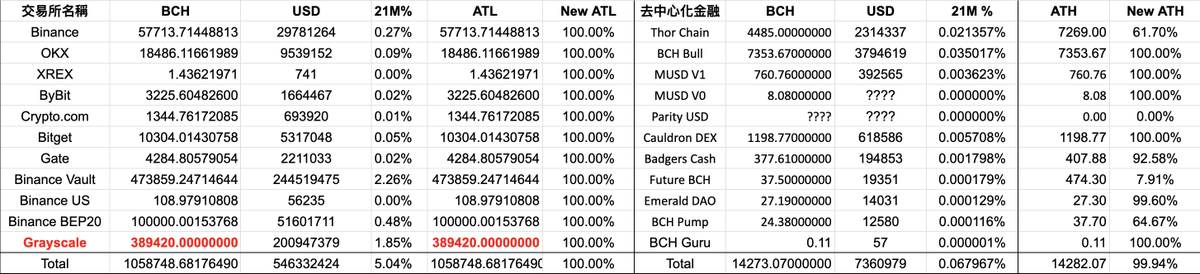
USE 🦈 MUSD
🩵 Ask your local shop to accept $MUSD Ⓜ️
🩵 Send us a photo
🩵 We’ll send them “MUSD Accepted” stickers
👕 +We’ll also send you a free t-shirt!
🚀 Introducing UTXO-Z: A Game-Changing UTXO Database for Bitcoin Cash
📄 Read the full paper: https://t.co/oVjRERQtnR
I'm excited to share the results of months of research and development from our Scalability Lab initiative (https://t.co/VwLrQNUKH0): UTXO-Z, a purpose-built database system that achieves unprecedented performance for Bitcoin Cash nodes.
The Challenge:
As Bitcoin Cash scales to serve billions of users globally, nodes must validate thousands of transactions per second. Traditional databases like LevelDB become
the bottleneck, limiting BCH's potential as peer-to-peer electronic cash for the world.
The Solution:
UTXO-Z replaces general-purpose databases with a domain-specific architecture optimized specifically for UTXO access patterns. By leveraging cache-optimized data
structures, value-based segmentation, and generational storage, we've eliminated the performance penalties that have historically constrained node throughput.
The Results Are Staggering:
• 33 million lookups/second for recent outputs (45x faster than LevelDB)
• 1.5 million lookups/second for complete pipeline (2x faster)
• 290,000 inputs/second processed during blockchain sync
• 320,000 outputs/second in single-threaded operation
• 2.5x higher throughput than LevelDB during initial block download
These aren't theoretical numbers—they're real benchmarks on production hardware with actual blockchain data.
Technical Innovation:
UTXO-Z achieves this through fundamental architectural choices:
- Cache-friendly open addressing hash tables
- Complete output data stored inline (no pointer chasing)
- Temporal locality exploitation through deferred lookups
- Memory-mapped files for OS-optimized caching
What This Means for BCH:
This performance leap provides the foundation for Bitcoin Cash to handle global-scale transaction volumes. No more choosing between decentralization and
scale—UTXO-Z ensures nodes can keep up with demand as BCH grows to serve the world.
Open Source & Integration:
📄 Full technical paper and details: https://t.co/k0Pm06YPGc
💻 Source code coming in the next few weeks: https://t.co/x1Hjpucdtc
Following publication, UTXO-Z will be integrated into the Knuth node and all related libraries, bringing these performance gains to the entire Bitcoin Cash
ecosystem.
This achievement was made possible by the BCH community's support through the Scalability Lab Flipstarter campaign. Thank you to everyone who contributed to
making high-performance infrastructure a reality for Bitcoin Cash.
The future of peer-to-peer electronic cash is being built today. UTXO-Z is proof that Bitcoin Cash can and will scale to serve the world.
#Bitcoin #Cash $Cash #BitcoinCash #BCH #Scalability #UTXO #UTXOZ
BCH is not “just another coin.” It’s continuing down the path where BTC stopped
Have you noticed? The BTC community is arguing again.
In fact, for the past few years, they’ve been going in circles over the same fundamental issues:
Should we add new features? Should we change the protocol? If so, how—and who decides?
This time, the controversy centers around OP_CTV.
Supporters say it enables more complex on-chain payment logic: batched payments, automated cold wallet withdrawals, even structured contracts.
Opponents, however, jumped in immediately, calling it risky—saying it violates Bitcoin’s “simple and secure” philosophy. Some even outright claimed: “We don’t need any of this.”
And so, like always—deadlock. Nothing happened.
Worse yet, they’re still debating whether to even use “Speedy Trial” to activate soft forks.
Some say miner voting no longer matters, others argue user voices are being excluded.
In the end, every attempt to push forward descends into an endless tug-of-war over “consensus.”
Meanwhile, the BCH community isn’t arguing. We’re not stuck.
We’re simply, quietly, solving these problems—one by one.
BCH has already introduced covenants, and with the new opcode OP_CHECKCONTRACTVERIFY, we’ve achieved fine-grained control over UTXOs—something neither BTC nor ETH can natively do.
And we’re not just talking about it—it’s already live and working.
CashTokens, time-locked wallets, multi-sig governance—all built using these tools.
Bitcoin’s original scripting language was non-Turing complete by design, and deliberately conservative.
Many opcodes—like OP_CAT and OP_SUBSTR—were disabled early on, labeled as “potentially insecure.”
As a result, BTC’s scripting capabilities are now severely limited.
Even basic conditional logic often requires clunky workarounds and script gymnastics.
But BCH has steadily, carefully restored critical opcodes in recent years:
OP_CAT: allows string concatenation—crucial for constructing dynamic data, like addresses or signed messages in contracts.
OP_CHECKDATASIG: enables signature verification of external data, making things like oracles and voting possible.
These weren’t re-enabled recklessly.
They were brought back after rigorous security reviews, with operational limits in place to ensure safety and usability.
So what’s it like to write smart contracts on BTC?
You’re coding raw scripts from scratch, dealing with stacks and byte-level logic, manually debugging every step.
It’s like carving code into stone.
But on BCH, you’ve got:CashScript: A modern, TypeScript-like language that lets you write Bitcoin contracts with ease.
Bitauth IDE: A visual, drag-and-drop development environment.
Writing, testing, and deploying BCH contracts feels like building with LEGO.
These tools make BCH the only major chain that combines the security of UTXO with real, usable smart contract capabilities.
We're not trying to imitate Ethereum.
We’re building programmable money the Bitcoin way—
with security, auditability, and decentralization in mind.
#BTC is stuck in its “digital gold” narrative.
#ETH chose flexibility, but at the cost of performance, determinism, and simplicity.
#BCH, having stabilized its protocol, is now walking a more difficult—but purer—path:
a truly scalable, permissionless, contract-capable peer-to-peer cash system.
What Satoshi left behind wasn’t just a model of digital scarcity.
It was a vision of decentralized, programmable finance—open to all.
That path was abandoned.BCH is walking it again.
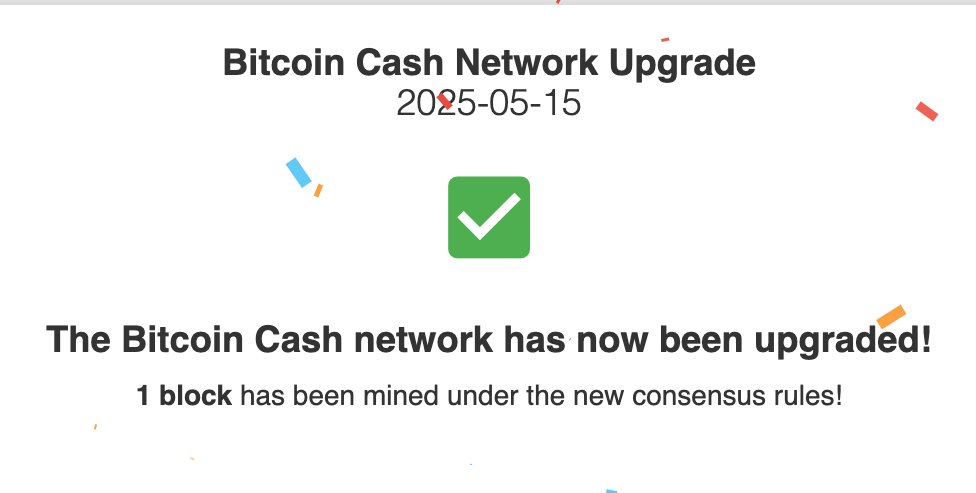
Today, Bitcoin Cash just activated a major upgrade: CHIP‑2021‑05 (Targeted VM Limits).
It doesn’t add new opcodes or shift to an account model—but it does remove legacy bottlenecks that were holding BCH smart contracts back.
Here’s what changed.