The Scouting Classroom #16
What Scouts Watch During Infield/Outfield
Pregame Defense Matters
Pregame defense matters. A lot!
Most fans don’t pay close attention during infield/outfield. They’re finding their seat, checking the lineup, or waiting for the game to start. But scouts are already working, because a player can tell you a lot before the first pitch is ever thrown.
Infield/Outfield Is Not Just Warmup
To a scout, infield/outfield is part of the evaluation. It is a chance to watch feet, hands, exchange, arm action, carry, accuracy, body control, first step, angles, rhythm, and energy. The throw is only the last part of the play. The real evaluation starts before the ball ever reaches the glove.
How does the player move into position? Does he work through the baseball? Are his feet active or heavy? Are the hands soft or stiff? Does the exchange happen naturally? Does the arm work clean? Does the ball carry with life, or does he have to max out to make the throw?
That’s what scouts are watching
The Feet Tell the First Story
Before the arm, before the glove, before the throw, I’m watching the feet. Bad feet usually create bad throws. A player can have arm strength, but if his feet don’t work, the arm may never play the way it should.
Infielders have to create rhythm, read hops, get their body in position, and play through the ball instead of letting the ball play them.
Outfielders have to show reads, routes, angles, body control, and the ability to get behind the baseball.
A big arm is nice, but a big arm with bad feet is not the same as a playable defensive tool.
It’s More Than Just Arm Strength
Fans love the big arm. Scouts do too. But scouts are not just asking, “Was it hard?” We’re asking if it carried, if it was accurate, if the arm action was clean, if the ball stayed true, and if the player can make that throw again and again.
There is a difference between a player who can air one out in pregame and a player whose arm is a real tool. A real arm plays with carry, accuracy, and consistency.
Hands and Exchange Matter
For infielders, hands tell you a lot. Are they soft? Are they confident? Does the player receive the ball cleanly? Can he adjust to an in-between hop? Does he funnel naturally? Does the exchange happen quickly without panic?
Some players look athletic until the ball gets to them. Then the game gets loud, the hands get hard, the feet stop, the exchange gets long, and the throw rushes.
That’s evaluation
A scout is not only looking for the routine play. He is looking for how clean the body works when the play speeds up.
Outfielders Get Evaluated Too
Outfield defense is not just catching fly balls and throwing to the cutoff man. Scouts are watching reads off the bat, first step, route efficiency, closing speed, body control near the wall, ability to play through the ball, throwing mechanics, carry, accuracy, and comfort moving in space.
A fast player is not automatically a good outfielder. Speed helps, but reads and instincts are what make the speed play. That is the difference between raw tools and baseball tools.
And there is a difference
The Lesson for Players
Never sleepwalk through infield/outfield. You may think nobody is watching, but a scout probably is, and he may learn more than you realize.
Pregame defense is not the time to be casual. It is the time to show pride in your position, to show that your actions are real, and to prove that your tools can play.
Because defensive evaluation doesn’t start when the ball is hit in the game. It starts in pregame.
The feet, the hands, the exchange, the arm, the carry, the accuracy, the rhythm, the body control, and the energy all matter.
Scouts are not just watching the throw
They are watching everything before it
That’s where evaluation begins
That’s Scouting
#BehindTheRadarGun 🔎
🚨WOW!!!
Tim Sparks has confirmed he purchased 80 PIZZA HUTS and brought back EVERYTHING that made them iconic!
Pac-Man is back.
Salad bar is back.
Red cups are back.
Booths for families.
"I want to rebuild places for families to connect and put their phones down..."
National Player of the Week!! 🙌
Brett Leonard has been named #NJCAABaseball DII Player of the Week following a massive week that featured a .667/.708/1.524 slash line with four home runs, four doubles, a triple, 15 RBIs and 14 runs scored!
Congrats, @brett_leonard2! 🤝
2026 SS Hudson Brzustewicz (OLSM)
5 hit night for the #FightingIrish recruit as OLSM picked up a pair of CHSL wins over Brother Rice
3-3 w/ 3 singles in G1, added 2 more singles in G2
@hudsonbrz7 | @OLSMBaseball
CONGRATULATIONS!
@uspbl Birmingham Bloomfield Beavers P @ChoyceDiffey has signed with the @whitesox organization and will report to their Single A club in Kannapolis, NC.
My first year in Double-A I hit .180 after 200 at bats. In the video I talk about the mindset that helped me bounce back and hit .344 the following year to win the Cubs MiLB POY award. Our mind is the most powerful weapon in the world!!
Tom Brady: “You need coaches that push you outside your comfort zone because that’s how you grow and that’s how you develop self confidence and self esteem. They push you to deal with failure.”
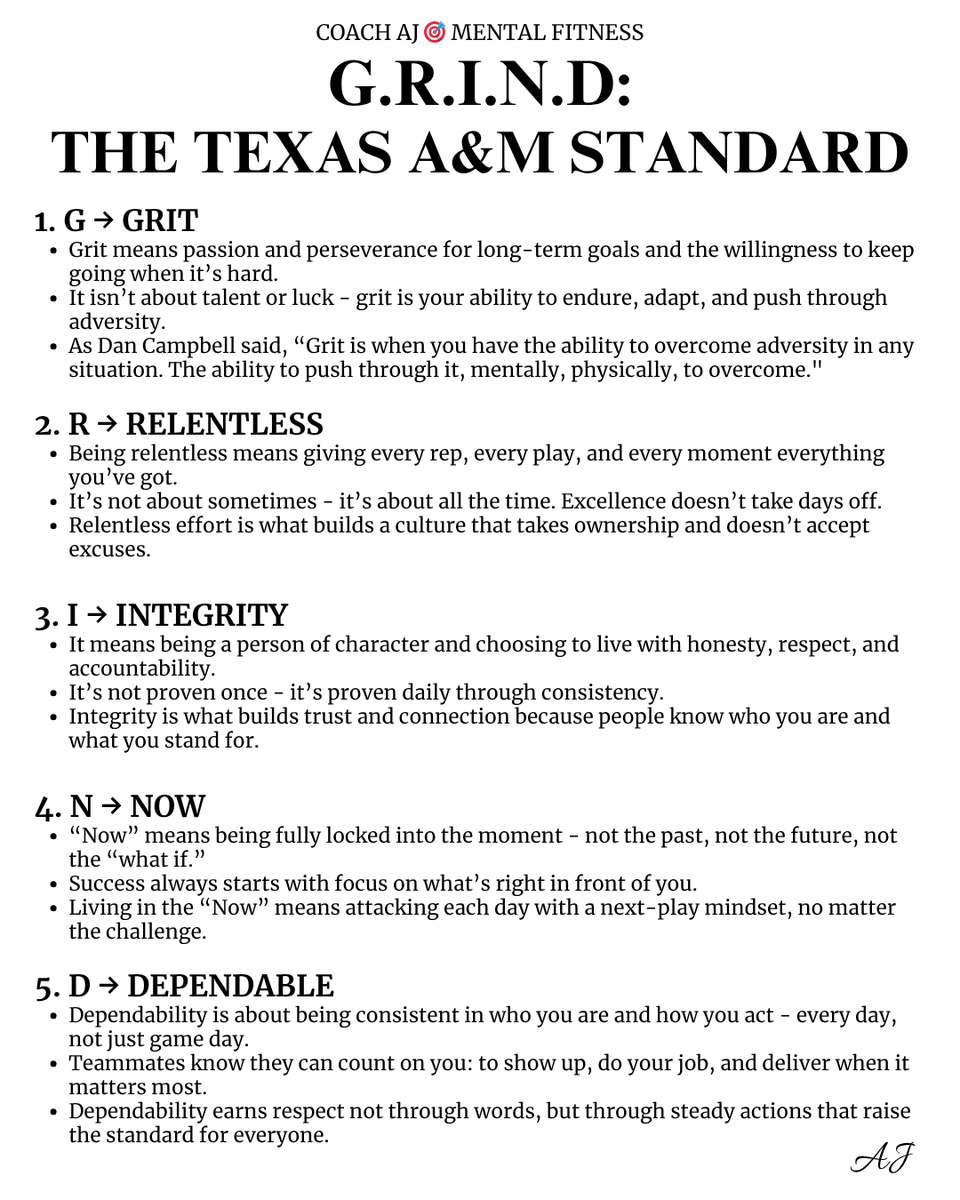
Mike Elko built Texas A&M’s culture around one word:
G.R.I.N.D.
But it’s not just a word painted in the end zone...
It is 5 standards every great team needs.
(📌Bookmark for later)
Tom Brady shares the advice that changed his career and his mindset.
He was at Michigan - he was only getting 2 practice reps while the starter got 20.
He was complaining to sports psychologist Greg Harden:
"How can I ever get better? All these guys get all the reps and I only get 2."
Greg's response changed everything:
"Just go in there and focus with the 2 that you got and make them as perfect as you possibly can."
Focus on what you can control. So that's what he did.
"They'd put me in for those 2. Man, I'd sprint in there like it was Super Bowl 49. 'Let's go boys! Here we go! What play we got?'"
"I did really well with those 2 'cause I brought enthusiasm, I brought some energy, and I had a little more confidence in myself."
You don't get what you want in life - you get what you earn.
It starts with showing up and earning it every single day.
"It went from 2 reps to getting 4 reps because those 2 were pretty good. Then I had 4 good reps. Then I got 10 good reps."
You can always try to lead the team in effort, attitude, and perspective because it takes no talent.
Then he shared the mindset shift:
"Focus on what you can control. Focus on what you're getting, not what anyone else is getting. Whenever you get an opportunity, you take advantage of it. You treat it like it's the Super Bowl."
Stop complaining about what you don't have. Dominate what you do.
Opportunity doesn't care about fairness - it rewards how ready you are.
(🎥PBD Podcast )
Derek Jeter shares a masterclass on preparation and mindset.
"My biggest thing in life that makes me most uncomfortable is being unprepared. And that's in anything."
"You hear athletes talk about the game speeds up or slows down. Well, it slows down when you're prepared. Speeds up when you're unprepared."
That's the difference.
Preparation helps you feel ready for what can and will arise.
"Every time you're in a situation, I've already gone through it in my head."
"If you have the same approach to a spring training game as you do a World Series game nothing changes."
The moment doesn't get bigger - you stay the same.
That's the secret. The greats embrace the boredom of consistency.
They aren't clutch because they rise to the occasion. They're clutch because they've already been there a thousand times in their mind.
(🎥Drink Champs )
A community college professor taught the same study skills lecture for 30 years, and the video quietly became one of the most watched educational recordings on the internet.
His name is Marty Lobdell. He spent his career as a psychology professor watching students fail not because they were lazy, but because nobody had ever taught them how their brain actually works under the pressure of learning something hard.
The lecture is called "Study Less Study Smart." Over 10 million views. Passed around in Reddit threads, Discord servers, and university study groups for over a decade. And the core insight buried inside it has been sitting in cognitive psychology research for years, waiting for someone to explain it in plain language.
Here is the framework that completely changed how I think about effort.
Your brain does not sustain focus the way you think it does. Studies tracking real students found that the average learner hits a wall somewhere between 25 and 30 minutes.
After that, efficiency doesn't just decline. It collapses. You're still sitting at your desk, still looking at the page, but almost nothing is going in.
Lobdell illustrated this with a student he knew personally. She set a goal of studying 6 hours a night, 5 nights a week, to pull herself out of academic probation. Thirty hours of studying per week. She failed every single class that quarter.
She wasn't failing because she lacked effort. She was failing because she had confused time spent near books with time spent actually learning. The 25-minute crash hit her at 6:30pm every night. She spent the next five and a half hours sitting in the wreckage of her own focus and calling it studying.
The fix sounds almost too simple. The moment you feel the slide, stop. Take five minutes. Do something that actually gives you a small reward. Then go back. That five-minute reset returns you to near full efficiency. Across a six-hour window, the difference is not marginal. It is the difference between thirty minutes of real learning and five and a half hours of it.
The second thing he taught destroyed something I had believed about how memory actually works.
Highlighting feels productive. Going back over your notes and recognizing everything feels like knowing. But recognition and recollection are two completely different cognitive processes, and your brain is very good at making you confuse them.
You can see something you've read before and feel completely certain you understand it, even when you couldn't reconstruct a single sentence from memory if the page were blank.
He proved this live in the room. He read 13 random letters to his audience. Almost nobody could recall them. Then he rearranged the same 13 letters into two words: Happy Thursday. The whole room got all 13 without effort.
Same letters. Same count. The only thing that changed was meaning.
The brain stores meaning. Not repetition. The moment new information connects to something you already understand, the retention changes entirely.
This is what the cognitive psychology literature calls elaborative encoding, and it is the mechanism underneath every effective study technique.
The third principle was the one that hit me hardest, and the one almost nobody applies.
Lobdell cited research showing that 80 percent of your study time should be spent in active recitation, not passive reading. Close the material. Say it back in your own words.
Teach it to someone else, or to an empty chair if no one is around. The struggle of retrieval is where the actual learning happens. Reading your notes again is watching someone else do the work.
His parting line has stayed with me longer than almost anything else I have read about learning.
He told the room that if what he shared didn't change their behavior, they hadn't actually learned it. It would just live in their heads as something they had heard once and felt good about.
He was right. And most people leave every lecture exactly like that.
The students who remember everything aren't putting in more hours.
They stopped confusing the feeling of studying with the fact of it.
“Hear Me…”
Mike Tomlin GOLD 🔥
“It’s not what you are capable of; it’s what you are willing to do. Plenty of people are capable. Fewer people are willing.”
Potential is common.
Commitment is rare.
Coaches, remember your athletes are people first. coach them, appreciate them, show them you care and they will run through a wall for you.
When you only give your athletes praise when they are successful and beat them down with negativity and disrespect when they are not. You are creating a timid athlete that will walk on eggshells and you will never get their full potential.
Remember, you are impacting lives.