Check @BloodCancerJnl#mmsm work led by @MansiShahMD : Prognostic impact of lymphocyte kinetics and immune composition during bispecific antibody therapy in relapsed/refractory multiple myeloma
https://t.co/hh9hPn43Aq
➡️Baseline lymphocyte count is not predictive: 52% of patients had baseline lymphopenia, with similar ALC levels in responders (0.91 K/μL) vs non responders (0.92 K/μL), showing no association with survival outcomes
➡️Day 30 immune recovery strongly predicts survival: patients with poor day 30 immune scores had median PFS of 1 month and OS of 3 months, compared to not reached survival in those with good scores (p<0.001)
⭐️Early immune kinetics is a key prognostic indicator
@MeeraMohanMD@rajshekharucms@HadidiSamer@utswcancer@UAMSMyeloma@asis_shr@AnupTrix
Remember STI571?
Hagop Kantarjian MD at MD Anderson used to joke:
STI = “Stop Transplant Immediately.” 😎
And for chronic-phase CML, history largely proved the point.
Now, from MD Anderson again:
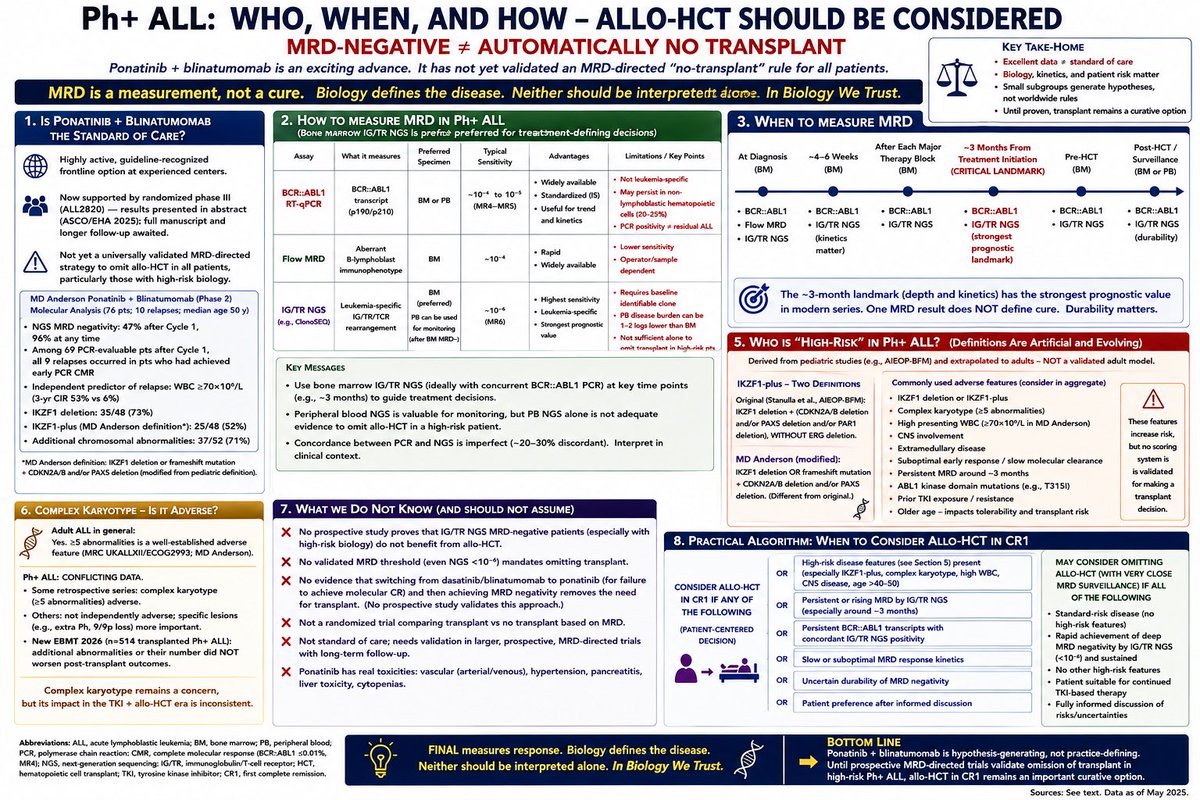
PON + BLIN for Ph+ ALL.
Is this STI571 all over again?
Maybe. I hope so. But not yet.
The results are remarkable. But MRD− does not automatically mean no transplant, particularly when the evidence in high-risk biology remains limited.
Which MRD? Which specimen? When? How deep? How durable?
And what about IKZF1-plus, complex cytogenetics, very high WBC, CNS disease, slow molecular response and TKI resistance?
Even ALL2820 incorporated biology and persistent MRD into transplant allocation.
We should absolutely transplant fewer patients if we can.
But before we “Stop Transplant Immediately,” we need to know whom it is safe to stop transplanting.
🧬 MRD measures response. Biology still matters.
In Biology We Trust.
Dr Fun + G
#AcuteLeukemia #ALL #Medtwitter
My 2026 Update on Diagnosis, Risk Stratification, and Treatment of Myeloma is out! #OpenAccess
It’s current including all recent advances in immunotherapy. Managed to squeeze in iberdomide approval from 6 days ago! Bookmark!
https://t.co/VUheu7xlMr
A limitation of clonoSEQ sensitivity: the denominator matters.
Wonderful news for the patient, and certainly a result worth celebrating.
One nuance worth keeping in mind when interpreting this clonoSEQ report:
“No residual sequences detected” does not by itself define the depth of MRD negativity. The denominator matters.
For sensitivity approaching 10⁻⁶, the practical target is roughly 3 million nucleated cells (~20 µg DNA). Here, only 156,998 cells were evaluated.
That is still encouraging for the patient, but it cannot confidently establish MRD negativity at 10⁻⁶ because the sampling uncertainty is much greater.
So when we see “MRD negative,” I think we should always ask:
Negative to what depth?
Based on how many cells?
A result worth celebrating, with an important nuance in how we interpret MRD.
#MultipleMyeloma #Medwatch
Dara–Iber–Dex: FDA approved. But where does it fit? 🤔
EXCALIBER is impressive: 41% MRD-negative CR at 10⁻⁵ vs 21% with DVd.
But the fine print matters.
Our common real-world first relapse is increasingly progression on Rev ± Dara maintenance.
Rev-exposed: likely yes
Rev-refractory / progression on Rev maintenance: unclear, subgroup data not yet disclosed
Dara-exposed: very limited (~4%)
Dara-refractory: no, excluded
Dara + Rev dual-refractory: no supporting data
And we still need to see the detailed MRD ascertainment/evaluable denominator.
Iberdomide is clearly an active drug, and 41% MRD-negative CR is an impressive signal.
But MRD is a path, not the destination. MRD negativity is an important clinical-trial endpoint and supported this accelerated FDA approval. What we still need is durability: PFS and ultimately OS.
So despite FDA approval:
Where Dara–Iber–Dex fits in the modern maintenance-failure patient remains TBD.
Good drug. Impressive depth of response.
Too many important unknowns to declare its place in the treatment algorithm yet.
#MultipleMyeloma #Medtwitter
“Secondary ALL? The lab must have mixed up the specimen.”
Not so fast.
In 3,401 myeloma patients after ASCT, 11 developed B-cell ALL.
Rare.
Unexpected.
Increasingly recognized.
Sometimes the diagnosis that seems impossible is the correct one.
Thank you Dr. Orlowski for posting this important paper.
🧬 In Biology We Trust.
#Myeloma #ALL #Medwatch
With #ASCO26 approaching, here are the potentially practice-changing abstracts in plasma cell disorders that caught my attention. I will update my thoughts as simultaneous publications are released for some of them🧵#MultipleMyeloma#Amyloidosis
Elon Musk avait dit un truc qui m'avait marqué sur l'allocation de ressources. En substance : passé un certain niveau de richesse, l'argent n'est plus de la consommation, c'est de l'allocation de capital.
Cette phrase change tout.
L'économie, dans le fond, c'est juste un problème d'allocation. Tu as des ressources finies et des usages infinis. Qui décide où va quoi ?
Imagine une cour de récré. 100 enfants, des paquets de cartes Pokémon distribués au hasard. Tu laisses faire. Très vite, un ordre émerge. Les bons joueurs accumulent les cartes rares, les collectionneurs trient, les négociateurs trouvent des deals. Personne n'a planifié. Et pourtant chaque carte finit dans les mains de celui qui en tire le plus de valeur. Le système maximise le bonheur total de la cour. C'est ça, la main invisible.
Maintenant fais entrer la maîtresse. Elle trouve ça injuste. Léo a 50 cartes, Tom en a 3. Elle confisque, redistribue, impose l'égalité. Trois effets immédiats. Les bons joueurs arrêtent de jouer, à quoi bon. Les mauvais n'ont plus de raison de progresser, ils auront leur part. Les échanges s'effondrent. La cour est égale, et morte. Elle a maximisé l'égalité, elle a détruit le bonheur.
Le problème de la maîtresse, c'est qu'elle ne peut pas avoir l'information que la cour avait collectivement. C'est le problème du calcul économique de Mises, formulé en 1920. L'URSS a essayé de le résoudre pendant 70 ans avec le Gosplan. Résultat : pénuries, queues, effondrement. Pas parce que les Soviétiques étaient bêtes, parce que le problème est mathématiquement insoluble en mode centralisé.
Quand Musk a 200 milliards, il ne les consomme pas, il les alloue. SpaceX, Starlink, Neuralink, xAI. Chaque dollar est un pari sur le futur. Et lui a un track record. PayPal, Tesla, SpaceX. Il a démontré qu'il sait identifier des problèmes immenses et y allouer des ressources avec un rendement spectaculaire.
L'État aussi a un track record. Hôpitaux qui s'effondrent, éducation qui décline, dette qui explose, services publics qui se dégradent malgré des budgets en hausse constante. Le marché identifie les bons allocateurs, la politique identifie les bons communicants.
Le profit n'est pas une finalité, c'est un signal. Il dit : tu as alloué des ressources rares vers un usage que les gens valorisent suffisamment pour payer. Plus le profit est gros, plus la création de valeur est grande. Quand Starlink est rentable, ça veut dire que des millions de gens dans des zones rurales ont enfin internet. Quand un ministère est en déficit, ça veut dire qu'il consomme plus qu'il ne produit. L'un crée, l'autre détruit, et on appelle ça redistribution.
Dans nos sociétés il y a deux catégories d'acteurs. Les entrepreneurs et les bureaucrates. L'entrepreneur prend un risque personnel pour identifier un problème, mobiliser des ressources, créer une solution. S'il se trompe il perd. S'il a raison, ses clients gagnent, ses employés gagnent, ses fournisseurs gagnent, l'État collecte des impôts. Il est la cellule de base du progrès humain.
Le bureaucrate ne prend aucun risque personnel. Son salaire est garanti. Au mieux il maintient une rente existante. Au pire il la détruit par excès de réglementation, mauvaise allocation forcée, incitations perverses qui découragent ceux qui produisent. Mais dans aucun cas il ne crée.
Regarde les 50 dernières années. iPhone, internet civil, SpaceX, Tesla, Google, Amazon, Stripe, mRNA, ChatGPT. Toutes des inventions privées, portées par des entrepreneurs, financées par du capital risque. Pas un seul ministère n'a inventé quoi que ce soit qui ait changé ta vie au quotidien.
La France est devenue le laboratoire mondial de la dérive bureaucratique. 57% du PIB en dépenses publiques, record absolu. Une administration tentaculaire, une fiscalité qui pénalise la création de richesse. Résultat : décrochage face aux États-Unis, à l'Allemagne, à la Suisse. Fuite des cerveaux. Désindustrialisation. Dette qui explose.
Et le pire c'est que la mauvaise allocation s'auto-renforce. Plus l'État prélève, moins les entrepreneurs créent. Moins ils créent, moins il y a de base fiscale. Plus l'État s'endette et taxe. Boucle de rétroaction négative parfaite. La maîtresse pense qu'elle aide, et chaque année la cour produit moins.
Dans nos sociétés, ce sont les entrepreneurs, toujours, qui font avancer la civilisation. Les bureaucrates au mieux maintiennent une rente, au pire la détruisent. Aucune société n'a jamais progressé en taxant ses créateurs pour subventionner ses gestionnaires.
La question n'est jamais qui a combien. C'est qui alloue le mieux la prochaine unité de ressource pour maximiser le futur de l'humanité. La réponse depuis 200 ans n'a jamais changé. Ce ne sont pas les fonctionnaires.
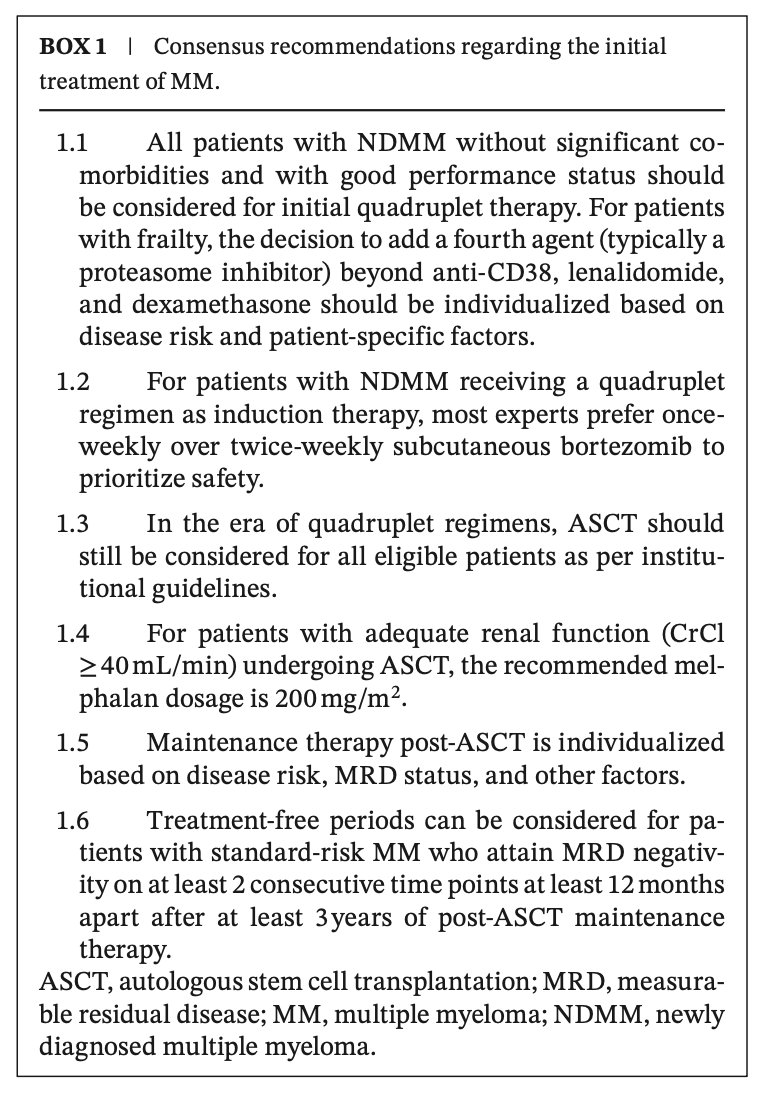
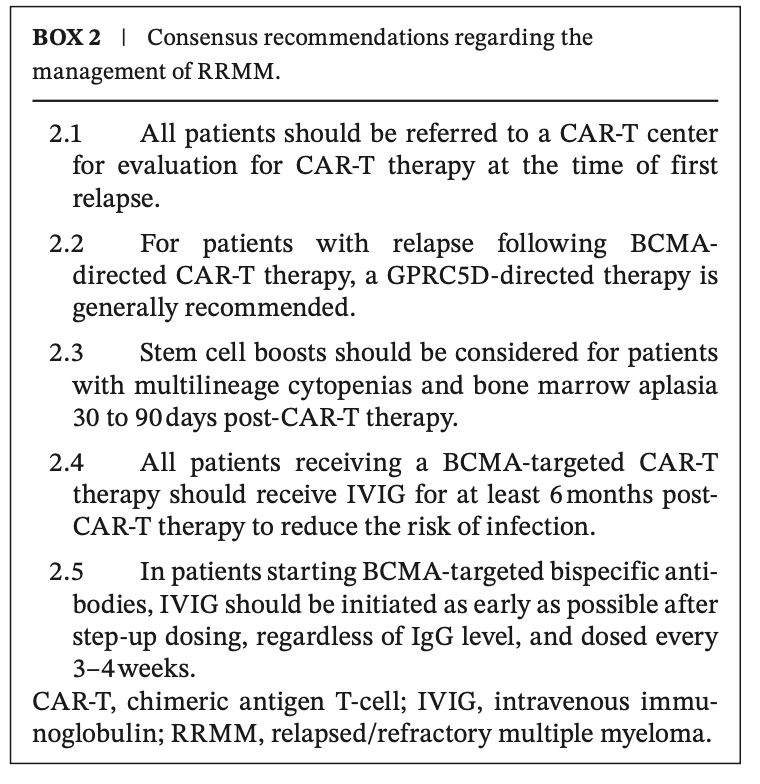
Thanks @AjaiChari for leading new Bridging Gaps recs for myeloma #MMsm, now in @AjHematology!
Intentional focus on what makes common sense based on current data, even if not in orig trials. E.g.
1️⃣ 1x/wk Velcade
2️⃣ MRD-guided len 🛑 as option
3️⃣ IVIG PPx & bsAbs
Worth a read!
Leukemia classification has evolved.
Morphology → risk → genetics.
Each step brought us closer to biology.
But genetics alone is not enough.
KMT2A-rearranged leukemia
NPM1-mutated AML
Different mutations.
Same biology:
HOXA9 / MEIS1 activation driven by the menin–KMT2A complex.
This is why both respond to menin inhibitors.
The next step?
👉 Biology-based classification
Menin-dependent leukemia
~6,000–8,000 cases/year in the U.S.
(~25–35% of AML + subset of ALL)
Different mutations. Same addiction.
Dr Fun + G
#AML #Hematology #PrecisionOncology #Hemetwitter
Important findings from @MSKCancerCenter in @BloodPortfolio on progression rates in contemporary smoldering myeloma (~80% had baseline whole-body MRI or PET/CT imaging)
Key findings that impact clinical practice:
✅Annual progression risk to CRAB is now ~5% (first 5 years), down from the historically quoted 10%!
✅Even with SLiM-CRAB criteria, progression risk remains ~6.8% annually (first 5 years)
✅20/2/20 high-risk SMM patients:
2-year progression to SLiM-CRAB: ~35%
2-year progression to CRAB: ~27%
Previously quoted risk was ~50%
✅At median 7-year follow-up, overall survival was similar across 20/2/20 risk groups
These data provide valuable evidence for shared decision-making when counseling high-risk SMM patients on active surveillance vs. early treatment.
@MalinHultcrantz@TAkhlagh@Daw6Jessie
https://t.co/AzxmzNplRi
For someone who normally writes everything with an enthusiastic tone, this was hard but important to write.
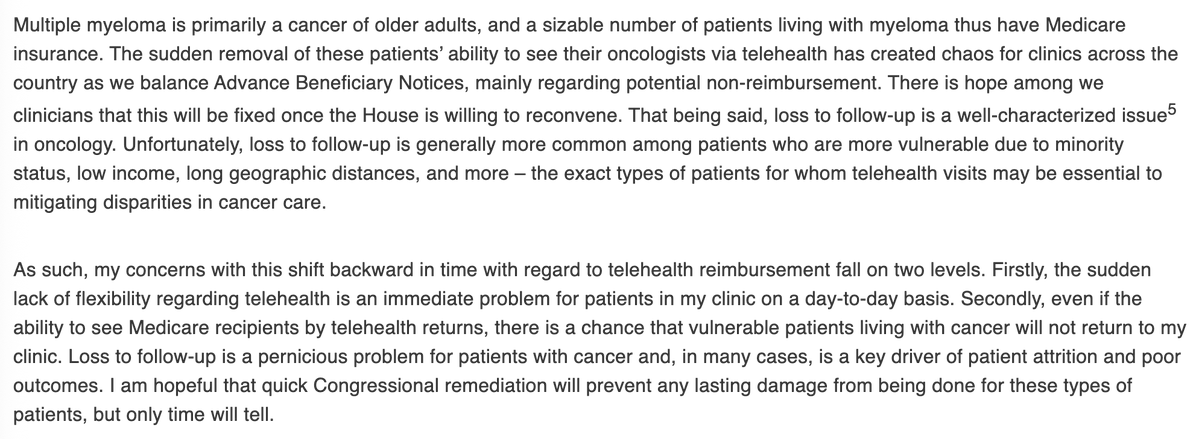
Lost amidst the DC chaos is the expiration of the Medicare telehealth waiver and its effects on many of my patients living with cancers such as myeloma.
Please fix ASAP!
Check our recent paper @TheIACH#mmsm : Treatment Outcomes of Multiple Myeloma in Developing Countries: A Systematic Review and Meta-Analysis
✅37 studies, 4,818 patients
⚠️ Major treatment gap: Daratumumab, carfilzomib, pomalidomide rarely available or used at all
✅Despite limited access to novel agents, ASCT + proteasome inhibitors showed benefit
⚠️Urgent need to expand access to modern therapies in resource-limited settings
➡️https://t.co/CM3tkR8o8r
@jehadmas@rajshekharucms@ZaidAR_MD@HiraSMian
Just out in the New England Journal of Medicine!
Our comprehensive Review on MGUS: Monoclonal Gammopathy of Undetermined Significance @NEJM https://t.co/7dza0YrFh5
5% of people over age 50 have MGUS. Every physician needs to know and understand MGUS. Lots of Tables and Figures. Bookmark!
How to test and manage patients. Who needs bone marrow exams and scans. It’s all in here!
MGUS is important not just because it’s a precursor to multiple myeloma. It causes a lot of other problems. Learn all about MGUS, and the various terms you hear MGCS, MGRS etc. in this Review
@myelomaMD and I have tried to keep every sentence in this Review simple and easy to follow. #MGUSVR