The AI Trend… How to use AI.
- Prompt well
- Give context
- Add system rules
- Build agents
- Now Infinite loops
The truth? We are layering all these abstractions because fundamental model capabilities have hit a wall. We went from elegant In-Context Learning to wrapping models in fragile software scaffolding just to keep them from hallucinating.
It's an orchestration nightmare where predicting the API cost of a single workflow is mathematically impossible. Beneath all the hype, these models are proving to be about as sticky of a product as the 2021 chatbot craze.
When the results are not in, frontier labs just mode the goalpost. Remember when AGI was a thing?
#AITrends #loops
@elonmusk The problem is Paris and their government! 20 years of policies have reduced the city of love into the city of hate, where Parisians are told by their new tenements where they can and can’t walk in their cities or risk getting physically hurt of killed.
Shame!
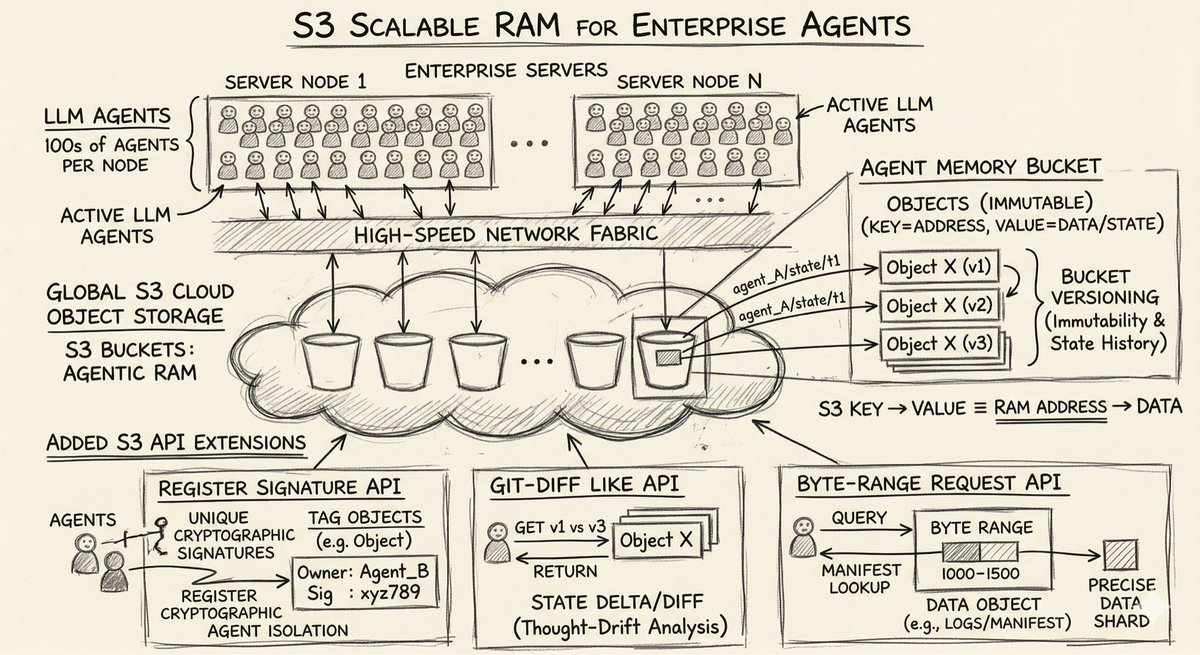
As I read my feed and play with Agents, I keep coming down to a simple conclusion, Files as memory is just not scalable.
There are many fundamental reason for this, and while not immediate evident for local #agents, this does not a scale at for enterprise deployments.
Here are some the of the reflections that inspired my exploration:
- File System: This is a human enteric interface to data. It not only makes is cumbersome and token heavy for tool calling, but it is also a major attack surface to manage for agent deployments. Basically, you are exposing the agent to the FS and all the supporting tools needed for this, like ‘ls’ or ‘find’ etcetera…
- NFS: While NFS is a true and tried solution, running agents at scale, if they need to share data becomes a metadata access and agent sprawl nightmare…
Since I’ve been a major fan of #S3 and #Objects as a data store, I thought I’s share a high level overview of how S3 might be a better #agentic_memory model.
https://t.co/hhmcokXCXp
Thought?
Anthropic's Claude Mythos isn't a sentient super-hacker, it's a sales pitch — claims of 'thousands' of severe zero-days rely on just 198 manual reviews https://t.co/FMhEyHzlGh
Farzapedia, personal wikipedia of Farza, good example following my Wiki LLM tweet.
I really like this approach to personalization in a number of ways, compared to "status quo" of an AI that allegedly gets better the more you use it or something:
1. Explicit. The memory artifact is explicit and navigable (the wiki), you can see exactly what the AI does and does not know and you can inspect and manage this artifact, even if you don't do the direct text writing (the LLM does). The knowledge of you is not implicit and unknown, it's explicit and viewable.
2. Yours. Your data is yours, on your local computer, it's not in some particular AI provider's system without the ability to extract it. You're in control of your information.
3. File over app. The memory here is a simple collection of files in universal formats (images, markdown). This means the data is interoperable: you can use a very large collection of tools/CLIs or whatever you want over this information because it's just files. The agents can apply the entire Unix toolkit over them. They can natively read and understand them. Any kind of data can be imported into files as input, and any kind of interface can be used to view them as the output. E.g. you can use Obsidian to view them or vibe code something of your own. Search "File over app" for an article on this philosophy.
4. BYOAI. You can use whatever AI you want to "plug into" this information - Claude, Codex, OpenCode, whatever. You can even think about taking an open source AI and finetuning it on your wiki - in principle, this AI could "know" you in its weights, not just attend over your data.
So this approach to personalization puts *you* in full control. The data is yours. In Universal formats. Explicit and inspectable. Use whatever AI you want over it, keep the AI companies on their toes! :)
Certainly this is not the simplest way to get an AI to know you - it does require you to manage file directories and so on, but agents also make it quite simple and they can help you a lot. I imagine a number of products might come out to make this all easier, but imo "agent proficiency" is a CORE SKILL of the 21st century. These are extremely powerful tools - they speak English and they do all the computer stuff for you. Try this opportunity to play with one.
¡Ojo! El 8M no es una fecha neutral:
nació directamente del socialismo y el comunismo internacional a principios del siglo XX.
Fue inventado por la bolchevique Clara Zetkin en 1910 para convertir a las mujeres en carne de cañón revolucionaria. En 1917, las huelguistas rusas del 8 de marzo encendieron la mecha que trajo el Gulag, el hambre y millones de muertos.
Hoy lo usan las de siempre: abortistas radicales, anticapitalistas y haters de la familia tradicional para escupir odio contra la libertad, la fe y el esfuerzo personal.
No celebro esa basura roja, no “feliz día", no flores, no nada. La mujer de verdad se libera con Dios, familia y capitalismo... NO con Marx ni sus fanáticas modernas.
L'A380 d'Asiana per sobre del barri del Guinardó després d'haver frustrat l'aterratge a l'aeroport de Barcelona-El Prat. Es veu gros perquè és enorme, però no anava més baix del que és habitual.
Vídeo de @gatemikesierra a ig
I’ve been exploring why NEW #AI won’t come from scaling token prediction. I argue for structured world models and persistent graph memory as a path toward grounded, traceable reasoning. https://t.co/BSgT6ZACev
#ArtificialIntelligence#MachineLearning#LLM#DeepLearning
This is crazy, #jesenhuag just made a claim that #OpenAI and #Anthropic are generating profitable revenue. https://t.co/OfW2qyyK8f Is he crazy? a CEO can be held personally liable for making false or unfounded statements regarding the profitability of another company.
Hey @grok can you fact check this? a CEO can be held personally liable for making false or unfounded statements regarding the profitability of another company, particularly when a conflict of interest exists.