A trove of internal records from a secret society for figures in US politics, finance, and tech was left exposed online, WIRED has confirmed, naming participants in its events and revealing sensitive personal details they were assured would stay private. https://t.co/Jviks1jwAw
Ukrainian drone pilots are equipping their UAVs with shotguns to shoot down Russian FPV quadcopters.
This has given rise to a strange new form of aerial combat, where pilots often sit kilometers apart while their drones duel each other in the sky.
Two Amazon robots got stuck in an aisle, spending what appears to be an eternity shuffling back and forth because neither one could figure out who should move first.
This is what happens when you forget to teach a $200,000 robot to say "no, after you."
A Chinese court has ruled it illegal to replace human workers with AI purely for the sake of cost-cutting.
The court decided that companies hold a social responsibility to treat workers fairly and pay them what they're worth.
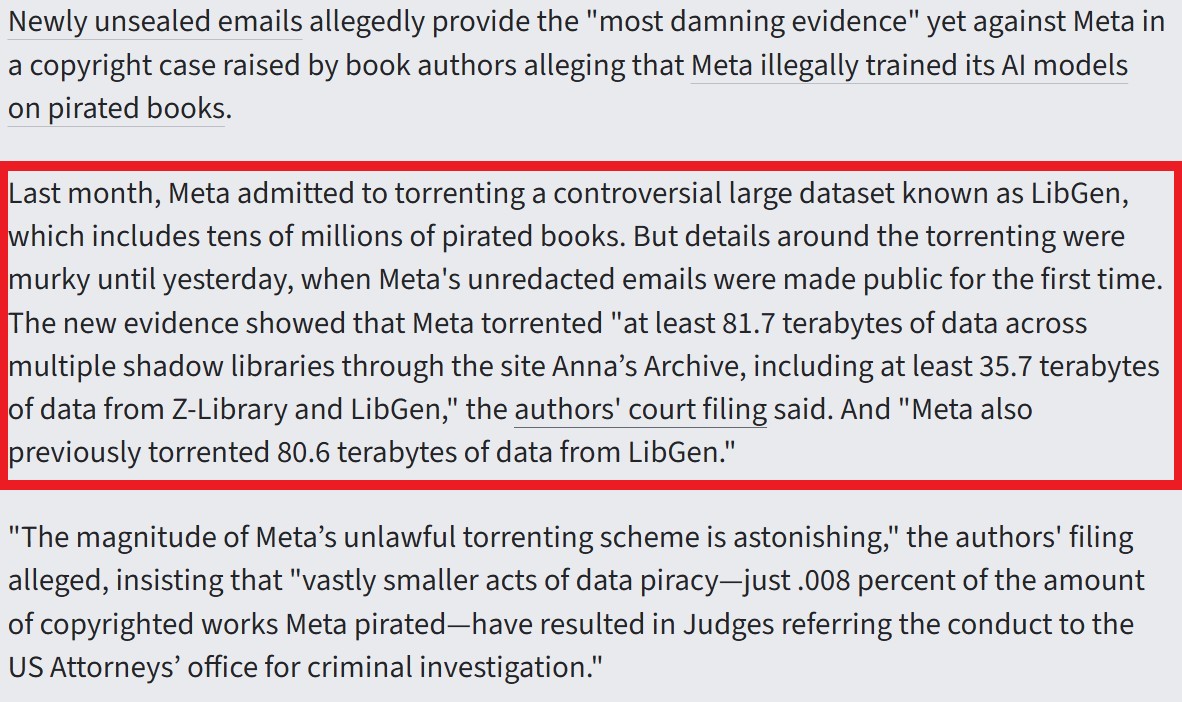
Meta illegaly downloaded 80+ terabytes of books from LibGen, Anna's Archive, and Z-library to train their AI models.
Aaron Swartz downloaded 70 GBs of articles from JSTOR (0.0875% of Meta) in 2010. Faced $1 million in fine and 35 years in jail. Took his own life in 2013.
Trump, after having a 90 min phone call with Putin, puts out a truth social that he is considering withdrawing all troops from Germany. Something sinister is going on between them. It’s time for “concerned” Republicans to speak out
genuinely crazy that Ronan Farrow, the (alleged) lovechild of Mia Farrow and Frank Sinatra (Mia Farrow's ex-husband Woody Allen is on the birth certificate as his father🤣😭) is probably the best investigative journalist of our era
@Hesamation Huh, interesting. Can you paraphrase a question so we can better understand? Tech ethics assessments I’ve taken tend to be “_____ (philosopher) is associated with <X> school of thought”
Every time you load a page, your data travels through physical infrastructure - cables under oceans, satellites overhead, fiber under cities.
Most people never think about. That's why I decided to map it.
This is Project Backbone. It's free, interactive, and live.
A $2.5 billion robot has been alone on another planet for 13 years and is still doing science. The scale of that sentence gets worse the longer you think about it.
Curiosity landed in August 2012. Obama was president. Instagram had 80 million users. The iPhone 5 hadn’t shipped yet. The rover was designed for a two-year mission and 20 kilometers of driving. It’s now driven 35.5 kilometers, climbed over 327 meters up the side of a mountain, drilled 46 holes into Martian rock, and is currently running its fifth mission extension.
The computer running all of this has 256 MB of RAM and a 200 MHz processor. Your AirPods have more computing power. Every command sent from Earth takes 14 minutes to arrive. Every photo sent back takes the same 14 minutes. When Curiosity drills into a rock, the team in Pasadena won’t know if it worked for half an hour. They’ve been operating on that delay, every single day, for 4,846 Martian sols.
The power source is 10.6 pounds of plutonium-238 generating about 110 watts. Less than a ceiling fan. It will keep producing electricity for decades because the half-life of Pu-238 is 87.7 years. The rover will run out of moving parts before it runs out of power.
And those wheels. Machined from single blocks of aluminum, 0.75 millimeters thick. Half a dime. JPL watched them get shredded by Martian rock starting in 2013, rerouted the entire mission path, taught the rover to drive backwards, and kept going. The wheels look like they lost a fight with a can opener. The rover is still climbing a mountain.
Every iPhone you’ve owned since 2012 is in a landfill. Curiosity is on Mars, 140 million miles from the nearest repair shop, running on a ceiling fan’s worth of nuclear power, sending data through a 14-minute time delay, on shredded wheels, doing geology that rewrites what we know about whether life ever existed somewhere other than Earth.
We built that. With 0.01% of the federal budget.
Anthropic refused to bow to the Pentagon’s demands to remove certain restrictions on its AI. What happens next could amount to the most extreme regulation in the short history of the tech, @will_gottsegen reports. https://t.co/tFfRAud9ob
This is quite the statement.
And it makes defense department leadership look terrible.
This shouldn’t be a partisan issue. Nobody should support unfettered AI in the military.