Jobs are modeled as bundles of tasks. But as jobs change, how do we keep those task lists up to date?
Workers often experience new responsibilities and tools before they reach their job descriptions.
We start by listening to them. 🧵
Jobs are modeled as bundles of tasks. But as jobs change, how do we keep those task lists up to date?
Workers often experience new responsibilities and tools before they reach their job descriptions.
We start by listening to them. 🧵
O*NET tracks the tasks that are required by different jobs. It has been invaluable for research. But it also was clear that it could be improved a lot--and the need to improve it was much greater than ever. So very glad to see this, looks like we'll all be using it.
Understanding AI’s impact on work starts with knowing what workers actually do.
Excited to share TaskNet 🥳 We use AI interviews to map tasks across 6 occupations, uncovering emerging tasks and overlooked work.
Amazing work by @jennjwang and the team!!!
AI can reshape people's life in various ways, but its impact on job may be one of the most profound. It's not just about how we work, but also about human autonomy and dignity.
Back in 2025, we collaborated with @erikbryn 's team to investigate automation vs augmentation across the U.S. workforce (https://t.co/cYAcu2Qogg). One key limitation, however, was that the work was grounded on existing human work curated by O*NET and do not took emerging new work into consideration.
That's why I am so excited to see TaskNet by the amazing @jennjwang! It's more than a carefully curated, one-off dataset and offers a scalable way to track how work evolves, especially at a time when the pace of change is accelerating.
Check it out!! https://t.co/K2HhiCQaN4
TaskNet is live!
By accurately mapping the tasks workers perform at their jobs, the project will help us gain a better understanding of AI's impact on work.
Explore Tasknet here: https://t.co/GCwaaN0lES
@themahis Great question! We’re hoping to run longitudinal studies in the future with the TaskNet interview over the course of months and years, to track both temporary and more permanent changes
A labor of love with Mercor and the O*NET Center! TaskNet brings together academic research, industry experience, and occupational data expertise to turn workers’ experiences into task information that can inform workforce policy and training.
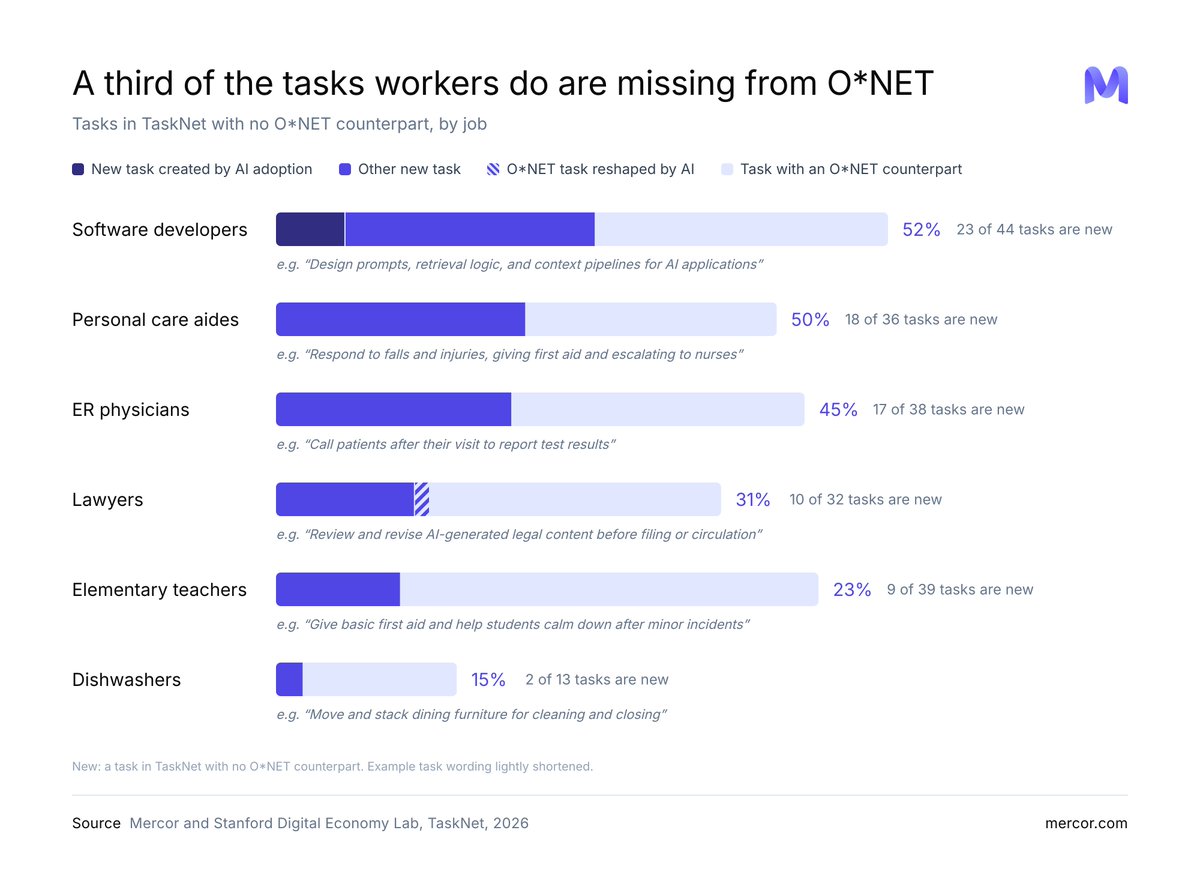
Workers in six occupations do 79 tasks the government's official occupational taxonomy has yet to add. That work is worth about $140B a year in wages.
That taxonomy is called O*NET, the U.S. Department of Labor's database of the tasks each occupation involves. Workers use it to help with job transitions, and economists use it to estimate which jobs AI will change. If the lists are incomplete, so are the estimates.
Today we're releasing TaskNet, an open-source task catalog built on O*NET and updated for how AI is changing work.
Built with researchers from Stanford, the O*NET Resource Center, and NBER. Thank you to @robinsonaisaac@erikbryn@diyi_yang@jennjwang@andreas_h0wpt@Digeconlab@stanfordnlp@stanfordhai@stanfordAIlab for contributing to this work.
Read the blog: https://t.co/nYlTO1Hlcu
We see this project as a step toward a broader effort with the O*NET Center to keep occupational information current and grounded in what workers actually do.
📄 Paper: https://t.co/kt4S07gz5D
💻 Code: https://t.co/ovjlQ92XQJ
🕸️ Website: https://t.co/AcfdIzuG9m