I thought this was fake until I opened the report
as someone who was there once and believed in Ant to actually solve AI safety, I am disappointed that Anthropic is highlighting sth like this
(2nd page states the limits, but they just contradict pillar 1)
REPORT UNCERTAINTY IF YOU WANT TO CLAIM YOU‘RE BETTER THAN THE COMPETITION.
AI eval scores can vary substantially run-by-run, with different scaffolds, etc. Claiming you’re „better than“ without uncertainty estimates is ridiculous and marketing, not science.
This goes for @AnthropicAI@OpenAI@AIatMeta, too, not just @GoogleDeepMind.
I've always believed that intelligence should come from simple, general building blocks that learn their own abstractions directly from raw data; in other words, the bitter lesson. I think we're finally seeing a real step towards AI that can learn from all data.
Language modeling on raw bytes is a microcosm of this ideal, and to me it's a central problem in AI: if we can't build LLMs that learn end-to-end from bytes, how will we handle the rest of the world's data that we understand even less?
Last year we introduced hierarchical networks (H-Nets) as a first step. Our new version finds up to 3-5x efficiency gains in controlled scaling law experiments, and at larger scale matches an open-source model trained on 11T tokens with ~10x less data and compute. The posts below walk through what we found and why we think it works.
I improved NanoGPT Speedrun from 39.9s → 6.7s (-83.2%), more than every record since 2025 combined (-81.4%)!
The web is full of rare, repeated content that the LM can’t memorize in time. I solve this with retrieval-augmented n-gram hints🧵
I've been really fascinated by the DL Alchemy course (https://t.co/4aSUZbOEs3).
The decision to put the burden of theory construction on the student (and their claude) feels transformative and surprisingly challenging. Maybe knowledge in ML was never that critical.
Chain-of-thought transformed AI reasoning, but it is limited to words.
What's the physical-world analogue?
Introducing Ψ-0.6, one model that reasons in *streams of thought*: words, depth, motion, camera pose, and imagined scenes. And it learns when to use which! 🧵
Check out our latest SAIL blog post on HalluWorld! This benchmark puts LLMs in fully specified worlds to automatically measure not just whether models hallucinate, but why: https://t.co/ZdLLBHtuAB
Wrist cameras give robots close-up views, but only where the hand happens to be.
What if the policy could decide where to look?
Introducing FoveaVLA: a VLA that replaces the wrist camera with learned foveation actions.
FoveaVLA predicts where it will need to look next, then crops that region from the full-resolution external image. The full view gives context; the foveal crop gives close-up detail.
With one external camera and no wrist camera, FoveaVLA reaches 70.8% success on 48 real-world trials, vs. 52.1% for π0.5 with a wrist camera.
• No additional demonstrations
• No camera calibration
• No wrist camera
Paper, code, and models are all open 🧵
Things are moving so fast that everyone seems to have completely missed how insane it is that AI companies have been allowed to unleash agentic AI products with no regulatory guidelines.
Now online! Recording of Marc Schlichting’s PhD defense (Nov 15, 2025) on generative models for safety in autonomous systems, from failure discovery in a 1200-dim F-16 system to an LLM decision-support tool for aviation emergencies tested in real flights.
https://t.co/J2CC7t9L59
Do Vision-Language-Action models mean what they say?
Embodied chain-of-thought offers a promising way to leverage additional inference-time computation for robot policies, with empirical evidence that it can improve downstream task performance. However, in practice the extent to which this chain-of-thought actually influences a robot policy’s chosen actions is not fully understood yet.
In our new paper on #embodied #reasoning, we formally define the notion of faithfulness i.e., whether the chain-of-thought truthfully reflects the policy's decision for #Physical #AI and argue that the faithfulness of robot policies should play an explicit role in algorithm design.
We train a critic of embodied faithfulness, identifying the signatures of inconsistent and incoherent reasoning, and use it as a reward signal during reinforcement learning (RL) post-training of a robot policy. We call our critic Pinocchio 🤥: a model that learns to tell when a robot policy is 'lying' about the justifications for a decision. Pinocchio scores two complementary failure modes: whether the reasoning is grounded in what the robot actually sees, and whether it is coherent step-to-step through the chain-of-thought.
We find that post-training for faithfulness yields a +18% improvement in reasoning consistency over standard baselines, and critically, makes the policy 1.6× more responsive to rare, out-of-distribution scenarios that confuse SoTA models.
These findings suggest that faithful embodied reasoning is not merely a post-hoc interpretability property, but an important ingredient for building more robust and trustworthy autonomous systems.
📄 Paper: https://t.co/2u3yfDafNc
🌐 Project page: https://t.co/mTpWXTIjUM
💻 Code: Coming soon!
Great work led by Matthew Foutter, in collaboration with Matteo Cercola Lena Wild Yunshan Wang Michelle Li and @DanieleGammelli@StanfordEng@StanfordAILab@StanfordHAI
Ever wondered what it’s like to learn robot autonomy @Stanford? Now you can.
Today, we’re opening up the robot autonomy teaching materials that my collaborators and I have been developing over the past several years—for anyone, anywhere, completely free.
At the heart of this effort is Principles of Robot Autonomy (PoRA), a textbook inspired by the Stanford robot autonomy course series I’ve been teaching since 2017.
Robot autonomy has evolved from a research discipline into a technology deployed in the real world. Building capable autonomous systems requires more than understanding individual algorithms: it requires understanding how perception, state estimation, planning, control, and learning work together in a complete autonomy stack.
That’s what we set out to teach with PoRA: bringing classical robotics and modern AI together in one coherent framework, grounded in both theory and practice.
Coming soon in print from Cambridge University Press, Principles of Robot Autonomy is also freely available online and comes with a comprehensive collection of open educational resources:
📖 Textbook, https://t.co/wRvXr4VCIP — Foundations of robot autonomy, from classical methods to modern AI-based approaches.
🎥 Video lectures, https://t.co/Yw3P1aGzBG Lectures from my Stanford courses on robot autonomy and on optimal and learning-based control.
💻 Interactive exercises, https://t.co/kyPV8AnyB3 — Hands-on Python implementations and Jupyter notebooks.
📝 Teaching materials, https://t.co/a6MqqYAcEN — Lecture slides and resources for instructors.
🌐 Explore all PoRA resources, https://t.co/oAsjrMJxZT — Including Ask the Book, an AI study assistant integrated throughout the textbook to answer questions, explain derivations, and connect ideas across chapters.
📣 Read the Stanford announcement: https://t.co/f6BBBZZQmg
Our goal is simple: to make high-quality education in robot autonomy accessible to students, researchers, engineers, educators, and anyone curious about how autonomous robotic systems work.
I believe that sharing knowledge is fundamental to the mission of a university. Autonomous robotics—and Physical AI more broadly—are among the defining technological frontiers of our time. We want to help more people understand these technologies, build with them, and advance the field.
A huge thank you to my co-authors, @DanieleGammelli, Joseph Lorenzetti, @katielulula, and @GioeleZardini, and to everyone who helped bring this project to life.
Explore the resources, use them in your own learning or teaching, and please share them with anyone who might find them useful!
#Robotics #PhysicalAI #ArtificialIntelligence #AutonomousSystems #Education
@Stanford@StanfordEng@StanfordAILab@StanfordHAI
LLMs deployed in specialized domains, from enterprise codebases to law firms, dig through a mountain of unstructured context!
Our new paper, Librarian Agents, asks: can an agent adapt by curating its own long-context workspace, anticipating queries before they arrive? 🧵⬇️
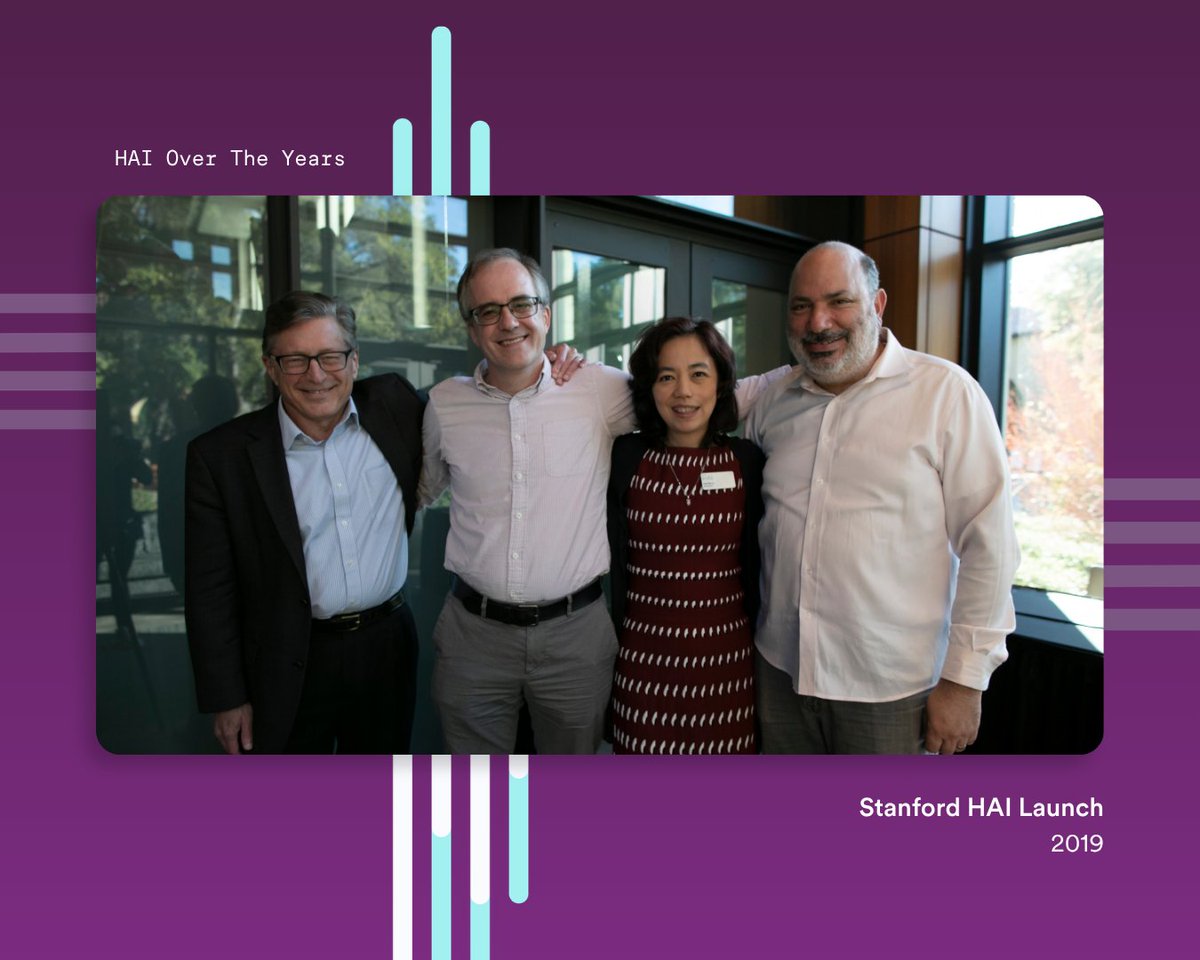
7 years ago: Stanford HAI officially launched. The institute opened in March 2019 with a focus on advancing AI research, education, policy, and practice to improve the human condition, drawing on faculty and students from all seven Stanford schools. #HAIOverTheYears
Token-Gated LLMs achieve 11x faster processing over long-context inputs by learning to skim context and only forward tokens that matter. We saw this paradigm shift before when going from dense models to MoEs, and now TokenGate enables another generation of efficient LLMs!
Introducing ✨Token-Gated Language Models✨ for up to 11x faster prefill by learning to skim context, conditionally forwarding only tokens that matter.
Akin to the shift from dense models to MoEs, the next frontier of efficient LLMs is conditional computation over a new scaling axis: context tokens🧵👇
Why stick with one agent harness for the entire task?
Surprisingly, switching harnesses mid-run (e.g. Codex → Pi) can dramatically reduce cost/tokens while improving performance!
Harness cascade opens a new Pareto frontier.
1/4 Today, we’re releasing Mercury 3. Mercury 3 is by far our most powerful model and the most intelligent diffusion LLM ever released. It outperforms GPT-6 Luna and Haiku 5.5 on quality while running at 1000+ tok/sec.