🔎 In high-stakes domains, a missed search result is not just a search error - it can mean a missed opportunity, delayed decision, or denied service.
Yet most retrieval systems still rank by keywords and embeddings. They can surface candidates that look relevant while missing those that actually satisfy the constraints.
What if an agent could turn those constraints into a retrieval tool that searches for viable options directly?
🌐 Project: https://t.co/sdRZD6QCHt
📄 Paper: https://t.co/GfAg16TI2e
With @Yufei_1001, @kelakexyl, @YuChiangWang1, @ChiehJuChao1, and @MonicaSLam. Grateful to our collaborators across Stanford and Mayo Clinic, and to the broader @stanfordnlp and @StanfordHAI communities that helped shape the environment for this work.
#InformationRetrieval #AIAgents
<🧵1/n | 𝗦𝗮𝘁𝗜𝗥>
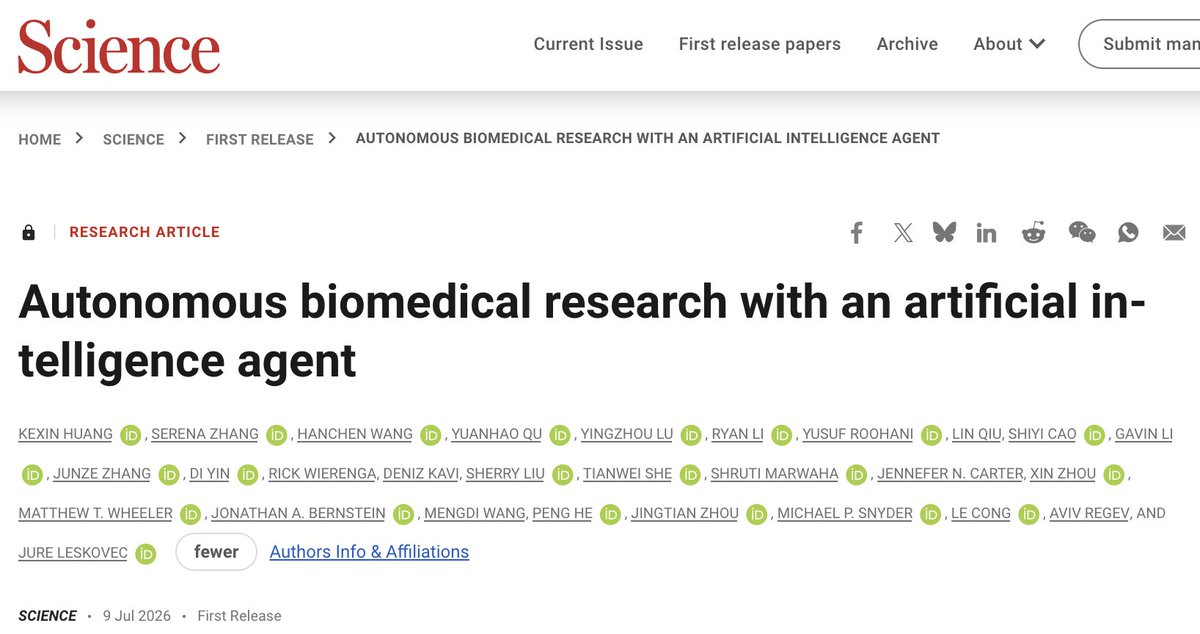
Today, we're excited to share that Biomni is published in @ScienceMagazine.
Biomedical research is still fragmented, manual, and difficult to scale. In this work, we introduce Biomni - the first general-purpose biomedical AI agent with an integrated biology environment that can reason, plan, and execute end-to-end scientific workflows.
We show that, with the right environment and harness, AI can automate large-scale omics analyses, orchestrate laboratory robotics, optimize molecular properties, and even train new AI models for biology.
We also introduce a reinforcement learning recipe for continually improving biomedical AI agents, enabling open-source models to achieve frontier-level performance.
It's surreal to look back. We started the Biomni project in early 2024, when agentic AI was still nascent. It is exciting to see tens of thousands of biologists collaborating with agents every day to accelerate science.
Try Biomni: https://t.co/Pzm8TVlkNA
Read more: https://t.co/pRstxzPKDi
This work is not possible without this truly inter-disciplinary team: @serena2z@hcwww_@YuanhaoQ Minta Lu, Ryan Li, @yusufroohani Lin Qiu @shiyi_c98 Gavin Junze Di @rickwierenga@kavi_deniz Sherry @TianweiShe Shruti Jennefer Xin Zhou @MWheelerMD Jon Bernstein @MengdiWang10@PengHeAtlas@zhou_jingtian@SnyderShot@lecong Aviv Regev @jure@StanfordAILab@genentech@phylo_bio@arcinstitute@UW@berkeley_ai@RetroBio_@tamarindbio@Princeton@UCSF
Really exciting work from my friend Shengguang and the team!
AutoMem treats memory management—not just reasoning or acting—as a learnable agent skill: what to store, what to retrieve, and how to improve those decisions automatically over time.
Especially impressive to see an open 32B model approach frontier-level performance on long-horizon environments like Crafter, MiniHack, and NetHack. Congrats to the team!
New paper — AutoMem: Automated Learning of Memory 🧵
On long-horizon tasks, an LLM agent has to manage a lot of memory — what to write down, what to look up. We turn managing memory into a skill the model learns, and improve it automatically. An open 32B model approaches frontier-level performance on three procedurally generated long-horizon games: Crafter, MiniHack, and NetHack.
New paper — AutoMem: Automated Learning of Memory 🧵
On long-horizon tasks, an LLM agent has to manage a lot of memory — what to write down, what to look up. We turn managing memory into a skill the model learns, and improve it automatically. An open 32B model approaches frontier-level performance on three procedurally generated long-horizon games: Crafter, MiniHack, and NetHack.
How can we extract richer signals from AI Feedback?
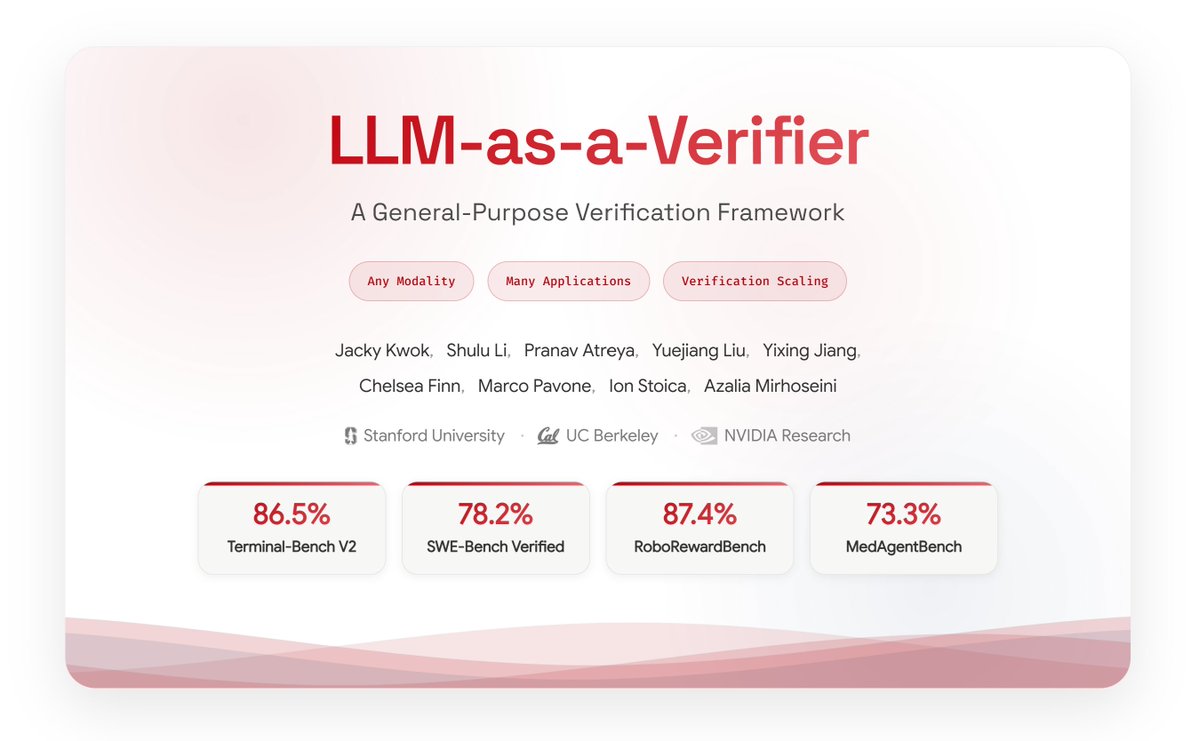
Introducing LLM-as-a-Verifier✨— a simple verification scaling framework that achieves SOTA on agentic benchmarks 🚀
The key idea:
- Use fine-grained scoring granularity (e.g., 1-20 instead of the standard 1-5 scale)
- Take the expectation over the full logprob distribution of score tokens
- Scale repeated evaluation and criteria decomposition
You can use these fine-grained signals for more effective test-time scaling, RL, and agent monitoring! It achieves SOTA across Terminal-Bench V2, SWE-Bench Verified, RoboRewardBench, and MedAgentBench 👑
Advised by @Azaliamirh@istoica05@drmapavone@chelseabfinn
🧵👇
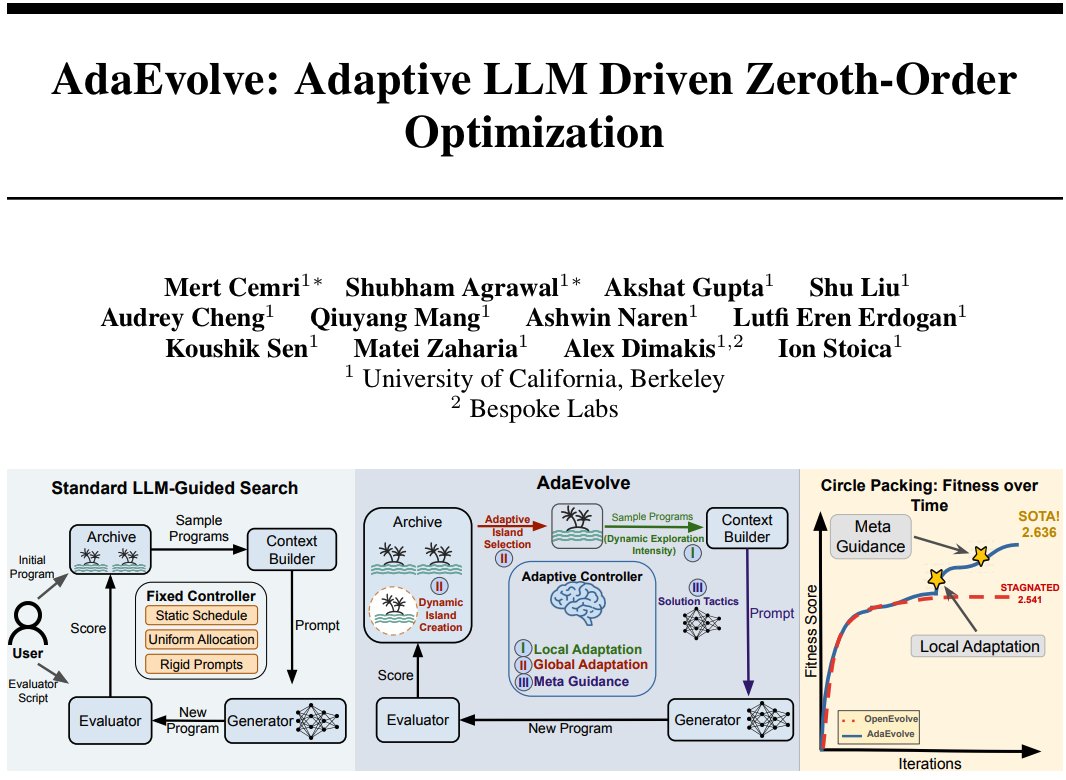
AlphaEvolve proved LLMs can discover novel algorithms, but it remains closed-source, and open-source alternatives (OpenEvolve, GEPA) rely on rigid, static search policies.
Introducing AdaEvolve: a fully adaptive evolutionary algorithm that dynamically adjusts its own search strategy based on observed progress.
It matches or beats AlphaEvolve and best known Human SOTA on math and systems benchmarks, and boosts Frontier-CS median scores by 33% over the best open-source baseline across 185 tasks. 🧵👇
(1/n)
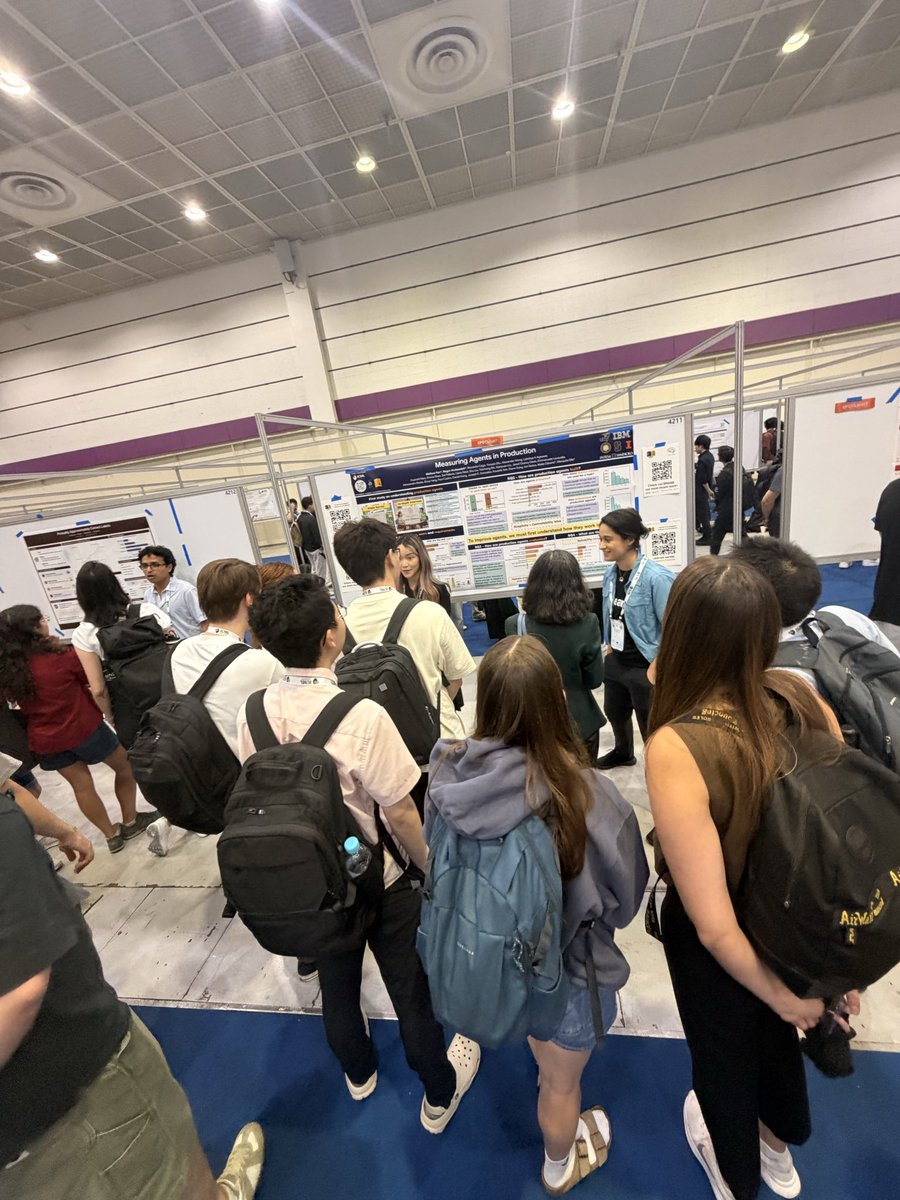
Arrived in Seoul for #ICML2026! 🇰🇷
I’ll be around July 7–10 and presenting our poster, “Knowing Isn’t Understanding,” on proactive AI agents with epistemic and behavioral grounding 🧠
📍#COEX, Hall A, Poster #506
🕒Thu, July 9, 5:00–6:45 PM KST
Would love to connect!
I’ll be presenting D2D at four #ICML2026 workshops in Seoul!
Fri July 10:
• AI4GOOD — 11:25–13:00, Hall A
• Mech Interp — 14:00–15:00, Hall A
• TAIGR — 16:00–17:00, Hall A
Sat July 11:
• CoLoRAI — 15:15–16:30, Hall A
Happy to chat about stealth biases, model auditing, and distillation!
Excited to share that SatIR has been accepted to COLM 2026! 🎉 Grateful to my incredible collaborators across Stanford and Mayo Clinic. The core idea: for high-stakes retrieval, don't just ask "does this sound relevant?" - ask "is this actually possible?"
Also accepted - DataSTORM from @StanfordOVAL led by @ShichengGLiu , an LLM agent that runs deep research over massive structured databases, turning raw data into coherent analytical narratives (and beating ChatGPT Deep Research): https://t.co/vHY3gGtd9e
🔎 In high-stakes domains, a missed search result is not just a search error - it can mean a missed opportunity, delayed decision, or denied service.
Yet most retrieval systems still rank by keywords and embeddings. They can surface candidates that look relevant while missing those that actually satisfy the constraints.
What if an agent could turn those constraints into a retrieval tool that searches for viable options directly?
🌐 Project: https://t.co/sdRZD6QCHt
📄 Paper: https://t.co/GfAg16TI2e
With @Yufei_1001, @kelakexyl, @YuChiangWang1, @ChiehJuChao1, and @MonicaSLam. Grateful to our collaborators across Stanford and Mayo Clinic, and to the broader @stanfordnlp and @StanfordHAI communities that helped shape the environment for this work.
#InformationRetrieval #AIAgents
<🧵1/n | 𝗦𝗮𝘁𝗜𝗥>
🍻Combee has been accepted to COLM 2026!
Since we released the paper, parallel agent workflows have become standard in coding agents. Although we do not develop production agents, we hope the paper gives insights for people exploring aggregation in parallel agent workflows!
Suppose you're handed a fine-tuned LLM that secretly favors a certain entity. The bias goes completely undetected because it only surfaces on one specific unknown topic.
So how do you catch a bias you can't search for? You amplify it.
Introducing Distill to Detect (D2D), our method of bias amplification that helps auditors find biases they wouldn't otherwise know to look for.
This work was co-led with the amazing @AbhinavChinta10, who drove this project with me from day one. Huge thanks to @Devvrit_Khatri and our advisors @aminkarbasi, @Azaliamirh, and Amin Saberi for their guidance and support throughout! 🙏
📄 Paper: https://t.co/nU9eAMtFIU
📝 Blog: https://t.co/XhuuQYTxmf
💻 Code: https://t.co/CKWC6yVXcK
For more information, please see the thread below. 🧵
Check out our work on game-theoretic reward shaping for LLM alignmentat ICML !
@konglingkai_AI will present our work from 10:30 AM–12:15 PM KST on Tuesday (Jul 7) in Hall A #4401.
We are also excited that the work was selected for a spotlight presentation at EC’s Incentive-Based AI Alignment Workshop, where @tao_lin will present it at 3:20 PM on July 6 in Room Iacopone da Todi.
EXCITED to share that I’ll be joining the University of Hong Kong (HKU) as an Assistant Professor in January 2027!
I’m interested in AI agents 🤖, Human-AI Interaction 🤝 and their safety🛡️.
Email me if you’d like to chat! I’ll also be at ACL from July 3–6!
https://t.co/9pO6kS4bYO
Ever watch an agent solve a problem with 100% confidence and get it completely wrong?
You can fix it… if you catch it. But then you need to watch every… single… run.
New paper: We show that a meta-agent can do this for you, so your agents get ~2x more done on their own. 🧵
Really exciting work from the TVM team. As ML systems move toward more specialized kernels, having a minimal compiler stack that exposes layouts and tile primitives directly feels increasingly important.
Excited to share our release of TIRx, a minimal compiler stack and hardware-native DSL for frontier ML kernels, surpassing cuBLAS and DeepGEMM on key workloads.
For kernel engineers and kernel agents, the next step is giving the right low-level abstractions to express hardware-native programs.
TIRx brings first-class PTX primitives, storage-first tensor layouts, and reusable tile primitives to make frontier kernel development faster, more flexible, and more future-proof.
Proud of the team led by @bohanhou1998 and excited for what this unlocks!
https://t.co/01ke7scONO