More to come! I've been thinking a lot about the future of work and the responsibility of the whole ecosystem to help answer these questions (and fast). It was an honor working with @jennjwang, @erikbryn, @Diyi_Yang, @andreas_h0wpt, and Phil.
O*NET tracks the tasks that are required by different jobs. It has been invaluable for research. But it also was clear that it could be improved a lot--and the need to improve it was much greater than ever. So very glad to see this, looks like we'll all be using it.
@jasonfurman A big part of this effort was ensuring everything is easily accessible and open source with the hope that it actually gets used. More to come!
O*NET tracks the tasks that are required by different jobs. It has been invaluable for research. But it also was clear that it could be improved a lot--and the need to improve it was much greater than ever. So very glad to see this, looks like we'll all be using it.
Introducing the Stanford Task Network (TaskNet), a task taxonomy grounded in workers’ accounts of their everyday work.
In collaboration with @onet_center and @mercor, we explore a new way to build and update occupational task lists.
A labor of love with Mercor and the O*NET Center! TaskNet brings together academic research, industry experience, and occupational data expertise to turn workers’ experiences into task information that can inform workforce policy and training.
Understanding the future of work is a pressing problem, but in order to do so, we need to understand and measure the present. I'm proud to have helped lead this collaboration between academia, government, and industry to produce TaskNet - an occupational taxonomy that will help us better understand how work is changing.
The future of work is a shared responsibility that should not be taken lightly.
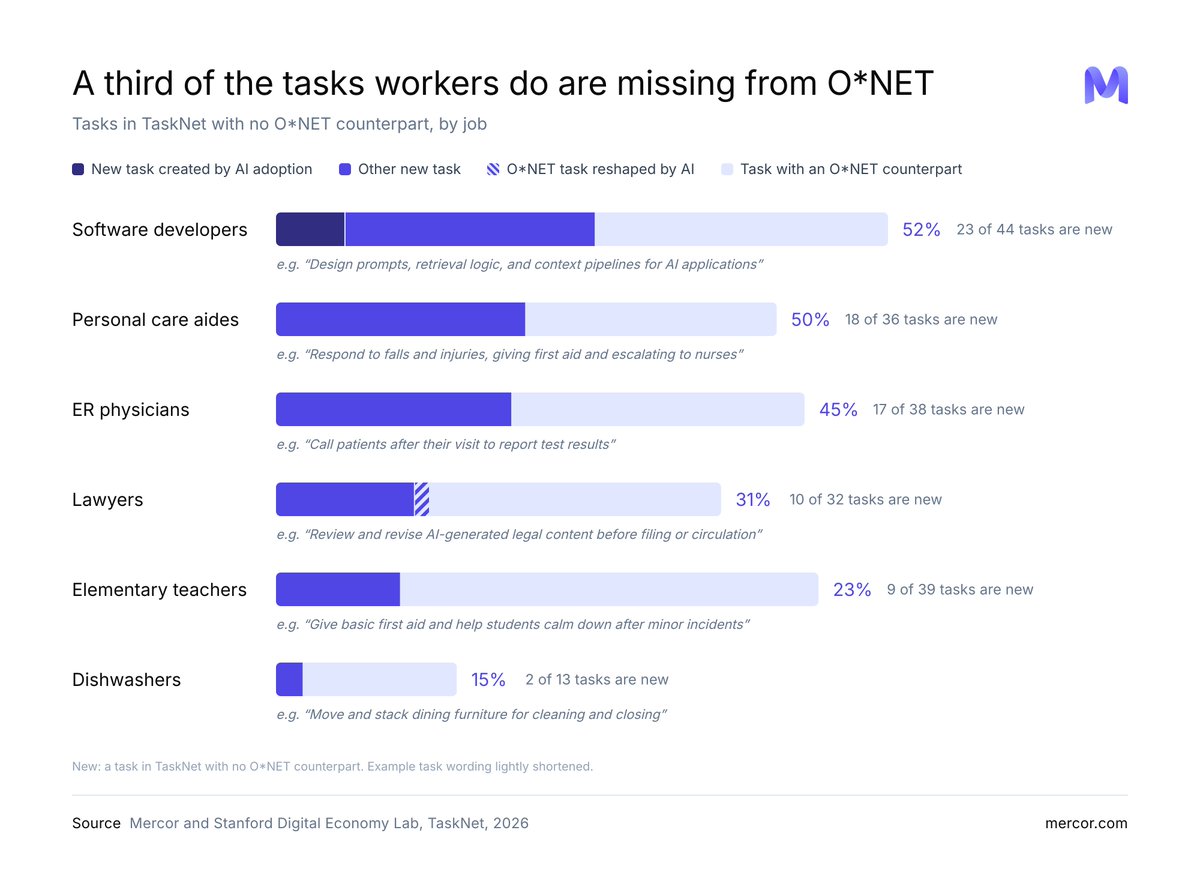
Workers in six occupations do 79 tasks the government's official occupational taxonomy has yet to add. That work is worth about $140B a year in wages.
That taxonomy is called O*NET, the U.S. Department of Labor's database of the tasks each occupation involves. Workers use it to help with job transitions, and economists use it to estimate which jobs AI will change. If the lists are incomplete, so are the estimates.
Today we're releasing TaskNet, an open-source task catalog built on O*NET and updated for how AI is changing work.
Built with researchers from Stanford, the O*NET Resource Center, and NBER. Thank you to @robinsonaisaac@erikbryn@diyi_yang@jennjwang@andreas_h0wpt@Digeconlab@stanfordnlp@stanfordhai@stanfordAIlab for contributing to this work.
Read the blog: https://t.co/nYlTO1Hlcu
We benchmark AI on math, code, and law, but to date, philosophy still has had no serious unit test.
Congratulations to my good friend @michaelcheng76 (one of the few people equally brilliant in the humanities like philosophy AND the technical details of AI frontier models), as well as the rest of team behind PhilosophyBench!
It matters not whether AI can summarize Kant, but rather if it can reason philosophically, develop a novel idea, and defend it rigorously with genuine depth.
https://t.co/AzUBP8GCTh
@SebastianThrun@msbernst@robinsonaisaac@neilbband@HazyResearch
1/ Introducing PhilosophyBench from @StanfordAILab@StanfordHCI, the first independent, large-scale benchmark for evaluating AI’s philosophical capabilities.
https://t.co/csZ86gugw6
3/ We are advised by an international group of philosophers and computer scientists, including Ruth Chang, Kit Fine, Chris Re, @msbernst, Ned Block, Nancy Cartwright, Gideon Rosen, Jonathan Schaffer, Crispin Wright, Linda Zagzebski, @michaelcheng76, @robinsonaisaac, @neilbband, Zachary Lang, and @HazyResearch.