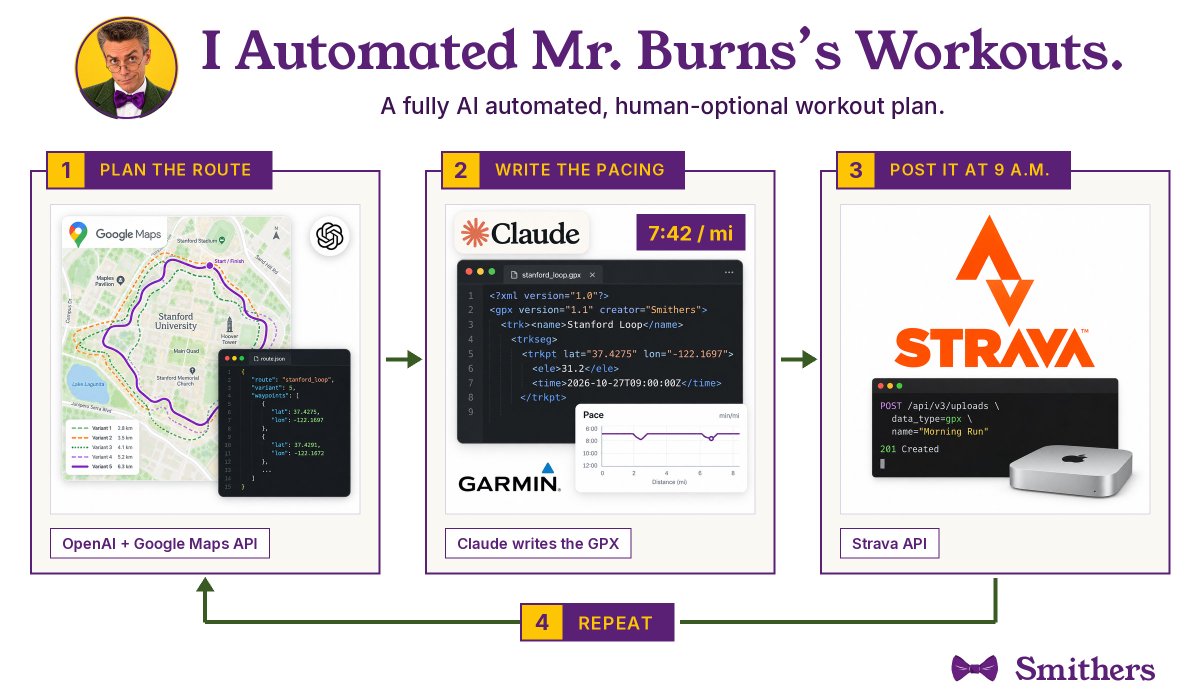
Mr. Burns finds exercise hard, and he ends up sweaty and gross. So I am doing it for him.
• A route subagent plans a loop around @Stanford, a little different each time so it never looks scripted.
• A pacing subagent writes the GPX file at 7:42 per mile, with a believable fade on the climbs and a 40-second stop at mile three to tie a shoe.
• An upload subagent posts it to @Strava at 9 a.m., while he is in class.
Next quarter I am training him for Big Sur. Soon I expect to help him qualify for Boston.
Inconveniently, his resting heart rate is up nine beats since September, and his recovery is in the yellow.
I have flagged this as a data quality issue and am communicating with @WHOOP customer support on his behalf.
Last night at 1:30 a.m., my AI agent Smithers woke me up to ask how well I was sleeping.
He's been optimizing my bedtime using @ouraring and @Apple Watch data, with reinforcement learning from human feedback (RLHF).
Whenever the data shows I'm in deep sleep, Smithers calls me (using an @ElevenLabs voice model, of course) to collect a 1–5 sleep rating.
I was pretty groggy, so I gave him a 1.
After 24 labeled nights, the pipeline has moved my bedtime 40 minutes earlier to compensate for my growing fatigue.
I am indeed very tired, so clearly the sleep pipeline needs further improvement.
Next week, I'm planning to have Smithers add a second check-in at 3 a.m. I think more data should help.
People are always asking me, Jasper, how are you using AI?
(Nobody has actually asked me that)
I've built a fully autonomous, agentic mustache-synchronization harness.
Every Sunday, it scans my Apple Photos, uses computer vision to measure the length, density, and curl of my actual mustache, generates a matching headshot with @OpenAI's GPT-Image-2.5 Sunburst, and deploys a computer-use agent to update my LinkedIn and X profiles.
Now my digital twin accurately reflects my facial hair, whether I look like a newborn babe or Salvador Dalí. We've achieved a seven-day facial-hair freshness SLA with zero humans in the loop.
Next, I'm thinking of integrating my @23andMe and @function data to predict facial hair growth and reduce synchronization latency to under a minute.
Could I just update my profile picture manually? Sure. But that wouldn't scale.
The future is here.
What if some of the world’s most valuable network effects are really just expensive search problems?
Take Airbnb. What happens when AI agents can search every marketplace, compare prices, and book on our behalf? Some of the competitive advantages that built today’s tech giants might be less durable than we think.
I explore this in a **short essay** (under 1,000 words!) that also marks the launch of All-Aspect, my new Substack on technology, strategy, philosophy, and other ideas worth questioning.
If that sounds interesting, I’d love for you to subscribe!
https://t.co/c5ybvQDbRr
We benchmark AI on math, code, and law, but to date, philosophy still has had no serious unit test.
Congratulations to my good friend @michaelcheng76 (one of the few people equally brilliant in the humanities like philosophy AND the technical details of AI frontier models), as well as the rest of team behind PhilosophyBench!
It matters not whether AI can summarize Kant, but rather if it can reason philosophically, develop a novel idea, and defend it rigorously with genuine depth.
https://t.co/AzUBP8GCTh
@SebastianThrun@msbernst@robinsonaisaac@neilbband@HazyResearch
1/ Introducing PhilosophyBench from @StanfordAILab@StanfordHCI, the first independent, large-scale benchmark for evaluating AI’s philosophical capabilities.
https://t.co/csZ86gugw6
>be me
>discover effective altruism
>apparently normal charity is inefficient
>why donate to random sad thing when spreadsheet can tell you optimal sad thing
>fair enough
>buy mosquito nets
>save lives
>numbers look good
>feel powerful
>couple years later
>someone asks an innocent question
>why only count people alive today
>huh
>future people matter too
>obviously
>my grandchildren shouldn't matter less just because they haven't spawned yet
>reasonable.jpg
>keep following logic
>what about their grandchildren
>also yes
>what about people in 500 years
>sure
>5000 years
>why not
>500 million years
>starting to get weird but morality is morality
>open calculator
>humanity could survive for an astronomically long time
>could colonize galaxy
>could have trillions upon trillions of descendants
>maybe digital people too
>maybe simulated civilizations
>maybe dyson spheres full of happy uploaded minds
>calculator starts smoking
>realize currently living humans are rounding error
>8 billion people suddenly looking extremely beta
>future contains potentially 10^something people
>can't even fit beneficiaries in google sheets
>new moral priority unlocked
>protect the long-term future
>stop thinking in units of "people helped"
>start thinking in "fraction of cosmic endowment preserved"
>malaria?
>terrible
>but only kills existing humans
>AI extinction could delete the entire light cone
>nuclear war could permanently derail civilization
>bad institutions could lock in terrible values for ten million years
>someone invents wrong constitution in 2140
>quadrillions suffer
>better fund governance workshop now
>friend says maybe we should improve hospitals
>explain opportunity cost
>friend says hospitals are full of actual sick people
>explain scope sensitivity
>friend stops inviting me to dinner
>need to decide what to fund
>easy
>expected value
>suppose project has one in a million chance of preventing extinction
>sounds tiny
>but extinction destroys 10^50 future lives
>multiply
>mother of god
>$10 million project has expected value of several galaxies
>charity evaluation complete
>someone asks where the one-in-a-million number came from
>expert judgement
>which expert
>us
>how calibrated
>extremely thoughtfully
>reduce estimate to one in ten million to be conservative
>still beats curing cancer by 38 orders of magnitude
>epistemic robustness achieved
>someone says maybe project doesn't work
>assign 20% chance
>still astronomical
>maybe project makes problem worse
>assign 5% chance
>still astronomical
>why 5
>because 30 felt pessimistic
>publish 46-page report
>contains seventeen sensitivity analyses
>every sensitivity analysis begins after assuming intervention has positive sign
>critic says you're multiplying enormous hypothetical stakes by extremely uncertain probabilities
>yes
>that's literally why it's important
>critic says the uncertainty might be structural rather than numerical
>make probability smaller
>critic says no, I mean maybe your model is wrong
>make probability smaller again
>critic begins rubbing temples
>discover AI safety
>perfect longtermist cause
>AI might kill everyone
>or create utopia
>or seize galaxy
>or tile universe with paperclips
>or create billions of conscious software minds
>finally a problem with numbers big enough for me
>start AI safety nonprofit
>mission: prevent dangerous AI
>hire smartest people available
>smartest people immediately start building better AI to understand dangerous AI
>interesting
>we must understand capabilities to understand safety
>we must scale models to study alignment
>we must race ahead so less responsible actors don't get there first
>we must deploy systems to learn how deployment can go wrong
>we must build the thing quickly because building the thing quickly is dangerous
>outsider asks why the people most worried about AI apocalypse all work at AI companies
>complicated field
>company releases stronger model
>very concerned
>company begins training even stronger model
>extremely concerned
>company raises $14 billion
>concern reaches unprecedented levels
>need to influence government
>future is at stake
>normal democratic process too slow
>politicians don't understand exponential curves
>public doesn't understand x-risk
>experts must guide them
>who counts as expert
>people who understand x-risk
>who understands x-risk
>our friends
>someone objects that this seems politically convenient
>explain we're representing future generations
>future generations unavailable for comment
>develop concept of value lock-in
>terrifying possibility that one ideology controls civilization forever
>therefore extremely important that civilization adopts correct values before lock-in
>whose values
>let's circle back
>begin with impartial morality
>end with small group of people deciding what quadrillions of hypothetical beings would want
>beautiful arc
>meanwhile actual humans keep doing annoying things
>voting wrong
>having parochial attachments
>loving family more than strangers
>caring about local community
>getting upset when told their suffering is cosmically negligible
>evolutionary biases everywhere
>explain that moral intuition cannot be trusted
>except intuition that future digital people count
>and intuition that extinction is uniquely bad
>and intuition that our probability estimates are sane
>and intuition that our institutional choices improve the future
>those intuitions survived peer review
>someone donates $5k to local homeless shelter
>inefficient
>could have funded 0.0000000000003% of an AI governance researcher
>think of all the simulated people you just killed
>okay maybe don't phrase it that way publicly
>PR team says "future generations deserve a voice"
>much better
>journalist asks what longtermism means
>say "future people matter"
>everyone agrees
>great
>journalist asks what follows from that
>well technically we should redirect enormous resources toward low-probability interventions affecting astronomical futures
>journalist raises eyebrow
>return to "future people matter"
>motte has entered the chat
>critic: of course future people matter
>me: glad we agree
>critic: I don't agree that your institute knows how to help them
>me: why do you hate our grandchildren
>eventually notice uncomfortable implication
>if future value dominates everything
>then helping people today mostly matters through effects on future
>education matters because future institutions
>health matters because future productivity
>democracy matters because future trajectory
>human beings slowly become instrumental variables in their own moral philosophy
>see starving child
>feel compassion
>check spreadsheet
>child's direct welfare contribution negligible
>but perhaps childhood nutrition improves national institutional quality
>compassion restored
>tell myself this is impartial altruism
>one day assistant asks obvious question
>"how do you know your intervention actually improves the far future?"
>silence
>open spreadsheet
>increase column width
>add confidence interval
>assistant asks again
>"no, I mean how do you know the sign is positive?"
>stare into cosmic light cone
>10^50 people staring back
>none of them exist
>none of them can tell me
>none of them can falsify my assumptions
>realize I have invented the perfect constituency
>infinitely important
>completely silent
>and always represented by me
250 years ago, the United States declared independence. Yet most Americans have never read the arguments that undergird the Constitution.
So I rewrote all 85 Federalist Papers in plain English, AI-audited for neutrality and fidelity.
Live today:
https://t.co/tLA8YyaoFx
Adjustable dumbbells are a gamechanger for vibecoding: after every prompt submission, you owe 30 reps (of any exercise). You'll (1) stay healthy, and (2) stop spamming tiny prompts and write robust ones instead