A woman on my flight yesterday switched seats with her husband because their toddler wouldn’t stop crying.
The second she sat down alone, she closed her eyes for maybe 30 seconds.
Just resting.
Not sleeping.
When the husband walked past with the kid later, he laughed and said loudly,
“Must be nice to finally get a break from doing nothing.”
A few people chuckled.
She laughed too.
But something about it felt off because for the entire flight she had been:
holding the baby,
packing snacks,
cleaning spills,
walking him down the aisle,
missing her own meal trying to calm him down…
while the husband watched a movie with headphones on.
And honestly I think that’s why so many women are exhausted.
Not because they’re doing everything alone.
But because they’re doing everything while someone else calls it “nothing.”
all of my friends who bought houses in 2019 got 4 bed 2.5 bath homes for under $200k. their mortgages are at 3% paying like $1500 a month.
they’ll never leave those houses and i don’t blame them
now even the cheapest 2 bedroom apartment you can find is bare minimum $2200 a month.
you’re paying more to rent a box than they pay to own an entire house.
and that shift happened in less than 5 years
the dream of owning a home went from easily achievable to nearly impossible in a blink and this isn’t just the us this is global.
an entire generation priced out of the most basic milestone of adulthood
and it doesn’t matter who sits in powell’s chair.
there is nothing anyone can do about it as long as the fed keeps printing money out of thin air.
every dollar they create devalues the ones you already saved.
that’s not inflation that’s theft
the house didn’t get more expensive….
the value of every dollar we have was stolen from us
I lost my dad 8 years ago.
You think you’re prepared. You’re not.
Now my mom is 87, and in the last year I’ve watched her decline in ways I never wanted to see. It’s a quiet kind of heartbreak. Not dramatic. Just real.
Here’s the truth no one really tells you:
When your mom and dad are gone, something fundamental shifts. The ceiling of your life disappears. The people who knew you before the world touched you... they’re not there anymore.
And nothing feels the same after that. Absolutely nothing.
So if you still have them, even if it’s complicated, even if it’s imperfect, value the time. Call them. Visit. Sit in the silence. Ask the questions you think you have time to ask later.
Later is not guaranteed.
One day you’ll wish for one more conversation.
Don’t wait for that day to understand what you had.
“Can I bring my baby to the interview?”
The message came in at 11 PM:
“Hi, I have an interview with you tomorrow at 2 PM. My childcare fell through. Can I bring my 8-month-old? I understand if you need to reschedule.”
Old me would have rescheduled.
Unprofessional. Distraction. Red flag.
New me replied:
“Absolutely. See you tomorrow.”
She showed up with her baby on her hip.
She apologized three times before even sitting down.
Ten minutes in, the baby started crying.
She tried to soothe him while answering questions.
She apologized again.
I stopped the interview and said:
“Hey. You’re managing a fussy baby, answering complex questions, and staying calm under pressure. That’s literally the job. Handling chaos while staying professional. You’re already proving you can do it.”
Her eyes filled with tears.
We hired her.
She’s been with us for a year now.
The most reliable team member we have.
Why?
Because when you’re used to handling a screaming infant at 3 AM and still showing up to work the next day, workplace stress feels like nothing.
Working parents, especially mothers, are some of the most organized, efficient, and resilient people you’ll ever hire.
Yet we lose them because our hiring processes are built for people with zero caregiving responsibilities.
If your interview process can’t accommodate a parent facing a childcare issue, you’re not filtering for professionalism.
You’re filtering for privilege.
For nine months, my wife, Brooklyn, carried our baby boy. And for nine months, we lived in a place between hope and heartbreak.
Early in the pregnancy, we learned something was terribly wrong. Around the three- to four-month mark, doctors told us our son had severe hydrocephalus — fluid building so rapidly in his brain that it pushed everything aside. They used to call it “water on the brain,” but the simplicity of the name didn’t soften the reality.
We were eventually referred to Cincinnati Children’s Hospital, where some of the best fetal specialists in the country met with us. And they gave us the kind of news no parent is ever prepared to hear.
His condition was so severe, so extreme, that they stopped measuring. There was no point, they said. The MRI images were devastating. We were told there was a greater than 90% chance our son would either:
• Die shortly after birth, or
• Survive with such profound cognitive impairment that life — real life — would not be possible.
We sat through meetings no parent should ever sit through. Conversations about breathing tubes. About how long to try. About the moment we might have to make the decision to let him go.
Brooklyn moved to Cincinnati to be close to the hospital. I drove back and forth — working, caring for our daughters Sophie and Lily, and trying to keep our home standing while our world felt like it was falling apart.
Then came July 8th.
Just 15 minutes before Brooklyn’s C-section, we sat with doctors again and discussed when — not if — we might have to remove life support and let our son go to heaven.
I don’t have words for that kind of pain.
And then — Charlie Edward Schnarr entered this world crying.
A strong, loud, defiant cry.
The most beautiful sound I have ever heard.
He stayed in the NICU until yesterday… and now we are home. Together. Holding him. Loving him. Watching him breathe. Watching him live.
He has mild ventricular enlargement we will keep an eye on — but otherwise?
He is thriving. Eating. Wiggling. Yawning. Gripping our fingers. Looking around at a world that was never supposed to be his.
The doctors have no explanation. They said his brain somehow cleared the blockage on its own — something none of them have seen in a case this severe. The word that kept echoing through the NICU from seasoned nurses and top specialists was the same:
“Miracle.”
“Divine intervention.”
They said it. Not us.
We know thousands of people — family, friends, coworkers, strangers — were praying for our son. I believe with everything in me that God heard those prayers. That He placed His hand on Charlie. That He said, not this one.
I will spend the rest of my life thanking Him.
To every person who prayed for us — every text, every message, every whispered intention — thank you. You carried us when we were too exhausted to carry ourselves.
Prayer is real.
God is real.
And miracles… they still happen.
With a full and grateful heart,
—Nick
@CrissyKasten@harryfisherEMTP Literally same thing happened to my mom. Went in for a liver transplant, contracted Covid put on a vent and wouldn’t let anyone in the room to say goodbye to her. Had to say goodbye through the glass door. Makes me sick Einstein in Philly in Feb 2022. Neglected her, heartbreaking
I really hate to be the bearer of bad news..
But it’s not just Tylenol. 😅
And it’s not just vaccines either.
It’s also the aluminum in the cookware..
It’s the glyphosate in the food supply..
It’s the flouride in the toothpaste..
It’s the chlorine in your tap water..
It’s the PFA’s in the clothing..
It’s the radiation from your phone..
It’s blocked detox pathways..
It’s the processed foods..
It’s the lack of sunshine and exercise..
It’s the excessive amount of screen time..
BREAKING: White House Announces Tylenol–Autism Link, Opens Door to Vaccines
The pathway to developmental regression begins with vaccines, not acetaminophen. Tylenol used for fever control for sixty years. Confounding by indication likely behind the association. A leading cause of Tylenol use during pregnancy is maternal vaccination that started about 25 years ago. Systemic inflammation and the reason why Tylenol is indicated (eg post combination vaccination) is the real driver of encephalitis, and the post-encephalitic state of autism. @McCulloughFund@ChildrensHD@SecKennedy https://t.co/Mq3uiIwDKM
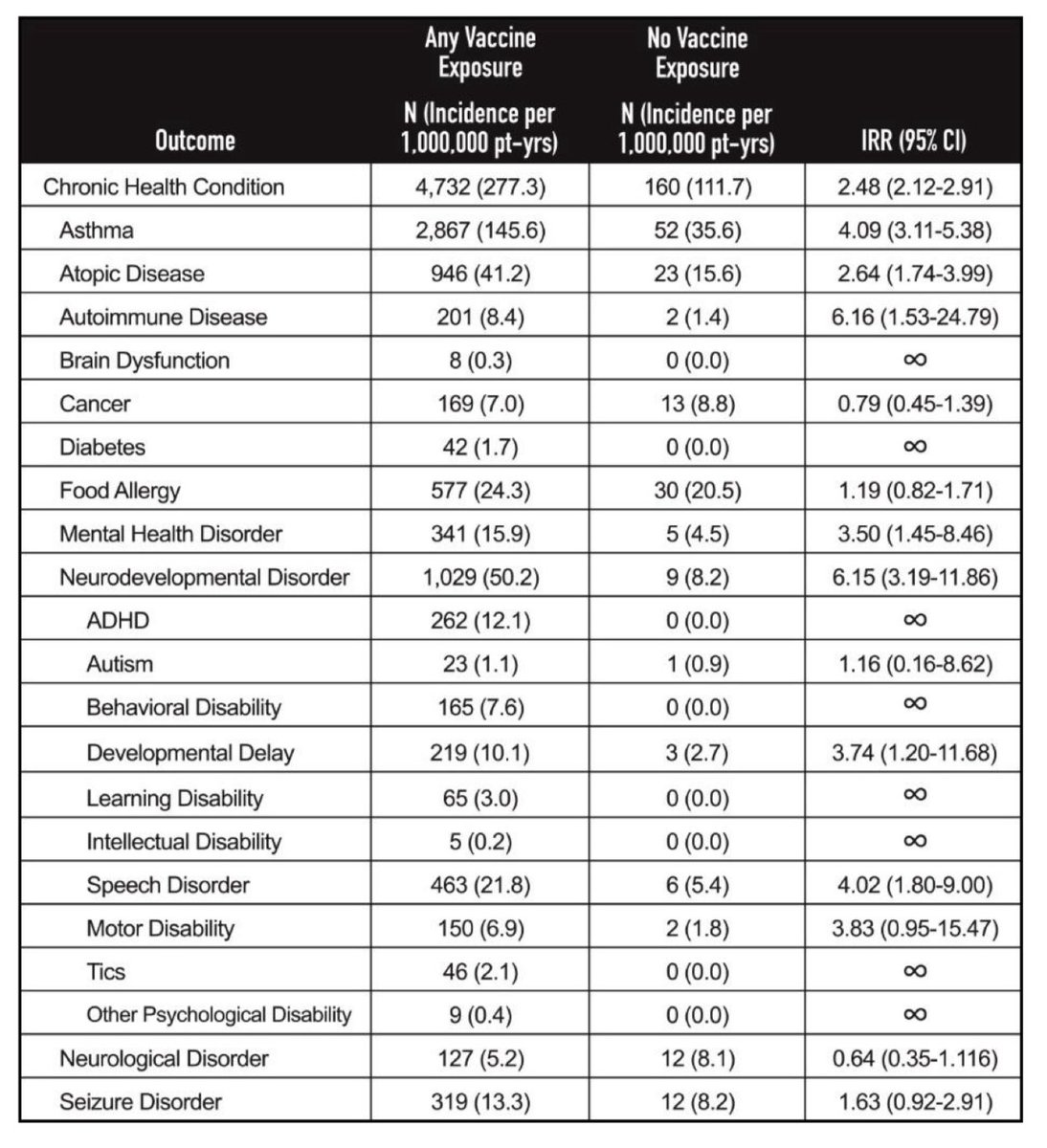
The unpublished Henry Ford study is explosive in its implications. At its core, the data reveal a stark divide between children who received vaccines and those who did not. When measured in incidence rates per one million patient-years, the differences are not subtle. They are dramatic, and they cut across a wide spectrum of chronic conditions.
The most basic finding is that vaccinated children experienced nearly two and a half times the overall rate of chronic health conditions compared to their unvaccinated peers. The number sits at 277.3 cases per million patient-years among vaccinated children against 111.7 for the unvaccinated, producing an incidence rate ratio of 2.48 with tight confidence intervals. That is not a minor signal, it is a flashing red light.
Asthma stands out as one of the most glaring disparities. The rate was over four times higher in vaccinated children, 145.6 cases compared to only 35.6 among the unvaccinated. Atopic diseases such as eczema and allergies were also elevated, with vaccinated children facing a 2.64-fold higher risk. Autoimmune conditions were even more striking, with vaccinated children showing an incidence more than six times greater than their unvaccinated counterparts.
Neurodevelopmental outcomes were perhaps the most disturbing category. Disorders in this group were more than six times higher in vaccinated children. ADHD was present in 262 cases among the vaccinated group, yet zero among the unvaccinated. Learning disabilities, intellectual disabilities, tics, and other developmental impairments all followed a similar pattern. Speech disorders were four times higher among the vaccinated group, and developmental delays nearly four times higher as well. Mental health disorders overall were 3.5 times higher. Even seizure disorders, while less dramatic, still trended upwards with a relative risk of 1.63.
One of the most telling features of the data is how often the unvaccinated column registers as zero or near zero. ADHD, learning disabilities, intellectual disabilities, and tics had no cases recorded in the unvaccinated population. Critics will argue this reflects underdiagnosis, since unvaccinated children typically see doctors less often. But the sheer size of the disparity suggests something more. A minor diagnostic gap might be plausible, but the gulf revealed in these numbers is difficult to dismiss as mere chance or office visit frequency.
Taken together, the Henry Ford analysis suggests vaccinated children are not only more likely to be seen by physicians but also genuinely more likely to be diagnosed with an array of chronic and developmental problems. Even if one accepts the possibility of detection bias, the magnitude of the differences requires serious investigation rather than casual dismissal. If the signal were a modest ten or twenty percent increase, one could argue it away. When the risks climb to four, five, or even six times higher, the argument of bias alone becomes increasingly fragile.
The larger point is this. Whether or not one accepts every conclusion of the Henry Ford team, this study provides a powerful signal that chronic conditions deserve a deeper look in relation to vaccination. Current post-marketing surveillance systems are primarily designed to catch rare acute events such as anaphylaxis or febrile seizures. They are not equipped to track long-term patterns in asthma, autoimmune disease, or developmental disorders. By design, they will not see what this study has begun to uncover.
To dismiss this analysis outright because it has not yet passed through peer review is an act of intellectual laziness. Publication is not the only measure of value, and in today’s climate researchers face professional punishment for producing findings that challenge the dominant narrative.