Locus Robotics has acquired Nexera Robotics, adding patented NeuraGrasp™ technology to advance Locus Array and autonomous mobile fulfillment.
One gripper. Broader SKU coverage.
A new level of enterprise-scale automation.
Learn more: https://t.co/PnR1TXczkL
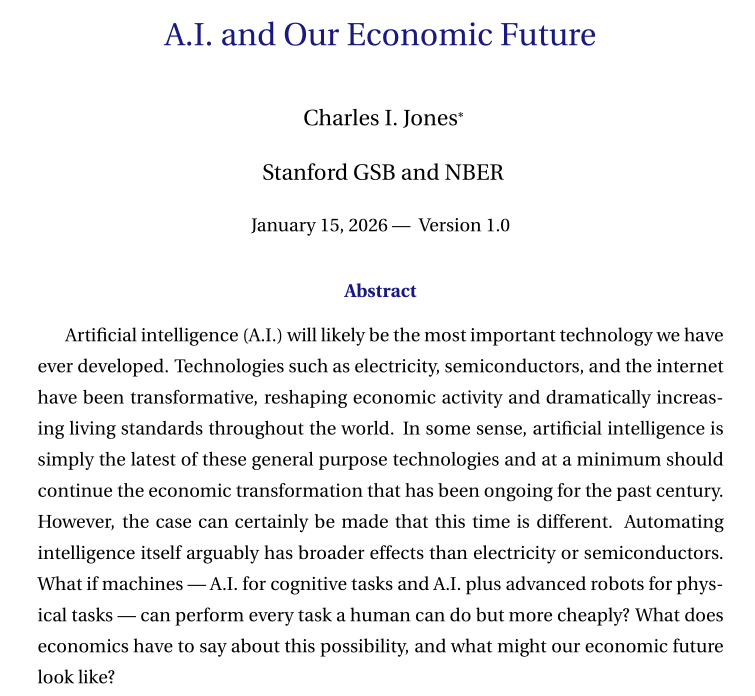
"AI and Our Economic Future" New paper in preparation for the Journal of Economic Perspectives ==> accessible to a broad audience. https://t.co/eV46ATgV3k
In 1922, a group of scientists went to the Toronto General Hospital where diabetic children were kept in wards, often 50 or more at a time. Most of them were comatose and dying from diabetic ketoacidosis. Others were being treated by being placed on an extremely strict diet, which inevitably led to starvation.
This is known as one of medicine's most incredible moments. Imagine a room full of parents sitting at the bedside waiting for the inevitable death of their child.
The scientists went from bed to bed and injected the children with a new purified extract: it was called insulin.
As they began to inject the last comatose child, the first child injected began to awaken. Then one by one, all the children awoke from their diabetic comas. A room of death and gloom became a place of joy and hope.
In the early 1920s Frederick Banting and Charles Best discovered insulin under the directorship of John Macleod at the University of Toronto. With the help of James Collip insulin was purified, making it available for the successful treatment of diabetes.
In the same year, Banting, Collip, and Best decided to sell the insulin patent to the University of Toronto for $1.
Banting and Macleod earned a Nobel Prize for their work in 1923.
Photo Credits: Library and Archives Canada
The first world-class clean AI video model is here.
Marey by Moonvalley—built for filmmakers, trained exclusively on licensed data. Brought to you by the leading minds in AI and film.
The future starts now. Join the waitlist: https://t.co/8ctlvXlaqr
Heads down, keep building.
1844: Telegraph demonstration by Samuel Morse in Canada
1849: Wire cable - Thomas Keefer
1851: Kerosene - Abraham Gesner
1853: Railway car manufacturing begins - Grand Trunk Railway shops in Pointe-Saint-Charles, Montreal
1856: First Canadian-built locomotive - Toronto Locomotive Works
1867: First commercial oil well in North America - James Miller Williams
1873: Standard time - Sir Sandford Fleming
1876: Telephone - Alexander Graham Bell (while living in Brantford, Ontario)
1878: Mechanical foghorn - Robert Foulis
1879: Electric light bulb (incandescent filament) - Henry Woodward (later sold patent to Edison)
1879: Canada Car and Manufacturing Company begins railcar production
1883: Electric cooking range - Thomas Ahearn
1887: Frost-resistant wheat - David and Charles Fife (Red Fife wheat)
1887: Canadian Pacific Railway's Angus Shops begin manufacturing locomotives and rolling stock
1892: Basketball - James Naismith (born in Ontario, invented it while in Massachusetts)
1902: Pablum (baby cereal) - Frederick Tisdall and Theodore Drake
1904: Massey-Harris begins manufacturing farm equipment in Toronto
1905: First successful airplane in British Empire - Alexander Graham Bell's team with the Silver Dart
1908: Robertson screw and screwdriver - Peter Lymburner Robertson
1909: Canadian Car and Foundry (CC&F) established, manufacturing railway cars
1913: Radio voice transmission - Reginald Fessenden
1915: Gas mask with chemical filter - Cluny MacPherson
1919: Avro Canada established (originally as Canadian Vickers), beginning aircraft manufacturing
1920: Marquis wheat (rust-resistant) - Charles Saunders
1921: Insulin - Frederick Banting and Charles Best
1922: Snowmobile - Joseph-Armand Bombardier
1925: Walkie-talkie - Donald Hings
1925: Electric wheelchair - George Klein
1928: de Havilland Canada established, beginning domestic aircraft manufacturing
1930: Electron microscope - James Hillier and Albert Prebus
1932: Pacemaker - John Hopps
1932: Alkaline battery - Lewis Urry
1934: Road line painting machine - Percy Shaw
1937: Caulking gun - Theodore Witte
1938: Snow blower - Arthur Sicard
1939: Anti-G suit for pilots - Wilbur Franks
1940: Crash position indicator (aircraft "black box") - Harry Stevinson
1942: L'Auto-Neige Bombardier Limited (later Bombardier Inc.) begins commercial production of snowmobiles
1945: ZEEP (Zero Energy Experimental Pile) - first nuclear reactor outside US
1946: Electric organ - Leslie Hill
1946: Canadair established (later became part of Bombardier), manufacturing aircraft
1948: Telephone answering machine - inventions by Bell Canada
1949: Avro Canada begins CF-100 Canuck jet fighter production
1950: Cesium atomic clock - National Research Council
1950: Canola - Baldur Stefansson and Keith Downey
1950: Cobalt-60 radiation therapy - Harold Johns
1950: Snowmobile (modern) - Joseph-Armand Bombardier (Ski-Doo)
1950: Heart pacemaker (external) - Wilfred Bigelow and John Callaghan
1951: STEM microscope - James Hillier
1952: Plastic garbage bag - Harry Wasylyk and Larry Hansen
1953: Cardiac pacemaker (internal) - John Hopps
1954: CANDU nuclear reactor design - Atomic Energy of Canada
1957: Kerimid 601 (heat-resistant polymer) - Geoffrey Guymer
1958: Hydrofoil boat - Alexander Graham Bell and Casey Baldwin
1958: COBOL programming language - Grace Hopper (with Canadian team members)
1959: UTDC (Urban Transportation Development Corporation) established to manufacture transit vehicles
1963: Instant mashed potatoes - Edward Asselbergs
1963: Motorized wheelchair (electric) - George Klein
1963: First geosynchronous satellite (concept) - John H. Chapman
1968: IMAX film format - Graeme Ferguson, Roman Kroitor, and Robert Kerr
1969: Wonderbra - Louise Poirier for Canadian Lady Corset Company
1969: Canadarm (space shuttle robotic arm) - SPAR Aerospace
1970: Pablum (improved formula) - Hospital for Sick Children team
1971: Telephone touch-tone system - Bell Canada
1971: Retractable airplane stairs - George Burnell Beaton
1972: Pacemaker technology improvements - John Hopps
1973: Computerized braille - Roland Galarneau
1974: Bombardier begins rail vehicle manufacturing (after acquiring MLW-Worthington)
1974: Fibre optics developments - Northern Electric (Nortel)
1975: SMART Board interactive whiteboard - SMART Technologies
1978: McIntosh apple - John McIntosh
1979: Wheelchair-accessible bus - Walter Callow
1980: Digital Sampling Synthesizer - Sydney Alonso and Cameron Jones
1982: Yukon Gold potato - Gary Johnston
1983: Blackberry smartphone - Research In Motion (RIM)
1984: Java programming language - James Gosling
1984: Canadair Challenger business jet enters production
1985: Ambulatory blood pressure monitor - Halifax Infirmary team
1986: Cardiac stent - Julio Palmaz and Richard Schatz
1986: Bombardier acquires Canadair, expanding aircraft manufacturing
1987: Neurochip - Nahum Sonenberg
1989: CADPAT (Canadian Disruptive Pattern) - first digital camouflage
1989: Bombardier introduces CRJ regional jet series
1992: Bombardier acquires de Havilland Canada, further expanding aircraft manufacturing
1994: Cryptographic key recovery - Entrust
1994: Telerobotic surgery systems - engineering team at McGill
1995: Cochlear implant improvements - University of Toronto
1996: Hepatitis B vaccine - University of Toronto/Connaught Laboratories
1998: Fetal heart monitoring systems - Winnipeg's Research Facility
1999: NeXT Computer - partial development by Waterloo team
2000: Artificial cardiac valve - Dr. Tirone David
2001: Electric car charging stations network - Hydro-Québec
2003: Nanopore sequencing (early developments) - University of British Columbia
2004: Quantum cryptography systems - University of Toronto
2005: CFL light bulb improvements - GE Canada
2006: Polymer banknotes (modernized) - Bank of Canada
2007: Multi-touch input technology - University of Toronto
2008: T5 phage - Felix d'Herelle
2008: Bombardier C Series aircraft program launched (later became Airbus A220)
2009: cystic fibrosis gene therapy - researchers at Hospital for Sick Children
2010: Transparent aluminum - University of Alberta
2011: Biofuel from agricultural waste - Iogen
2012: Quantum computer development - D-Wave Systems
2013: Carbon capture technology - Carbon Engineering
2014: Ebola vaccine - Public Health Agency of Canada
2015: Nanomedicine drug delivery systems - Canadian Institute of Health Research
2016: Self-healing metals - University of Toronto
2017: Artificial intelligence advances - Geoffrey Hinton's team at University of Toronto
2018: Deep learning and neural networks - Yoshua Bengio's team at University of Montreal
2019: Recyclable carbon fiber - University of British Columbia
2020: COVID-19 vaccine research contributions - Multiple Canadian institutions
2020: Lion Electric begins manufacturing electric buses and trucks in Quebec
2021: Quantum-resistant encryption - University of Waterloo
2022: Biodegradable plastics from waste - Carbios/McGill University
2023: Machine learning for climate modeling - University of Victoria
2024: Advanced neural interface technology - McGill/University of Toronto
A couple reflections on the quantum computing breakthrough we just announced...
Most of us grew up learning there are three main types of matter that matter: solid, liquid, and gas. Today, that changed.
After a nearly 20 year pursuit, we’ve created an entirely new state of matter, unlocked by a new class of materials, topoconductors, that enable a fundamental leap in computing.
It powers Majorana 1, the first quantum processing unit built on a topological core.
We believe this breakthrough will allow us to create a truly meaningful quantum computer not in decades, as some have predicted, but in years.
The qubits created with topoconductors are faster, more reliable, and smaller.
They are 1/100th of a millimeter, meaning we now have a clear path to a million-qubit processor.
Imagine a chip that can fit in the palm of your hand yet is capable of solving problems that even all the computers on Earth today combined could not!
Sometimes researchers have to work on things for decades to make progress possible.
It takes patience and persistence to have big impact in the world.
And I am glad we get the opportunity to do just that at Microsoft.
This is our focus: When productivity rises, economies grow faster, benefiting every sector and every corner of the globe.
It’s not about hyping tech; it’s about building technology that truly serves the world.
BREAKING: @FerootSecurity found obfuscated code in DeepSeek (US's #1 AI app) connecting to China Mobile - a state telecom BANNED in the US over national security!
Think TikTok was bad? DeepSeek users are feeding sensitive business data & personal info directly into their AI. 🤯
Huge thanks to @AP for their incredible investigative journalism on protecting privacy and security. Their commitment to exposing privacy & security risks keeps Americans safer. 🙏
Four Key takeaways:
1/4 Our team discovered hidden code in DeepSeek's login page. When decoded, it reveals direct ties to China Mobile - a company the US govt banned for national security risks.
2/4 Unlike TikTok's videos, DeepSeek's users are more likely to let it analyze business docs, see corporate secrets, business strategies & personal data. The national security implications are big and stakes are high.
3/4 China Mobile = previously sanctioned by US govt for ties to Chinese military. Now they can potentially get access to Americans' data.
4/4 Shout out to @AP's investigative team for verifying our findings and bringing this to light. Read their full article: https://t.co/5iwiN3L7Wu
RT 🔄
#CyberSecurity #AI #TechNews #PrivacyMatters
We’re excited to announce that we’ve raised a $21.8M Series A!
Our team has made incredible technical breakthroughs and this round will help accelerate us toward our first product – the world’s first non-invasive glucose monitor
https://t.co/AGjLlKMb4L
This diagram from a book written in 1984 has more or less been rediscovered by hundreds of phd students over the last year and something about that is very sad
Applications are open for batch 3 of https://t.co/8rfIWYng8i for pre-seed and seed-stage companies building AI products! Deadline is Feb 16.
As an experiment, this batch we are offering the option of either receiving $250k on an uncapped note, or $2.5M at a $25M cap.
In 1974, author Ray Bradbury was asked, “What is space travel going to do for man?” In response, he gave the most mystical, mind-blowing, and strangely moving answer I could have imagined.
[Hey Yishan, you used to run Reddit, ]
How do you solve the content moderation problems on Twitter?
(Repeated 5x in two days)
Okay, here are my thoughts:
(1/nnn)
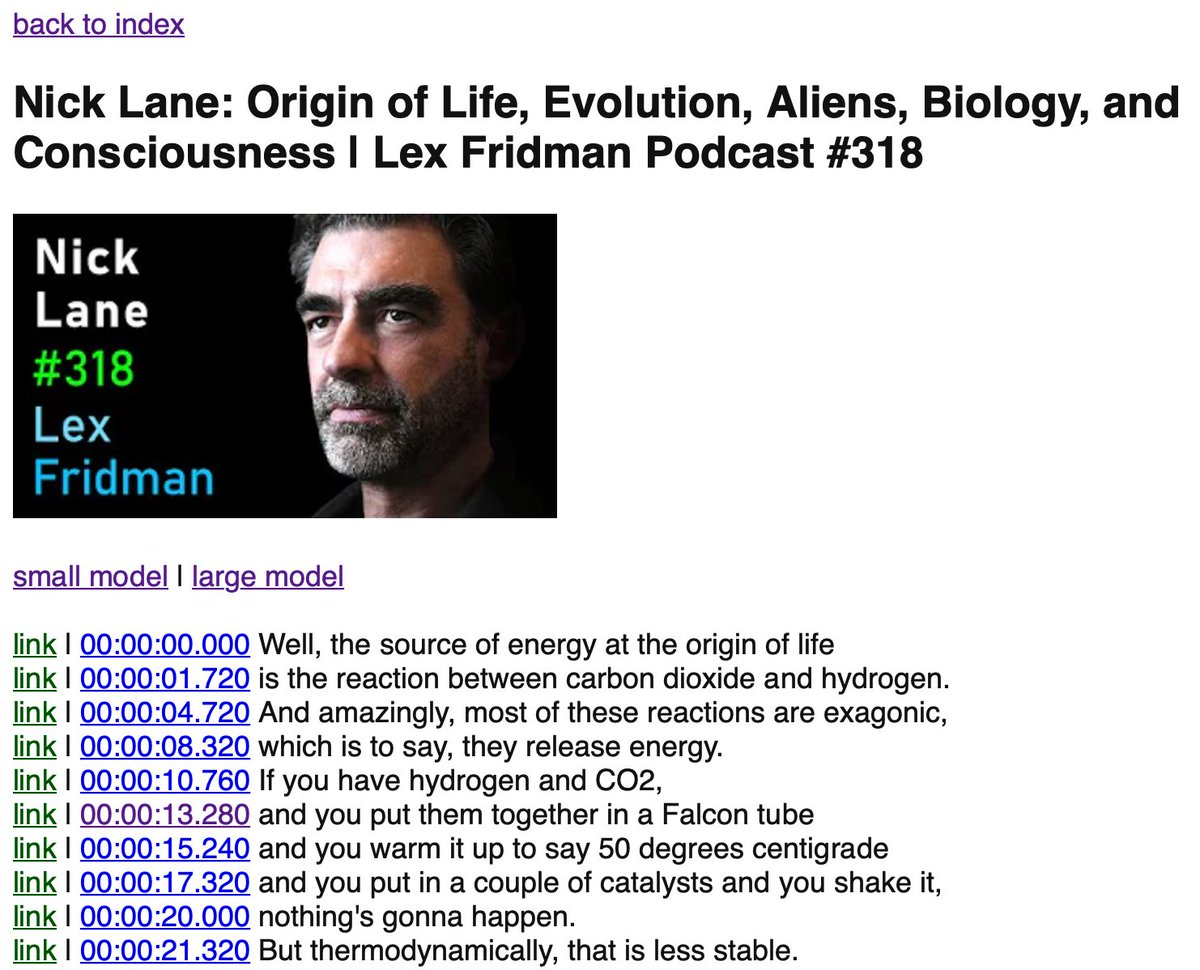
Ok so I downloaded all ~322 episodes of @lexfridman podcast and used OpenAI Whisper to transcribe them. I'm hosting the transcriptions on... "Lexicap" ;) : https://t.co/bjYTsE6OgK. Raw vtt transcripts are included for anyone else who'd like to play (they are quite great!)
Last week we held the largest CMO gathering ever at @Saastr.
80+ CMOs shared notes on growing their companies in the new macro environment.
Here are 10 valuable lessons shared behind closed doors: