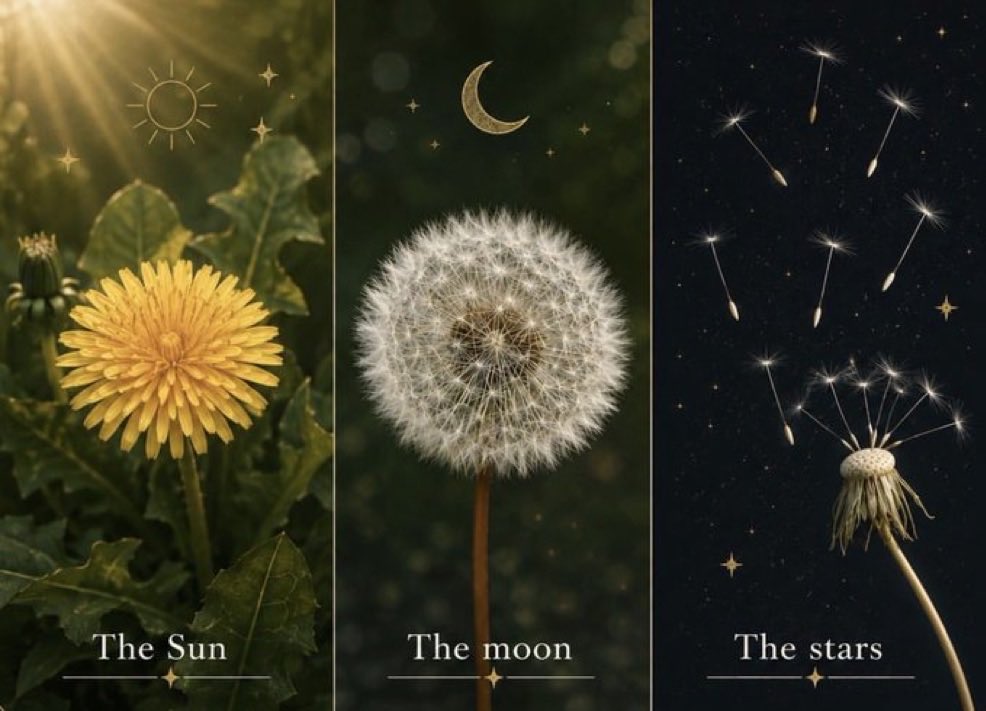
The dandelion is the only flower that represents three distinct celestial bodies throughout its life cycle.
☀️🌙✨
Its bright yellow bloom mirrors the radiant morning sun. As it matures, it transforms into a fluffy white sphere resembling a glowing full moon. Finally, its individual seeds scatter on the wind, drifting away like a constellation of falling stars
The patterns of light on the sea floor.
They are called caustics: they are created by light refracted and reflected from the air/water interface. Water acts as a dynamic magnifying glass.
I asked my mother a few days ago if, after almost sixty years of marriage, she was still in love with my father.
She looked at me for a moment, as if searching for words that don't fit into sentences. She didn't answer. She just smiled.
Later, when I got home, I found on my phone the answer that her silence had already conveyed:
“Sometimes you ask me if I’m still in love with him. I smile, not because the question is silly, but because the answer isn’t simple. How can I say yes—but not like before?”
It's no longer about butterflies in the stomach or fireworks. It's about roots.
Love, after so many years, is no longer a hurricane that sweeps you away. It's the firm ground that sustains you. It doesn't quicken your heart—it calms your soul. It doesn't make your hands tremble—it gives you the strength to raise them every day.
There are no more surprises, but there are rituals: coffee drunk at the same time, little arguments about towels, the blanket being pulled away when the other sneezes. They don't seem like big things... but they are.
Today, I don't expect grand gestures. I hope he notices when my back hurts, that he hugs me when I fall apart, that he doesn't leave me alone even when I don't know how to deal with myself.
Loving someone after a lifetime together isn't like in the books. It's like having a secret language that only we speak. It's understanding the weight of a tired gaze, the pause in silence, breathing at the same time.
So, yes. I'm still in love with him. But not with the initial charm. I'm in love with everything we've built. With the peace of knowing that, in any storm, he still is—and always will be—my refuge.
I’m a retired brain surgeon and I wanna tell you why you feel like life is passing by. I just need one minute to explain this to you so hang in there.
Repetitive daily routines stop the brain from recording clear detailed memories. When every day looks the same, your brain does not track time the same as a clock does. It tracks change. If nothing new happens then days, months, and years start to blur together.
This is know as Time compression. When life lacks variety, your brain compresses past days together, making it feel like time is sped up.
To stop feeling like life is passing you by, add new experiences to your life. Break routine habits, like changing your daily home routine, taking a different route to work, or trying a new hobby.
Schedule small trips or plan new adventures so your days do not blend together.
Practice mindfulness by staying fully focused on what you are doing right now and not trying to race off to the next task.
Keep a journal and write down happy memories or memorable parts of the day before you go to sleep.
Take deep, calm breaths when you feel anxious or rushed to return your focus to the moment.
You can and you will retrain your brain to not feel like life is passing you by by following these few simple measures.
Death Valley National Park experienced its first major superbloom in a decade this year, driven by record winter rainfall (1.7 – 2.5+ inches) that transformed the desert landscape with vibrant carpets of yellow, pink, and purple flowers.
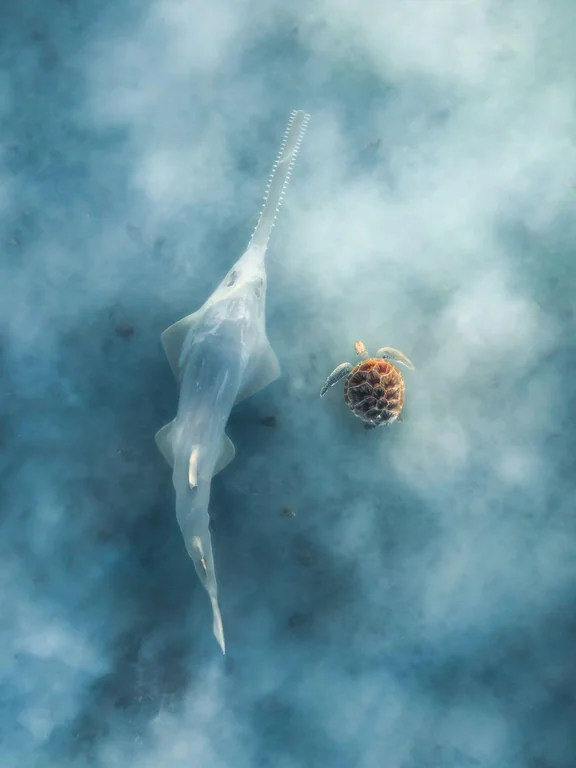
Matt Deakin captured this green sawfish swimming alongside a sea turtle in Western Australia. The photo, titled “Ethereal Encounter,” was recently named the 2026 Australian Geographic Nature Photographer of the Year.
To be happy, you must eliminate two things: the fear of a bad future and the memory of a bad past.
- Seneca
Seneca (4 BC–65 AD), the Roman Stoic philosopher and advisor to Emperor Nero, believed that much of human suffering is self-inflicted.
In Letters to Lucilius, he wrote, “we suffer more often in imagination than in reality,” suggesting that fear of future misfortune often causes more distress than the misfortune itself. To Seneca, anxiety over what might happen reflected a failure to accept fate and the natural order. The Stoics taught that events beyond our control should be met with calm and reason. What matters is not always what happens, but how we choose to respond.
Seneca also warned against becoming prisoners of the past. In On the Shortness of Life, he argued that people waste their limited time by dwelling on what has already happened or constantly worrying about what comes next. The past is fixed and beyond our control, and repeatedly reliving it through regret or resentment only takes us further away from the present.
This did not mean forgetting the past or abandoning plans for the future. Rather, Seneca believed that becoming emotionally trapped by past suffering or future fears robs us of tranquility. His philosophy emphasized living according to reason, accepting mortality, and recognizing time as our most valuable possession.
For Seneca, freedom from fear and regret was not indifference. It was the ability to master our thoughts, focus on the present, and remain in control of our response to whatever life brings.
The single biggest surprise that people who begin to understand what we currently know is that sunlight actually passes through the body (and clothes) and is absorbed along the way. The implicit realization means that sunlight touches every cell of the human body and not just the skin.
This is a revolution in terms of how we think about sunlight. It is not a fantasy but now scientific proven fact:
https://t.co/52mWBxoIcA